While most approaches to privacy in blockchains focus on cryptographic guarantees using ZK or FHE, the reality is that they’re practically impossible to succeed for most real-world use cases.
In an orthogonal direction to meet privacy needs - in collaboration with @RohanKadekodi, @bariskasikci and team from @UW - we explore how to make blockchain and other workloads private without sending sensitive information to cloud-hosted AI systems.
The core idea is simple: partition workloads into two parts. One part runs locally on the user’s device and incorporates private information (keys, trading strategies, PII data) as context; the other part leverages the cloud for non-private processing. While this sounds simple, the real challenge is getting the smaller on-device models to meet accuracy of cloud models while maintaining strong performance. That’s where the key ideas lie behind AgentFlux framework.
See the project website and paper for more details: https://t.co/HGFEIUK1wn
Paper: https://t.co/mH5VYuYIeR
Announcement: https://t.co/S61UE2Zixn
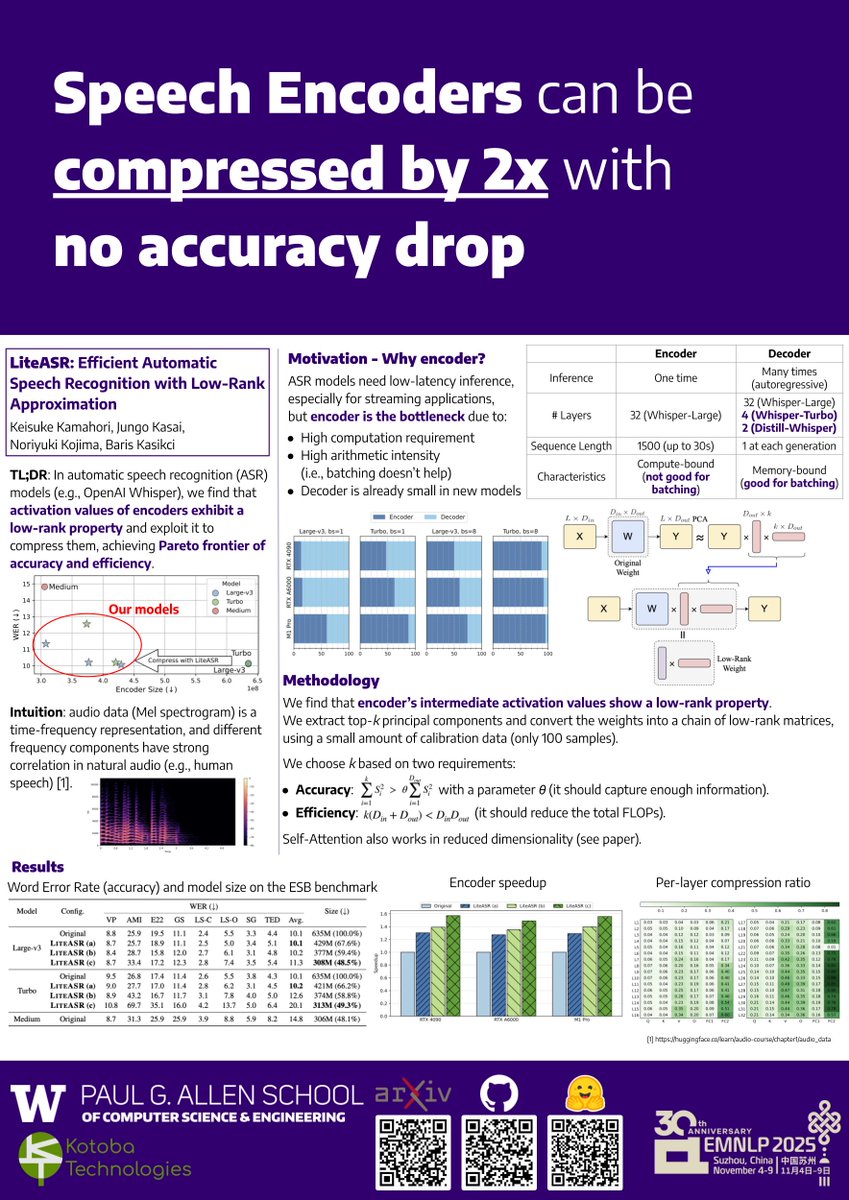
I will be attending #EMNLP2025 this week to present LiteASR, a compression method for speech encoders (a collaborative work with @kotoba_tech).
Catch our poster at the first poster session on Wednesday morning. Happy to chat about efficiency, speech, or both!
🍾Thrilled to share with y'all that I will be joining the University of Iowa as an Assistant Professor of Computer Science in Fall 2020!
#LetsCaucusForComputing@UIowaCS@uiowa
I am on the tenure-track job market! I work at the intersection of systems and disciplines such as economics (PhD) and law (post-doc). I would love to join a dept that values interdisciplinary work!
Application material: https://t.co/E58n1tZ7Ly
Fun project w/ @RohanKadekodi & @vj_chidambaram!
As storage devices get faster, file system SW overhead dominates. SplitFS minimizes these overheads by servicing system calls in user space.
Simple idea. Devil's in the details.
Deets, code & workloads: https://t.co/jm0zooYBbL