A fascinating pattern from 240+ years of US market history:
→ 1781: First company to reach $1M market cap
→ 1924: First company to reach $1B market cap
→ 2018: First company to reach $1T market cap
👉 Notice something?
→ $1M → $1B = 1,000x in ~150 years
→ $1B → $1T = 1,000x in ~100 years
👉 Not only has the market-cap ceiling expanded by 1,000x repeatedly, the time taken to reach the next 1,000x milestone has compressed.
👉 Every generation believes the current ceiling is the limit. History says otherwise.
→ In 1781, a $1B company would have sounded impossible.
→ In 1924, a $1T company would have sounded absurd.
→ Today, many believe $10T-$20T is the upper limit.
👉 Maybe. Or maybe we're making the same mistake investors have made for 240 years.
👉 If technological progress, productivity, AI, robotics, energy abundance and global GDP continue expanding, the next century could produce companies that make today's trillion-dollar giants look small.
👉 And the next waves could include:
→ Artificial Intelligence
→ Robotics
→ Physical AI
→ Energy abundance
→ Automation
→ Biotechnology
→ New computing architectures
👉 The lesson isn't that every company will become a $10T company. It's much more important: Don't confuse today's market-cap ceiling with a permanent limit.
👉 For more than two centuries, the ceiling has moved. The question is not whether it can move again. It's what technology and productivity breakthrough will push it higher next.
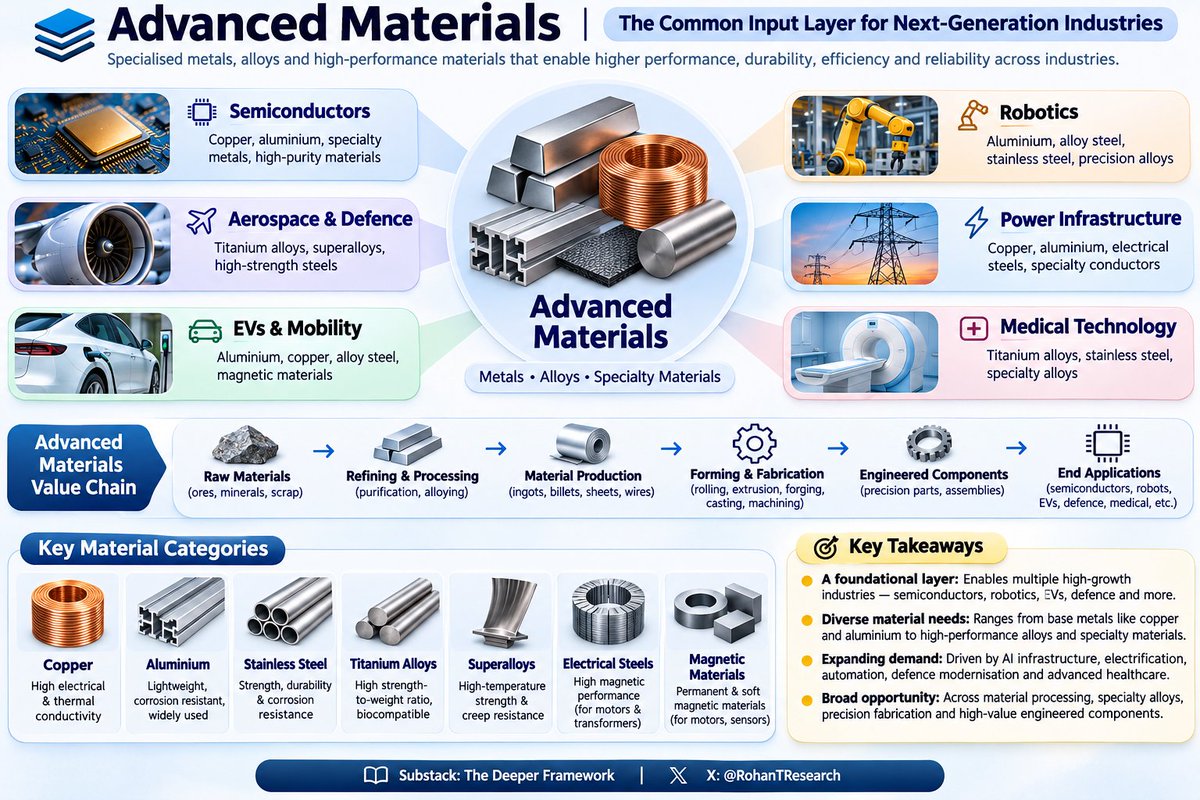
Advanced Materials: The common input layer behind multiple supercycles
👉 Semiconductors, robotics, aerospace, power infrastructure, EVs and medical technology may look like different industries. But they share a foundational layer: Advanced Materials.
→ Copper and aluminium enable power and connectivity
→ Specialty metals and high-purity materials support semiconductors.
→ Titanium alloys and superalloys serve demanding aerospace applications
→ Magnetic materials enable motors, sensors and power systems.
👉 The opportunity is not limited to one end market. It sits across the materials that multiple industries need to scale.
👉 As India builds advanced manufacturing capability, the materials supply chain becomes a strategic layer to track - not just the finished product.
AI’s biggest bottleneck may not be GPU availability. It may be GPU utilization.
👉 The industry is spending billions to build AI data centers, but installed capacity means little if the GPUs aren’t being used to generate revenue.
👉 Think about it:
→ GPUs are procured.
→ Data centers are built.
→ Power and cooling are installed.
→ But where are the paying workloads?
👉 A data center running at 50% utilization has already incurred much of its infrastructure cost, yet is generating revenue from only a fraction of its potential capacity.
👉 The real challenge is no longer just building more AI infrastructure. It is ensuring that existing infrastructure is productively utilized.
👉 The winners may not simply be those who own the most GPUs, but those who can keep them busy, generate consistent demand and maximize revenue per unit of computing capacity.
👉 In the AI infrastructure race, capacity is the headline. Utilization is the business.
#GPU @mehul_n_trivedi@DhawalDoshi5
@Prouspering Mixed signals ahead of the opening, yet GIFT Nifty is up 0.85%, signalling a positive opening for Indian markets. Brent crude is near $88.18/barrel, marginally lower. a strong domestic opening may still face global volatility. Watch whether the gap-up sustains after the open.
A breakdown of the 3 major approaches and their underlying technologies.
1. Single-Phase Immersion Cooling:
→ Servers are submerged in a dielectric fluid that remains liquid throughout the cooling process.
→ Heat from GPUs, CPUs and other components transfers directly into the fluid.
→ The heated fluid is then circulated through a heat exchanger, where the heat is transferred to a secondary cooling loop.
👉 Two main configurations:
→ Natural convection: Hot fluid rises and cooler fluid descends naturally.
→ Forced convection: Pumps circulate the fluid to improve heat transfer and temperature uniformity.
👉 Why it matters ?
→ Relatively straightforward system architecture.
→ No boiling or vapour management inside the tank.
→ Can support high-density computing with appropriate system design.
2. Two-Phase Immersion Cooling:
→ The dielectric fluid is selected to boil at a temperature suitable for the cooling system.
→ When the hardware generates heat, the fluid absorbs energy and changes from liquid to vapour.
→ The vapour rises and comes into contact with a cooled condenser. It condenses back into liquid and returns to the tank. The cycle repeats continuously.
👉 The main technologies involved:
→ Pool boiling: Heat causes the liquid to boil at the surface of electronic components.
→ Condensation: Vapour releases heat to a condenser and returns to liquid.
→ Vapour management: The system controls vapour containment, pressure and fluid recovery.
👉 Why it matters ?
→ Phase change enables substantial heat absorption.
→ Can support very high heat fluxes with suitable designs.
→ Offers a potential route for cooling extremely high-density computing systems.
👉 However, fluid availability, cost, environmental considerations and system complexity are important challenges.
3. Hybrid Immersion Cooling:
→ A hybrid architecture combines immersion cooling with other thermal management technologies.
→ For example, immersion may cool the server hardware while a secondary liquid loop transfers heat to a dry cooler or cooling tower.
→ Other configurations may combine immersion with direct-to-chip liquid cooling or air cooling for different components.
→ The objective is to optimise the overall system rather than rely on one cooling method for every component.
👉Follow for more!! Bookmark for future reference.
@DhawalDoshi5@mehul_n_trivedi
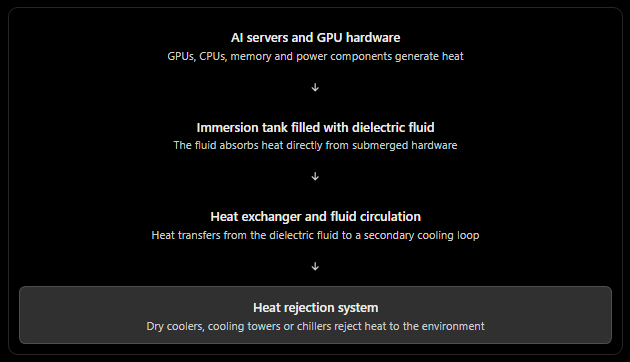
Immersion Cooling: The Next Layer of AI Infrastructure
👉 As GPUs and AI servers become more power-dense, removing heat efficiently is becoming mission-critical.
👉 In immersion cooling, servers are submerged in dielectric fluid. The fluid absorbs heat, transfers it through a heat exchanger to a secondary loop, and the heat-rejection system - dry coolers, cooling towers or chillers - releases it into the environment.
👉 The opportunity spans immersion tanks, dielectric fluids, heat exchangers, pumps, fluid networks and heat-rejection equipment.
AI compute creates the heat. Cooling infrastructure must manage it.
#DataCentres #Cooling
@unusual_whales Nvidia’s surge is lifting the broader semiconductor complex, but a dramatic one-day rebound doesn’t erase the prior losses or resolve concerns around AI valuations and returns on data-centre spending.
India's AI, Semiconductor & Manufacturing Boom Can't Run Without This Invisible Industry. Here's Why Ellenbarrie Industrial Gases Could Be a Silent Beneficiary.
👉Industrial gases are often overlooked, yet they are as essential to manufacturing as electricity.
👉Industrial gases are to manufacturing what electricity is to homes - essential, but often unnoticed. Every one of them will require industrial gases
• Semiconductor fabs
• AI data centres
• Defence factories
• Steel plants
• EV manufacturing facilities
• Electronics clusters
• Hospitals
👉Instead of betting on the end products, Ellenbarrie represents a play on the critical inputs powering India's manufacturing supercycle.
👉Deep Dive into Industrial Gases: https://t.co/cbHSDkiIiG
👉Follow @RohanTResearch for more!! Bookmark for future reference.
Disclaimer: Not a buy/sell recommendation. Do your own due diligence.
#StocksToWatch #StocksInFocus #Investing
Musk’s repeated “singularity” declarations are a reminder that the term is being used more as a broad signal of accelerating AI progress than as a clearly defined milestone.
The statements are best treated as a strong signal of Musk’s view - not proof that a singularity has occurred.
@KobeissiLetter Watch whether the rebound holds through the cash session and broadens beyond semiconductors. A strong opening is momentum; sustained buying and improving fundamentals are confirmation.
This is a credit-risk warning, not proof that Anthropic is about to default. Anthropic may still grow rapidly, but its ability to turn revenue into durable cash flow is the test. The concern also reaches beyond Anthropic: financing pressure could ripple through AI infrastructure providers and chipmakers that have guaranteed related loans.
Tushar bhai, there are mulitple reasons behind a good mileage even on highways:
1. Cabin temperature to keep the battery's thermal system cool
2. Outside weather, winters (good mileage), summers (average mileage)
3. Smooth driving (good mileage), Stress on pedals (below average mileage)
👉 Driving style is favourable:
1. Hybrid:
Summers: Mileage would be around 15-17 kmpl
Winters: 16-19 kmpl
2. Non-Hyrbid:
Summers: Mileage would be around 13-14 kmpl
Winters: 14-15 kmpl
👉 Driving style is not favourable:
1. Hybrid:
Summers: Mileage would be around 10-12 kmpl
Winters: 12-14 kmpl
2. Non-Hyrbid:
Summers: Mileage would be around 9-10 kmpl
Winters: 11-12 kmpl
Above figures are approximates, and still I don't think the cost saving would be that much significant. Instead the cost of tech could be saved.