Liebe und nicht so liebe Leute,
im SPIEGEL-Spitzengespräch „Ist unsere Welt aus den Fugen?“ zerlegt Habeck Merz nicht mit Parteipolemik, sondern mit dessen eigenem Markenkern: soziale Marktwirtschaft.
Denn wenn Wachstum nur noch heißt, dass viele verzichten sollen, während wenige profitieren, dann ist das kein Wohlstandsversprechen mehr.
Dann ist es Standortpolitik mit Klassenaroma.
@SM_94911@WomenBeingAwful I would divorce in an instant. Even with all the demands of a divorce that there are today. There is nothing worse, then to live celibate in a relationship.
@wingzeroendles1@WomenBeingAwful Depending on where you live, a divorce is sometimes the worse evil, then just staying in such a relationship. That's why more and more men no longer want to get married.
Good news.
Germany, France, Italy, Spain, Poland and the Netherlands have agreed to push for deeper integration of European capital markets and stronger EU-level supervision through ESMA.
A real step towards a true Capital Markets Union and a stronger European financial system.
@FriedrichK70381@i_iangg Willst du immer kleinbei geben nur weil die andere Partei Atomwaffen hat? Irgendwann kommt der Punkt wo man sich entscheiden muss ob man lieber im Stehen stirbt oder auf Knien leben will.
@NRowe041726@DickBonnet@paullewismoney In Europe, South Korea, Japan, where waiters get payed a living wage, burgers don't cost so much. Honestly most meals cost less then in the USA. So that argument is blatantly false.
@jaydewee@libertaeredeju@DerBardeRalph Bismarck hat die Rente eingeführt um die aufkommende Bürgerbewegung zu beschwichtigen. Der hat das nicht aus nächsten Liebe gemacht. Der Zweck war es die Menschen vor der Revolte gegen die Eliten zu beschwichtigen.
Le Pens Ziehsohn hat die zukünftige Zusammenarbeit mit der AfD ausgeschlossen.
Bereits vor zwei Jahren hat der Rassemblement National jede Zusammenarbeit eingestellt. Nach den Europawahlen verhinderte er die Aufnahme der #AfD in die große Fraktion der „Patrioten für Europa" und zwang sie dazu, mit skurrilen Einzelkämpfern aus anderen Staaten mühsam die eigene Fraktion „Europa souveräner Nationen" im Europäischen Parlament zusammenzuzimmern.
Selbst viele europäische
Rechtsnationalisten halten die AfD für politisch toxisch - nicht zuletzt wegen #Kreml-Nähe und fragwürdiger Verbindungen nach #China.
Sie würden #Europa zurück in einen Zustand des nationalen Gegeneinander führen, denn ist Europa schwach freut es die Autokraten in #Russland, #China und den #USA!
#AfDzerstörtDeutschland
#AfdzerstörtEU
“ Make us sovereign, and the only way to do it is together. From Portugal to Ukraine,
Let’s create the United States of Europe!“
The choice for Europeans is simple: federate or perish. And I am convinced Europeans will choose to unite Europe.
🇪🇺🇪🇺
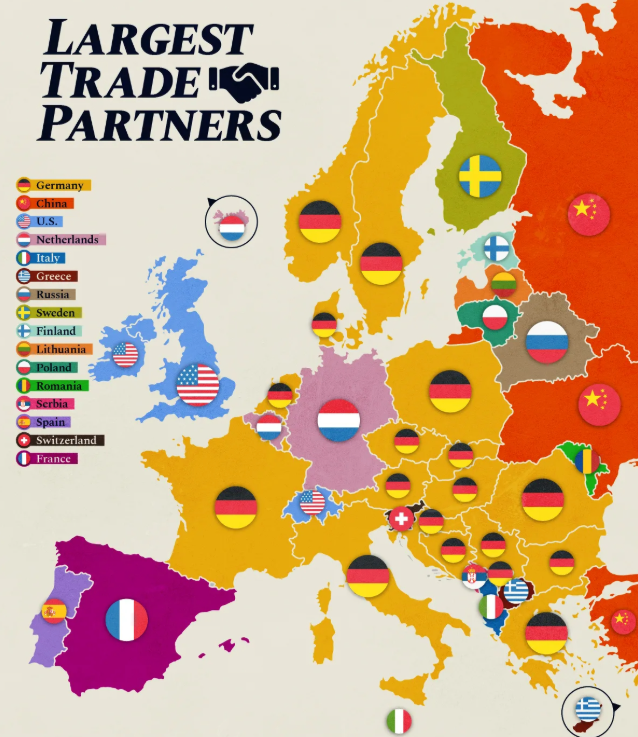
In 2025, Germany was the largest export destination for 16 of the other 26 EU member states.
Germany also dominates intra-EU trade: in 2025 it accounted for 21.1% of all intra-EU goods exports and 22.0% of all intra-EU goods imports — more than any other member state.
Its export machine depends on the single market.
Around 55.9% of German exports went to the EU in December 2025.
Germany is also the EU’s external export champion: it generated 26.1% of all EU goods exports to non-EU countries in 2025 — more than Italy, France or the Netherlands.
Germany’s industrial model was built by the euro, the single market, Eastern enlargement, European supply chains and access to a continental consumer base without tariffs, borders or currency risk.
Europe made German power possible.
AfD reaching almost 30% is the result of Germany’s own strategic failures.
Its agenda is pure populism: blame the EU — while ignoring that Germany has been the biggest beneficiary of the European economic order.
In 2025, Germany accounted for around 21.1% of all intra-EU goods exports — by far the largest share of any member state
Inside the single market, Germany is the central trade hub: it appears among the top four intra-EU export partners of 25 EU countries, more than any other member state.
And without the euro, Germany’s national currency would certainly be much stronger, driven by its persistent current account surplus, low debt and lower risk premium — making German exports far less competitive.
Add higher trade barriers with its main customers — EU countries — and Germany’s export model would face exactly the shock the EU has helped it avoid.
The single market, the euro, Eastern enlargement, EU trade policy and continental supply chains all reinforced German export power.
Yet AfD campaigns against the same European system that made Germany powerful.
The irony is even bigger on energy. Germany’s economic crisis did not come from “too much Europe.”
It came from bad German policy: shutting nuclear, relying on cheap Russian gas, underinvesting in energy infrastructure, keeping fiscal policy too tight for too long, and then being exposed when Russia weaponised energy.
Before the war, Russia supplied around 55% of Germany’s gas and roughly 45% of EU gas imports.
Going back would not be sovereignty. It would be repeating the mistake.