#HadrianFactTuesday - Did you know that Hadrian was initiated into the Eleusinian Mysteries three times?
The Eleusinian Mysteries, celebrated annually at Eleusis near Athens in honour of Demeter and Persephone, were the most revered secret religious rites of the Greek world. Their ceremonies promised initiates hope for a blessed afterlife, yet their sacred secrets were never revealed.
Hadrian's first initiation may have taken place during his stay in Athens in AD 112, when he was still a private citizen, although no contemporary record of this initiation survives. He is then recorded as participating in the Mysteries during his visit to Athens in AD 124, and he returned to Eleusis in September AD 128 to receive the highest level of initiation (epopteia).
By progressing through all three stages of the Mysteries, Hadrian became one of the very few Roman emperors, and one of the few known individuals, to attain the full sequence of initiations.
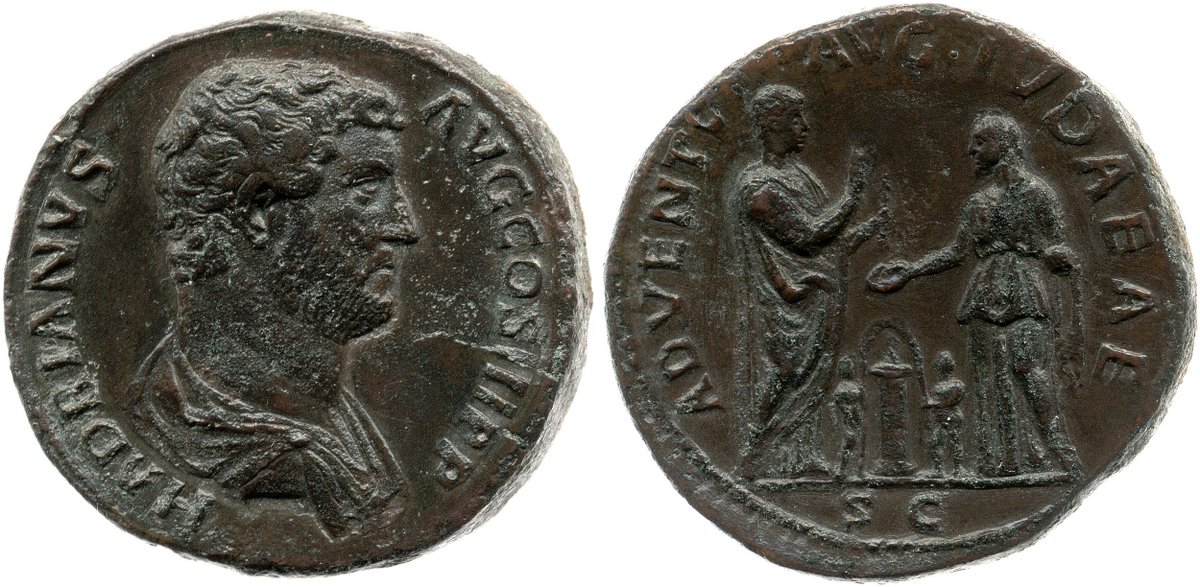
#HadrianFactTuesday - Did you know that Hadrian's travels were commemorated on coins?
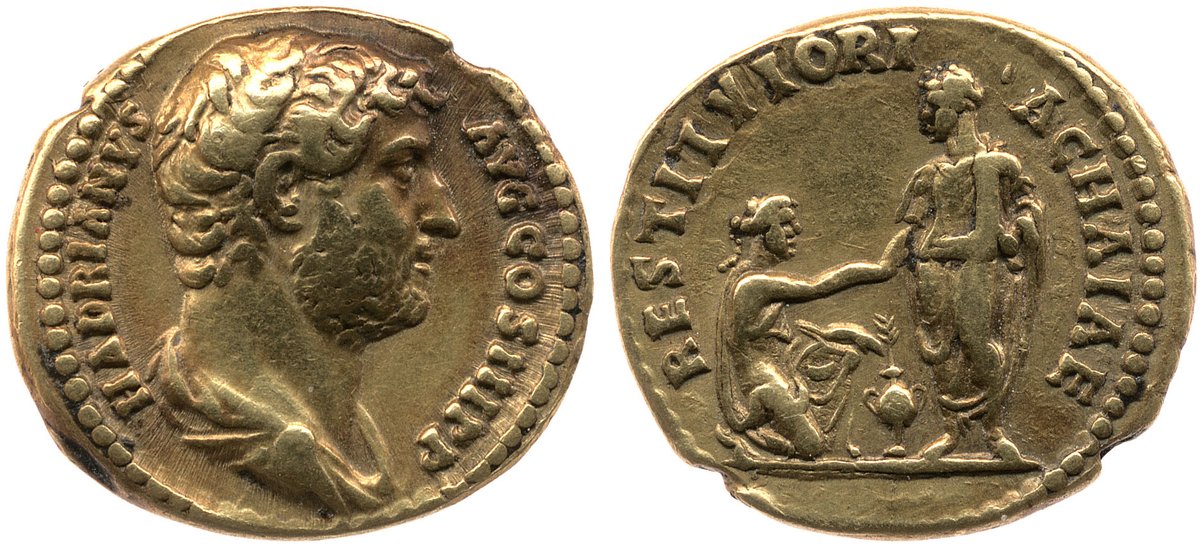
Hadrian's reign is notable for a series of coins that vividly commemorated his personal visits to nearly every province of the empire. These coins were issued especially in the later years of his reign. They often depicted the emperor's arrival (adventus), his benefactions (restitutor), or his inspection of the provincial armies (exercitus). Each province Hadrian visited was also personified, typically as a female figure in local dress, sometimes with distinctive attributes (e.g., Africa with an elephant-skin headdress, Egypt with a sistrum and an ibis, Britannia with a shield and a lance). The province is often shown greeting or kneeling before Hadrian, symbolising the emperor's presence and beneficence.
These coins served as imperial propaganda, reinforcing Hadrian's image as a travelling, hands-on ruler who personally cared for and improved the provinces. The imagery communicated messages of peace, prosperity, and unity under Roman rule, and celebrated Hadrian's role as a benefactor and restorer.
#MythologyMonday - Sucellus, a Gallo-Roman deity associated with agriculture and wine, particularly in the territory of the Aedui. In some regions, he functioned as a chthonic deity associated with death and the afterlife, acting as an ancestor of the Gallic race and a guardian of the dead. He is often depicted as a middle-aged bearded man with a large hammer (or mallet) and a barrel.
Sucellus was first mentioned by the Roman writer Julius Caesar as "Dis Pater" in his "Commentaries on the Gallic War" in 52 BC. Caesar described Sucellus as a god of artisans and craftsmen, noting that he "was held in great honour as the inventor of all sorts of mechanical arts."
#TheatreFriday - The theatre at Hierapolis (modern-day Pamukkale, Türkiye) was built in the second century AD under Hadrian during a period of extensive rebuilding following a devastating earthquake in AD 60. It was later expanded during the reign of Septimius Severus. Its forty-five rows of seats, separated by two diazomata, could seat around 15,000 spectators.
The magnificent façade of the theatre was decorated with intricate friezes depicting a procession of Septimus Severus with his family and the gods, as well as scenes from the life of Dionysus. Over time, the theatre was adapted to suit changing tastes, hosting gladiatorial contests and even aquatic spectacles. Situated above the famous travertine terraces, it is one of the best-preserved Roman theatres in the ancient world.
New episode! ⚔️
We finally got him. @ConnIggulden joins us on @rock_swords 🗡️📚
Nero. Agrippina. Arnhem. D&D. Gemmell. Why fantasy is harder than #histfic. And the knot that didn't make it into A Dangerous Book for Boys.
Don't miss this one.
📺 https://t.co/6XxrciTyCn
@Romanfiction Hi Alex,
Ive just finished Caesars Avenger, it might be the best yet, and wanted to say thank you again for writing these.
I now look forward to book 4, although I had an idea how it all ends, there is already much more prior to than I initially understood. 🔱
#ReliefWednesday - Marble stele with a tauroctony relief in a carved out square, dedicated by Galerios, son of Proteos. Dated to the end of the 2nd – beginning of the 3rd century AD.
The dedication reads:
Κυρίō (!) Μίθρᾳ εὐχ[ὴ]ν̣
Γαλέριος Προτέως (!) ἐπιγναφ{α}εύς
“To Lord Mithras,
Galerius Proteos, engraver, fulfilled a vow.”
The second long Greek inscription is not contemporary and was added later. It records that Aurelius Marcus, at his own expense, adorned this same small stele with paint and dedicated it to the god Helios-Mithras.
National Historical Museum, Sofia, Bulgaria.
#HadrianFactTuesday - Did you know that Hadrian had a lifelong passion for hunting?
The emperor was so devoted to hunting that he faced reprimands in his youth, and he continued to hunt frequently during his reign. During his travels, hunting was a recurring activity. Notably, during his time in Asia Minor, he founded the city of Hadrianotherae (meaning ‘Hadrian’s Hunts’) after a successful hunt in which he killed a she-bear. He also went hunting for boar in Pannonia, riding his favourite horse, Borysthenes. Unfortunately, Borysthenes died in Gallia Narbonensis during one such hunt. This event is commemorated by Hadrian, who composed an epitaph in honour of Borysthenes.
During his Egyptian tour, Hadrian hunted in the Libyan Desert with his beloved companion, Antinous. This event is commemorated in both literature and art. The poet Pancrates wrote a poem about the hunt, fragments of which survive on papyrus. The poem describes Hadrian and Antinous assembling for the hunt, with Hadrian striking the lion with his spear and ultimately saving Antinous from danger. The Hadrianic tondi (reliefs later reused on the Arch of Constantine) commemorate occasions when Hadrian and Antinous hunted together, including hunts for bears, wild boars, and lions.
Hadrian's love for hunting was also commemorated in coinage. One such coin depicted the emperor with the head of a she-bear on the reverse, celebrating both the hunt and the founding of the city Hadrianotherae.
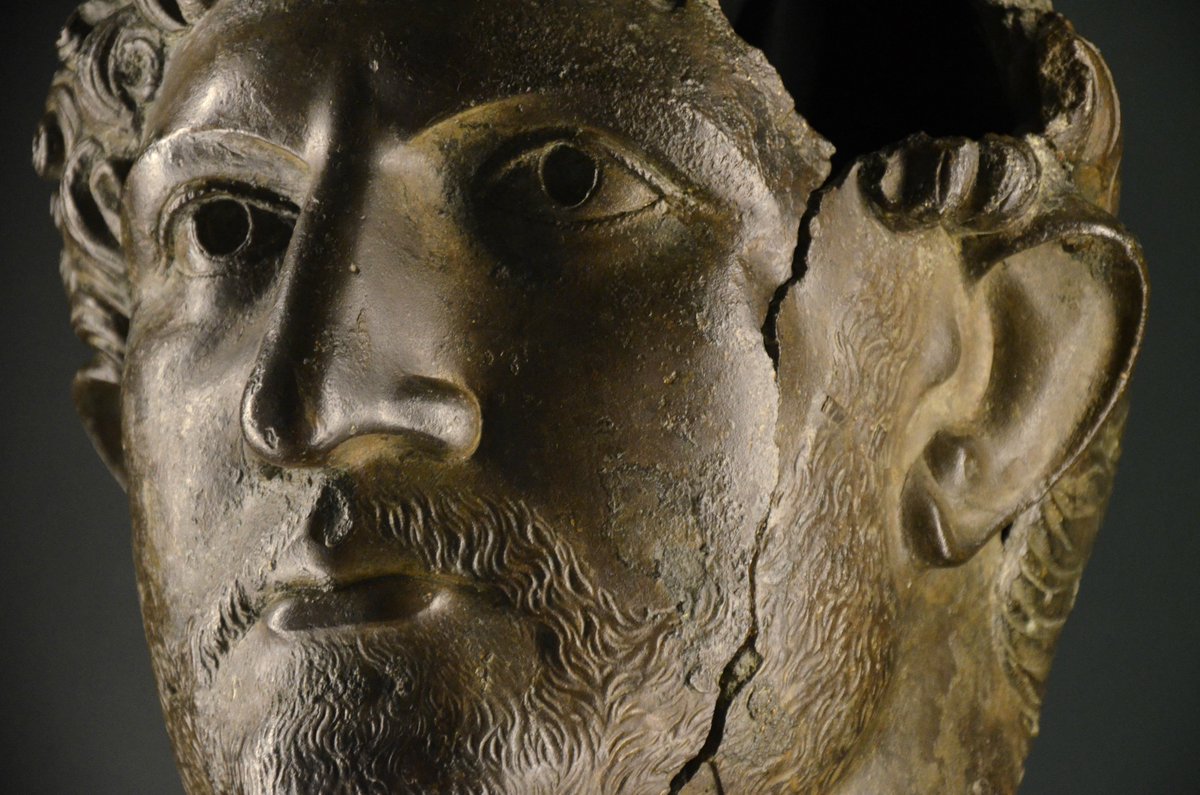
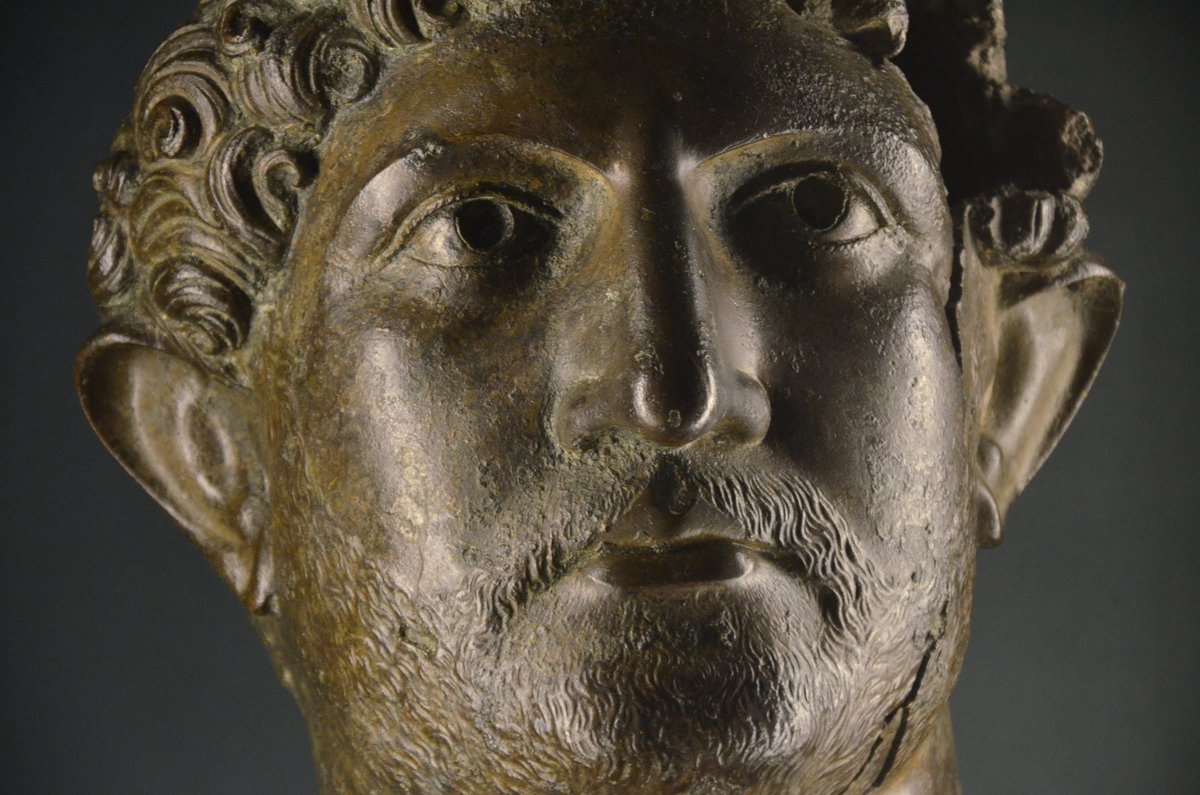
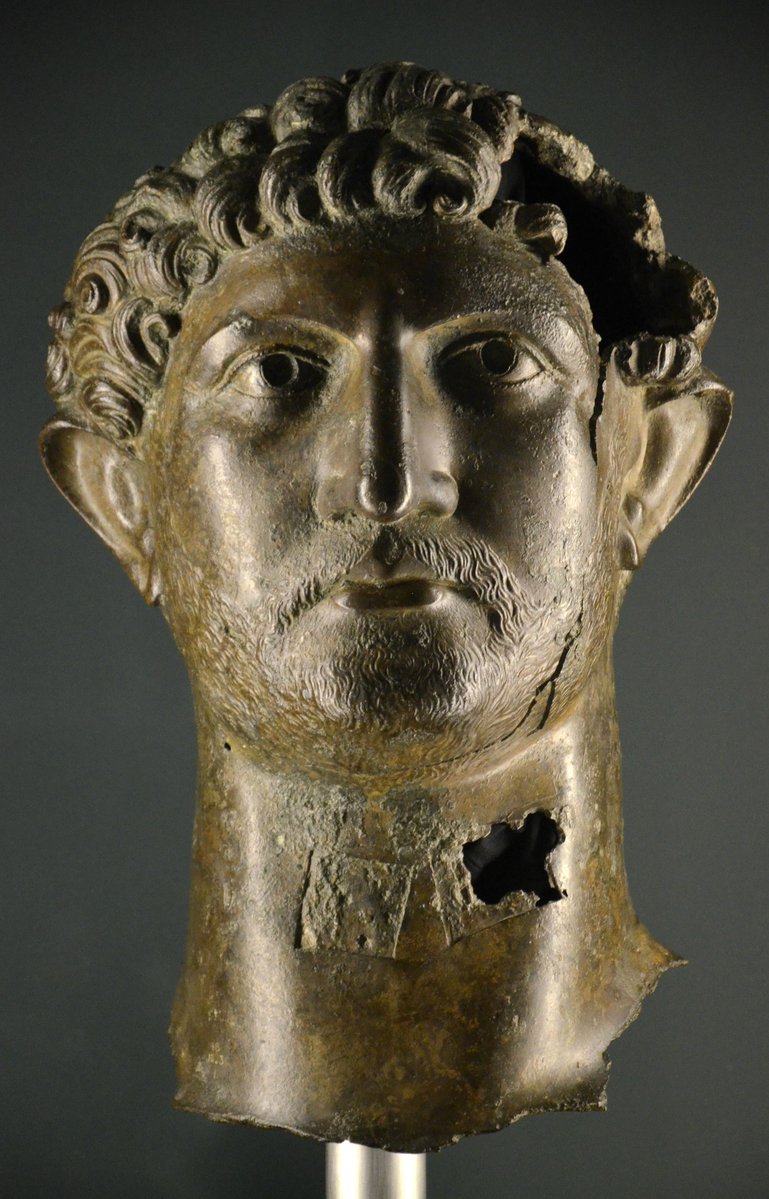
#PortraitThursday - The bronze head of Hadrian, discovered in the River Thames, is one of the most striking surviving Roman sculptures in Britain. Discovered in 1834 near London Bridge, this head is believed to have originally belonged to an over-life-size statue of the emperor that stood in Roman Londinium (modern London). The style suggests it was made locally.
The head is cast in bronze, a material far more valuable and less commonly preserved than marble because it was often melted down and reused. Its survival is therefore unusual. Only three bronze portraits of Hadrian have survived from antiquity, and the head found in the Thames is the only one discovered in Britain.
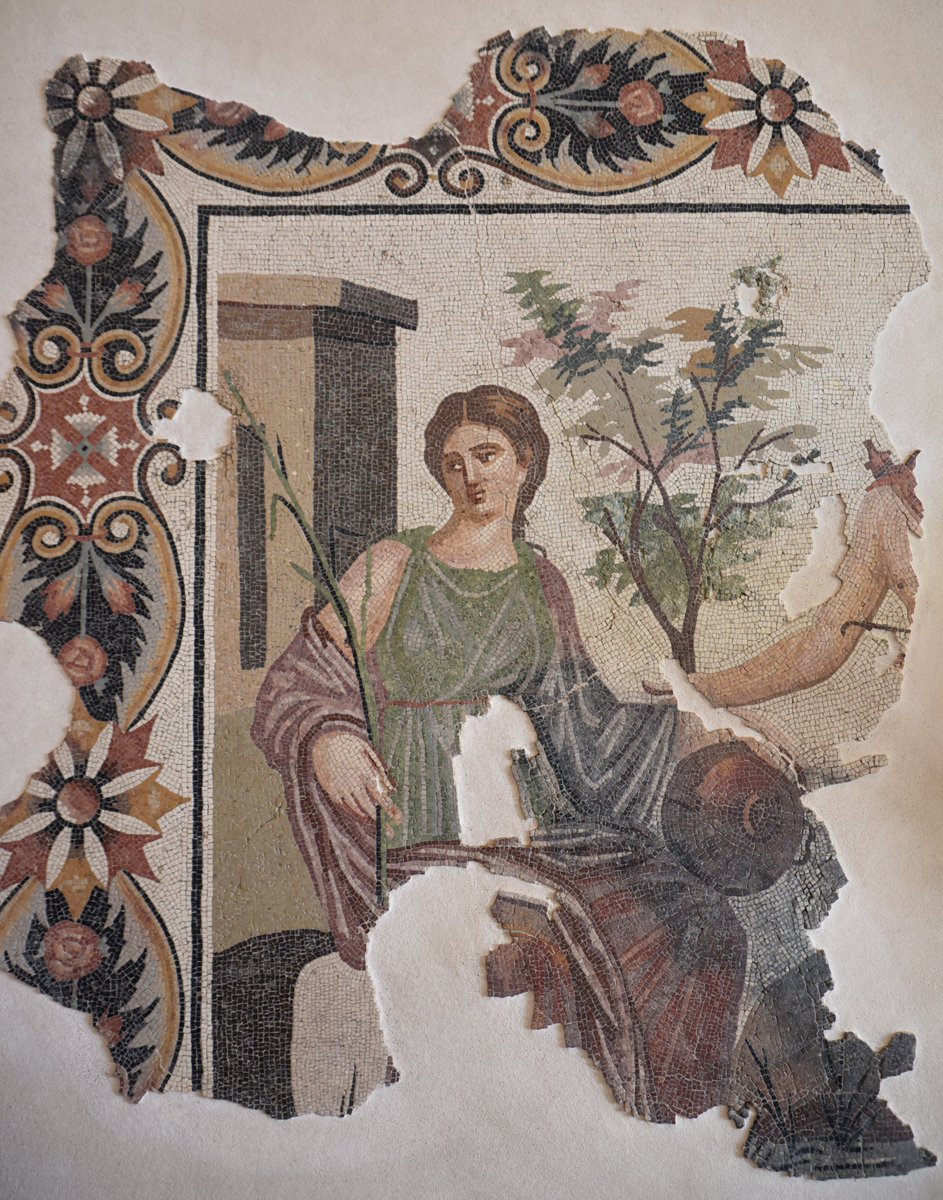
#MosaicMonday - Mosaic from Lambaesis in Numidia depicting Apollo and the nymph Cyrene. The nymph Cyrene, who was loved by Apollo, holds a flagon in her left hand (possibly signifying the sacred spring of Cyrene) and a reed in her right hand. To the right, only Apollo's bare arm is preserved, but he can be identified by the quiver on his shoulder. The mosaic dates to the 2nd or 3rd century AD.
Museum of Lambaesis, Algeria.




![carolemadge's tweet photo. #ReliefWednesday - Marble stele with a tauroctony relief in a carved out square, dedicated by Galerios, son of Proteos. Dated to the end of the 2nd – beginning of the 3rd century AD.
The dedication reads:
Κυρίō (!) Μίθρᾳ εὐχ[ὴ]ν̣
Γαλέριος Προτέως (!) ἐπιγναφ{α}εύς
“To Lord Mithras,
Galerius Proteos, engraver, fulfilled a vow.”
The second long Greek inscription is not contemporary and was added later. It records that Aurelius Marcus, at his own expense, adorned this same small stele with paint and dedicated it to the god Helios-Mithras.
National Historical Museum, Sofia, Bulgaria.](https://pbs.twimg.com/media/HINNZY1XwAA_Fmq.jpg)








![carolemadge's tweet photo. #ReliefWednesday - Marble stele with a tauroctony relief in a carved out square, dedicated by Galerios, son of Proteos. Dated to the end of the 2nd – beginning of the 3rd century AD.
The dedication reads:
Κυρίō (!) Μίθρᾳ εὐχ[ὴ]ν̣
Γαλέριος Προτέως (!) ἐπιγναφ{α}εύς
“To Lord Mithras,
Galerius Proteos, engraver, fulfilled a vow.”
The second long Greek inscription is not contemporary and was added later. It records that Aurelius Marcus, at his own expense, adorned this same small stele with paint and dedicated it to the god Helios-Mithras.
National Historical Museum, Sofia, Bulgaria.](https://pbs.twimg.com/media/HINNdLPWcAA225m.jpg)