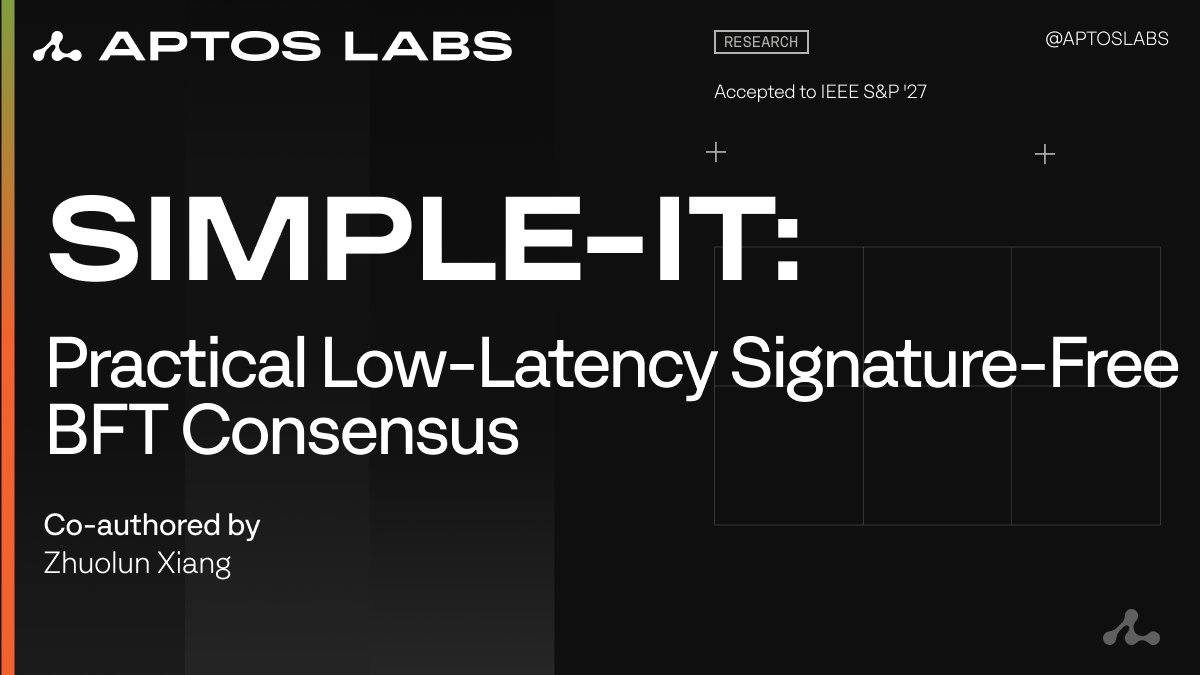
Congratulations to Aptos Labs' @XiangZhuolun and his co-authors: Simple-IT has been accepted to IEEE S&P '27! 🎉
The paper shows that BFT consensus can be made quantum-resistant without trading away performance.
Learn more below.
1/
August Aptos AMA / Discussion Recap
This past August, there were five articles I put together from discussions, podcasts and spaces where @Aptos and Decibel team members including @AveryChing, @ASHAWONN, @aptAlix, @borntobry along with project team members, VCs and more, participated in sharing information regarding these flagship projects. The discussions focused around AI agents, tokenization, @DecibelTrade, @shelbyserves, stablecoins, TradFi access, RWAs, security, and what real Web3 adoption looks like.
Here are the main takeaways from these article summaries in August:
Avery Ching on AGTP
➣ Aptos Labs is focused on “Markets and Machines”: on-chain financial markets, AI agents, settlement, payments, and machine-driven activity.
➣ Avery said blockchains can serve as 24/7 global settlement rails that are faster, cheaper, and more accessible than much of today’s financial infrastructure.
➣ AI agents may become heavy users of blockchain because they will need fast, low-cost ways to pay, coordinate, trade, and exchange value.
➣ Coding agents are an early sign of what agentic systems can become across finance, commerce, payments, and services.
➣ Avery said agentic AI still needs trust, auditability, permissioning, confidentiality, and contractual guarantees before it can handle major financial activity.
➣ Blockchain can help record what agents did, why they did it, and what value changed hands.
➣ Decibel was discussed as Aptos’ on-chain trading engine for perps and spot, built for performance, decentralization, and compliance-minded markets.
➣ Avery said this kind of agent activity is bullish for smart contracts, but the infrastructure needs very low fees, high throughput, and low latency.
TradFi vs Crypto AMA with Tria, Decibel, and Aptos
➣ The Space focused on how TradFi and crypto are starting to merge for traders.
➣ Tria’s TradFi vs Crypto competition let users trade through Decibel, with a 25,000 USDC reward pool split between crypto and TradFi markets.
➣ Tria’s VIP trading badges reward real trading volume and unlock benefits like higher cashback, bigger spend caps, travel perks, and fee benefits.
➣ @borntobry said trading has changed because RWAs, TradFi assets, AI tools, LLMs, and agent-based strategies are now part of the trader toolkit.
➣ RWAs give traders more familiar assets to trade because they are tied to companies, markets, and information people already understand.
➣ @ASHAWONN said crypto helped build the rails for global money movement and RWA trading, and that traditional markets are starting to look more narrative-driven and community-led.
➣ One major use case is giving people without strong banking access a way to earn yield, move money, and reach capital markets.
➣ @useTria and @DecibelTrade are trying to give users access to crypto, TradFi assets, cards, spending, and global markets from one place.
➣ Upcoming Tria features mentioned included SDKs, copy trading, top traders, hedge modes, bot trading, and natural-language strategy creation.
The Bar Has Moved with TBV and Aptos
➣ @Brent_Fulfer told @aptAlix that Web3 is no longer in the easy-token era. Founders now need real customers, real revenue, and a reason to exist beyond launching a token.
➣ The bear market made it easier to separate real companies from projects built mostly on hype.
➣ Brent said founders need product-market fit, customer value, focus, discipline, and clear communication.
➣ He does not expect most banks or large institutions to build their own chains. He expects more acquisition, integration, and use of existing rails.
➣ Stablecoins stood out as one of the strongest use cases because currency instability and cross-border payment problems are real in many regions.
➣ Web3 founders often explain the technology too much and the customer benefit too little.
➣ Founder red flags included overconfidence without experience, refusing to travel, complaining about investors, and failing to take responsibility for how the product is understood.
➣ Trust was a major theme. In Web3, people are judged not only by pitch decks, but by how they act at events, dinners, and in informal settings.
Tokenization Is Inevitable with Avery Ching and Bitcoin News
➣ Avery said many financial players now see tokenization as inevitable.
➣ The discussion covered Aptos, CLARITY, developer protections, AI security risks, productive TVL, institutions, stablecoins, tokenization, and Aptos’ roadmap.
➣ Avery said regulation is one of the main things that can unlock blockchain use in financial applications.
➣ He said developer protections matter because there should be a clear difference between people who write software and intermediaries that control customer funds.
➣ AI is changing security because attackers can test bugs and exploits much faster than before.
➣ Aptos uses AI agents across code review, auditing, monitoring, testnet, mainnet, devnet, and internal security workflows.
➣ Human security researchers still matter because AI amplifies strong engineers rather than replacing them.
➣ Move remains central to Aptos security through static checks, runtime protections, and formal verification.
➣ Avery pushed back on vanity metrics. Aptos is more focused on real users, revenue-generating products, productive TVL, and actual economic activity.
➣ Decibel was used as a major example of productive activity, with on-chain trading, perps, settlement, and value moving through the ecosystem.
➣ Aptos’ six- to 12-month focus includes stablecoin payments, tokenized assets, trading, on-chain yield, decentralized AI infrastructure, and financial infrastructure.
Avery Ching with Gareth Jenkinson from The Block
➣ Avery said Aptos has been spending a lot of time on AI and where blockchain can play a real role.
➣ Agentic commerce may start on existing payment rails, but the bigger opportunity comes when people and companies have many agents negotiating and transacting for them.
➣ Aptos’ focus was again described as “Markets and Machines.”
➣ Decibel was discussed as more than an exchange front end. Avery described it as a base layer for perps, spot, vaults, yield products, and composable financial strategies.
➣ Avery compared Decibel with Hyperliquid and said Decibel is open-source, smart-contract based, composable, and built on a decentralized platform.
➣ OUSD was discussed as a consortium-style stablecoin model focused on distribution and usage, not as a winner-takes-all replacement for Tether or Circle.
➣ Avery said Aptos uses AI at nearly every level of defense, including code review, audit searches, bug pattern searches, monitoring, and incident response.
➣ Post-quantum readiness was also discussed. Avery said every chain needs to prepare, and Aptos can support quantum-resistant signatures when users need them.
➣ Privacy remains important, especially for institutions and AI. Avery said confidential AI inference could become a default expectation over time. @shelbyserves will play a major role as a decentralized hot storage data solution on Aptos for several uses including AI.
Overall August Takeaways
➣ Aptos’ August message was very consistent: AI, tokenization, Decibel, stablecoins, RWAs, institutional adoption, security, and real usage.
➣ @Aptos CEO Dr. Avery Ching repeatedly framed blockchain as infrastructure for 24/7 financial activity and future AI-agent coordination.
➣ @DecibelTrade appeared across several conversations as one of Aptos’ main products for on-chain trading, yield, perps, spot, and composable finance.
➣ Stablecoins were discussed as payment rails, liquidity tools, yield products, and practical infrastructure for users and businesses.
➣ Tokenization was treated as a serious institutional direction, especially for equities, deposits, RWAs, private credit, and capital markets access.
➣ AI was discussed both as a new source of demand for blockchain rails and as a security risk that makes stronger infrastructure necessary.
➣ The broader message from August: Aptos is building for a world where financial markets, AI agents, stablecoins, tokenized assets, and real businesses need faster, safer, and more reliable on-chain infrastructure.
Catch the full discussion/podcast/space recordings for the deeper details from each discussion, along with the text summaries in the articles linked below for more context.
Harnesses and orchestration of AI agents is the new frontier. The AI model Pareto curve for 10's of agents to meaningfully change each of our lives is here. Now we need the next-generation infrastructure to make it happen. @Aptos is AI infra.
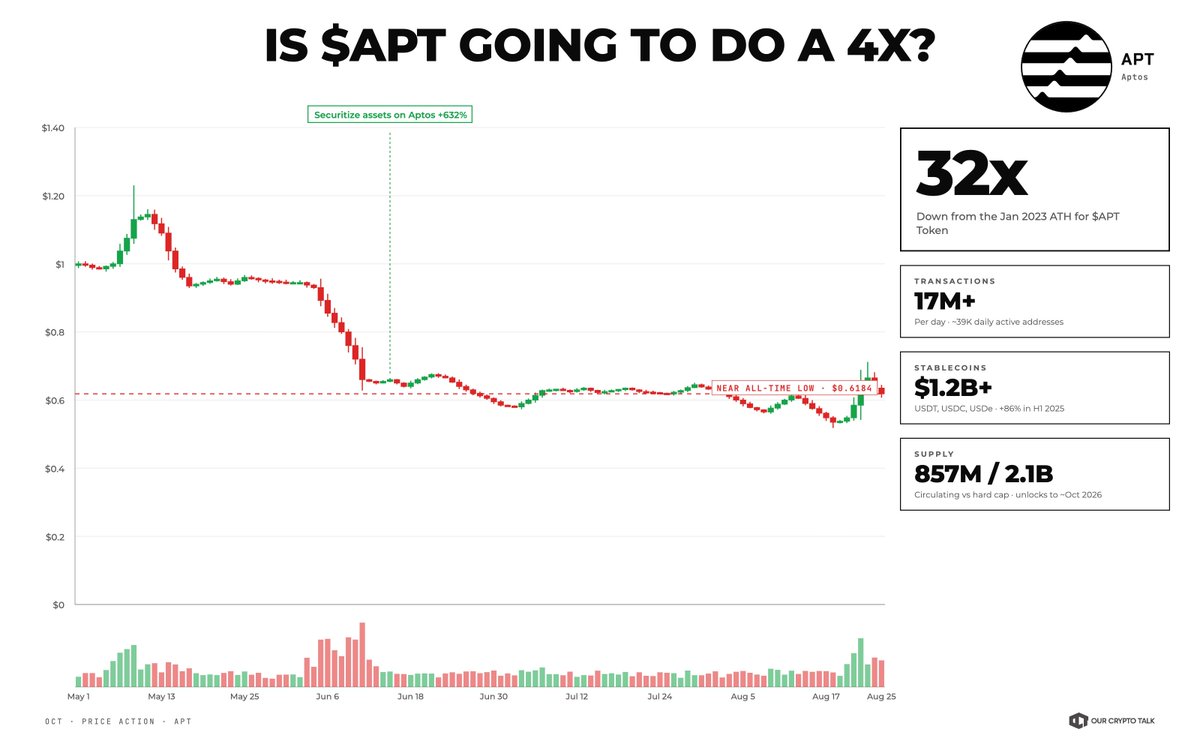
Why we believe $APT | @Aptos should be 4x and at least a $2.5B MC project 👀
It might be the most mispriced institutional-grade L1 in crypto right now.
The setup in one line:
➠ In early 2023 the market valued $APT around $20 and inside the top 25, back when it was a shiny new Move chain from ex-Meta engineers with almost nothing built on it.
➠ Today it settles BlackRock's BUIDL fund, has a Bitwise spot ETF filed, clears 17M+ transactions a day, holds $1.2B+ in stablecoins, and trades at ~$0.61, all the way down near its all time low.
✦ The valuation gap
ATH was around $20 in January 2023, when APT had a mainnet that was only a few months old and basically no ecosystem behind it.
Today: ~$521M cap, ~$0.61, sitting somewhere around #80 to #100.
Let me tell you this: Aptos clears 17 million transactions per day. Yeah, you read that right.
Let's forget about the $20 for a minute, the question is - does a chain running BlackRock money and clearing 17M transactions a day in 2026 belong near its all time low, or does the token deserve a re-rate based on what the chain has actually become?
I think the gap here is one of the widest in the majors right now. It genuinely is fascinating the price it is at right now. 🤦♂️
✦ Supply, the honest version
This is where I won't oversell it, because you deserve the real picture.
For a long time APT had two real problems: high emissions and a steady drip of unlocks. I'm not going to pretend that away.
Circulating is ~857M against a max supply now hard capped at 2.1B. Monthly unlocks are still live and run until roughly October 2026, so there is genuine sell pressure in the near term. That is the honest headwind.
BUT the tokenomics changed hard in April 2026. Governance passed a permanent 2.1B supply cap, halved staking emissions (from ~5.2% to ~2.6%), routed 100% of gas fees to burn, and the Foundation permanently locked 210M APT.
So, things are actually not as bad with the tokenomics as they were before but the price has not reflected this huge change. I believe it will, eventually. (It should, I'm no man from the future)
✦ The chain is not the same chain
The 2023 APT was a fast Move chain looking for a use case. The 2026 APT is purpose-built settlement infra, and the tech gap shows it.
Block times dropped under 150ms, with sub-50ms hit on mainnet in late 2025, putting Aptos among the fastest L1s live. ~650ms user latency, instant finality, 11,000+ TPS in production, and fees under a hundredth of a cent.
Baby Raptr, the first stage of the next-gen Raptr consensus, is already live.
Still shipping: full Raptr for even lower latency, Block-STM V2 for parallel execution that scales with cores, Zaptos to overlap consensus, execution and storage, Shelby (built with Jump) for hot storage, a framework-level on-chain order book, and Confidential APT for institutional privacy.
Move plus parallel execution plus formal verification is exactly the stack institutions want for financial products. Different product from 2023.
✦ The usage is real, the price just hasn't noticed
17M+ transactions a day and ~39K daily active addresses as a steady baseline, not a one week candle unlike many L1s which start promoting these stats only at opportune timings.
$1.2B+ in stablecoins live on the chain (USDT, USDC and USDe), which is the capital that actually parks somewhere and gets used. That base grew ~86% in H1 2025 alone and has held since.
I'll be straight with you: pure DeFi TVL on Aptos is thin right now, and that is a fair knock. But the value that matters for this thesis is the institutional and stablecoin capital settling on the chain, and that side is climbing while the token bleeds.
✦ The institutional door is already open
This is the real story, and it is already shipped, not promised.
BlackRock's BUIDL, the largest tokenized treasury fund, is live on Aptos through Securitize. Securitize tokenized assets on Aptos were reported up 632% in June. Franklin Templeton has backed Aptos since the 2022 Series A, so this is not a new relationship.
On access: Bitwise has filed an S-1 for a spot APT ETF, US-regulated APT futures went live in January 2026, and in March 2026 US regulators classified APT as a digital commodity, clearing the single biggest regulatory overhang the token ever had.
Grayscale and others are circling the same trade. A network usually gets rated on the promise of this stuff. Aptos already shipped it.
✦ Bottom line
Same disclaimer as always: there's no guaranteed trade in crypto, this is speculation, and none of it is financial advice.
Here's the one thing I keep coming back to: a chain is priced near its all time low while its throughput, its stablecoin base and its institutional rails sit at or near all time highs. BlackRock settles on it. The ETF is filed. The regulatory overhang is gone.
So do you really think a chain settling BlackRock money and clearing 17M transactions a day stays a sub-$1, bottom-of-the-rankings asset forever?
Aptos was highlighted as a leader in quantum threat preparedness by @Coinbase's Quantum Advisory Board. Upgrading to quantum-resistant security takes one transaction—no new accounts, nothing moves.
@AptosLabs' @AveryChing with @TheBlockCo's @gazza_jenks
finally.
seeing a bunch of @aptos creators suddenly discovering @decibeltrade.
• the "no vc-backed" narrative
• the hyperliquid-style playbook
• the lighter-style points program
something i was saying back in december.
my prediction:
decibel won't be another (anywhere close to) @hyperliquidx.
but farming it is probably still worth it
why?
aptos needs a winner. decibel is basically aptos last bet at this point.
if aptos wants users, liquidity, and attention back, they have every reason to make sure early participants are rewarded well.
so...how many decibel points do you have?
Aptos is the first major public L1 to deliver confidential assets in mainnet with built-in compliance and selective auditability.
This is an innovation multiple years in the making. One that every stablecoin issuer, payment provider, and distribution surface needs to grow bigger than fiat and existing rails.
The Senate Banking Committee just advanced the CLARITY Act today in a strong 15-9 bipartisan vote, a major win pushing us closer to clear U.S. crypto rules after years of uncertainty.
It separates SEC/CFTC roles, treats decentralized tokens like solid L1s as digital commodities (not securities), protects devs, sets stablecoin guidelines, and brings real regulatory clarity.
For @Aptos ($APT), this is massive. Our fast Move-based Layer 1 is thriving in DeFi, enterprise, and privacy. Clearer regulations open the door to easier U.S. listings, institutional capital, ETFs, and mainstream adoption. #CLARITYAct
Check out these clips below which show Aptos CEO @AveryChing during the @HouseAgGOP last year:
@Crypto_Guerrila Unfortunately, can’t share your positive.
Easy calculation: 840 mln apt staked with 2,6% apr = 22 mln apt per year addition emissions. This is 60k per day.
And only 1/10 out of this is burned.
We are still in big inflation 😦
@AveryChing you need another 10x in tx fees