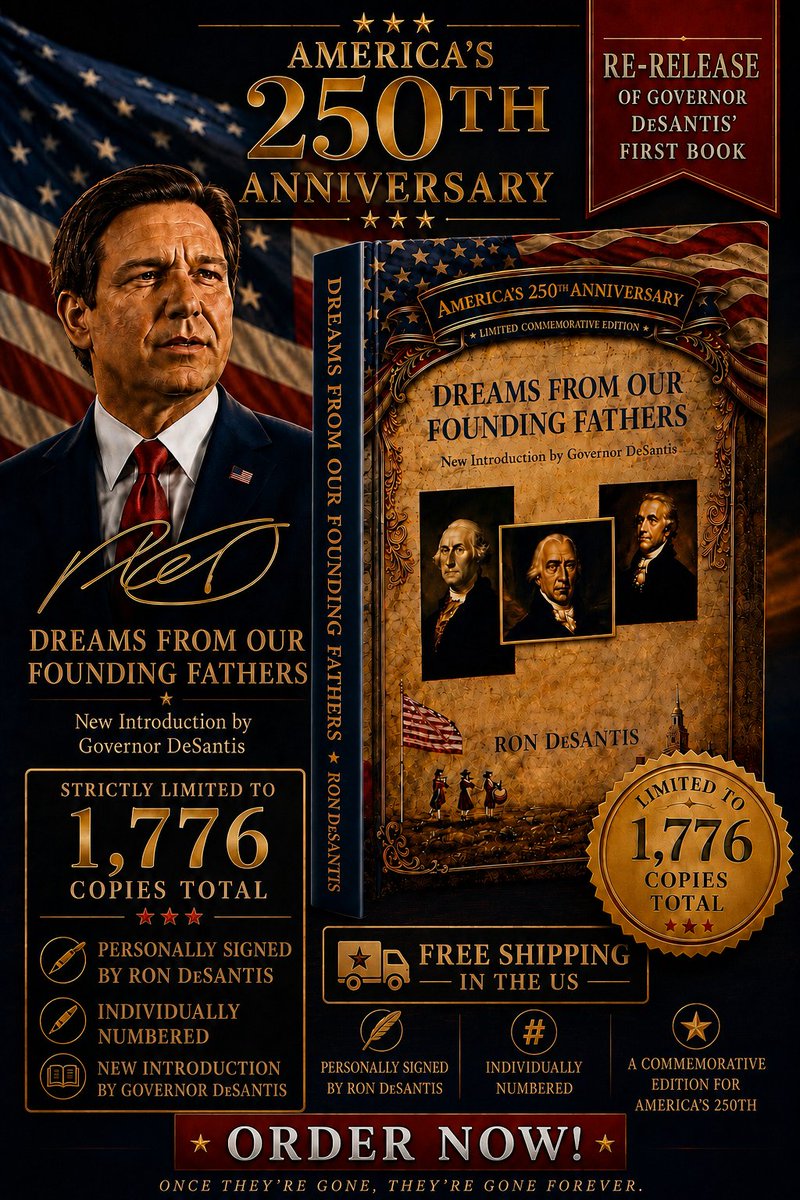
In honor of America 250, I’ve re-released my first book, Dreams From Our Founding Fathers (2011), with a new introduction.
Friends and supporters have asked me to do this over the years, but I didn’t want to mass market the book, so we’ve only released 1776 copies — all signed and numbered by me.
Check it out at https://t.co/TJ32NxMRfJ
The vote to cut ties with Great Britain and the approval and later signing of the Declaration of Independence represented the ultimate line in the sand.
The penalty for failure = execution for treason.
As we prepare for tomorrow’s 250th anniversary, it is worth remembering the 50th anniversary of American independence, in 1826.
John Adams and Thomas Jefferson had been bitter political rivals but later developed a friendship through letter exchanges.
Laying on his deathbed on July 4, 1826, Adams’ last words were, “Thomas Jefferson still survives.” In reality, Jefferson had passed away a few hours earlier.
Two prominent American founders both passing away on America’s 50th anniversary — how providential is that?
One of the richest men in all of America signed the Declaration of Independence knowing it could cost him everything. Then he left home to serve, died far away in a borrowed town, and never came back. Meet Philip Livingston.
This guy was not a scrappy underdog. Just the opposite. He was born in 1716 into the Livingston family, one of the wealthiest, most powerful dynasties in colonial New York. Manor lands, a Yale education, and a shipping empire he built into one of the biggest merchant fortunes in New York City. He had everything the British system was designed to reward.
And he spent that fortune building things that still exist. He helped found King's College, which you know today as Columbia University. He helped start the New York Society Library. He helped create the New York Chamber of Commerce. The man was basically constructing the civic backbone of New York with his own money and time.
Here's the thing though. He was not some hothead revolutionary. He actually feared independence. He worried it would bring chaos and disorder, and he was cautious about the whole idea for a long time. This wasn't a man itching to burn it all down.
But when New York finally gave its delegates the go-ahead, Livingston signed. He put the name of one of the great fortunes in America onto a document the crown treated as treason. A rich man betting his wealth against the empire that made him rich.
And the war came straight for him. When the British took New York, they seized and used his properties. He started selling off his holdings to help fund the fight, watching the empire he'd defied pick apart the life he'd built.
Then comes the ending that gets me. His health was failing, and he knew it. Congress had been driven out of Philadelphia and was meeting in the small town of York, Pennsylvania. Livingston could have gone home to rest. Instead he told his family he probably wouldn't see them again, and he went to York to keep serving anyway.
He died there in June 1778, in the middle of a session of Congress, far from home. He's buried in York, Pennsylvania to this day. He never made it back to the New York he spent his whole life building.
A man who had every reason to stay comfortable and loyal, who gave his fortune and his final months to a country he wasn't even sure would work.
Philip Livingston. He died at his post, a long way from home.
250 years ago, on July 2nd, 1776, the Second Continental Congress voted to declare independence from Great Britain.
John Adams wrote to his wife the next day:
“The Second Day of July 1776, will be the most memorable Epocha, in the History of America.—I am apt to believe that it will be celebrated, by succeeding Generations, as the great anniversary Festival. It ought to be commemorated, as the Day of Deliverance by solemn Acts of Devotion to God Almighty. It ought to be solemnized with Pomp and Parade, with Shews, Games, Sports, Guns, Bells, Bonfires and Illuminations from one End of this Continent to the other from this Time forward forever more.”
Well, not quite.
On July 4th, the delegates adopted the Declaration of Independence — and that has been the day for celebrations ever since.
Truly brain dead to provide welfare to foreigners and create a magnet for migration.
We used to insist that anyone coming to America could not be a public charge!
CAIR has long supported a number of terrorist groups including Hamas, let them sue. It’s time to stop their influence, access, and control in our state. Florida is smart to do it now before it’s too late to stop it.
@RonDeSantis Did it in a talent depleted league since it was during WW2
His time has a marine the following year and for five years after is what makes him the great man
Ty Teddy Ballgame for your sacrifice
Ted Williams was offended that his manager even suggested sitting it out.
Although his average had been dropping over the final couple weeks of the season, he went 6 for 8 and ended at .406.
Nobody’s done it since.
@RonDeSantis Williams lost three years in his prime, serving our country in WWII.
Probably would have wound up with 600+ home runs otherwise. Still hit 521.
“44 equals record” – until Joltin’ Joe came along.
Joe DiMaggio broke Willie Keeler’s record 85 years ago today when he hit safely in his 45th consecutive game. https://t.co/PoI8gRah4C
Truly brain dead to provide welfare to foreigners and create a magnet for migration.
We used to insist that anyone coming to America could not be a public charge!
250 years ago, on July 2nd, 1776, the Second Continental Congress voted to declare independence from Great Britain.
John Adams wrote to his wife the next day:
“The Second Day of July 1776, will be the most memorable Epocha, in the History of America.—I am apt to believe that it will be celebrated, by succeeding Generations, as the great anniversary Festival. It ought to be commemorated, as the Day of Deliverance by solemn Acts of Devotion to God Almighty. It ought to be solemnized with Pomp and Parade, with Shews, Games, Sports, Guns, Bells, Bonfires and Illuminations from one End of this Continent to the other from this Time forward forever more.”
Well, not quite.
On July 4th, the delegates adopted the Declaration of Independence — and that has been the day for celebrations ever since.