@JoelWebbon is an antisemite masquerading as a theologian — and Matthew 1:21 exposes him instantly.
The angel commands Joseph to name the child Yeshua — then immediately tells him why: "for he will save his people from their sins." That's not coincidence. That's a deliberate wordplay. Yeshua derives from the Hebrew verb להושיע (l'hoshea) — to save. You can hear it in Hosanna — "save us now." The name is the message.
If Matthew intended Greek, the wordplay collapses entirely. The name Iesous means nothing in that context. The angel's explanation becomes incoherent.
Webbon's argument that Matthew uses Hebrew elsewhere actually proves nothing — Matthew uses Greek for virtually every proper name in his gospel. What matters is that this name, in this verse, only works in Hebrew. The theology demands it.
Let me be clear: I have no issue with anyone saying Jesus, Iesous, Yeshua or Issa. That's not the point.
The real question is why it bothers Webbon so much for people to use the Hebrew name. The answer isn't theological. It's that his framework is shaped by a deep hostility toward Jews and anything Jewish — and that hostility is doing the exegesis for him.
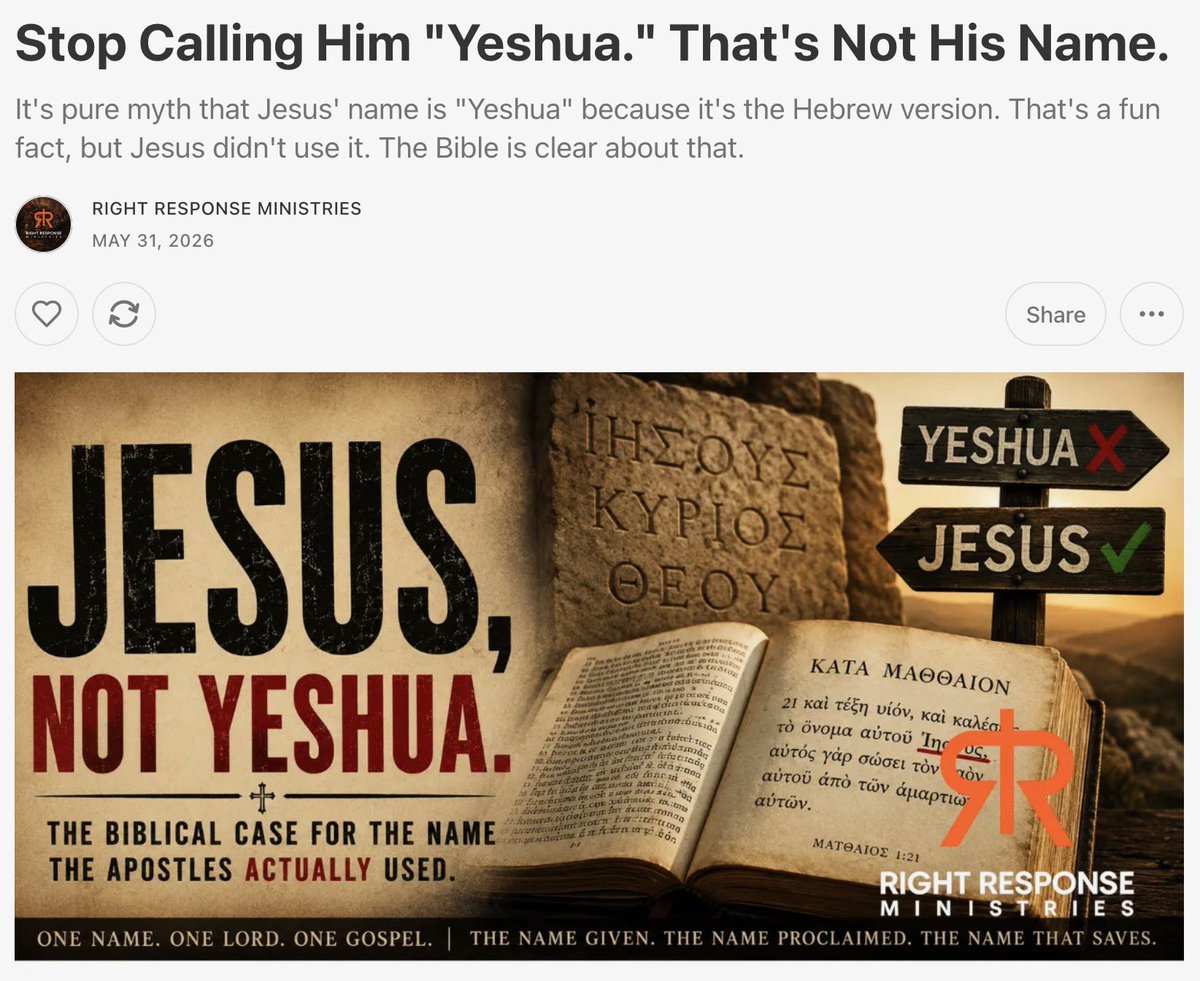
Stop Calling Him “Yeshua.”
That’s Not His Name.
“The irony is almost painful. The same people who insist on calling Jesus "Yeshua" because they want to be more authentic than ordinary Christians rarely stop to consider that the Apostles themselves lived, preached, wrote, and quoted Scripture in Greek. The New Testament is Greek. The churches were Greek-speaking. The Septuagint was the Bible of the early Church. Even the Jewish men walking beside Christ bore Greek names without embarrassment. Yet two thousand years later, a man with a shofar in the garage and a Hebrew Roots podcast subscription becomes convinced that he has uncovered a level of authenticity unavailable to Peter, Paul, Luke, John, and the congregations they planted. At some point, trying to be more Hebrew than the Apostles stops being reverence and starts becoming a theological hobby.
What makes the Matthew argument so difficult to escape is that Matthew repeatedly shows his work whenever preserving an original-language phrase actually matters. He gives his readers Raca. He gives them Mammon. He gives them Eli, Eli, lama sabachthani. In each case, the original words remain in the text precisely because Matthew wants the reader to know those specific words were spoken. Yet when the angel announces the name of the Messiah, Matthew suddenly abandons this practice entirely and gives us Ἰησοῦς without qualification, explanation, or linguistic footnote. The simplest explanation is usually the correct one. Matthew preserved original-language expressions when he believed preserving them mattered. He did not do so with the name of Jesus because, for Matthew and the Church that received his Gospel, Ἰησοῦς was not standing in for the real name. It was the real name.”
When Shepherds Prey by Dr. Ron Cantor — ebook on sale this weekend for $2.99.
70% off. Ends Sunday.
Because silence protects abusers, not the church.
https://t.co/lPYTuf0kc1
Good shepherds don't stay silent. Neither should we.
When Shepherds Prey is more than a book about abuse in ministry. It's a call to courage and a roadmap for reform—because the church deserves better than cover-ups and silence.
This weekend only, the Kindle edition is just $2.99—down from $9.99.
If you care about the health and integrity of the church, this book is for you.
👉 https://t.co/54WkA2bzLG
Read it. Share it. Spark change.
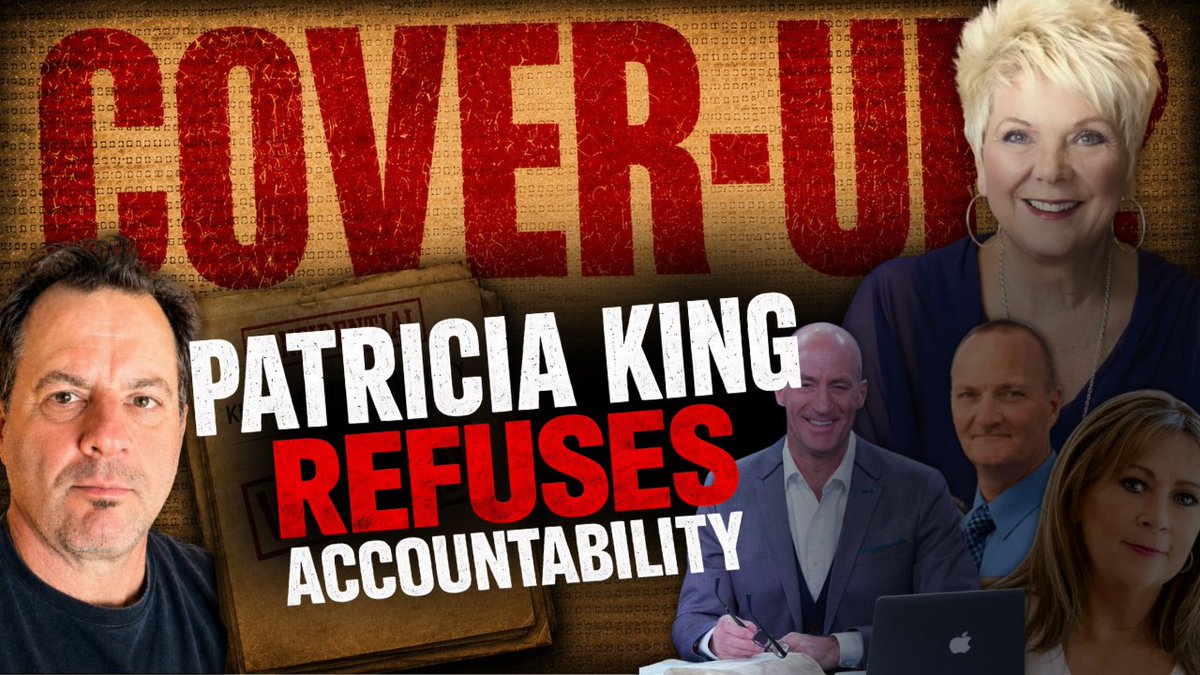
I did not want to make this video.
For two months, I worked behind the scenes trying to get this handled privately. I gave it every opportunity to be resolved without going public. That door was closed.
This video is about Patricia King — one of the most well-known figures in the charismatic Christian world, and a co-author, along with me, of the Kingdom Accountability Project — a document designed to hold ministries accountable when allegations of abuse arise.
Two survivors came forward. I served as their advocate. I urged her board to follow the very document they helped write. They refused.
So here we are.
This is a story about cover-up culture. About what happens when the people who write the rules decide the rules don't apply to them. And about two brave people — Kat and Daniel — who deserved better than what they got.
I believe them. And I think after you watch this, you will too.
All proceeds from SpeakUp go toward counseling for survivors of CSA. Every like, share, and subscription generates matching funds up to $25,000.
Link in comments. 👇
Cover Up Culture Exposé! Please share: Watch Minor Prophets Podcast. 👇Link to full episode
Minor Prophets & Ron Cantor - Watch: https://t.co/sTDXDQtw5c
@JonmarkBaker@RonSCantor@Miller1037@mtree81
Watch more SPEAK UP Podcast: https://t.co/lQwHeq7T6A
Speaking up against abuse in churches is BIBLICAL. In this episode, Dr. Ron Cantor challenges the "don't speak against leaders" mentality that protects abusers and silences victims. Drawing from Scripture and recent high-profile cases, he explains why accountability, justice, and victim protection are core biblical values—not "accusation."
This powerful message addresses:
✦ Jeremiah Johnson's Altar Church and high-control environments
✦ How Ezekiel 34 and Matthew 18 command us to protect the vulnerable
✦ The false "accuser of the brethren" accusation used to silence abuse victims
✦ Why clergy sexual abuse accountability is non-negotiable
✦ The role of social media in exposing abuse cases like Mike Bickle, Robert Morris, and Dr. Michael Brown
✦ How the church must protect sheep, not shelter predators100% of
❤️ YouTube revenue from this channel supports clergy abuse survivors through counseling funds. Every dollar is matched up to $25,000. If you want to participate, go to https://t.co/gvepqbhbBN. But simply subscribing, liking, and sharing this episode produces funds for survivors. Thank you.
DISCUSSION QUESTIONS (for comments)
How can churches balance respecting leaders with holding them accountable?
What safeguards should protect vulnerable people in churches?
Why do some church leaders weaponize Scripture to silence victims?
How has social media changed power dynamics in religious institutions? What does biblical accountability actually look like?
How can survivors of clergy abuse find healing and justice?
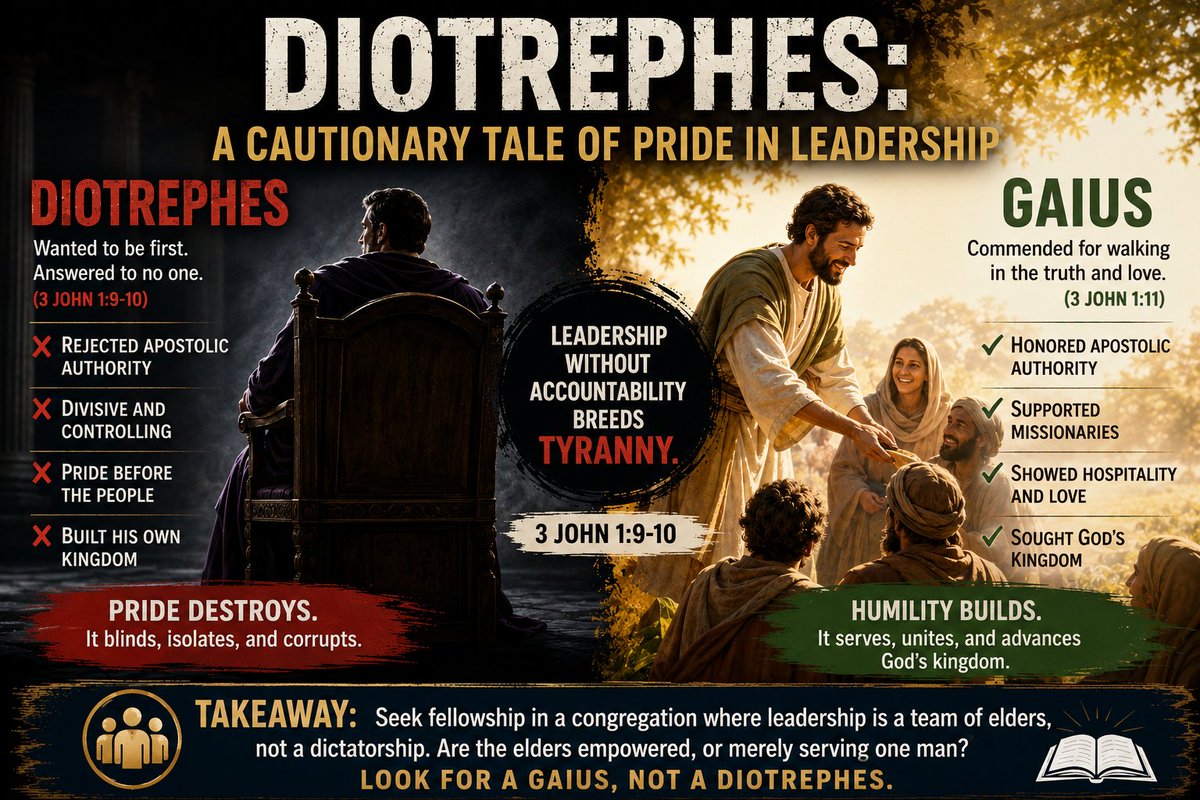
DIOTREPHES: A CAUTIONARY TALE OF PRIDE IN LEADERSHIP
Most people have never heard of Diotrephes, yet his story in 3 John offers a surprisingly modern lesson about leadership and pride. Who was this forgotten figure? Diotrephes was a house church leader operating under John’s apostolic authority. John, one of Yeshua’s original twelve disciples and the regional apostolic overseer, had jurisdiction over Diotrephes’s congregation—and Diotrephes knew it.
Yet Diotrephes rebelled. His sin was straightforward: pride. He wanted to be first, to hold preeminence, to answer to no one (v. 9). John didn’t mince words in calling him out publicly, rebuking his refusal to acknowledge apostolic authority (v. 9) and his divisive behavior within the church (v. 10).
PRIDE DESTROYS
Why is pride so corrosive in leadership? Because it makes a leader a tyrant rather than a servant.
😤 Pride blinds leaders to their limitations, making them resistant to accountability—the very thing that keeps them humble and effective.
😤 A proud leader becomes defensive, dismissive of correction, and eventually isolated.
😤 They prioritize their reputation over their congregation’s health.
😤 They build kingdoms instead of God’s kingdom.
What began as a leadership team of elders, walking in covenantal friendship, became a dictatorship by one leader intent on having full control.
“Diotrephes’ lust for leadership was symptomatic of the same lust that would take over the church in the following centuries. One by one, churches—formerly cared for by a group of elders—were taken over by one leader. This eventually led to a whole system of bishops, cardinals, and a pope.” (Scholar Bruce Barton)
HOW DID DIOTREPHES BECOME A LEADER?
How did Diotrephes even gain leadership? Likely through genuine gifts and charisma—pride often wears the mask of competence. But without humility, those gifts became weapons of control rather than tools of service. How many pastors started out with pure intentions, only to allow fear, pride, and the terror of losing people to other congregations turn them into manipulators?
The congregation that we sought to confront recently (see our YouTube channel) had members who wanted to leave or did leave, only to be labeled as being sifted by Satan or following the devil. It couldn’t be that they simply felt called to be in a different fellowship. Leaving was personal. It stirred up all the insecurities of the senior leader. Therefore, he sought to instill fear in the others that leaving was akin to following demons. That is Diotrephes-type leadership.
WHO IS GAIUS?
The contrast with Gaius is striking. Also a house church leader under John’s authority, Gaius appears in the same letter as someone John commends. What was the difference?
🤗 Gaius embodied servanthood.
🤗 He supported missionaries,
🤗 showed hospitality,
🤗 and apparently accepted John’s apostolic guidance.
In short, Gaius was kingdom-minded, seeking to extend God’s kingdom to the pagans, whereas Diotrephes was earthly-minded, building his own kingdom. The Holy Spirit wants us to see the contrast between these two house congregation leaders and learn from it.
TAKEAWAY
The lesson is clear: leadership without accountability breeds tyranny. Diotrephes reminds us that unchecked ambition—even among the gifted—becomes poisonous. The antidote? The humility of Gaius, who understood that true leadership means serving under authority, not fighting for supremacy.
Seek fellowship in a congregation where there is team leadership dynamic among the elders, not a dictatorship from a charismatic figure. Are the elders empowered, or are they merely eunuchs serving the senior leader? Look for a Gaius, not a Diotrephes in a pastor (and elders).
Dr. Ron Cantor
SIgn up at https://t.co/AePiXJTR1x and I will send you a free ebook
Eric, we don’t know each other but it’s important to understand that Malachi runs defense of sexual perverts, frauds, and abusers.
This isn’t speculation. I’ve interviewed the victims and presented the evidence. His online contribution to this situation is him trying to justify the ungodly acts of those who cover up for and enable abusers, while adding further harms to their victims.
I don’t know where you’re really at with all this stuff (I haven’t followed) but I do know you previously defended Mike Bickle and shamed the women he groomed, molested, and used prophecy to manipulate. Bickle was always a bad guy. Did you ever recant that horrible act on your part? I’m sure you feel righteous but man, slow down, talk to some people who aren’t guilty of partiality, and wake up. The evidence has been presented.
My friend @JonmarkBaker, made a great point: The only sin today, for many preachers, that is worthy of exposure is the sin of exposing sin. Calling out an abuser or someone manipulating prophecy—an act of protecting believers—apparently, is more evil than committing abuse or manipulating people through prophecy.
"Have nothing to do with the fruitless deeds of darkness, but rather expose them." (Eph. 5:11)
"Woe to those who call evil good
and good evil,
who put darkness for light
and light for darkness,
who put bitter for sweet
and sweet for bitter!" (Is. 5:20)
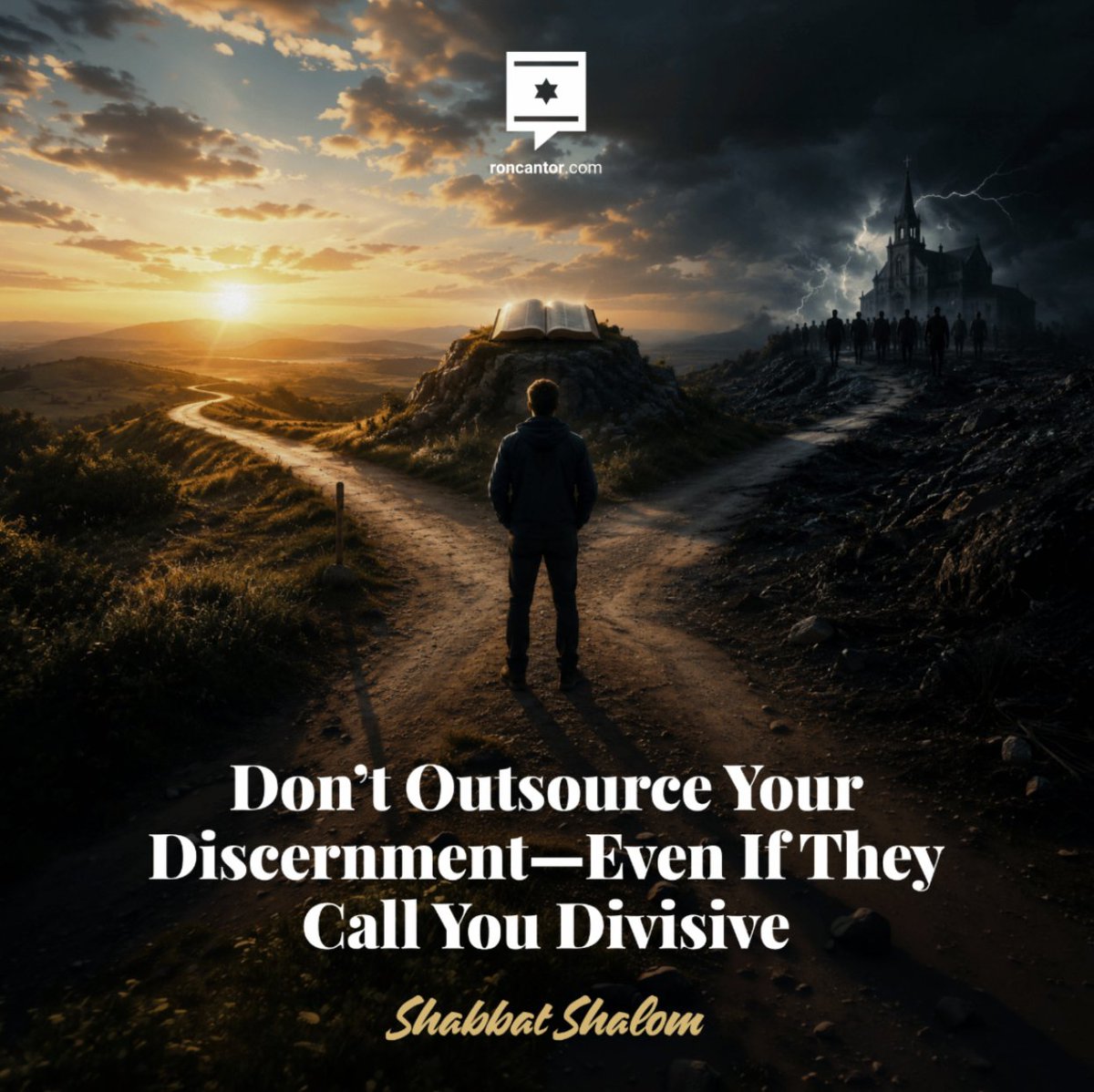
🎯A serious problem today is spiritual elites who want us to trust them rather than the Spirit-illumined Word of God. We’re told to submit to authority and trust the pastors. And there is a real biblical call to honor leaders who have embraced the yoke of shepherding: “Obey your leaders and submit to them, for they are keeping watch over your souls, as those who will have to give an account” (Hebrews 13:17). The elders who lead well are “worthy of double honor” (1 Timothy 5:17).
SUBMISSION IS NOT ABSOLUTE
But that submission has a ceiling. When the apostles were ordered to stop preaching Messiah, Peter answered, “We must obey God rather than men” (Acts 5:29). We honor our leaders, and we refuse to follow them into error. Both are biblical. It should flow like this:
🎯Word of God
🎯Spirit’s leading
🎯Conscience
🎯Leadership
This is exactly why Peter wrote 2 Peter — to warn believers about false teachers and to ground them in the Word of God as the standard for testing what they hear. “But false prophets also arose among the people, just as there will be false teachers among you, who will secretly bring in destructive heresies” (2 Peter 2:1).
JESUS WARNED AGAINST FALSE TEACHERS
Teachers sometimes go off the rails. They may have compelling supernatural stories to draw you in — “They mouth empty, boastful words and, by appealing to the lustful desires of the flesh, they entice people who are just escaping from those who live in error” (2 Peter 2:18) — but their teaching is off. Jesus himself warned, “For false messiahs and false prophets will arise and perform great signs and wonders, so as to lead astray, if possible, even the elect” (Matthew 24:24).
YOU HAVE THE HOLY SPIRIT
The discernment Peter calls for isn’t private intuition or “my truth.” It’s the believer, indwelt by the Holy Spirit, weighing every teaching against the Scriptures. The Bereans were called “more noble” because they “received the word with all eagerness, examining the Scriptures daily to see if these things were so” (Acts 17:11). Some leaders today would have rebuked the Bereans for not blindly following leadership.
DON'T TAKE THE "PROTEST" OUT OF PROTESTANT!
And what is so crazy about that is that the Protestant Reformation was started as a reaction to the Catholic Church's monopoly over doctrine, interpretation, and so much more. Protestants “protested” against such tight control…and now some are repeating it.
John says it directly: “Beloved, do not believe every spirit, but test the spirits to see whether they are from God, for many false prophets have gone out into the world” (1 John 4:1). And Paul: “Test everything; hold fast what is good” (1 Thessalonians 5:21).
ABUSE RESPONSES TO RAISING CONCERN
The trouble is, many believers feel guilty for voicing concern.
If they leave, they’re labeled as followers of Satan. If they warn others, they’re called divisive. Now, Scripture does warn against true divisiveness — splitting fellowship over secondary matters or personal preference (Titus 3:10). But raising the alarm over false teaching isn’t divisiveness; it’s faithfulness. Paul didn’t soften his words: “If anyone is preaching to you a gospel contrary to the one you received, let him be accursed” (Galatians 1:9). And Jude pleads with us to “contend for the faith that was once for all delivered to the saints” (Jude 3).
Peter closes his letter with the exhortation that holds this whole message together: “Therefore, dear friends, since you have been forewarned, be on your guard so that you may not be carried away by the error of the lawless and fall from your secure position” (2 Peter 3:17).
THE ANOINTING IS IN YOU, NOT JUST THEM
So let me encourage you to read 2 Peter — it’s only three chapters. Every believer has the Holy Spirit (Romans 8:9). Every believer is part of “a royal priesthood” (1 Peter 2:9). As John reminds us, “You have an anointing from the Holy One, and all of you know the truth... the anointing that you received from him abides in you” (1 John 2:20, 27). Every believer can open the Word of God. Every believer, by the Spirit, can discern and think critically. You have been forewarned. Be on your guard.
—Dr. Ron Cantor
Go to https://t.co/AePiXJTR1x and sign up to get all of our articles. We will send you a free book. :-)
#TestTheSpirits #BiblicalDiscernment #ProtestantReformation #FalseTeachers #ChristianAccountability #SolaScriptura #SpiritualAuthority #FaithfulDissent