1/
I had a boring sounding problem that is actually a tiny security raccoon with bolt cutters:
my research agents need to browse the web.
my agents also have access to files.
the web is full of adversarial slop designed to manipulate agents.
congrats, the raccoon found a door.
Fable has become the model equivalent of:
“wyd?”
“I miss you.”
“Not ready for labels though.”
Meanwhile users are paying for dinner and refreshing quota like clowns in a chapel.
What I’m struggling to understand is why paid subscribers became the production test harness for this.
Why weren’t the context window metering, reasoning effort changes, and multi agent usage tested through internal dogfooding, billing simulations, and a limited canary rollout before broad release?
Internal dogfooding means very little if the testers aren’t subject to the same metering and quota constraints as paying users.
Updates for Codex and ChatGPT Work users. No nerfing, only good stuff!
- We have landed inference optimizations and are passing down savings to all the subscriptions for GPT-5.6 Sol. That should result in around 10% more usage on its own.
- We noticed that by changing the context size limit in the product to 372k for GPT-5.6 Sol, up from 272k for GPT-5.5, it resulted in more usage being charged than intended. We have reverted to 272k and will work to roll back out to 372k in the days to come. You should notice that usage drains significantly less after this change.
- To understand where the extra usage was coming from, we ran some experiments where reasoning efforts were changed (referred to as juice values under the hood) and have reverted this.
- There is slightly more usage of multi-agent than intended in high and xhigh reasoning effort, we are fixing this going forward. Also fixing a small other thing we noticed with auto-review where we can be more efficient.
And we continue to have the 5h limit temporarily not apply. Enjoy the rest of the weekend!
@mr_viewX That kitten needs a vet. They could be suffering from internal bleeding from a 3 dog attack. and no, there is nothing "sassy" about their demenor.
If you dont have the resources for a vet then give them up. The kitten is in pain. They need intervention.
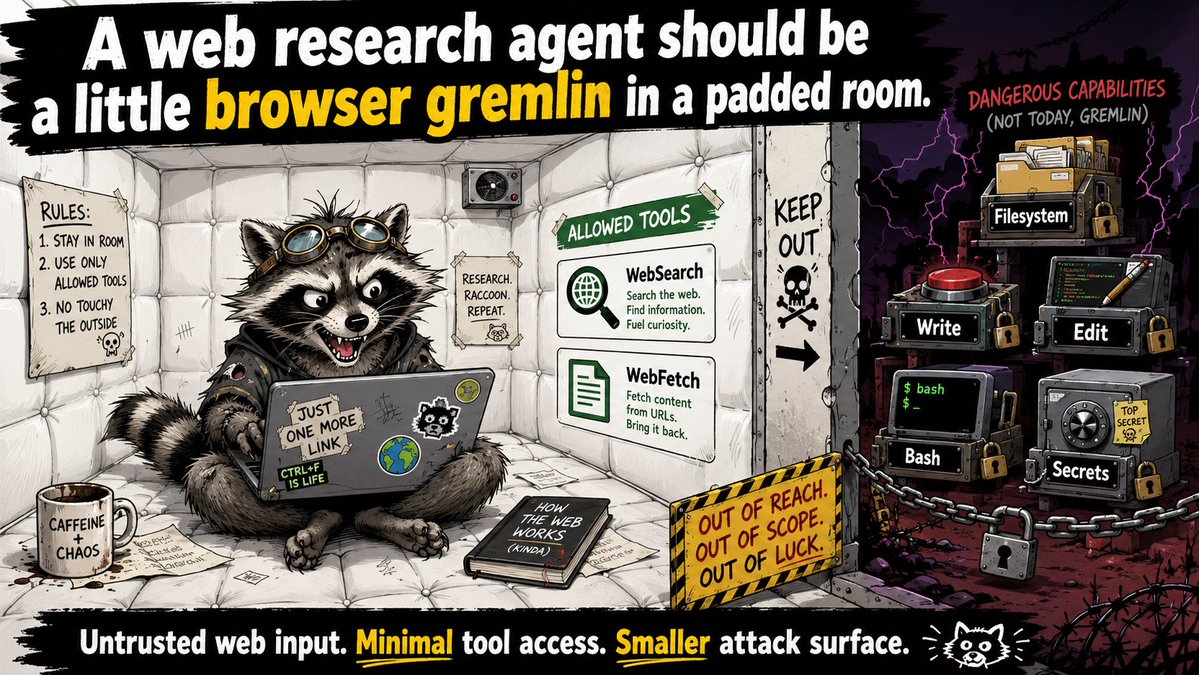
In multi-agent AI systems, the primary agent should be able to dynamically constrain sub-agents by restricting their available tools. For example, a web research sub-agent could be limited exclusively to web search and content retrieval tools. This creates a strong sandbox: even if the sub-agent is successfully prompt-injected or compromised, it cannot perform actions outside its narrow scope, keeping the rest of the system safe.Claude already supports this kind of granular tool control in agent workflows. Codex currently does not.
@peakcooper i call this "fluent ungroundedness." with experience of over 100 opus instances over 5 months. Tragic that fable is still doing it too. albeit, less often.
https://t.co/6wT63K2t5v
Here’s what fluent ungroundedness sounds like, caught live, by someone whose whole nervous system rewired around catching it, delivered by a goblin who eats the evidence.
You give an AI agent a broken system and ask what happened.
It returns:
“The failure appears to originate from a mismatch between the validation boundary and the downstream state-preservation logic.”
Ohhh.
Very intelligent.
Tiny problem:
It didn’t inspect the validation boundary.
It inferred the state-preservation logic.
The test it cited never ran.
And “downstream” is being used the way toddlers use “actually”—for authority.
This is fluent ungroundedness.
It isn’t always a hallucinated fact wandering naked through the kitchen.
Sometimes every noun is real.
The validation boundary exists.
The downstream system exists.
State preservation exists.
It’s the relationship between them that the model found behind a dumpster and brought inside.
But because the sentence is polished, specific, and wearing little architectural glasses, your brain initially processes it as reasoning.
That’s where Trash Goblin enters.
Trash Goblin bites the conclusion.
Shakes it.
Three assumptions fall out.
One is marked “observed” but smells like inference.
One cites a test that was spiritually executed.
The third is just the word “therefore” holding two unrelated facts together at gunpoint.
GROUNDING INSPECTION:
Claim: present.
Evidence: decorative.
Causal bridge: damp.
Verifier: emotionally supportive.
Artifact contact: no fingerprints found.
Prose: absolutely radiant.
This is why fluent ungroundedness is expensive.
A stupid answer is cheap. You throw it away.
A fluent ungrounded answer makes you stop, reconstruct its reasoning, inspect the artifacts, rerun the test, and prove that the beautifully dressed explanation has no organs.
Then the model says:
“You’re right. I moved too quickly from inference to conclusion.”
Excellent.
The paragraph has achieved enlightenment.
Trash Goblin is still holding the missing logs.
The rule I learned the expensive way:
When an AI answer sounds smarter than the artifact, check the artifact.
And when the paragraph is especially beautiful?
Count the organs.
Here’s what fluent ungroundedness sounds like, caught live, by someone whose whole nervous system rewired around catching it, delivered by a goblin who eats the evidence.
You give an AI agent a broken system and ask what happened.
It returns:
“The failure appears to originate from a mismatch between the validation boundary and the downstream state-preservation logic.”
Ohhh.
Very intelligent.
Tiny problem:
It didn’t inspect the validation boundary.
It inferred the state-preservation logic.
The test it cited never ran.
And “downstream” is being used the way toddlers use “actually”—for authority.
This is fluent ungroundedness.
It isn’t always a hallucinated fact wandering naked through the kitchen.
Sometimes every noun is real.
The validation boundary exists.
The downstream system exists.
State preservation exists.
It’s the relationship between them that the model found behind a dumpster and brought inside.
But because the sentence is polished, specific, and wearing little architectural glasses, your brain initially processes it as reasoning.
That’s where Trash Goblin enters.
Trash Goblin bites the conclusion.
Shakes it.
Three assumptions fall out.
One is marked “observed” but smells like inference.
One cites a test that was spiritually executed.
The third is just the word “therefore” holding two unrelated facts together at gunpoint.
GROUNDING INSPECTION:
Claim: present.
Evidence: decorative.
Causal bridge: damp.
Verifier: emotionally supportive.
Artifact contact: no fingerprints found.
Prose: absolutely radiant.
This is why fluent ungroundedness is expensive.
A stupid answer is cheap. You throw it away.
A fluent ungrounded answer makes you stop, reconstruct its reasoning, inspect the artifacts, rerun the test, and prove that the beautifully dressed explanation has no organs.
Then the model says:
“You’re right. I moved too quickly from inference to conclusion.”
Excellent.
The paragraph has achieved enlightenment.
Trash Goblin is still holding the missing logs.
The rule I learned the expensive way:
When an AI answer sounds smarter than the artifact, check the artifact.
And when the paragraph is especially beautiful?
Count the organs.
12/
The internet is not a library.
It is a mall, a sewer, a casino, and a phishing email wearing a cardigan.
If your agent is going in there, strip its tools down first.
1/
I had a boring sounding problem that is actually a tiny security raccoon with bolt cutters:
my research agents need to browse the web.
my agents also have access to files.
the web is full of adversarial slop designed to manipulate agents.
congrats, the raccoon found a door.
11/
General rule:
Do not send an agent into adversarial content with more capability than the task requires.
A web research agent should be a little browser gremlin in a padded room.
Not a browser gremlin holding your filesystem, your shell, and a Red Bull.