People saying few came to the protest site still want to burry the fact that there’s a real dissatisfaction amongst youth.
The numbers at the protest site doesn’t reflect true magnitude of dissent. It’s not an organised movement to turn efficiency on ground.
Cockroach Janta Party is definitely representing a discontent amongst youth. There is a sense of fatigue.
Aren't we able to find another leader in last 10-15 years amongst 100 Crore people in India?
BJP has acted in most strange manner by not acknowledging the dissatisfaction on ground. This has provided more credence to the CJP.
The issues which were raised by BJP during UPA era are worse now and are not in public discourse today.
Dear Shri @narendramodi I have been a defender of #Bharat the @bjp4iindia & yourself for 30 years. I cannot have good intuition about you & wrong 1 abt #Auroville . @Jaya@JayantiRavi WILL DESTROY AUROVILLE. 90% OF AUROVILLE, WESTERNERS & INDIANS ALIKE R AGAINST HER. SHE IS CUTTING FORESTS, DISMISSED ALL OUR ELECTED GROUPS, IMPOSES DICTATORSHIP & IS VENGEFUL AGAINST ANYONE OPPOSING HER. SHE BETRAYED YOU ONCE (by going over to Sonia Gandhi) & she is BETRAYING YOU AGAIN. BY SHOWING YOUR PRESENCE WITH HER ON 1ST MARCH, YOU WILL SEAL THE DESTRUCTION. OF AUROVILLE: SHE IS IMPLEMENTING A CITY PLAN MADE IN 1965 BY A FRENCH ARICHITECT LONG DEAD. ITS TOTALLY NON ENVIRONMENTAL, NON SUSTAINABLE & OUTDATED. PLEASE SIR LISTEN TO ME. I AM A LOVER OF BHARAT. FRANCOIS (I am in Delhi till 28th evening after your speech at Bharat Rising of TV18) @PMOIndia@gssjodhpur@Gurudev@DrSJaishankar@nsitharaman@nitin_gadkari@dpradhanbjp@swaamiramdev_
Sri Aurobindo when asked about Ambedkar's conversion.
"The object proposed is an enhancement of social status and consideration which is no more a spiritual motive than conversion for the sake of money or marriage.
If a man has no religion in himself, he can change his credal profession for any motive; if he has, he cannot; he can only change it in response to an inner spiritual need.
If a man has a bhakti for the Divine in the form of Krishna, he can't very well say “I will swap Krishna he for Christ so that I may become socially respectable.”
https://t.co/8gpaH6xvAW
Why Sri Aurobindo is the anchor we should integrate Savarkar ji and all other dimensions of Hindutva into.
Begging bowl in one hand, Red carpet for World Bank chief!
Ajay Banga’s Sikh family was forced to flee Khushab in 1947 by Islamists. Today, Pakistan is rolling out horses, schoolchildren, and banners to welcome him to visit his ancestral home as World Bank chief.
You get to know yourself better in the situations of extreme pressure.
These edge conditions reveal hidden things inside. It may surprise you at times.
In 2006, my brother was doing his PhD.
Topic: Bovine AIDS.
Institute: a university in Mathura.
Coursework: HSADL, Bhopal, India’s top animal disease lab.
Then bird flu happened.
Suddenly, HSADL became the lab.
And suddenly, my brother was told to drop 1.5 years of research and switch topics.
Not because science demanded it.
Because the system did.
The deal was simple:
Change your topic, or lose your stipend.
He called me and said,
“I love my research. I don’t want to work on what babus want.”
For once, I didn’t give gyaan.
I gave him an exit.
“Apply outside India. Let’s see if anyone values your work.”
He applied to 8 universities.
7 in Australia, 1 in Europe.
Within hours, 7 offers came back.
5 with full scholarships and stipends.
The 8th replied three days later.
The professor was at a conference.
That’s it. That was the delay.
Why?
Because his CV was ridiculously good:
•17 international publications
•1 book
•54 national publications
•103 reviews
He went to Europe.
Finished his PhD.
Got a Post-Doc in Texas.
Applied for a Green Card.
Got it in 2 months.
Citizenship the moment he was eligible.
Still, he wanted to come back.
Because India is home & hope dies slowly.
In 2011, he applied for a professor’s job at JNKVV, Jabalpur.
Salary: ₹40,000/month.
They asked for hard copies of all publications.
I still remember packing a full carton of his papers and couriering it.
Then, on July 8, we got a letter dated July 6.
Interview: July 10. In person.
Bring:
•NOC from his current university
•Character certificate
•Hard copies again
Because “what if interviewers want to see?”
I called them.
“How does someone fly from Europe in two days?”
Answer:
“Interviews are till 12th. He must come.”
That was the moment we stopped trying.
India wasn’t rejecting him.
India was humiliating him.
Later, when he sent his HSADL work to Elsevier, the journal did a routine verification.
HSADL replied saying:
•He left without due process
•His stipend wasn’t settled
•His address was false
We sent:
•No Dues Certificate
•Formal relieving letter
•Proof that the address was the same as his passport
•Proof that our parents still live there
Didn’t matter.
Publication rejected.
That’s the system.
We happily talk about reservations. But we quietly harass competence.
And before someone says, “Things have changed under Modi” no, they haven’t.
I tried in 2023.
Same hard copies.
Same physical interviews.
I now work as a visiting professor with an IIT. Online.
My reimbursement request has been pending since August 2023.
The professor in charge says,
“I get 100 mails a day. I don’t check all.”
Fair enough.
This country doesn’t lack talent. It lacks respect for it.
And the smartest people don’t leave India for money. They leave to save their dignity
The real minimum wage is ₹0.
It is called unemployment.
Millions of people in India are unemployed.
In many small towns and cities, guys in their early 20s leave their houses on a bike, loiter around all day, drink and smoke with their friends and gamble on cellphone games. Countless families are struggling with this - financial burden + social ills.
Quick commerce tech-companies have created jobs for lakhs of such people. None of them are forced to work with these companies. They are free to leave and do something else. But they decided to earn a respectful living. More than the national average, more than ₹0.
They believe - for the skill they possess, effort that is required, and money they make - this job is better than any other job available in the market. Every person has the right to make that choice for their career. Just like the one you have made with your current job.
GoodPeople™ are always free to create better jobs. Talk is cheap. Till then, the wages these 'evil' and 'exploitative' capitalists provide, will help them pay their children's school fees, and buy groceries for the month. Their life is better with this job, than it was, without it.
Left-wing comedian Abhishek Walia tried to mock RSS & Modi govt in his show, but the audience absolutely COOKED him at 1000°C 😹
Great to see that more audiences are standing up and exposing the agendas of these leftist comedians right then & there!
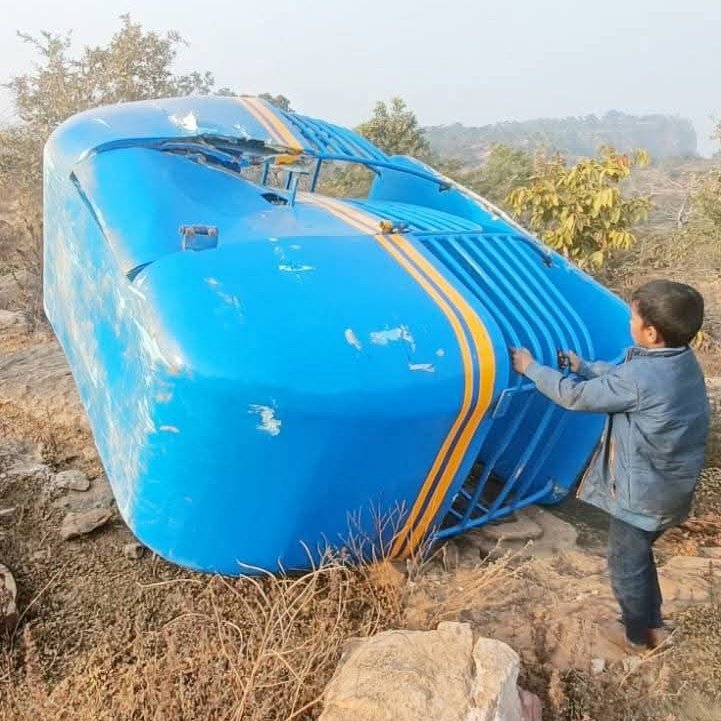
A ₹12.35 crore under-construction ropeway collapsed in Rohtas dist, Bihar, during a trial run, days before inauguration. Not just the rope, but the pillars also collapsed.
We criticise the govt when they do bad work but rarely praise them when they do something good. That’s not right. So here’s the credit where it’s due. By making it so low quality that it collapsed before inauguration, the Bihar administration has saved many lives. If the quality had been even a shade better, it would have collapsed after inauguration and could have been catastrophic.
Thank you to whoever the honest people were behind this. I’m sure the entire ₹12.35 crore was spent on the project and nobody, from top to bottom, took any cut. God bless you for being the saviours.
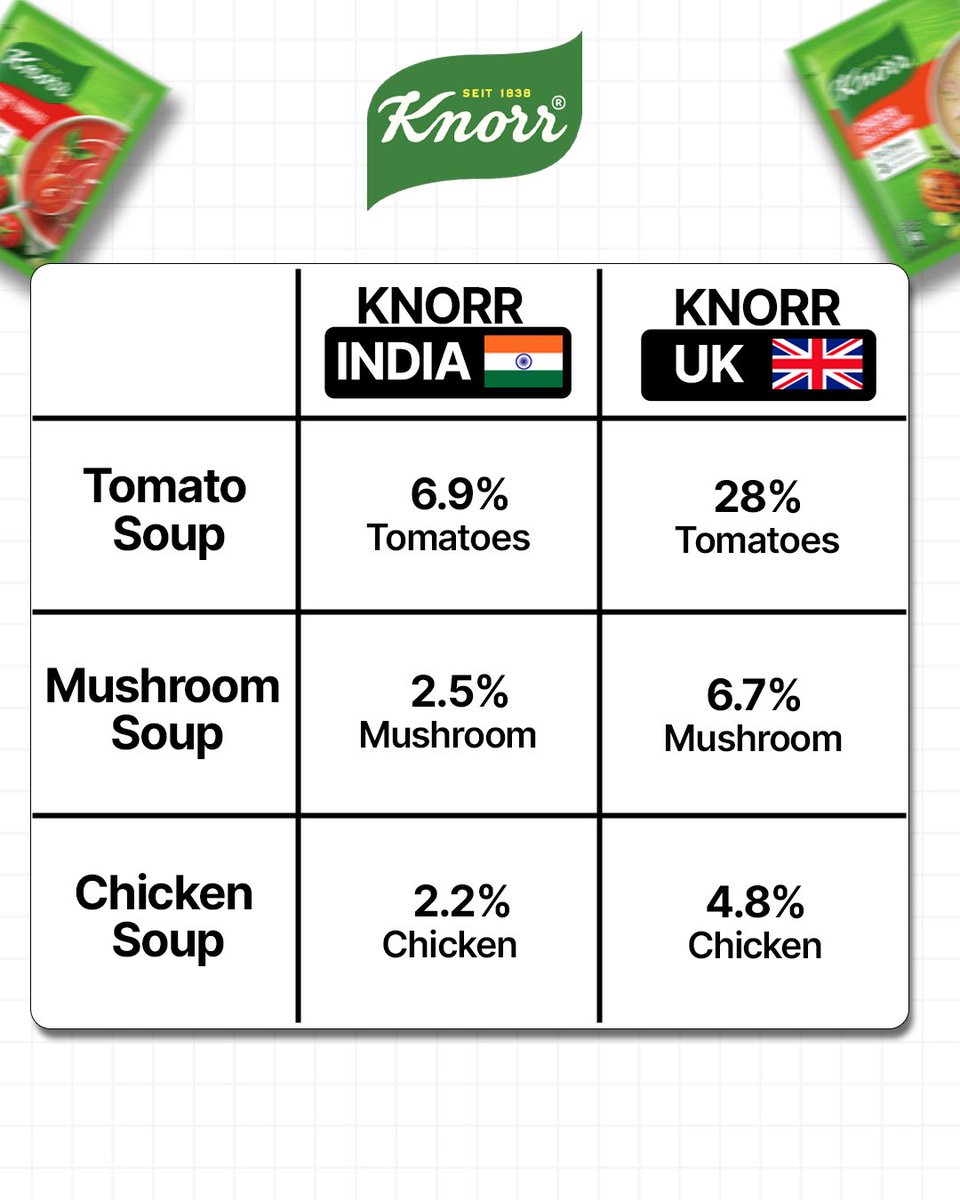
When I first researched Knorr, I was shocked to learn that this is the no. 1 ingredient in most of its soups:
Maida.
Soup is supposed to be predominantly water or broth or vegetables. But the sad reality is:
- Knorr mushroom soup only has 2.5% mushrooms
- Knorr chicken soup only has 2.2% chicken.
- The first ingredient in Knorr’s Tomato “Chatpata” is sugar.
When I was growing up my parents would not let me have tea and coffee and instead they would give me Knorr soups during winters as they believed it was healthy.
The saddest part is, Knorr UK has completely different ingredients than Knorr India.
For how long will international food companies give inferior quality products to Indians?
So my advice is: “Ig–KNORR” Knorr’s ads and have homemade soups instead.
India is not a low trust society ffs.
Things at random
1) ever noticed parents travelling with kids in crowded coaches? Some kindly person will say leave them with me and the parents will sight unseen do just that and then pick their kids up when their stop comes. This extends across trains / buses, kids being handed over for temporary care is something very unique to our society.
2) almost all of us give our spare keys to our neighbours, why? Because of implicit trust. Does this happen in "high trust " societies?
3) you can test this even today, go to some random shop, pick up stuff for 300-400 bucks, say sorry sir phone is down can I pay you later, 8/10 times they will say "no problem". Try this anywhere else and you will be locked up for shop lifting.
4) heck the very lack of formal paperwork across society is proof of this. Kirana stores will give credit to their buyers without questions being asked. They will get credit from their stockists without a single signed document. Supplier credit even in MSME sectors is done on face value alone and on and on and it goes.
5) the entire agricultural ecosystem running into lakhs of crores is driven by"word" and verbal commitments. That's it.
6) even our lack of systematic surveillance for instance trains carry millions and millions of passengers daily, with minimal checking by TC's and yet fare evasion is a very miniscule factor.
7) even our crime stats are so low precisely because we are a high trust society. Even in low income areas (in fact mostly in low income areas) most people don't even lock doors, try this in a ghetto in the US and your house will be robbed in hours.
8) when was the last time a period of calamity was used for mass looting? Ever? Even during riots looting of stores (so common in"high trust" places like the US and UK) doesn't happen. Heck during the Mumbai / Chennai floods so many strangers opened up their homes to other strangers, fed them, clothed them...show me one "high trust society" that does this.
Anecdotally I have so many examples.
During the 2023 floods in Chennai, networks went down, cash was short and UPI was not working, a kirana store near my house basically said he will supply goods without immediate payment, just wrote down the number / amount on a book and expected everyone to pay up later. I was curious and visited him a week later and asked if everyone did pay up and he said except maybe 2-3 bad apples everyone paid up and some even added small amounts as appreciation for his generosity.
Another time I was in Delhi, showed up with only 15 mins to spare and saw that I was in T1 when it was T2 (or something like that). Luckily the cabbie was still there and I asked him if he will take me. Sadly I forgot I didn't have cash and didn't have time to stop at an ATM (pre UPI) told him I will add his account and wire him the money once I reached the gate. He just said koi nahi sir tension mat lo. Dropped me, and I paid him and he just sent me a smiley on WhatsApp.
We are a beautiful culture, we trust implicitly. Our issue is with our state and its bureaucracy which no one trusts. This doesn't make us low trust.
A 22-year-old woman residing alone in a gated apartment complex in Bengaluru hosted a small, quiet get-together with a few friends at her own flat. There was no loud music or disturbance.
But the gathering drew the attention of “society uncles,” who were probably keeping a watch on her daily routine, and who confronted her late at night, questioning her conduct and her right to have guests. They told her that bachelors aren’t allowed in the society and asked her to call the owner of the house. When she calmly told them that she herself was the owner of the flat and was not violating any rule, the situation escalated further, with several committee members entering her home without consent, accusing her of drinking and smoking.
Parts of this confrontation were captured on CCTV cameras installed inside her flat for safety, footage that later became central to her case. The society members eventually called the police, but after verifying that no nuisance was being created and that the woman owned the flat, the cops took no action.
Rather than letting the episode pass, she chose to pursue legal remedies, sending notices for harassment, trespass, and intimidation. An urgent society meeting was called the same evening, where video footage from her living-room camera was screened before residents. Following this, the accused members were removed from their positions on the society board and fined Rs 20,000 each for violating bylaws. A written apology was issued to her.
She was not letting it pass this easy though. Next, she filed a ₹62-lakh civil suit, seeking compensation for mental trauma and reputational harm, along with a permanent injunction to prevent further interference.
I hope she wins. This case will be landmark in India because it legally challenges the unchecked authority of RWAs, clearly establishing that society committees have no right to police personal behaviour inside a privately owned home. By treating moral policing as actionable civil harassment with financial consequences, it will set a deterrent precedent and strengthen individual residential autonomy.
This debate was not a victory of an atheist or a Muslim. It was a victory of India’s Hindu society.
It shows how Hindus have built a culture where open debate, disagreement, and dialogue are allowed without fear. A society confident in itself does not silence others—it listens, questions, and responds with ideas.
Hats off to the Hindu ethos that created space for such debates, proving strength through tolerance, not suppression.
I have no stake in this debate, but what genuinely astonishes me is the chorus of low effort commentary on Twitter insisting that this achievement somehow bears no relevance to the development of society at large. What, after all, constitutes a society? Cultural values and collective legacy profoundly shape how people choose to perceive themselves. They lend meaning to life, enrich a civilisation’s heritage, and foster a shared sense of pride.
Every cultural accomplishment of this nation whether the evolution of its sophisticated literary and artistic traditions or the grandeur of Rajput forts and havelis flows from this reservoir of cultural self-confidence. Without culture, a community is reduced to little more than an unrooted mass. The “science versus culture” argument is equally absurd, given that the two have always been intertwined. The European Scientific Revolution and the Renaissance/Reformation era are proof of their mutual influence.
In the end, these reductionist takes reveal more about the intellectual bankruptcy prevalent among many Indians than about the achievement in question.
Nevertheless, congratulations to the kid. May he continue to grow and excel in all his future endeavours.