Bitcoin layer-2s are entering a more serious phase.
The recent @CoinDesk piece on Botanix's shutdown raises an important question for the sector: does the market want programmable BTC for its own sake, or products that solve clear financial problems using Bitcoin?
For us at @RootstockLabs, the answer is increasingly clear. Users do not adopt infrastructure because it is elegant. They adopt it because it gives them access to real utility.
As @dieguito said it: "Building an ecosystem is more like settling a new city than it is like launching a new application."
Programmability on $BTC isn't the destination. It's the starting point. Rootstock has run EVM-compatible smart contracts secured by Bitcoin since 2018. What matters is where you point that capability: at financial problems Bitcoin's security and settlement are uniquely suited to solve.
That's where we keep building. BTC-backed lending. Transparent, protocol-based products. Institutional-grade Bitcoin finance, where users can verify what's happening on-chain.
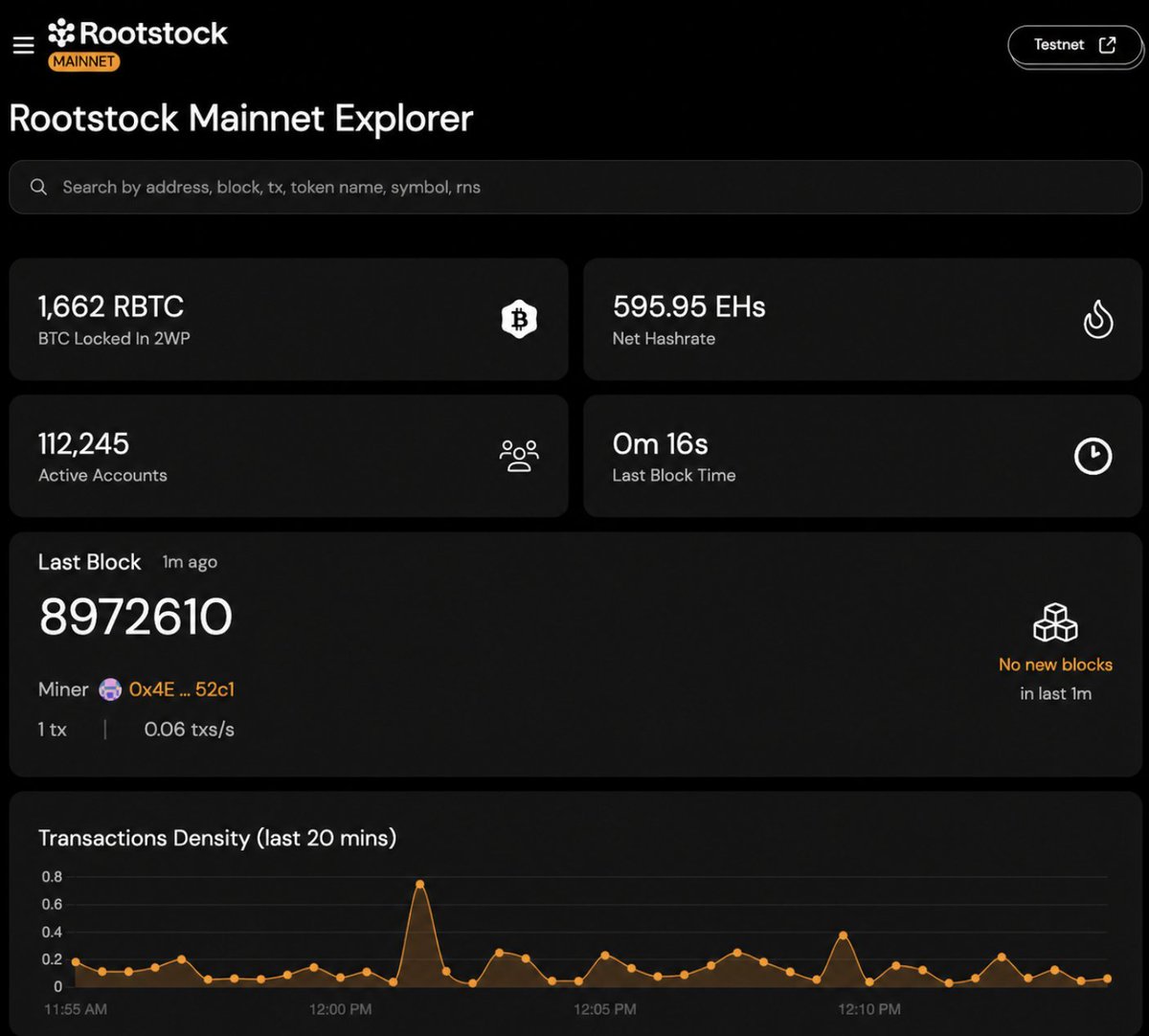
More updates to the Rootstock Explorer this month.
🔗 https://t.co/DZzdcLTq5z
The latest one makes transaction activity more human-readable, search results clearer, and contract workflows smoother.
Details in the thread 🧵👇
Using BTCFi shouldn't mean leaving Bitcoin's security behind.
Rootstock is merge-mined with $BTC, with over 84% of Bitcoin's computing power securing the network.
rBTC is now easier to recognize for what it really is: Bitcoin on Rootstock.
Not a separate asset, not a new token. $BTC, working across smart contracts, lending, payments, and on-chain capital markets.
The logo changed, not the functionality.
https://t.co/08ob1fLS8w
As institutions move beyond simply holding Bitcoin, one question gets bigger.
How can $BTC be used productively without compromising on security, transparency, or trust assumptions?
🔗 https://t.co/HpjnVkoCz4
Join us on 14 July for a webinar with industry experts.
We’ll cover Bitcoin-backed financing, treasury trade-offs, and real-world liquidity planning for Bitcoin-native companies.
What happens when $BTC stops being just a treasury asset and starts becoming part of how debt itself is structured?
This was the crux of the latest piece from Tony Dicarlo, Director GTM Liquidity at RootstocLabs:
🔗 https://t.co/Xmrd2Yj9p3
At @BTCPrague, Tony observed the same pattern across Digital Asset Treasury companies: raise capital through dollar-denominated liabilities, hold Bitcoin as the backing asset, and let the long-term divergence between the two do the work.
His framing is simple:
• Issue liabilities in a depreciating asset.
• Hold an appreciating, fixed-supply asset.
• Let the spread compound over time.
That has obvious relevance for Bitcoin treasury companies. But the more interesting question is where this goes next.
Mortgages, insurance float, corporate debt, sovereign balance sheets.
These are not fringe markets. They are some of the largest financial structures in the world. And if Bitcoin can become productive collateral inside them, the conversation moves beyond “who is buying BTC?” into “how does Bitcoin reshape credit?”
This is also where Bitcoin-secured finance becomes important.
For Bitcoin to sit inside real financial products, institutions need more than exposure. They need infrastructure that can support collateral, lending, stable assets, onchain execution, and settlement without moving away from Bitcoin’s security assumptions. That is the opportunity @rootstock_io has been building toward.
Bitcoin should not have to choose between being held and being used.
The next phase of Bitcoin-secured finance is about making Bitcoin productive while keeping it anchored to the network that made it credible in the first place.
RSKj Vetiver 9.0.3 is out.
A patch release fixing the trace_transaction and trace_block JSON-RPC methods, with minor bug fixes and improved logging.
Not mandatory, but nodes relying on these tracing methods should update.
https://t.co/oHRKskflUi
Most stablecoins ask users to trust a centralised issuer and off-chain reserves.
@moneyonchainok took a different route: A dollar-pegged stablecoin backed by $BTC, governed by smart contracts, and built on Rootstock.
Learn more in the thread 👇🧵
Can you guess what topic made Javi say “minus bearish squared”? 🫢
@GoldenGatsby caught up with @JavierHermosa21 from @Braiins for a quick game of Bullish or Bearish at @BTCPrague.
Full video: https://t.co/0yG0Shj0kw
Bitcoiners will spend Bitcoin on coffee, beer, pizza, (weed), art, and apparently even an NBA referee bribe. Ask them when they last sold, though? That's when the confession wall gets interesting.
We put two simple questions on a wall at @BTCPrague and handed people markers. What's the last thing you bought with $BTC? When was the last time you sold?
The answers are worth a read. Pizza and beer. Coffee. Clothing. A water bottle. A magazine. Bitcoin art. A car. A donation. Weed.
"My freedom," some writes. For some people, Bitcoin isn't just something to trade. It's something that gives them access, choice, and control.
(And then there's the NBA ref bribe)
Then there was the sell side of the wall. "Never". "Last week". "NEVER". "💎 Hands".
That was the contrast. People had endless answers for what they bought. But when it came to selling, the answers got a lot simpler and narrower.
That's the point. Bitcoin is becoming something people use. It's still also something a lot of people really don't want to give up.
P.S. Two future Bitcoiners, hard at work.
Atlas, a single interface for moving $BTC and other assets into Rootstock.
🔗 https://t.co/tXSBhpt3ug
@Changelly_team is now live on Atlas, adding another simple route for users to move assets into @rootstock_io and access BTCFi.
🇦🇷☀️ ¡Buen feriado para todos!
Pasamos por acá para recordarles que mañana a las 10 hs tenemos una nueva edición de ¿Qué hacemos con los bitcoins? ⚡
🎙️ @manuferraritano recibe a @aeidelman para una charla imperdible sobre Bitcoin y mucho más.
🔔 Activá el recordatorio y no te lo pierdas. Nos vemos en vivo acá https://t.co/fvwaageO3d