my throat's been scratchy for two days, dang it
on top of that i havent finished:
- buying equipments
- writing lore
- setting up redeems and panels
- streamelements
zatsu as i waddle my way through allat sometime. not now. i will lose my voice.
my throat's been scratchy for two days, dang it
on top of that i havent finished:
- buying equipments
- writing lore
- setting up redeems and panels
- streamelements
zatsu as i waddle my way through allat sometime. not now. i will lose my voice.
The last train’s gone. The café’s still open.
I’m Ren Raku and I’m officially joining IRIAM as an Early Access Streamer.
Late-night conversations about life, philosophy, and whatever else keeps us awake.
The seat across from me is yours...
#JumpOnIRIAM#IRIAMEarlyAccess
I can feel you ..! The exasperation ...please don't get mad at me for nitpicking !! I'm very grateful for your work, ママ 🙇♂️
Before you get my ass for vagueposting I'm almost out of PD jail teehee.
I can feel you ..! The exasperation ...please don't get mad at me for nitpicking !! I'm very grateful for your work, ママ 🙇♂️
Before you get my ass for vagueposting I'm almost out of PD jail teehee.
There's a subset of people who can't tell the difference between an independent contractor and an employee, and where they differ in terms of the obligations a company has to them.
Which is fair, since people also use "salary", "wage" and "fee" interchangeably - when there are actually slight differences.
Just so everyone's on the same page:
Most corporate vtubers you know are independent contractors, NOT employees. They're paid fees from percentage cuts on stream revenue, merch and voice packs, appearance fees, collab licensing - and it goes up and down month to month.
So: not a salary, which is a fixed amount paid at fixed, regular intervals.
Some agencies might offer a minimum guarantee if the talent hits their minimum content output goals for the month - which is generally a goodwill thing offered when the talent hasn't hit sufficient monetization goals in the early months, more as a safety net. Given the independent contractor relationship, the agency isn't actually REQUIRED to do this.
This is the "[low] base salary" people are referring to with some early agency talents who have talked about it on their streams, and it's probably why people get confused about what talents are actually entitled to.
(Worth noting: in some cases, the minimum guarantee "salary" is a "draw" - as in, it's recoupable against future earnings. So it's an advance, not an income. I don't speak for Cover Corp, but I have seen this "recoup from future earnings" arrangement at some other agencies.)
Now - revenue sharing with an indie contractor only makes sense as a structure if both sides are actually putting something in, to give the VTuber IP its best chances of success. And usually, both parties are clear on expectations - or rather, who provides what.
The talent brings the performance, the hours, and usually the audience relationship/community building.
That last one is very much a talent contribution no matter how big or small the agency is, because more audience = more people who can be monetized from, so agencies and vtubers will obviously seek to grow that. A more known agency may provide an "initial fanbase" at debut so you're not entirely starting from zero, but it's still entirely on the talent to retain and further grow it.
The agency is supposed to bring the things a solo creator can't easily buy: back in the day, it was enough to provide just a model and rigging for it. But getting a VTuber model is a lot more accessible nowadays, so you've also got to consider things like production and music budgets, promo reach, management, event and sponsor access, sometimes training (singing, dancing, Japanese) or studio time.
That's what the agency cut is for. And under formal employment, a lot of that would attach automatically by law - more on that in a moment.
But under contractor status, the agency owes exactly what's in the contract and nothing else - which puts a LOT of weight on how well that contract was drafted, and how much leverage a debuting talent had to negotiate it at the time. Plenty of what gets promised lives in the recruitment ads, the interviews, the pitch meetings - rather than in the document.
And even then, the contracted stuff sometimes doesn't materialize - budgets shrink, staff turn over, companies overcommit across a whole wave and can't follow through.
On paper, yes - the talent is entitled to what's on the contract. In practice, enforcing it means one contractor going after an agency, often across borders...usually while still signed to them. (Side-eyeing you, microcorps.)
Now - about "employee status":
It's a lot more protected. In most countries, if you hire someone as an employee, you're required by law to pay and provide a bunch of things in a timely manner.
So that's things like fixed(!) salaries, overtime pay (if applicable), pensions, insurance, other statutory benefits - whether the employee brought in 2k or 20k in revenue. You also often have strict thresholds for things like termination or making someone redundant, especially in Japan. (Hooray for labor laws and protections!)
On top of that, a functional employer is also expected to give employees the means to do the job - so that's why things like equipment and courses can be, and often are, covered by companies.
But the minimum legal obligations aren't cheap. In Japan, employer-side social insurance contributions alone run roughly 15-16% on top of gross salary, and that's before you count anything else (equipment, training, anything discretionary.)
It's not a viable expense for many companies, especially when you're launching new VTuber IP (x4-5 batches of costs, given a wave size) - and you don't always know how soon it'll get monetized, how much it's going to rake in, how long that audience gravy train will last...well, that's kind of hard to justify in the budget for the performers - on top of the asset costs, and agency staff costs.
A former VTuber agency director once told me that "corpo vtubing is very much gacha - you release a bunch of IPs built together with a bunch of performers and staff, and you hope one of them catches on, and that the rising tide lifts all boats in the agency. There's no clear target dates or numbers for a return on your investment."
So it's understandable why agencies try to exercise that control over their performers, in order for their vision to be realized, for success and profit to roll in, yada yada. But they can only do so much, because well - independent contractor, not employee.
To be clear: independent contractor status isn't necessarily a "downgrade" for the talent. It's not really a choice either; it's the model basically every agency offers, so "choosing" it mostly means choosing to sign.
And most showbiz veterans can tell you that many areas in the entertainment business work this way: musicians live and die by revenue splits with their labels on album/streaming numbers, tour sales, brand deals etc.
(Different industries have various workarounds for the "not earning enough in the early days" issue. Kpop agencies defer this - they cover a LOT more costs upfront for things like training, food and housing, though it's usually recouped from earnings later. J-idols at the lower rungs do a lot of unglamorous dispatch work while their own IP isn't paying yet. All of these solutions have different trade-offs, but that's for a different analysis post.)
But there are also benefits to being an indie contractor on a revenue split: your upside isn't capped, so if you blow up, you're not on a fixed salary watching your agency bank the difference. (Keyword: "if" you blow up.)
So when people say "just pay them a proper salary," even if it's out of consideration for their oshis, they're not just describing a baseline - they're also describing a ceiling, and usually a shorter leash (without realizing it.)
And importantly, the exclusivity clause for VTuber performers typically binds professional conduct related to the performance identity and possible competition, not the whole person. Yes, you're generally exclusive as a VTuber talent, and yes, the persona is usually the agency's IP.
But without naming names, for obvious reasons: some of your corpo oshis still run their prior creator brands from before they went corpo, albeit usually on reduced schedules and changed scope/branding. Some other corpo oshis do paid work (illustration, for example) that's not performance-related under their other identities.
So yes, your oshi at the bigger agencies might be slammed - but generally, if you have the capacity for it, you CAN still have other income streams outside of your corpo vtubing gig. (Other than working a regular day job, that is.)
The tradeoff is real, though - and it's not the same tradeoff for everybody, which is why some people have expressed curiosity or concern on the whole "moving to Japan" uptick amongst corpo vtubing talent under JP agencies. (Even if yes, sometimes your oshi wants to move there just because they like the place.)
Contractor status doesn't produce one risk profile; you often get wildly different ones depending on where the talent physically lives. A Japan-based talent is on National Health Insurance and the national pension by default (mandated by law for all residents) - so the safety net under them exists, whether or not the agency built it.
European-based talents have similar fallbacks for health coverage. SEA-based talents who have mostly paying audiences from the west can make their money go further, so it's less about safety nets and more that the maths is in their favor.
But if you're in the US...well. Insurance has to be self-sourced if your employer doesn't cover it, and we know how infamous US healthcare costs are. Same contract, same agency - but completely different risk and exposure tiers.
That's why "does the agency cover medical/(insert benefit here)" is a question with all sorts of different correct answers, depending on who's asking it.
Also worth knowing, because it's recent and barely discussed: "not an employee" thankfully no longer means "no protections," at least in Japan.
The Freelance Act took effect in November 2024, and it requires all sorts of things:
- written contract terms upfront
- payment within 60 days of delivery
- no unilateral reduction of agreed remuneration
- 30 days' notice before termination or non-renewal on continuous contracts of six months or more (with reasons disclosed on request)
- actual harassment-prevention measures - which matters because freelancers were previously outside workplace harassment law entirely.
These are a direct answer to a lot of what I said earlier about promised things not materializing - well, at least on the parts that involve getting paid.
The stated government position is that these rules apply where all or part of the business activity is considered to be undertaken in Japan. How it will play out in practice for remote streaming talent outside of Japan, though - I can't tell yet.
But these protections are only for how your oshi gets treated by the company, not how much they actually bring in raw revenue. Nothing in here obliges a paying audience or a brand sponsor to show up.
Now there's also actually a hard boundary on how much control companies in general can exercise before the "independent contractor" classification is moot.
There have been MANY cases around the world where businesses got taken to court because they exercised too much control over an independent contractor, and courts ruled: no, you should be classifying them as an employee, and paying them a proper salary and benefits if you're going to demand this much.
(Whether you have the resources to take the business to court, though, is another story. Depending solely on the law to protect you can be slow and resource-heavy.)
In a nutshell:
Yes, the pay structure really is "just the way it is". This independent contractor structure is the model that corpo vtubing + the wider entertainment industry largely runs on - and for the most part, both talent and agency are aware of this when they enter into agreements.
Neither party chose a conventional or stable 9-5, so expecting corpo vtubing to behave like one - even for the bigger agency names - is where a lot of the "but my corpo oshi deserves a regular bag" arguments go to shit.
I can't speak for whether this business model is sustainable or not - your corpo oshi is an adult who made the choice to do it this way, and things can change with both audiences and brands/sponsors over time. But I don't think having "contractor status" as a talent is the actual risk here.
The main danger is getting into a bad deal, or one that disproportionately requires more time and money out of you than what you're getting back from the job - and in some cases, you end up having to pull the plug before your time + effort invested get a proper fighting chance to pay off.
Or as we've seen with many other now-dead agencies (Specialite EN, FSP JP)...your company just pulls the plug instead.
Issue is - as an individual performer, that's a good chunk of your time and lots of opportunity cost that's now sunk.
For the company? That's just a few gacha rolls that didn't work out.
#RAINArambles
The reason you're confused is justified because you can't ever know the 100% the truth of it, unless you're in it. No one will risk talking specifics too.
The reality is your support is worth more to your oshi than you think, and they're likely far more thankful for it than you think you deserve. Just enjoy and have fun!
A lot of sensationalism is going around this discourse (which is probably being driven by younger audiences), but as a professional unc who turned 31 this year, I think people just need to understand that, generally: employment is for benefits, contract work is for more freedom.
For example in America, the W-2 status is for an employee of a company. The company automatically withholds federal, state, and payroll taxes from every paycheck, so technically, the employee does take home less money than it officially says on the job salary. But in return, the employee receives corporate benefits like subsidized health insurance, retirement account matching, guaranteed PTO, and more. W-2 is just more about prioritizing stability and security for your job and life: you take home less money in the short term, but you win out by going slow and steady.
In contrast, the 1099 status classifies someone as an independent contractor. This person is still hired by a company, just on a fundamentally different basis. For one, they don't even get a salary: they invoice the company for their hours/work, and receive payment in return. This payment can be a lot or a little, depending on how much they work. Relative to the W-2 doing the same thing, the 1099 will have higher gross pay since they're not subjected to company withholding or benefits. But because of that, they will need to calculate and pay their own income taxes, find their own health insurance, and may not have the same protections if the company suddenly goes under, or if they get injured and are unable to work. But generally, they also have more autonomy with how they can do their job, and more financial leeway like the ability to file for more tax deductions, or contribute to retirement accounts more aggressively.
When I took my first attending job after residency, a lot of comments memed on my "employed physician" badge because it seems like the "unemployed physician" title would just be nonsense. But it's really just describing that I'm a W-2 employee of the hospital, rather than a 1099 contractor who is just taking shifts there. In reality, contracting is a very popular route for many doctors to take, and almost 25% do! Locum tenens work is hot everywhere, and 1099 physicians can usually negotiate anywhere from a 15% to 50% increase in salary from their W-2 counterparts. For hard workers willing to deal with the clerical side of it, play the tax sheltering game creatively, and accept the comparative financial risk, 1099 can be a very attractive option to make a ton of money.
The takeaway here is that employment does not necessarily mean that someone is cushy and rich, and independent contracting does not automatically mean that someone is living paycheck to paycheck. Employment vs. contracting are just two different ways for someone to get paid for what they do. Just from what I've noticed in the corporate vtuber scene, it is practically industry-standard to hire talents as independent contractors. That doesn't necessarily mean that a company is keeping their talents in a basement and feeding them beans and toast. Obviously this doesn't apply to everyone, and especially since the person I'm QRTing is part of a Japanese company (which has already been making headlines for their recent decisions), so I encourage everyone to do more research into their own country's labor compensation structure and how benefits are assigned.
Well, yes ! Being a VTuber isn't all about streaming, regardless of that being what's mainly done. Videos/clips give audiences a reason to stay, look more into you and eventually hook onto your streams. They are vital tools for discovery, and that holds true in many cases.
After hearing what Tavi said about how his videos bring him more growth than his shorts or streams ever did, I wonder if vtubers in general should make more videos than just streaming?
Then again, I am no content creator, so I wouldn't really know what goes behind the scenes.
Of course you do earn from merch too but yeah, the salary thing can be very different for other agencies,,, you MIGHT have that or no, since "contractor" is the keyword in most cases.
I'm trying to be tentative with my usage of words here, please correct me if I'm wrong. (3/3)
🧵 I can't comment on behalf of anyone because I'm indie (duh) but I can testify from what I've learnt of the industry.
When you join a VTuber agency, they take you on as contractors, not employees. So technically- (1/?)
💬: How much do you get paid per hour tho?
🔅: Nothing. You guys are the ones paying me
🔅: If there's good in your heart you guys are the ones super chatting me
🔅: I could easily make $1000/h or I could easily make nothing
🔅: I don't have a salary
🔅: I depend 100% on you guys
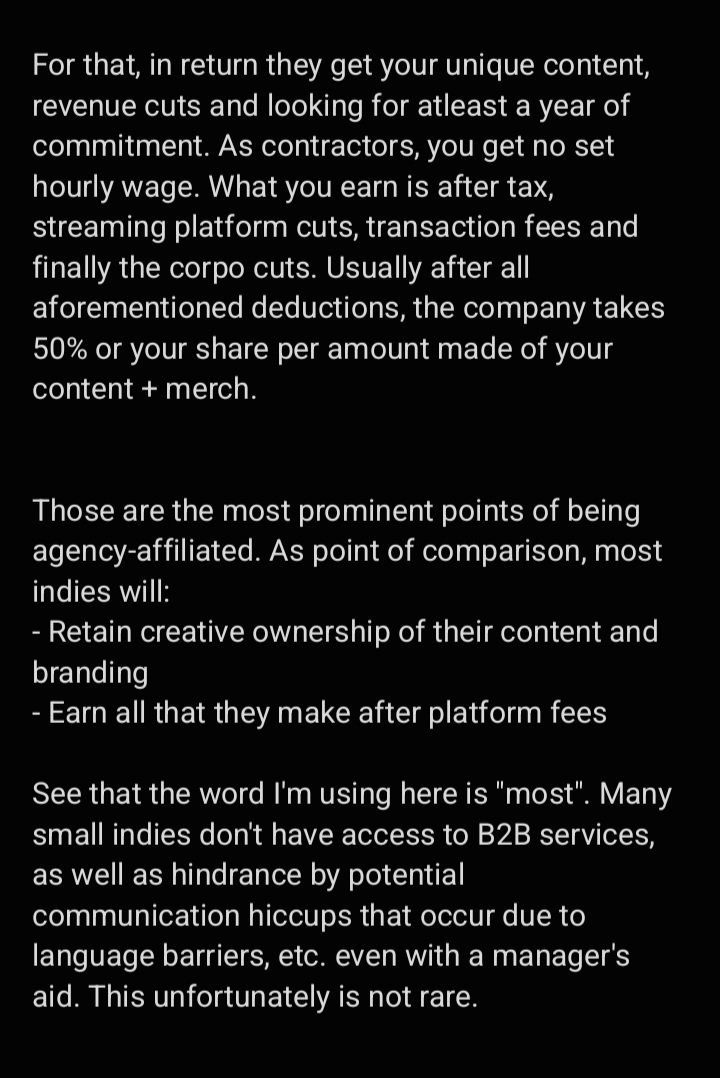
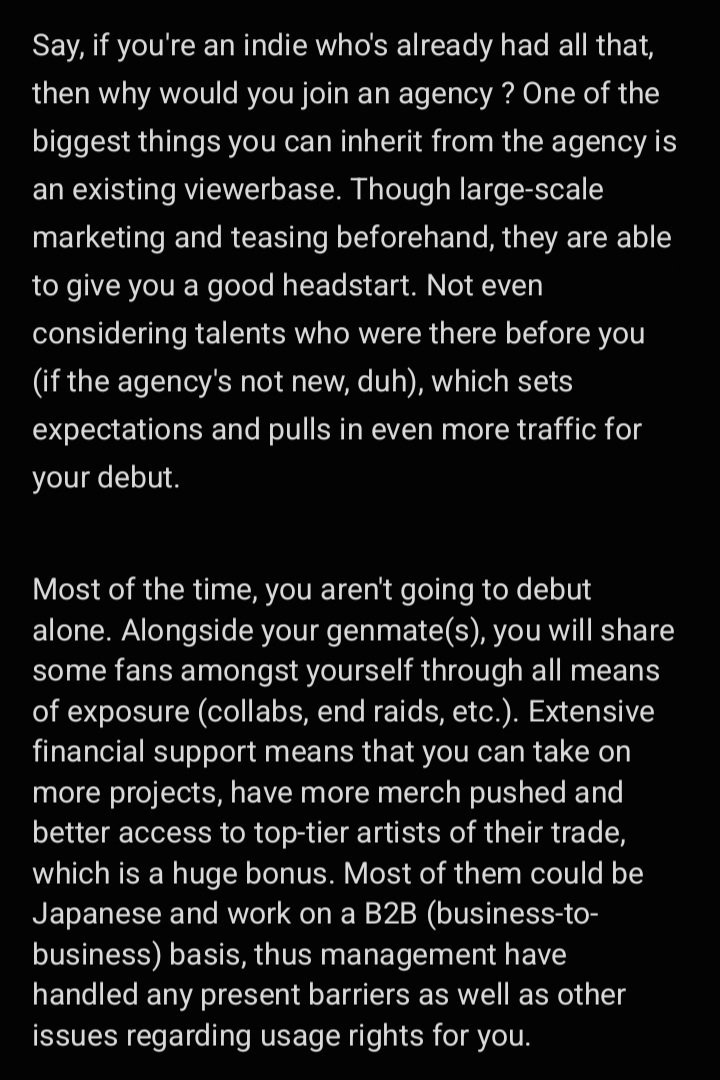
- you earn from whatever you make. About the pay cuts, putting aside platform deductions, companies'd also take some since the character you are playing is theirs. The IP is theirs. That also goes for all the content that you put out, none of that is truly yours. (2/?)








![RAINAplease's tweet photo. There's a subset of people who can't tell the difference between an independent contractor and an employee, and where they differ in terms of the obligations a company has to them.
Which is fair, since people also use "salary", "wage" and "fee" interchangeably - when there are actually slight differences.
Just so everyone's on the same page:
Most corporate vtubers you know are independent contractors, NOT employees. They're paid fees from percentage cuts on stream revenue, merch and voice packs, appearance fees, collab licensing - and it goes up and down month to month.
So: not a salary, which is a fixed amount paid at fixed, regular intervals.
Some agencies might offer a minimum guarantee if the talent hits their minimum content output goals for the month - which is generally a goodwill thing offered when the talent hasn't hit sufficient monetization goals in the early months, more as a safety net. Given the independent contractor relationship, the agency isn't actually REQUIRED to do this.
This is the "[low] base salary" people are referring to with some early agency talents who have talked about it on their streams, and it's probably why people get confused about what talents are actually entitled to.
(Worth noting: in some cases, the minimum guarantee "salary" is a "draw" - as in, it's recoupable against future earnings. So it's an advance, not an income. I don't speak for Cover Corp, but I have seen this "recoup from future earnings" arrangement at some other agencies.)
Now - revenue sharing with an indie contractor only makes sense as a structure if both sides are actually putting something in, to give the VTuber IP its best chances of success. And usually, both parties are clear on expectations - or rather, who provides what.
The talent brings the performance, the hours, and usually the audience relationship/community building.
That last one is very much a talent contribution no matter how big or small the agency is, because more audience = more people who can be monetized from, so agencies and vtubers will obviously seek to grow that. A more known agency may provide an "initial fanbase" at debut so you're not entirely starting from zero, but it's still entirely on the talent to retain and further grow it.
The agency is supposed to bring the things a solo creator can't easily buy: back in the day, it was enough to provide just a model and rigging for it. But getting a VTuber model is a lot more accessible nowadays, so you've also got to consider things like production and music budgets, promo reach, management, event and sponsor access, sometimes training (singing, dancing, Japanese) or studio time.
That's what the agency cut is for. And under formal employment, a lot of that would attach automatically by law - more on that in a moment.
But under contractor status, the agency owes exactly what's in the contract and nothing else - which puts a LOT of weight on how well that contract was drafted, and how much leverage a debuting talent had to negotiate it at the time. Plenty of what gets promised lives in the recruitment ads, the interviews, the pitch meetings - rather than in the document.
And even then, the contracted stuff sometimes doesn't materialize - budgets shrink, staff turn over, companies overcommit across a whole wave and can't follow through.
On paper, yes - the talent is entitled to what's on the contract. In practice, enforcing it means one contractor going after an agency, often across borders...usually while still signed to them. (Side-eyeing you, microcorps.)
Now - about "employee status":
It's a lot more protected. In most countries, if you hire someone as an employee, you're required by law to pay and provide a bunch of things in a timely manner.
So that's things like fixed(!) salaries, overtime pay (if applicable), pensions, insurance, other statutory benefits - whether the employee brought in 2k or 20k in revenue. You also often have strict thresholds for things like termination or making someone redundant, especially in Japan. (Hooray for labor laws and protections!)
On top of that, a functional employer is also expected to give employees the means to do the job - so that's why things like equipment and courses can be, and often are, covered by companies.
But the minimum legal obligations aren't cheap. In Japan, employer-side social insurance contributions alone run roughly 15-16% on top of gross salary, and that's before you count anything else (equipment, training, anything discretionary.)
It's not a viable expense for many companies, especially when you're launching new VTuber IP (x4-5 batches of costs, given a wave size) - and you don't always know how soon it'll get monetized, how much it's going to rake in, how long that audience gravy train will last...well, that's kind of hard to justify in the budget for the performers - on top of the asset costs, and agency staff costs.
A former VTuber agency director once told me that "corpo vtubing is very much gacha - you release a bunch of IPs built together with a bunch of performers and staff, and you hope one of them catches on, and that the rising tide lifts all boats in the agency. There's no clear target dates or numbers for a return on your investment."
So it's understandable why agencies try to exercise that control over their performers, in order for their vision to be realized, for success and profit to roll in, yada yada. But they can only do so much, because well - independent contractor, not employee.
To be clear: independent contractor status isn't necessarily a "downgrade" for the talent. It's not really a choice either; it's the model basically every agency offers, so "choosing" it mostly means choosing to sign.
And most showbiz veterans can tell you that many areas in the entertainment business work this way: musicians live and die by revenue splits with their labels on album/streaming numbers, tour sales, brand deals etc.
(Different industries have various workarounds for the "not earning enough in the early days" issue. Kpop agencies defer this - they cover a LOT more costs upfront for things like training, food and housing, though it's usually recouped from earnings later. J-idols at the lower rungs do a lot of unglamorous dispatch work while their own IP isn't paying yet. All of these solutions have different trade-offs, but that's for a different analysis post.)
But there are also benefits to being an indie contractor on a revenue split: your upside isn't capped, so if you blow up, you're not on a fixed salary watching your agency bank the difference. (Keyword: "if" you blow up.)
So when people say "just pay them a proper salary," even if it's out of consideration for their oshis, they're not just describing a baseline - they're also describing a ceiling, and usually a shorter leash (without realizing it.)
And importantly, the exclusivity clause for VTuber performers typically binds professional conduct related to the performance identity and possible competition, not the whole person. Yes, you're generally exclusive as a VTuber talent, and yes, the persona is usually the agency's IP.
But without naming names, for obvious reasons: some of your corpo oshis still run their prior creator brands from before they went corpo, albeit usually on reduced schedules and changed scope/branding. Some other corpo oshis do paid work (illustration, for example) that's not performance-related under their other identities.
So yes, your oshi at the bigger agencies might be slammed - but generally, if you have the capacity for it, you CAN still have other income streams outside of your corpo vtubing gig. (Other than working a regular day job, that is.)
The tradeoff is real, though - and it's not the same tradeoff for everybody, which is why some people have expressed curiosity or concern on the whole "moving to Japan" uptick amongst corpo vtubing talent under JP agencies. (Even if yes, sometimes your oshi wants to move there just because they like the place.)
Contractor status doesn't produce one risk profile; you often get wildly different ones depending on where the talent physically lives. A Japan-based talent is on National Health Insurance and the national pension by default (mandated by law for all residents) - so the safety net under them exists, whether or not the agency built it.
European-based talents have similar fallbacks for health coverage. SEA-based talents who have mostly paying audiences from the west can make their money go further, so it's less about safety nets and more that the maths is in their favor.
But if you're in the US...well. Insurance has to be self-sourced if your employer doesn't cover it, and we know how infamous US healthcare costs are. Same contract, same agency - but completely different risk and exposure tiers.
That's why "does the agency cover medical/(insert benefit here)" is a question with all sorts of different correct answers, depending on who's asking it.
Also worth knowing, because it's recent and barely discussed: "not an employee" thankfully no longer means "no protections," at least in Japan.
The Freelance Act took effect in November 2024, and it requires all sorts of things:
- written contract terms upfront
- payment within 60 days of delivery
- no unilateral reduction of agreed remuneration
- 30 days' notice before termination or non-renewal on continuous contracts of six months or more (with reasons disclosed on request)
- actual harassment-prevention measures - which matters because freelancers were previously outside workplace harassment law entirely.
These are a direct answer to a lot of what I said earlier about promised things not materializing - well, at least on the parts that involve getting paid.
The stated government position is that these rules apply where all or part of the business activity is considered to be undertaken in Japan. How it will play out in practice for remote streaming talent outside of Japan, though - I can't tell yet.
But these protections are only for how your oshi gets treated by the company, not how much they actually bring in raw revenue. Nothing in here obliges a paying audience or a brand sponsor to show up.
Now there's also actually a hard boundary on how much control companies in general can exercise before the "independent contractor" classification is moot.
There have been MANY cases around the world where businesses got taken to court because they exercised too much control over an independent contractor, and courts ruled: no, you should be classifying them as an employee, and paying them a proper salary and benefits if you're going to demand this much.
(Whether you have the resources to take the business to court, though, is another story. Depending solely on the law to protect you can be slow and resource-heavy.)
In a nutshell:
Yes, the pay structure really is "just the way it is". This independent contractor structure is the model that corpo vtubing + the wider entertainment industry largely runs on - and for the most part, both talent and agency are aware of this when they enter into agreements.
Neither party chose a conventional or stable 9-5, so expecting corpo vtubing to behave like one - even for the bigger agency names - is where a lot of the "but my corpo oshi deserves a regular bag" arguments go to shit.
I can't speak for whether this business model is sustainable or not - your corpo oshi is an adult who made the choice to do it this way, and things can change with both audiences and brands/sponsors over time. But I don't think having "contractor status" as a talent is the actual risk here.
The main danger is getting into a bad deal, or one that disproportionately requires more time and money out of you than what you're getting back from the job - and in some cases, you end up having to pull the plug before your time + effort invested get a proper fighting chance to pay off.
Or as we've seen with many other now-dead agencies (Specialite EN, FSP JP)...your company just pulls the plug instead.
Issue is - as an individual performer, that's a good chunk of your time and lots of opportunity cost that's now sunk.
For the company? That's just a few gacha rolls that didn't work out.
#RAINArambles](https://pbs.twimg.com/media/HR2MbJlbcAEXL2B.jpg)