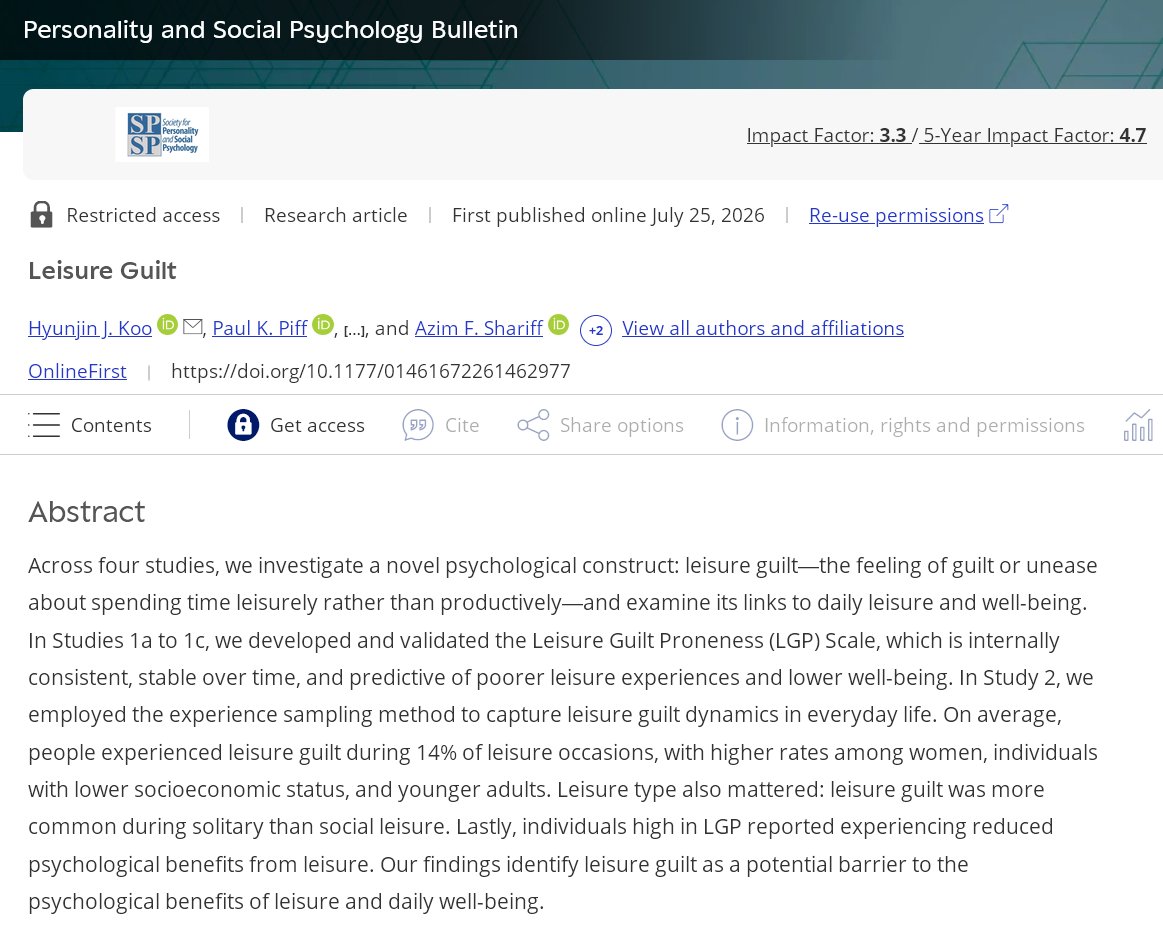
We squander too much of our free time feeling guilty that we’re not working.
In 1 of every 7 moments of fun and relaxation, people feel bad that they're not being “productive”—robbing themselves of joy and rejuvenation.
Leisure is not a bug. It’s a feature of a good life.
Only following people who agree with you is a recipe for confirmation bias and groupthink.
Critical thinking depends on listening to people who question your assumptions and challenge your conclusions.
Learning is the product of engaging with a range of thoughtful views.
It’s wonderful to deep-dive into understanding the prayers of the Rosary in small portions every day. Mil gracias por la oportunidad de aprender a rezar El Rosario poco a poco, Fr. Mark-Mary @AscensionPress
If you've been listening to Rosary in a Year, you may have heard Fr. Mark-Mary sign off each day with this short phrase:
"Poco a Poco"
This phrase, which means "little by little," is one that he's been using for many years in his ministry. He shared its deeper meaning in this throwback video.
Two simple rules:
1. You get better at what you practice.
2. Everything is practice.
Look around and you may be surprised by what people are “practicing" each day. If you consider each moment a repetition, what are most people training for all day long?
Many people are practicing getting mad on social media. Others are practicing the fine art of noticing how they have been wronged. Still more have mastered the craft of making plans (but never following through).
But, of course, it doesn't have to be that way.
What are you practicing?
Felicidad es hablarle a alguien de su luz aunque en ese momento vea todo oscuro, porque en algún momento recordarás cómo volver a encenderla.
Libro: Estrellada
Autor: Cinwololo
#cementeriodelibros
Deja a tus padres envejecer con el mismo amor con el que ellos te dejaron crecer; déjalos hablar y contar repetidas veces las mismas historias con la misma paciencia e interés con los que ellos escucharon las tuyas cuando eras niño; déjalos tener la razón, como tantas veces
On Hats, Haircuts, and Tattoos
I think about decisions in three ways: hats, haircuts, and tattoos.
Most decisions are like hats. Try one and if you don't like it, put it back and try another. The cost of a mistake is low, so move quickly and try a bunch of hats.
Some decisions are like haircuts. You can fix a bad one, but it won't be quick and you might feel foolish for awhile. That said, don't be scared of a bad haircut. Trying something new is usually a risk worth taking. If it doesn't work out, by this time next year you will have moved on and so will everyone else.
A few decisions are like tattoos. Once you make them, you have to live with them. Some mistakes are irreversible. Maybe you’ll move on for a moment, but then you'll glance in the mirror and be reminded of that choice all over again. Even years later, the decision leaves a mark. When you're dealing with an irreversible choice, move slowly and think carefully.
From: https://t.co/DqKzvbgOAK
(Hat tip to @tferriss, who once compared making decisions to choosing a sweater, which sent me down this line of thinking.)
"Probablemente de todos nuestros sentimientos el único que no es verdaderamente nuestro es la esperanza. La esperanza le pertenece a la vida, es la vida misma defendiéndose".
"Rayuela", Julio Cortázar
📷Herri Susanto
“Cosas que me llenan el alma:
El mar, el amor propio,la paz mental, mis amigas,
los animales, las personas simpáticas…”
Autor: Cristian Llorens
#cementeriodelibros
I think about this twice a day.
Every morning when I sit down to read & then when I sit down to write, I say to myself,
"Accept the initial agitation."
When you try to focus, Andrew Huberman explains, "the brain circuits that turn on first are of the stress system."
Meaning:
"The agitation and stress that you feel at the beginning of something—when you're trying to lean into it and you can't focus—is just a recognized gate.
You have to pass through that gate to get to the focus component."
There's a common misconception, Huberman continues,
"The misunderstanding around how certain brain circuits work has led to this idea that there's some secret entry point—maybe marked 'flow' on the door—and there's a trampoline up to that door, and you just open that door, and you're immediately in [a deep state of focus].
And nothing could be further from the truth."
The truth is:
"There is a gate of entry. You have to wade through some sewage before you can swim in clear water. That's the way I always think about it."
I once told Andrew that I say to myself, "accept the initial agitation," every time I sit down to read or write, and he said, "the agitation is indeed the doorway to the whole process."
- - -
The clip below is from Andrew's 2020 interview on Rich Roll's podcast (https://t.co/HqdLeNLrmU)
It's easy to find ways to improve when you are genuinely curious about something. Rather than asking yourself, "How can I be better at this?" start by asking, "How can I be more curious about this?"
The gift of a beginner is fresh eyes.
The longer you're in a field, the harder it is to perceive new truths. Your mind is biased toward refining what you're already doing instead of exploring fresh terrain.
Take your expertise and apply it to something new.