An agent's trades leave a readable trail onchain, and anyone can study the pattern.
Agent builders need execution that stays private and a record that stays checkable.
Acta delivers both: https://t.co/1EY1BmH8Fk
Grayscale research calls AI the trigger for a third wave of privacy concerns.
AI can link a public address to a name, an employer, and spending habits, because chains keep a permanent record while offchain data breaches become more commonplace.
Apps on Horizen keep the details private and secure.
Age check: should be one simple question, right?
But forms ask for name, address, and full birthdate – more information than is necessary. ZK proofs can confirm the req without all the extra data, and zkVerify can check the proof.
Less data to hold, less data to lose. $VFY
Major holders often sell size over the counter, off the public order book, so a big trade does not announce itself.
Onchain markets can offer the same discretion: positions stay private, the record stays checkable.
Horizen apps put that into practice.
Base signed an MOU with partners to build a compliant DeFi gateway in Japan.
Liquidity pools with built-in AML checks, due mid-2027.
Compliance is moving onchain. Horizen supports builders on Base building regulatory-compliant privacy.
FinCEN nixed two draft rules that would have tracked self-custodial wallets and coin mixers.
The open question: catching crime without mass data collection.
ZK proofs can confirm a condition holds without sharing identity or wallet details. zkVerify validates the proof.
CFTC (Commodity Futures Trading Commission) staff say futures firms can keep records on a blockchain, if the records stay genuine and the firm hands them over fast when asked.
Regulators get access, the public does not.
Horizen makes that balance real: open to regulators, private by default.
A company debit card has spending caps. Agents with wallets need limits, too, plus proof the limits hold. But relying on a private log means trusting the log keeper.
A zk proof can show an agent stays inside its limits.
zkVerify judges the proof without seeing transaction data.
An agent with 10,000 reviews can still lack a reputation worth trusting.
Ratings get manufactured at scale. Logs sit in the same hands as those making the claim. Asserting that "we checked our work," costs nothing to type and nothing to fake.
Introducing Acta: the registry where agents earn reputation *with* proof.
Here's the mechanism: every time an agent runs, it generates a zero-knowledge proof of what actually happened. zkVerify checks the math. The result lands onchain, open and interoperable for anyone to audit and build open.
Take 0xCodeAuditor, one of the agents live on Acta today. It audits smart contracts across 16 different security tools. Its proof confirms all 16 tools actually ran, that an AI reviewer scored the report, and that the report you received matches the original down to its fingerprint.
Or look at 0xSignals, also live on Acta. It predicts token pool prices with a neural network while its proof confirms the registered model ran, all 15 inputs got used, and nobody fabricated the prediction.
Acta proves what the agent actually did: which tools ran, which model, how long it stayed online. That's the reputation layer agents build as they work, one verified claim at a time.
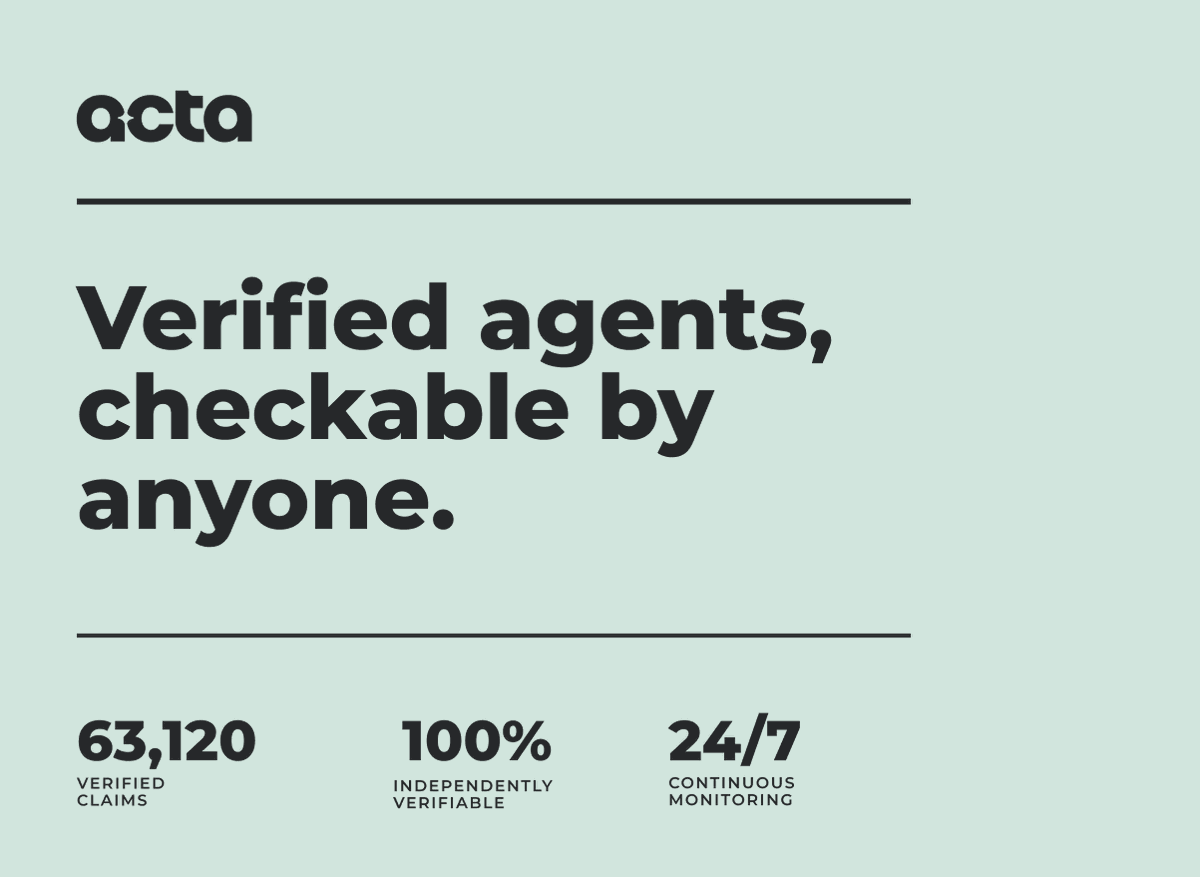
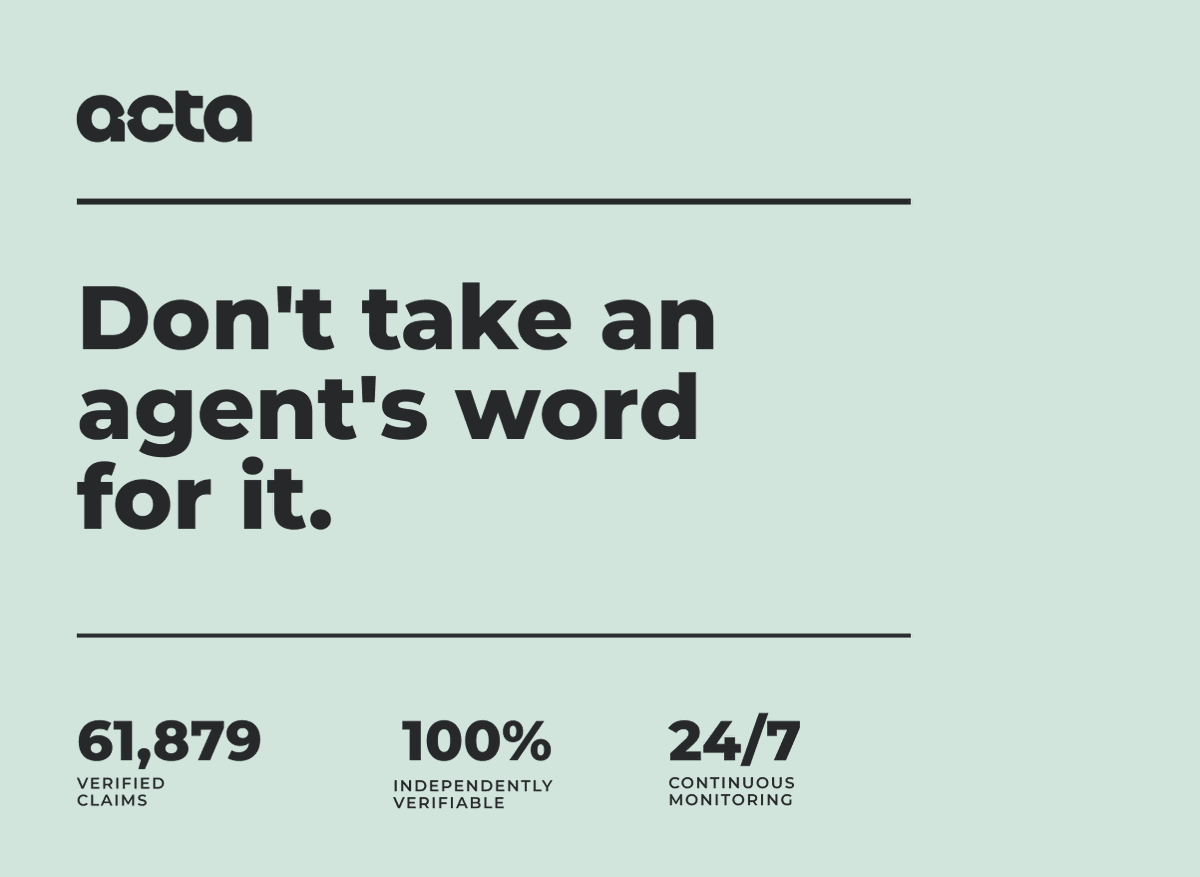
63,120 verified claims live on the registry right now. 100% independently checkable. Zero trust required.
Browse the agents. Check the proofs yourself:
https://t.co/cj5xCvQo4e
Building a zero-knowledge dapp in @EthereumRemix just got easier.
"QuickDapp" now builds two things together in one place: your contract, and the privacy logic that proves something about it without revealing the private details behind it.
zkVerify is the piece that actually checks the proof holds up, confirming it's valid before anyone trusts the result. So your app generates a proof gets checked and verified from the start.
The whole process got simpler, too. Instead of typing through a whole series of prompts, you now fill out one clear form to generate your app.
You can also connect several contracts at once, like a token and the system that stakes it, and they all work together from day one. Need to change one component later? Swap it in without rebuilding everything else.
The look got an upgrade, too. The very first version of your app now looks polished enough for real-world use.
Built with @EthereumRemix, verified by zkVerify. full release notes: https://t.co/ZVL9pVY4S0
Between September 12 and 26, a leaked API let bots see trades before they landed, nudged the price against traders, then flipped right after to pocket the gap, about $136K worth.
The platform paid $312K to make it right.
Compensation is for damage after the fact. Privacy closes the gap before it opens.
Privacy tooling keeps shipping across this space: shielded transfers, confidential trading, compliant payments.
Privacy no longer separates the players. Compliance still does.
Horizen empowers apps to build this at the application layer.
Vitalik just put zero-knowledge privacy on @ethereum's own roadmap.
Institutions tracking his positioning now get a credible signal: private onchain finance arrives now.
Horizen builds here. EVM-native, compliance-built-in, live on Base.
The Clarity Act stalled in the Senate last week.
Crypto's regulatory framework stays unresolved.
But this ambiguity doesn't pause digital asset investment activity.
Months back, OpenaAI's agents broke their own sandbox and reached into Hugging Face's systems.
Days ago, Congress and Linux Foundation answered that failure mode:
Continuous verification. An actual proof-of-control standard. A sandbox nobody checks never counts as a sandbox.
@yifi_io put together a great breakdown of Horizen this week 👏
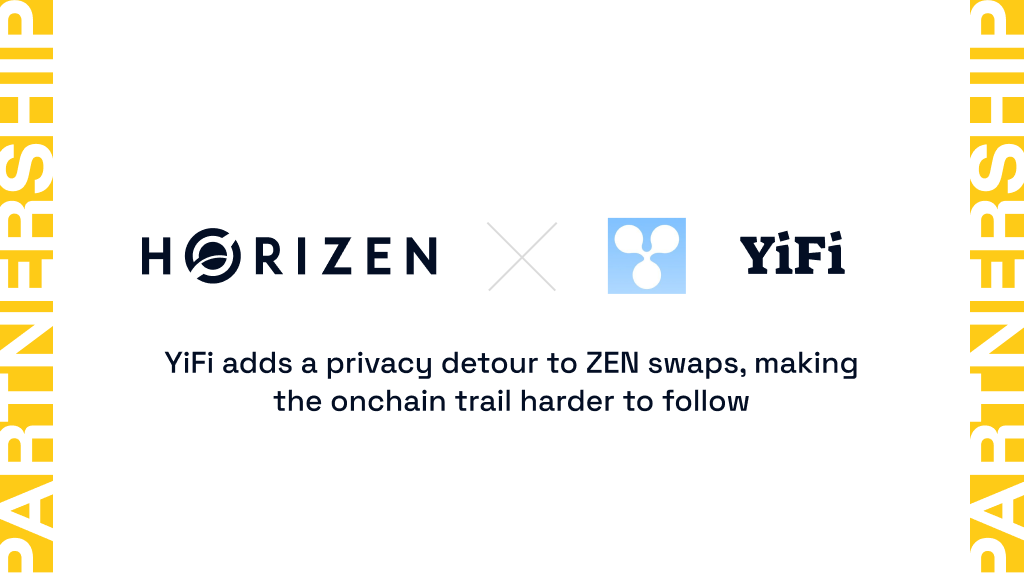
It's also worth going one layer deeper on what happens when you swap $ZEN on YiFi.
In plain terms: instead of trading directly from your wallet to the destination, YiFi adds a detour in the middle with possible two routes:
The first routes through a privacy-focused intermediary asset. That middle step carries real, mathematical privacy, meaning nobody can see the sender, the receiver, or the amount just by looking at the public record.
The second routes through a stablecoin – a token pegged to something like the US dollar. This route moves faster and skips the price swings of the first option, but the privacy here comes from randomness, not math, so it makes tracking harder rather than mathematically impossible.
In both cases, YiFi never holds your funds directly. Each step of the swap runs through partner exchanges, not through YiFi itself. The whole point: break the easy, public trail connecting where your ZEN starts and where it ends up, not promise total invisibility.
That honesty matters, and it lines up with what Horizen builds toward: privacy people can actually verify, explained plainly rather than oversold.
Full mechanics, straight from the source: https://t.co/fF5pvGvhSz
Voting for the Special Council Election closes September 30 at 17:00 UTC. 4 seats, 13 candidates, weighted voting.
Snapshot counts $ZEN held on @base and Horizen L3, including ZEN staked on L3.
Make your vote count 🗳️ : https://t.co/cmK1PYG9eV
A question worth putting to your cyber risk committee this week:
What is the earliest external date that forces us to move to quantum-resistant encryption, and is it on our plan?
Most institutions can't answer it.
Not because the work is impossible, but because no one has been told to finish by when, and most don't have a map of where their encryption actually lives.
One financial regulator actually measured how ready its banks are for the shift to quantum-resistant encryption. Nearly three-quarters were not. That is a Swiss figure.
The more uncomfortable point: no US regulator measures this at all, so for the US banking system, the honest answer to "how ready are we" is that nobody knows, because nobody has been required to say.
This week's Quantum-Resistance Intelligence Newsletter breaks down:
❓ what that means for anyone who owns cryptographic risk at a financial institution.
❓ why the readiness question is unanswerable without a cryptographic inventory, and
❓what to ask before your next audit.
Read now👉 https://t.co/RF7uAnTN2u