$NVDA Groq 3 LPX is now in full production with $NBIS set to become the first AI cloud to deploy it.
The new inference stack pairs Rubin GPUs for heavy context processing with Groq 3 LPX for ultra-fast token generation giving Nebius a purpose-built architecture for faster agentic AI.
Love this question! I think execution is being priced in, but there’s another piece: scalability.
$RKLB and $ASTS have business models that can accelerate much faster than the more manufacturing-heavy space companies. Manufacturing can absolutely grow, but it tends to scale more linearly. Applications and services can scale exponentially once the infrastructure is in place. Yes they all look similar today because they are all manufacturing but the application layer is what will change ASTS and RKLB in 5 years.
All great companies, and this isn’t a knock on $RDW, $VOYG or $LUNR. But valuation isn’t just about what a company earns today, it’s about how big it can become and how quickly it can get there.
IMO that difference deserves a premium. NFA
@Fibonacci_TA $ASTS price action seemed pretty strong this week as compared to other names both in the space sector and in other sectors. The volume was also notably low when being sold. Bullish.
@Stevendiaz Totalmente de acuerdo. Aunque las compras de insiders suelen considerarse positivas, creo que hay que coger con pinzas el momento actual de la acción… compras de insiders ahora = no hay acuerdos firmados + fomo porque la empresa anuncie alguno de esos tres acuerdos “prometidos”.
Here’s how I’m going to play this for $AAOI
As soon as I can at 8 AM (2 AM in the US), I’m going to sell and watch from the sidelines
We’re sitting right at the $110 support level
If it breaks, there’s a massive gap down with no significant resistance levels all the way to $80
To be honest, it’s hard for me to believe the US market won't do its usual thing at the open and sell like crazy
Then again, dropping below $110 sounds crazy too, though I hope it does
It would be a generational buying opportunity
Since $KEEL is getting more attention lately, it’s worth sharing a great summary of how the company has and continues to develop.
I believe one partnership could take it to ATH in a few sessions. Two or three, while unlikely in 2026, maybe even all the way to $15 by year end.
I increased my position after the slight dip today after the top in $KEEL , and here is some reasoning on why for those who aren't familiar with $KEEL .
Many of you remember $BITF. The Canadian Bitcoin miner that traded between $1 and $6 for years while the crypto cycle did its thing.
That company no longer exists.
What replaced it is one of the most interesting AI infrastructure setups on the market and almost nobody has updated their thesis.
On April 1 2026 Bitfarms completed a full legal redomiciliation from Canada to the United States.
Reheadquartered in New York City. Rebranded as Keel Infrastructure. New ticker $KEEL on Nasdaq and TSX. 99.3% of shareholders voted yes.
The board voted unanimously. This was not a half measure. This was a complete corporate transformation approved by essentially everyone who touched it.
The name is not an accident. A keel is the foundational spine of a ship. Remove it and everything collapses.
Management chose that name deliberately because that is exactly what they are building. The irreplaceable foundation that AI compute platforms are built on top of.
Now let me tell you what this company actually is today.
The single most valuable asset in AI infrastructure right now is not GPUs. It is not software. It is secured power capacity in constrained markets.
Every hyperscaler on earth is in a desperate race to find power for their data centers. They are waiting years for grid connections. They are paying premiums nobody talked about two years ago. Whoever owns the power wins.
$KEEL owns the power.
2.2 gigawatts of development pipeline across North America. Let that number sink in. Not a vision board. Not a press release.
Actual secured power capacity with existing interconnections, qualified land, and established relationships with utilities in markets where new entrants simply cannot get access anymore.
The flagship sites are already real.
Panther Creek Pennsylvania. 350 megawatts.
Anchored in one of the most constrained data center markets on the east coast. Close proximity to major metropolitan demand. Existing power infrastructure. Zoning already secured. This is the site that KBW flagged as the primary valuation driver.
Sharon Pennsylvania. 110 megawatts. Additional Pennsylvania footprint in the same high-demand corridor.
Moses Lake Washington. 18 megawatts operational today. Cooler climate enabling free-cooling efficiencies that dramatically lower operating costs for high-density HPC workloads.
The balance sheet transformation is just as important as the asset base.
$520 million in total liquidity. Cash and Bitcoin combined. They repaid a $100 million Macquarie debt facility entirely and in full. Every restrictive covenant is gone.
The capital structure is now clean enough to pursue project-level financing with investment grade counterparties. That matters because the next phase of growth gets funded by the projects themselves not by diluting shareholders.
The team they are assembling is not a Bitcoin mining crew trying to pivot. These are infrastructure professionals.
New CFO hired with deep infrastructure finance experience. New board chair from the infrastructure world. Senior go-to-market and engineering hires across the organization.
Working with T5 on data center operations. Turner on construction. Corgan on design. WWT on technology integration. Vertiv on power and cooling infrastructure. These are the exact partners that the biggest hyperscalers use to build their own facilities.
And the revenue base is already there. $229 million in 2025 revenue up 72% year over year. Yes the Bitcoin mining business is being wound down through 2026.
That is intentional. Management is deliberately replacing cyclical crypto revenue with something that carries a completely different valuation multiple. Long term investment grade leases with hyperscalers that pay predictable recurring revenue for decades.
Lease talks are already underway under NDA.
Management confirmed it on the earnings call.
Here is the re-rating math that makes this interesting.
The market is currently pricing $KEEL near power-only valuations. It sees a money-losing miner in transition and is applying a discount accordingly.
But the comp set for what this company is becoming is not Bitcoin miners. It is data center REITs and infrastructure developers that trade at 20 to 30x EBITDA on long term contracted cash flows.
A single signed investment-grade lease with a hyperscaler changes the entire narrative overnight. Not gradually. Overnight.
The moment one of the major cloud providers signs a long term capacity agreement at Panther Creek or Sharon, Wall Street has to reprice this as an AI infrastructure landlord not a struggling miner.
KBW maintained a $3 price target with the stock trading well below that.
2026 is permits and lease signings. 2027 is first megawatts from new sites. 2028 and beyond is scale beyond 2 gigawatts.
The assets are real. The power is secured. The team is built. The capital structure is clean. The pivot is done.
$BITF holders who have not looked at $KEEL recently are looking at a completely different company than the one they remember.
$ASTS may be getting pulled deeper into the carriers satellite strategy after $T COO Jeff McElfresh publicly highlighted its FCC approval to test Grain Management’s 800 MHz spectrum.
The band matters because Grain’s 800 MHz sits next to AT&T and Verizon’s 850 MHz holdings making it a natural fit for broader carrier-backed D2D service.
What really stands out is McElfresh saying the progress “builds on our announced satellite-connectivity joint venture” which suggests AST’s testing could be tied directly to how that shared spectrum strategy comes together.
$KEEL supports @GovernorShapiro’s EO & Pennsylvania's new GRID Standards for responsible data center development - the way we've built at Panther Creek & Sharon from day one.
Permitting at both campuses stays on its existing timeline.
Read more: https://t.co/OIvAhOua1a
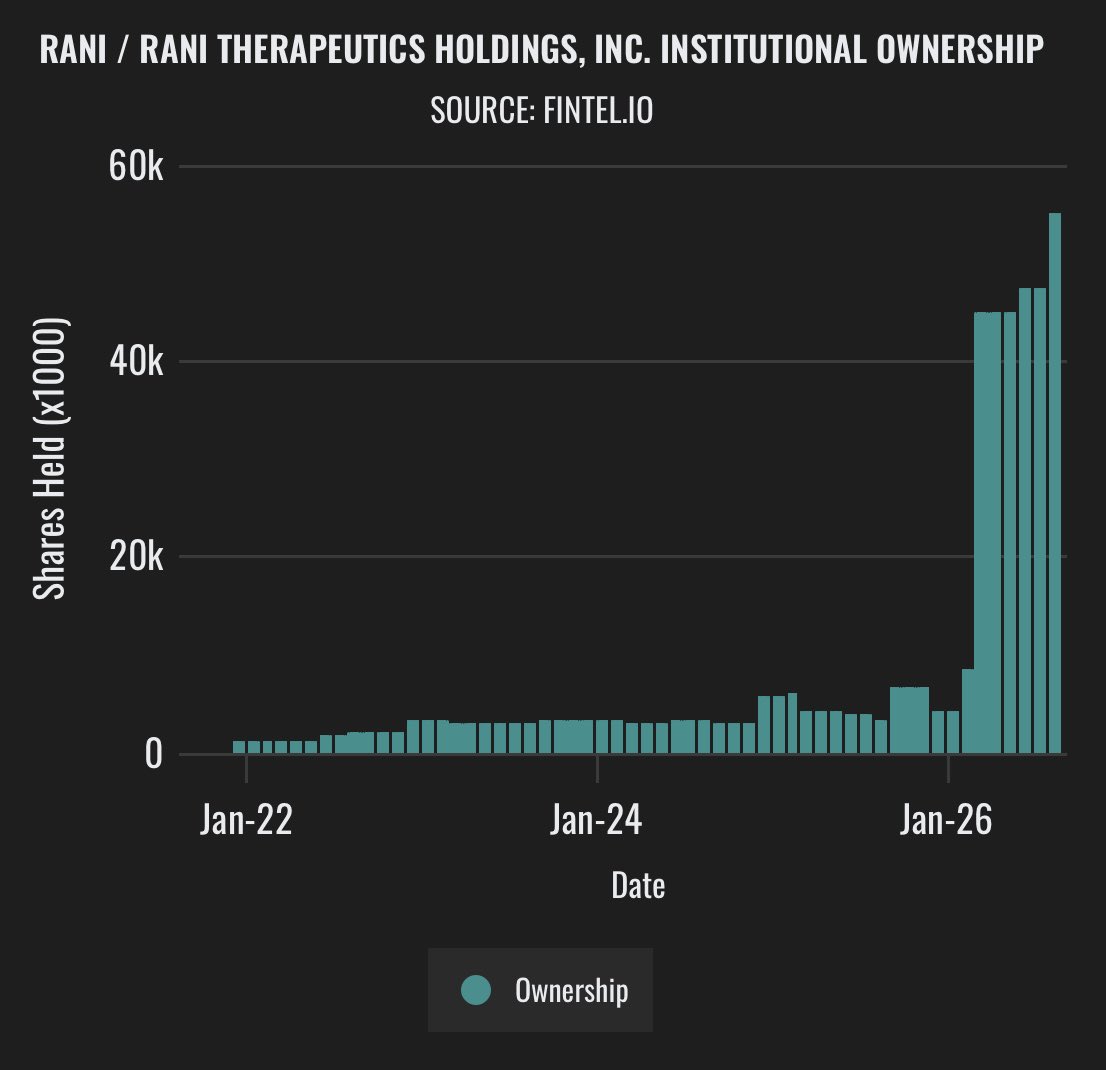
$RANI Rani Therapeutics - the company wants to turn injectables into pills. 2025-2026 brought external validation + positive clinical data, but also dilution.
RANI is betting its RaniPill capsule can deliver biologics (currently injected) orally with comparable bioavailability.
What's NOT so pretty: at least 4 dilutive rounds in 18 months+ no product revenue so far.
Upcoming months will be key: start of RT-114 Phase 1b; if Chugai exercises its option for additional targets; cash burn rate vs. stated runway ("at least through 2027").
NFA
$RANI Rani Therapeutics - the company wants to turn injectables into pills. 2025-2026 brought external validation + positive clinical data, but also dilution.
RANI is betting its RaniPill capsule can deliver biologics (currently injected) orally with comparable bioavailability.
The data point that actually matters (weight loss in obese patients) comes in phase 1b, expected to start by end of 2026.
Jul-2026: new agreement with PegBio to explore oral delivery of several metabolic/obesity candidates via RaniPill. Expands the pipeline, but it's optionality.
$AAOI at Rosenblatt Summit says it hopes to hit 20% market share, something no U.S. vendor has ever achieved.
Keynotes:
> Gross margins are expected to reach 40% by the end of 2027, with CPO laser chips capable of carrying margins above 60%. 800G and 1.6T revenue is currently rising and remains the main growth driver.
> U.S.-based production is becoming increasingly valuable to customers, who are willing to pay a premium and feel more secure given the China-related and broader political risks facing the semiconductor supply chain.
> Capital spending will remain heavy throughout 2026, tied directly to growth. If they don't keep investing, they risk becoming too small to stay competitive.
> Their lasers are comparable to, or better than, competitors like $LITE, $COHR, and $AVGO in design, especially at high power levels (300-400 mW). The main gap isn't technical capability but the ability to manufacture at scale.
> They're in active CPO discussions with five companies, some of which are also exploring NPO, and expect to have multiple CPO customers by 2028.
> Management is open to LTAs but is cautious since locking up too much capacity with one large customer could discourage other prospective customers from viewing AOI as an available resource, so any LTA needs to guarantee long-term profitability without sacrificing flexibility. Several are reportedly on the table, but none have been finalized yet.
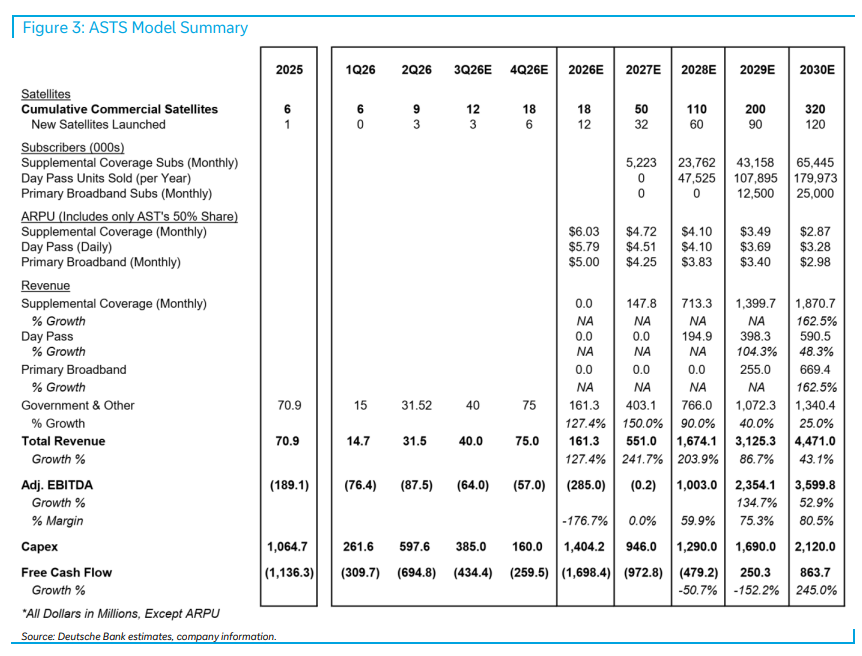
Deutsche Bank thinks $ASTS could scale into a massive global connectivity platform with the firm seeing supplemental coverage subscribers growing more than 12x to 65.4M by 2030.
That volumes being supported by 60+ MNO partners, nearly 50 gateways across five continents and government pipeline that already includes $100M of awards with management pointing to multiple multibillion-dollar opportunities beyond D2D.
The biggest constraint right now is launch availability rather than demand or manufacturing as satellite production ramps toward ~45 completed by February while Deutsche Bank models the constellation scaling to 320 cumulative satellites by 2030.
$DGXX earnings call was actually quite good.
To add Chinos post:
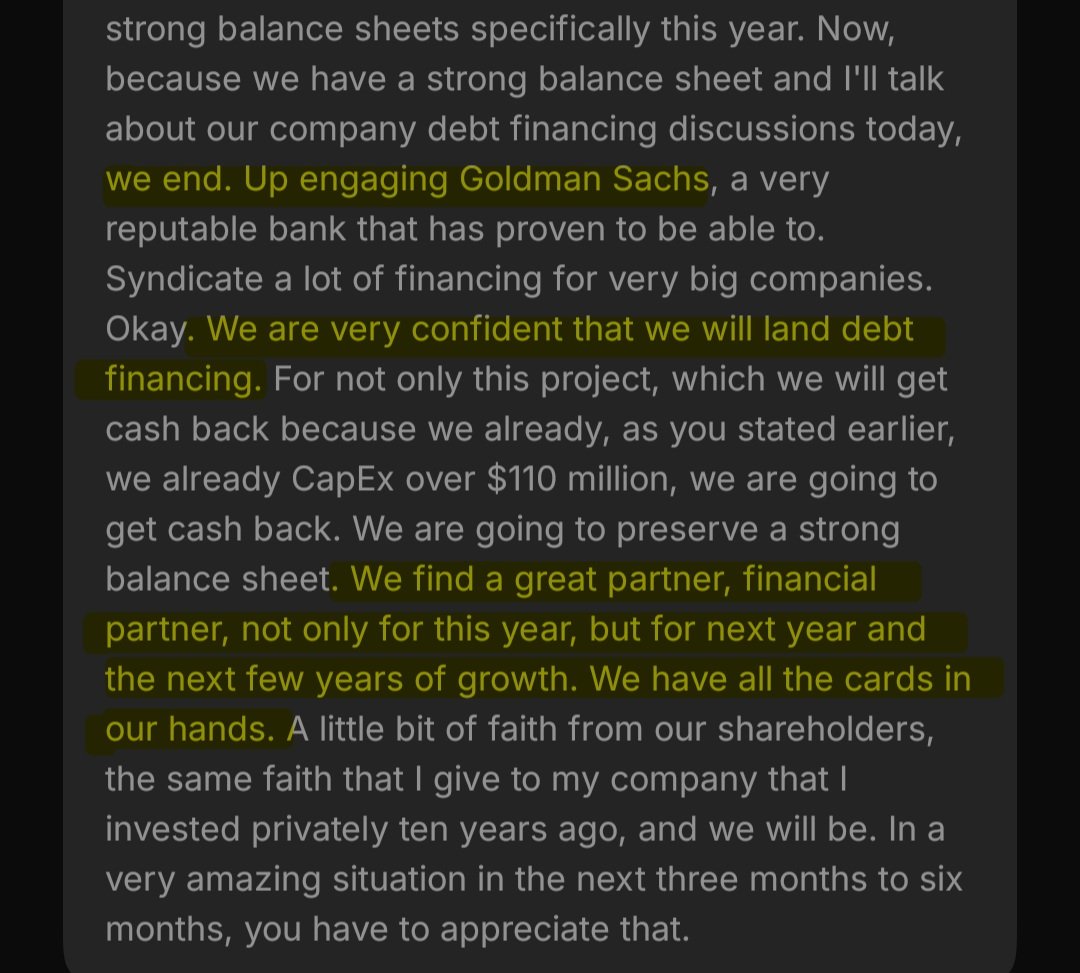
- Michel mentioned that DigiPower X is close of debt financing deal with Goldman Sachs to fuel growth.
- Last ATM draw was done mid $7 which is also welcome news.