Author question: is 50 Amazon reviews magic? I have been sitting at 49 in Canada
#bookreviews#authors
Threaten to Undo Us eBook : Seiler Scott, Rose,: https://t.co/ywdemHVgqE: Kindle Store https://t.co/Lg8Mi3JVNy
This is one of my favorite books of all time, and one I recommend to everyone who asks for a recommendation whenever I get the chance
It paints a beautiful picture of the very different world that used to exist, one where greatness was still prized more highly than equality and equity, and so men did great things
They built magnificent homes, gorgeous palaces, and immense empires. New men built businesses the scale of which had never been seen, and the old elite pushed high culture to its greatest flowering. Those who were talented could and did rise, and those who were incompetent quickly lost it all and fell away
It was a world of consequences good and bad, of rewards for excellence and punishment for falling behind
It was a world of pride and hauteur, but also of public faith and policy rooted in a deep and abiding belief in Christianity
It was a world before tax policy punished the competent for the benefit of the incompetent, a world before the disastrous equality of the present
And in this book, Emmerson shows what that world looked like, good and bad, and how it functioned
Such is the best way to jump into remembering that a different world used to exist
The more I read, the more I begin to suspect that great books are not born from plots, but from a single idea, simple enough to sound almost ridiculous and deep enough to contain an entire human life within it.
"The Odyssey" is a man who cannot get home for ten years.
"Don Quixote" is a man who fights windmills.
"The Magic Mountain" is a man who goes away for three weeks and stays for seven years.
And yet all of them are great books.
Because literature has never been the art of what happens.
It has always been the art of what what happens means.
One man is trying to return home.
One man is pursuing impossible ideals.
One man is late in leaving.
And somewhere between these seemingly insignificant events lies the entirety of human nature, with its hopes, illusions, fears, loves, ambitions, and its eternal inability to understand in time what is actually happening to it.
Perhaps that is why great books survive.
Because beneath all their plots they tell only one story.
The story of humanity.
We were absolutely floored by the millions of you that watched us make silly water sillouettes on our driveway last summer. We are starting out the summer the only way we know how, and this time it’s all about movies! What else do you want to see? We have a whole summer ahead, a driveway and a hose. The possibilities are endless!!!
At a WEIMAR talk in Germany, an elderly woman raised her hand for Q&A. She was the niece of Carl Weirich, whose story I tell in the book! She gave me a diary he'd dedicated to his life with his first wife Friedel, who died in 1920.
More in ZEITGEIST👇
https://t.co/dP8wdKS79T
When Germany reunified in 1990,
two became one.
But the language remembered what politics tried to move past.
East Germans had words West Germans didn't use.
𝗔𝗯𝘄𝗶𝗰𝗸𝗹𝘂𝗻𝗴 ➖ the winding down and liquidation of East German institutions. Clinical in the West. Felt like erasure in the East.
𝗕𝗲𝘀𝘀𝗲𝗿𝘄𝗲𝘀𝘀𝗶 ➖ a West German who arrived in the East acting like they knew better about everything. Coined by East Germans. Still used today.
𝗢𝘀𝘁𝗮𝗹𝗴𝗶𝗲 ➖ Ost + Nostalgie. The bittersweet longing for certain parts of everyday life in the former DDR.
𝗪𝗲𝗻𝗱𝗲 ➖ the turning point. The word East Germans chose for 1989. Not revolution. Not liberation. Wende. A turn. As if history had simply changed direction.
35 years after reunification, these words are still alive.
Because the wall in the language
took longer to fall
than the wall in Berlin.
𝗟𝗲𝗮𝗿𝗻 𝗚𝗲𝗿𝗺𝗮𝗻 𝗦𝗶𝗺𝗽𝗹𝘆 🇩🇪
@TheNorfolkLion I see you are reading KJV. Although the language is poetic, it is not the English we speak today. You may find another translation easier to understand: NIV, NLT or ESV. NASB if you still want it similar to KJV. May God quietly speak to your heart whichever you choose. 🙏❤️
Winston Churchill fought his depression with bricks. He'd lay them for hours at his country home in Kent. He joined the bricklayers' union. And in 1921 he wrote about why it worked. It took psychology another 75 years to catch up.
He called his depression the "Black Dog." It followed him for decades. His method for fighting it back was as basic as it sounds: laying brick after brick, hour after hour.
Churchill spelled out his theory in a long essay for The Strand Magazine. People who think for a living, he wrote, can't fix a tired brain just by resting it. They have to use a different part of themselves. The part that moves the eyes and the hands. Woodworking, chemistry, bookbinding, bricklaying, painting. Anything that drags the body into a problem the mind can't solve by itself.
Modern psychology now calls this behavioral activation. It's one of the most-studied depression treatments out there. Depression sets a behavior trap. You feel bad, so you stop doing things, and doing less means less to feel good about. Feeling worse makes you do even less. The loop tightens until you can't breathe inside it.
Behavioral activation breaks the loop from the action side. You schedule the activity first, even when every part of you doesn't want to. Doing it produces small rewards: a wall gets straighter, a painting fills in, a messy room gets clean. Those small rewards slowly rewire the brain. Action comes first, and the feeling follows.
Researchers at the University of Washington put this to the test in 2006. They studied 241 adults with major depression and compared three treatments: behavioral activation, regular talk therapy, and antidepressants. For the people who were most severely depressed, behavioral activation matched the drugs. It beat the talk therapy. A 2014 review of more than 1,500 patients across 26 trials backed up the result.
Physical work like bricklaying does something extra on top of this. It crowds out rumination, the looping bad thoughts that grind people down during the worst stretches of depression. Bricklaying needs both hands and gives feedback brick by brick: each one is straight or crooked. After an hour you can see exactly how much wall you built. No room left for the mental chewing.
The line George Mack used in his post, "depression hates a moving target," is good poetry. The science behind it is sharper. Depression hates a brain that has somewhere else to be.
He grew up hearing stories of Siberia, exile, and survival and made them his responsibility to preserve.
Robert Victor Siwicki, a British descendant of Polish deportees, shares how his grandmother’s experiences during WW2 shaped his identity, values, and sense of duty.
From the Eastern Borderlands to Siberia, and through Anders’ Army to a new life in England, his family’s journey reflects the fate of thousands of Poles.
🎥Filmed at the opening of the IPN exhibition “Trails of Hope. The Odyssey of Freedom” in San Marino.
📺Watch this short interview with Robert Victor Siwicki and discover how the memory of war and exile continues to shape identity across generations.
Ich will mehr positive Geschichte bringen. Daher hier das 1905 im Kaiserreich entstandene Bild "Sommerabend" von Heinrich Vogeler. Es zeigt eine Szene aus der Künstlerkolonie Worpswede im Teufelsmoor nördlich von Bremen.
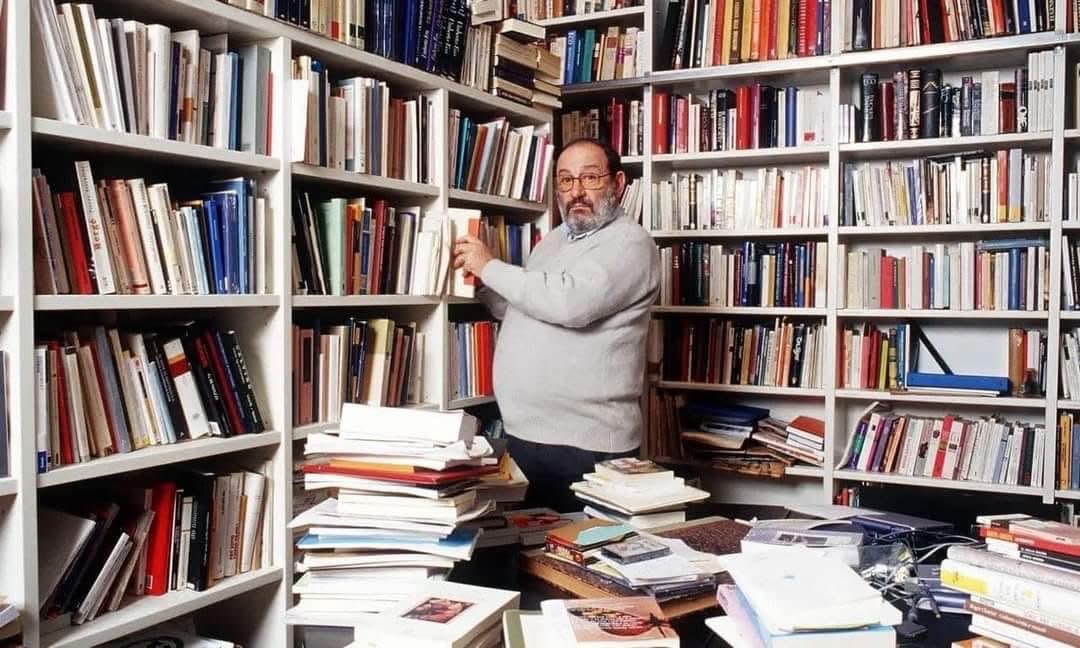
Umberto Eco, who owned 50,000 books, had this to say about home libraries:
“It is foolish to think that you have to read all the books you buy, as it is foolish to criticize those who buy more books than they will ever be able to read. It would be like saying that you should use all the cutlery or glasses or screwdrivers or drill bits you bought before buying new ones.
“There are things in life that we need to always have plenty of supplies, even if we will only use a small portion.
“If, for example, we consider books as medicine, we understand that it is good to have many at home rather than a few: when you want to feel better, then you go to the ‘medicine closet’ and choose a book. Not a random one, but the right book for that moment. That’s why you should always have a nutrition choice!
“Those who buy only one book, read only that one and then get rid of it. They simply apply the consumer mentality to books, that is, they consider them a consumer product, a good. Those who love books know that a book is anything but a commodity.”
Come hear the #Langley community chorus this weekend or next heshttps://langleyadvancetimes.com/2026/04/25/langley-chorus-explores-time-in-trio-of-concerts/
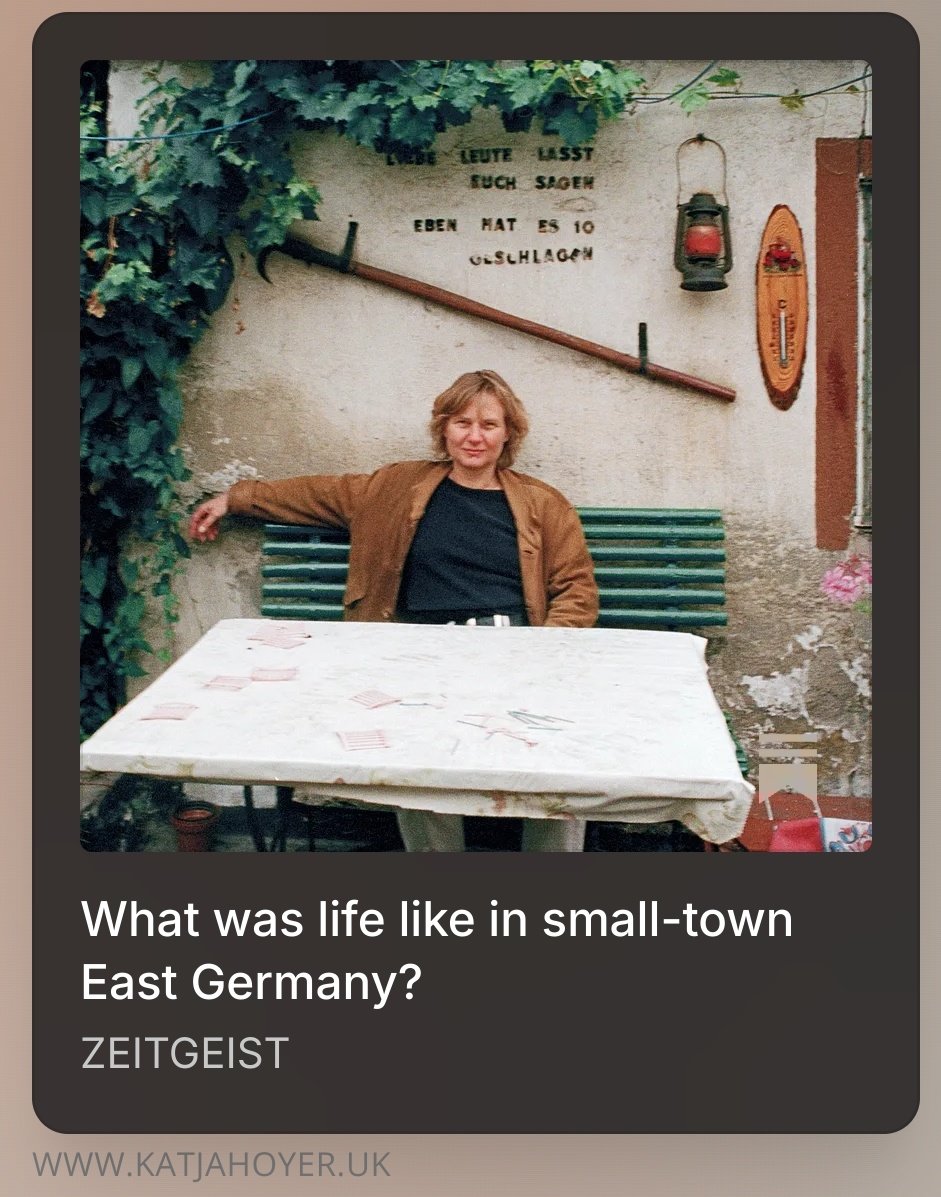
Cordia Schlegelmilch's family left the GDR in the 50s as her father didn't want to be a judge in a system of show trials and death penalties. In 1990, she returned East to find out about the life she might have led.
Her fascinating findings in ZEITGEIST👇
https://t.co/UNAlgeHM4r