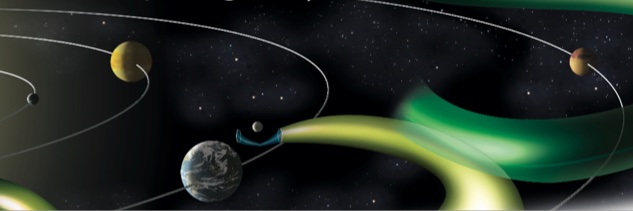
What if a spacecraft could cycle between Earth and Moon orbits, performing multiple circuits of each, naturally and indefinitely, with zero propulsion?
We’ve discovered a new class of stable, prograde, low-energy cycler orbits that do just that.
Why these orbits matter:
Ballistic → fuel-free
Stable → long-term ready
Near-chaotic → agile with low ΔV
Low-energy → access to Earth/Moon, Lagrange points, Sun–Earth L1/L2, even heliocentric space
At the AAS/AIAA Astrodynamics Specialist Conference in Boston next week, I’ll present on a new family of ballistic Earth-Moon cycler orbits that are stable, prograde, and mission agile—unlike any cyclers in the current literature.
The example below is shown in both the Earth-Moon rotating frame and inertial frame.
Conference Paper: https://t.co/v3VDPIT0X4
Absolutely insane video of US military showcasing new drone swarm launchers from unnamed ground vehicles in a recent exercise in Germany.
Modern warfare has changed…
@HeatherKIN23639 The company's proposal was covered by NBC News a few months ago and the FCC seemed to say that they have no jurisdiction on what space activities do to the ground.
https://t.co/rp6wUHhUp2
What would a mirror in orbit look like from the ground?
One pass of Reflect Orbital’s demo satellite over Lone Pine, CA, computed from its FCC filing (18 × 18 m, 625 km altitude).
Peak: about 3× full-moon light, for a few minutes.
Why do it?
The company says reflected sunlight could extend solar farm hours and light search-and-rescue or work sites at night.
From 7 miles away (11 km) you don’t see the mirror, only a column of glowing air. From this orbit: any one town, like Lone Pine, would get a few minutes of light each pass, with passes about 70 nights a year. The same mirror could light other places on other passes.
Orbit and mirror: FCC file SAT-LOA-20250701-00129. Atmosphere: Kocifaj, Bakos & Kundracik 2026 (ApJL). Terrain: USGS. Imagery: USDA. Shrubs are illustrative.
@ReflectOrbital, corrections welcome.
@BigginsInUSA@StefanBurnsGeo@Inghams85 Are you really arguing that people shouldn’t see the consequences before it’s built?
Crash testing is a big part of how cars got safer, and today most of it is simulated before a car is built. Better to see the consequences before something is made than after, to help decide.
@Inghams85@BigginsInUSA@StefanBurnsGeo No problem. I've seen tons of different reactions to what aerospace engineering could do to the night sky. It goes from "Hell yeah let's do it" to "what are we thinking? This will ruin everything". I guess it's a new fault-line in our world, pitched over simply as "old" vs "new"
@Inghams85@BigginsInUSA@StefanBurnsGeo This is Reflect Orbital's idea, not SpaceX's, and maybe you missed that someone did suggest that I suggested it:
https://t.co/bTDYdBGA0e
To be clear: I’m not advocating this. I’m showing what a filed, FCC-approved system would look like from the ground. Trying to provide an objective physics-based answer.
Agreed that the night sky and ecological effects deserve scrutiny. To be clear, I’m not proposing this. I modeled the company’s own filing to show what one pass would look like. Same idea as my earlier work on what orbital data centers would do to the night sky.
https://t.co/jbOlbjibs7
Now interactive: my simulation of 500,000 orbital data center satellites. Pick any latitude, date and time, then explore two brightness models alongside actual stars. App and code in the first reply. Try your sky and report back.
@BigginsInUSA@StefanBurnsGeo@Inghams85 I’m not proposing it. Reflect Orbital is. I computed what it would look like from the ground so people can judge for themselves. I’ve done the same for the proposed sun-synchronous orbital data-center constellations and their effect on the night sky.
https://t.co/ngI1lmtIYC
SpaceX wants up to a million satellites as orbital data centers. Half would ride the day-night line, sunlit while the ground below is dark.
Top and bottom are the same sky at the same moment. The only difference is how bright they're assumed to be.
@SciAm covered it today.
Thanks. I've done some other work on the proposed orbital data centers and what they would do to the night sky. In researching that, I came across the orbital mirrors.
I like the photorealism in your rendering. Building on the tools I had, I added real terrain and ground imagery, (I also used your last reference on the atmospheric glow), but I still don't have accurate ground texture. I've actually been to Lone Pine, before a hike up Mt Whitney.
Your 38 full moons for 54 m matches my ~3 for the 18 m demo (9× the area). On the mirror being bright like Venus outside the beam, it looks like that Hainaut paper assumes 90% of the light scatters rather than reflects. A good film material used for the reflector would be much fainter, so that parameter may have to wait until one flies.
It's trying to. It includes the beam lighting the terrain with shadows, the glowing air (using a model from a recent paper by astronomers), and that "air glow" lighting the ground. But it leaves out ground-to-ground lighting, which is small in the open desert.
The bigger difference is exposure. It's being shown like a camera would see, brighter than what our eyes would see. To the eye, it's bright moonlight that comes out of nowhere.
We built a 33-foot bag to catch asteroids.
Then we spent 11 days proving some of its most important systems work.
Inflation. Structural validation. Sensor imagery. Closure.
One step closer to asteroid capture and space debris removal.
Full press release here:
https://t.co/5rbbibQUa1
#Space #NASA #SpaceTech #Asteroidmining #Aerospace
In the next ten years, humanity will make one choice that decides the next thousand.
Option A: an Orwellian world run by a tiny hyperclass that controls AI, owns every resource, and turns the rest of us into permanent dependents.
Option B: for the first time in history, a world where the systemic corruption that has ruled us for decades simply stops being possible.
Yesterday I wrote that Milei and Bukele exposed the empire of lies. Javier Milei reposted it. Today I want to explain why that post was only the beginning, and why I've never been more optimistic.
If you're on the left, or even the far left, read this one to the end. I'm not trying to convert you. The stakes are your future too.
Start from first principles. A system produces exactly what it rewards.
For decades, the Western system has been captured by one worldview: administrations, universities, NGOs, media, international institutions. The left didn't win the argument. It won the hiring committees.
Once a system is captured, its incentives flip.
You don't get promoted for solving problems. You get promoted for managing them. A solved problem kills a budget line. A managed problem renews it every year.
You don't succeed by telling the truth. You succeed by saying the right words. So hypocrisy becomes a career skill. The professor who preaches equality and runs the most closed network in the country. The politician who votes for open borders and lives where none of it ever reaches him.
You don't build fair systems. You build systems that look fair and quietly pay the people who run them. Inflation is a tax on the poor that funds the state. Programs fund the consultants who design more programs.
That's what "systemic" means. Nobody has to be evil. Honest people inside the machine either adapt or leave. After forty years, the ones still there are the ones who adapted.
Here's the irony. The first countries to break free were the ones at the very bottom.
Argentina was bankrupt. El Salvador was a graveyard. The system had nothing left to promise them, and that's exactly why they woke up. When the lie stops paying, people stop believing it.
No civilization is dead as long as its people can still see the problem clearly. Rock bottom is often where the rebound starts.
Now the West is caught in a vise.
On one side, AI. A technology that exposes managed incompetence. When a model can read a 2,000-page law, audit a national budget and compare outcomes across 50 countries in seconds, "it's complicated" stops working. The expert class loses its monopoly on knowledge.
On the other side, a generation of tech builders who think from first principles and don't owe their careers to the system. They have more capital, more talent and more reach than most countries. And they've seen up close how the machine works.
Put the two together and the old system is close to checkmate. It can't compete on results. It can't hide behind complexity. It can't control the narrative anymore.
So what does a system do when it can't win? It tries to own the thing that's beating it.
Listen to Marc Andreessen. He has said publicly that in 2024 he sat with Biden administration officials who told him AI would be two or three big companies working hand in hand with the government, that investors shouldn't even bother funding AI startups, and that parts of the underlying math could be classified the way nuclear physics was in the Cold War. He walked out and endorsed Trump. Former Biden officials now say that's not what was said. Read both versions and decide who you believe.
The logic doesn't depend on one lunch, though. Control three companies and you control the models. Control the models and you control what billions of people read, ask, learn and are allowed to say. Add a digital ID, a programmable currency and the scanning of private messages that Europe keeps putting back on the table. Then you don't need a Ministry of Truth anymore. A compliance department is enough.
1984 with a better UX.
And last Tuesday, Democrats took back Congress. This isn't theoretical anymore. The keys to the house are on the table.
Now imagine we don't hand them over.
Intelligence becomes almost free. Expertise stops being a privilege. A kid in a village in Brittany or a suburb of Lagos gets the same doctor, the same lawyer, the same tutor as a billionaire's son. The cost of producing almost everything collapses. And systemic corruption becomes nearly impossible, because anyone can audit every budget, every law and every promise, instantly.
For the first time in human history, a society that could be truly equal. The old left version was equality by sharing scarcity. This one is equality through abundance. A world where poverty stops being a law of nature.
Which is exactly what the left always said it wanted.
So to my friends on the left, one honest question. Which side actually leads there? The side that wants AI open, cheap and in everyone's hands? Or the side that wants it locked inside three companies and a regulator?
Milei and Bukele proved the impossible was possible at the scale of a country. AI is offering the same thing at the scale of civilization.
All we have to do is not give the keys to the people who were paid to keep the problem alive.
That's the choice. And I've never been more optimistic, because for the first time, we can all see it.