June 5, 1944. You've been awake for 40 hours.
Yesterday, the operation was called off. Eisenhower stood in a muddy airfield in England, stared at the forecast, and postponed the largest invasion in human history by 24 hours because of weather. So 156,000 men sat on ships, in ports, crammed into LSTs and Higgins boats, trying not to think about what tomorrow meant.
You're 19 years old. You're from a town so small your whole graduating class fit in one room. You've been in the Army 14 months and you've never fired a weapon at a person. None of that prepared you for tonight.
The chaplain holds a service on deck. It's dark and the ship is rocking. Half your platoon shows up. The other half write letters. The guy next to you, Kowalski from Cleveland, keeps folding and unfolding the same piece of paper. You ask if he's going to send it. He says he doesn't know who to send it to.
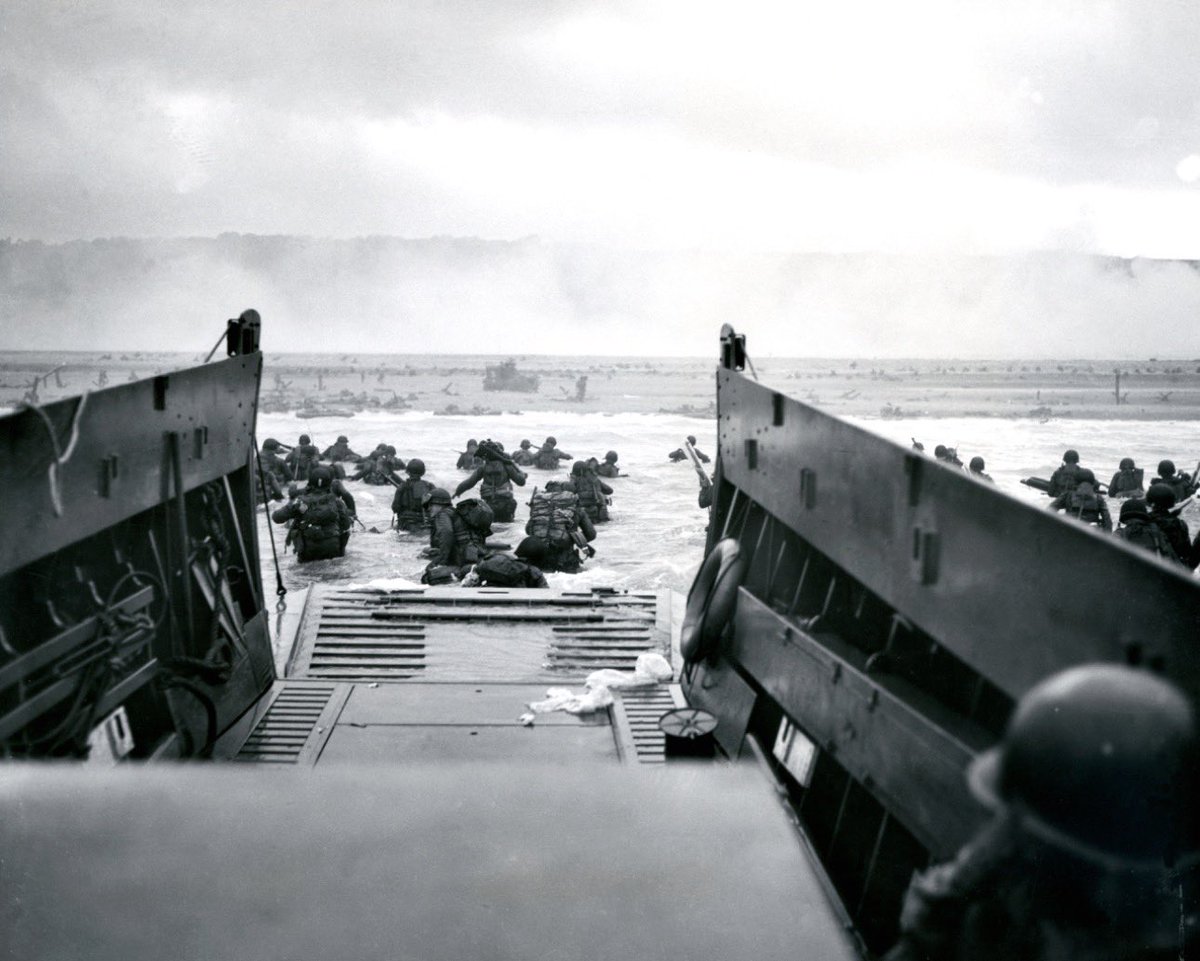
At 0100, the order comes down. You climb the rope net over the side of the ship in the pitch dark, down into the Higgins boat bucking in the swells below. 35 men in a steel box 36 feet long. The smell of diesel and seawater and vomit hits you before you're even seated.
The English Channel in early June is not kind.
Eight-foot swells. The bow punches up and crashes down, again and again, spraying ice-cold seawater over everyone. Within 20 minutes, the guy across from you is sick. Then the guy next to him. Then the guy next to you. Then you. There's nowhere to go. Nowhere to look. You're soaked through your wool uniform and the wind is in the low 50s and you've been awake so long the fear has almost become boring.
One sergeant keeps whispering the Hail Mary. Not loud, not for anyone, just to himself, over and over, like a machine that can't stop. A kid from Georgia named Willis is crying and doesn't seem to know it. Nobody says anything to him. Nobody has the energy.
Then the battleships open up.
USS Texas. 14-inch guns. The shockwave from a single salvo is so violent it physically moves the air in your chest. The noise is past sound. It's concussive, it's physical, it rewires something deep in your brain. The sky over Normandy turns orange. Then red. Then orange again. B-17s roll over in formations so vast they blot out the stars, 1,000 planes heading for the coastal batteries, the bunkers, the gun emplacements.
You think: nothing on that beach is still alive. Nothing could be.
You are wrong, and you don't know it yet.
What you don't know: the Air Force bombers delayed their drop by 30 seconds to avoid hitting the fleet. Thirty seconds at bombing speed puts 13,000 bombs 3 miles inland. Into French farmland. Into empty fields. Not one bomb lands on Omaha Beach. The German 352nd Infantry Division, dug into concrete bunkers along the bluffs, is untouched. Alert. Waiting.
You also don't know about the tanks.
Command planned to send 64 amphibious Sherman DD tanks ahead of the infantry to provide cover on the beach. They were supposed to float. In calm water, they could. But this is not calm water. The 741st Tank Battalion launches their tanks from 6,000 yards out. The swells hit the inflatable canvas screens. The screens collapse. Twenty-seven of 32 tanks sink straight to the bottom of the Channel, 100 feet down. The crews inside most of them never get out. The infantry landing in the first wave will hit the beach with almost no armor. They just don't know that yet either.
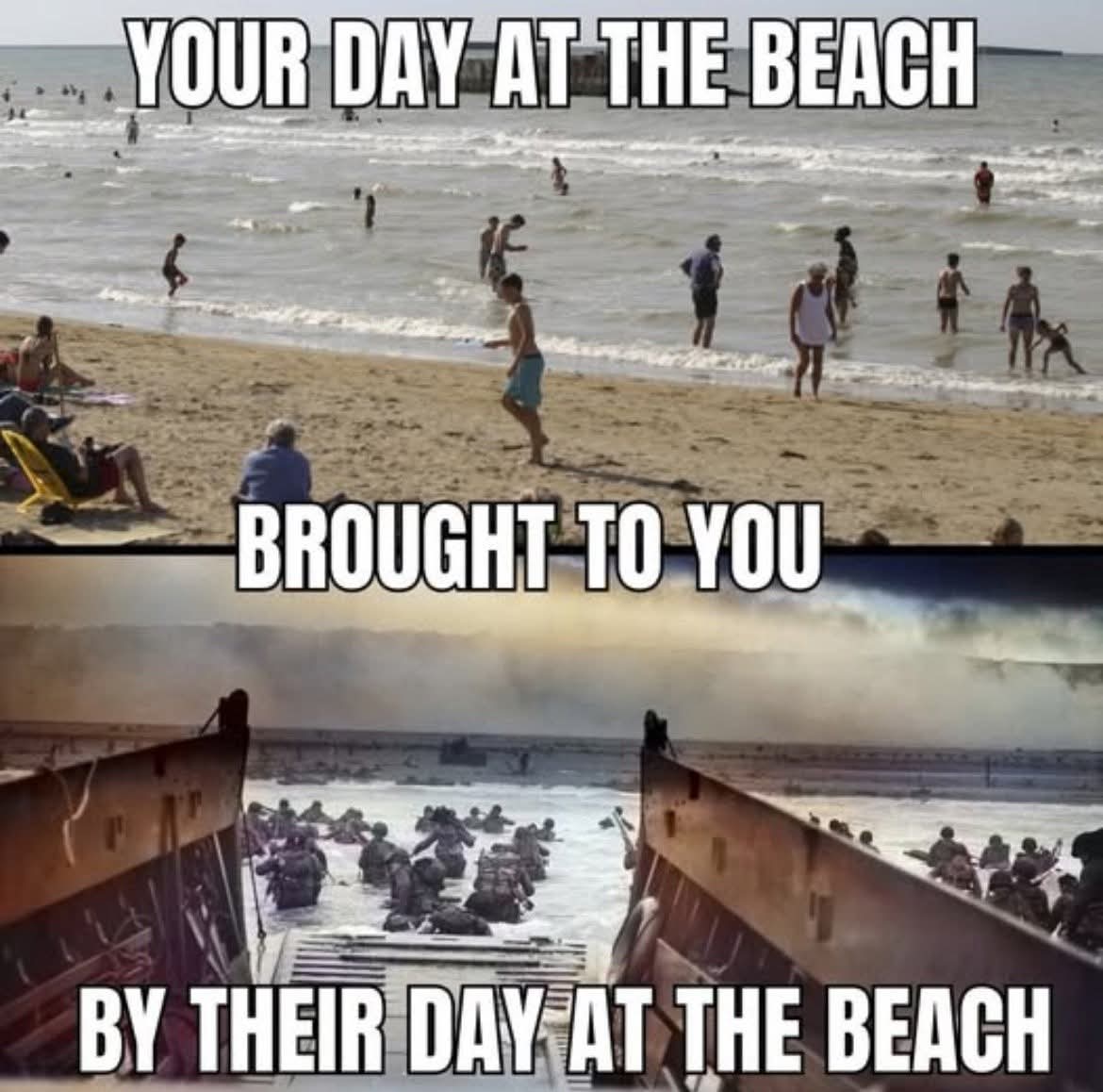
H-Hour. 0630. June 6, 1944.
Your ramp drops.
The lieutenant in front of you steps off and is dead before he hits the water. Not wounded. Dead. You don't stop. There's no stopping. 35 men are behind you in a boat with nowhere to go but forward.
You jump left. The man to your right jumps right. You never see him again.
The water is chest deep and 50 degrees and you have 70 pounds of gear on your back. German MG-42 machine guns are firing 1,200 rounds per minute from the bluffs 300 yards ahead, and the sound is not like the movies. It's mechanical. Industrial. Like a factory running at full speed. The rounds hit the water around you so fast you can't track individual splashes, just a constant disturbed surface in every direction.
You cannot run. You can barely walk. The beach is still 80 yards away.
The soldiers from Company A, 116th Infantry made it to shore first. They were from Bedford, Virginia, a town of 3,200 people. There were 35 men from Bedford in that company. The German guns had been pre-sighted on the waterline. Before most of them could clear the ramp, before they could even get wet, the machine guns hit them. Nineteen of the Bedford boys died in the first 15 minutes. Bedford, Virginia lost more men per capita that morning than any community in America. The town wouldn't know for weeks.
You make the shingle. A narrow strip of gravel at the base of the bluffs. You press yourself into it so hard you feel the rocks through your jacket. The guy beside you is a technical sergeant you've never met, from a different unit entirely, blown here by chaos. He's got blood on his sleeve and he is absolutely furious. He looks at you and says what Colonel George Taylor will say to everyone still pinned on this beach:
"Two kinds of people are staying on this beach. The dead and those who are going to die. Now let's get the hell out of here."
You get up.
It takes six hours to clear 300 yards of sand.
Not with a charge. Not with anything glorious. In tiny groups, one gap in the wire at a time. Sergeant Philip Streczyk crawls through the smoke near the E-1 draw and finds a seam the Germans left in the defenses. He takes six men through it. Another cluster flanks a machine gun nest from an angle the Germans didn't fully cover. A corporal nobody has heard of stands up in the open and throws two grenades into a bunker aperture and clears it by himself. Acts of individual, unrepeatable courage happening in the smoke all across a 6-mile front, uncoordinated, unrecorded, unwitnessed.
Meanwhile, half a mile off the beach, USS Frankford sees the infantry getting slaughtered and makes a decision that violates every piece of common sense a naval officer has. She drives her destroyer to within 800 yards of the beach, so close she's bouncing her keel off sandbars, and opens up direct fire on the bunkers at point-blank range. They can't miss at that distance. Three other destroyers follow her in. The crews know they are one lucky German shell from being sunk in 15 feet of water. They do it anyway.
By noon, small groups are on the bluff.
By early afternoon, you can stand on the high ground and see the entire beach below. The tide came in. The men who were wounded and couldn't crawl fast enough are gone. The obstacles are still there, draped with things you don't look at directly. You eat half a K-ration because it's the first food since yesterday and your hands are shaking too much to open the other half.
By nightfall, 2,000 Americans are dead, wounded, or missing. On this one beach. In one day. It is the single costliest day in American military history.
You sleep in a shell crater in French soil. Still wet. No sleeping bag. 40-something degrees now that the sun is down. The man a crater over is crying softly. You don't check on him. You need him to be fine. He probably is. You tell yourself he probably is.
Tomorrow the hedgerows start. Weeks of fighting through walls of vegetation 10 feet thick, every field a potential ambush, every sunken lane its own kill zone. The Germans mastered it. The terrain was not on the maps. Nobody had planned for it.
But tonight you're alive.
You think about Kowalski and his unfolded letter. You think about the Bedford boys. You think about the tanks on the bottom of the Channel with their hatches sealed.
You get out your paper and you write your own letter.
This time you address it.
82 years ago today. Most of them were teenagers. Most had never left their home states. They were seasick and soaked and terrified and they went anyway.
The youngest survivors are over 100 now. Most are gone.
Remember them today, not as marble statues. As kids who threw up over the side of a boat at 3 AM and climbed a cliff at dawn anyway.
That is what courage actually looks like.
The raw emotion when they finally meet their hero…
They’ve read about D-Day. But nothing — nothing — prepares you for standing in front of someone who lived it. Watch their emotion as these students meet World War II Veteran Jack Boeki, and you’ll understand why.
@Normandy@WW2Facts
#dday #hero #thankyou #neverforget #freedom
Out of 16.4 million Americans who served in WWII, only about 40,000 are still alive.
They’re dying at a rate of ~100 per day.
These are the heroes who saved the world from tyranny.
Find one. Thank one. Listen to their stories.
While you still can.
The Jaws of Death. So reads the caption on this National Archives image of A Company 16th Inf. landing on Easy Red Sector of Omaha Beach. 2/3rds will become casualties. The American graveyard is today above the bluffs. See here https://t.co/EEg00P06y6
For tomorrow’s sacred 82nd anniversary, we remember the men who stepped off from the boats into hell itself.
Waves stained by real crimson blood, skies torn by fire, and courage that refused to break.
Tonight, as I do every year at this time, I’ll be raising a glass to a scared young man, who 82 years ago was preparing to go ashore on the beaches of Normandy as part of an event code-named Operation Overlord.
D-Day.
I can’t imagine what was going through his mind. I’d be scared to death and I’m sure he was too. But in that first wave was a 21-year-old Private First Class from Henry County, VA by the name of Allen Homer Sink.
Fortunately, he would survive that initial wave, participate in battle until it ended in August, then come home to marry and raise a family of four, including two daughters after the war ended.
He would also become my father-in-law until his death in 2006.
His nickname for some reason was “Hank” and when I asked him how he got it, he said some guy in the Army said he “looked like a Hank.” From the time I first met him, he was a salt-of-the-earth man who was never afraid of anything. He was a carpenter by trade, and he’d stand up on the tallest roofs, grab bumblebees with his bare hands when they tried to persuade him to move elsewhere, and never be bothered by anything.
His hands were tough and leathery, but he was a softie. He spoiled his children, complained when my mother-in-law would gripe about something involving one of his alleged misdeeds, and always thought he was fooling everybody when he snuck around the back of the house and lit a cigarette, a habit everyone opposed but he could never part himself from.
He could talk your ear off for hours at a time, and I always suggested he become a greeter at Wal-Mart when he retired because then he could talk all day to strangers and none of them would – like his wife and daughters often did – tell him to be quiet for a few moments. Yet for all his love of talking, there was one subject he just wouldn’t discuss.
June 6, 1944. Omaha Beach.
In 1998, when he was 76 years old, the subject came up again. The movie “Saving Private Ryan” came out and the beginning was gruesome. Reviews said it was incredibly realistic to what really happened that day. I asked Hank if he wanted to go see it.
“No,” he shook his head. “I don’t ever want to see any of that again.”
He did offer that he remembered the night before when troops were loaded into the boats for the amphibious assault. He said it was raining and that once everyone was in place, they gave everybody ice cream and told them to try to get some sleep. Then the next thing he knew, they were waking everybody up telling them to stay low and head for the beach.
No, that doesn’t sound like somebody drugged the ice cream. Not at all.
That’s all he would say about the subject, and he never said another word about it until the final months of his life. Alzheimer’s would gradually rob him of his mind, and as his condition deteriorated, memories of the past would briefly spill out. One evening he thought I was his commanding officer and he was back at Normandy. It is the only time I ever saw him where he appeared to be scared. Ever.
It reminds me every day of something I had unknowingly taken for granted. The greatest generation did fight in and win World War II, then did incredible things over the next 50 to 60 years after the war. But many carried unspeakable memories from the War, ones they would never talk about and carry inside them to their graves. Those veterans lost a piece of themselves in battle they would never, ever, get back.
I mean, how can you at the tender age of 21 storm a beach, see friends die only a few feet from you, wonder each night if you will wake up alive the next morning and then return home a year later and try to pick up on the same normal life you had before you left? I told him once that after seeing “Saving Private Ryan”, I understood why he was never afraid of anything; after you’ve made it through something like that, everything else pales in comparison.
So tonight, I raise a glass to Hank and the 150,000-plus men, who like my father-in-law, were very young, very scared, and still charged that beach, paying a price that even for the survivors would last the rest of their days.
Rest In Peace...
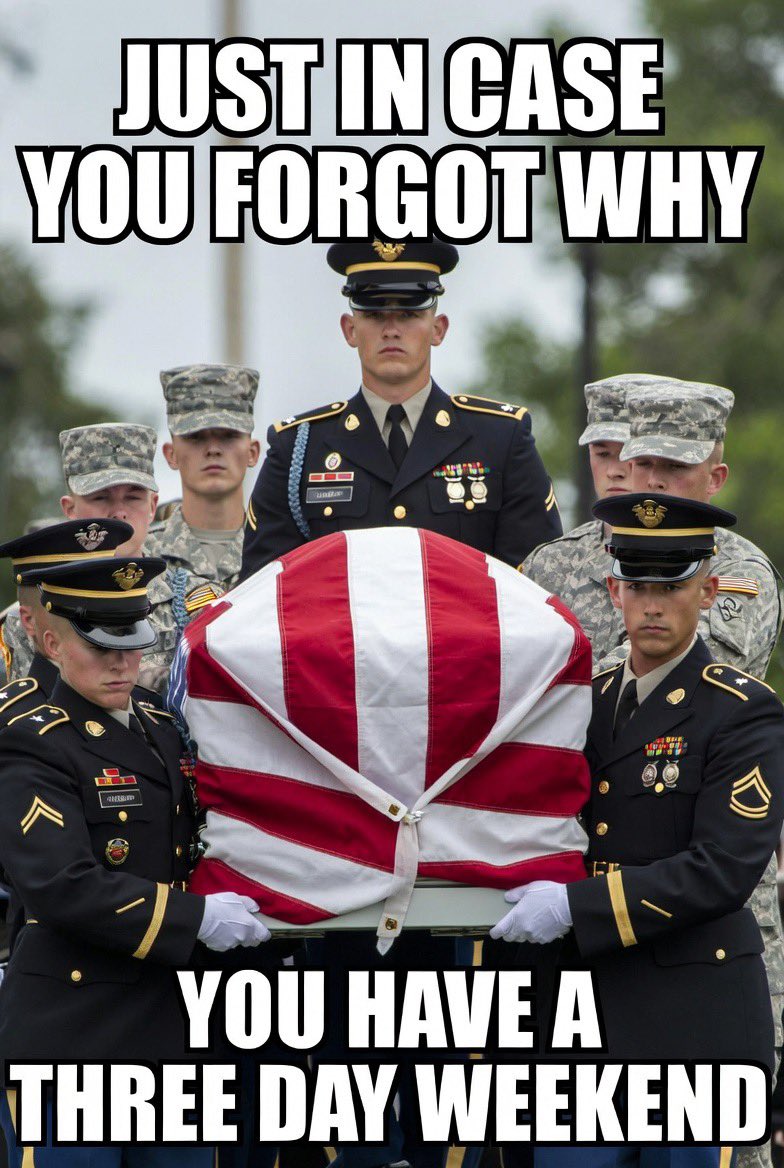
🇺🇸 Just in case you forgot why you have a three-day weekend…
This is it.
Not the barbecues. Not the beach trips. Not the sales.
This is the reason.
The folded flag. The final salute. The ultimate sacrifice so the rest of us could be free.
This Memorial Day, we honor the fallen.
We remember their names. And we never take this freedom for granted.
If you ever get the chance to go to Normandy, take it. Don't just visit it-take your time and let it sink in, because it is one of the most humbling experiences I've ever had.
Standing there, looking out across those beaches, you can almost feel the weight of what happened there. It's hard to fully understand what those soldiers went through until you're standing in that place, realizing the courage it took just to run toward that shore.
The beauty of Normandy is quiet and powerful, but so is the sacrifice it represents. The rows of white crosses, the history in the ground, the silence in the air-it all reminds you that freedom came at a tremendous cost.
It's the kind of place that stays with you long after you leave. It makes you grateful, reflective, and a little more aware of how much was given for the life we live today.
Normandy is more than a battlefield. It is a lesson in sacrifice, bravery, and remembrance. 🙏🇺🇸🙏