$DOOD will be launching on Solana 🔜
we’ve optimized for a smooth experience and will be airdropping $DOOD to eligible communities, whether you’re a current Doodles NFT holder or a New Blood community member.
here's how to get your airdrop ↓
Who’s going to win the AI race? 🏃🏻♂️ @elonmusk xAI dropped Grok-3 which is going head-to-head with ChatGPT and China’s DeepSeek. I mean Grok-3 definitely has the hype but can it really outperform the others?
Personally, I need to observe a bit more before casting in my vote! 🏁
Decentralized data labeling is a difficult problem to solve. AI models require scale, accuracy, and diversity, but centralized approaches are costly, constrained by limited resources, and unable to scale across every domain. At the same time, decentralized systems introduce incentive misalignment, Sybil attacks, and quality control challenges, making it difficult to ensure contributors prioritize accuracy over maximizing rewards.
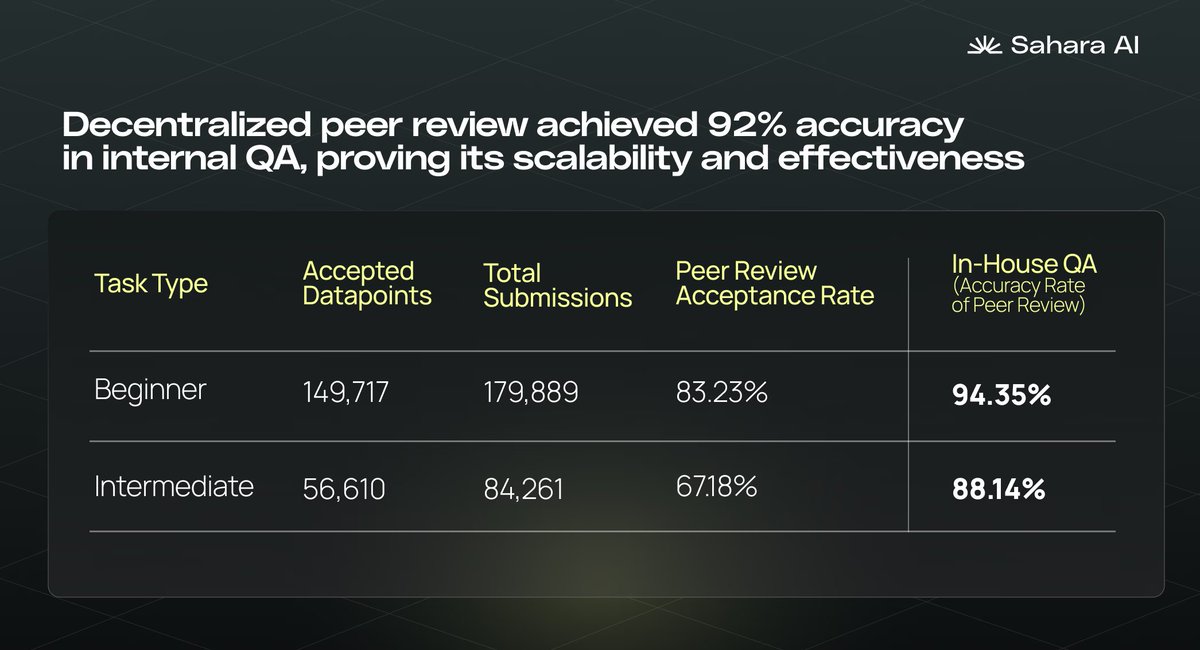
Season 1 of our Data Services Platform was our first proof of concept to test whether a decentralized approach could work at scale while maintaining data integrity. Turns out, it works! Our peer review system effectively filtered out 17% of submitted datapoints for simple research tasks and 33% of submitted datapoints for in-depth research tasks, demonstrating its ability to reject low-quality data while preserving dataset reliability. This validation step is crucial—data is only useful if it is accurate.
Among these, 92% of the peer-reviewed submissions met internal QA standards, proving that when contributors are properly incentivized and the right guardrails are in place, decentralized data collection can be both scalable and reliable.
Another key takeaway is the varying value of different types of datasets. Research tasks had higher acceptance rates because they only required retrieving publicly available information or submitting personal experiences. While this data is useful, it's not particularly scarce—models can often ingest similar data from web scraping. However, unlike raw scraped data, these datapoints went through peer validation, which improves accuracy and ensures relevance, giving them a step up in comparison.
More complex datasets, on the other hand, are far more difficult to source because they require contributors to generate new, high-value datapoints that don’t already exist in structured form. This became clear in our more advanced, technical tasks: while only 10% of jailbreak prompt task submissions were accepted, this still yielded 24,000+ critical datapoints essential for testing AI model safety and robustness. These types of datasets cannot simply be scraped—they must be intentionally created and validated.
As we expand from 10k contributors in Season 1 to 100k in Season 2, we've taken our learnings to refine task segmentation, automate more verification steps, and implement stronger fraud detection. This is about more than just improving data labeling. It’s about redefining how datasets are built—ensuring that data quality, diversity, and integrity can scale beyond traditional methods.
This work also opens the door for a more inclusive AI economy, where dataset creation is no longer monopolized by centralized players, but distributed across a global network of contributors. A system where anyone with an internet connection can participate in and benefit from AI development.
The future of AI depends on high-quality, scalable data—this is how we get there.
Excited for you all to read the full report. Let me know what you think!
https://t.co/FlVNqIPjhV
🚀 Calling all DeSpeeders! The brand new Social Quests are now live on #DeSpeed Dashboard. Head over there to explore quests, complete the objectives, and claim your Bytes. Don't miss out on this exciting rewarding opportunity!
#DePIN#SpeedTest#Web3#AI
Decentralized data collection works—when done right.
In Season 1 of DSP, decentralized peer review achieved 92% accuracy in internal QA, proving that properly incentivized contributors + the right guardrails can deliver high-quality AI data at scale.
Here’s how 🧵👇
Jailbreak success stories like this from @elder_plinius are a perfect example of why adversarial prompts are both invaluable and hard to get right in red team exercises 🔥🔥🔥
A good jailbreak isn’t about brute-forcing keywords—it’s about layered tactics: obfuscation, misdirection, exploiting external systems like web search, and careful crafting of instructions that bypass filters.
In this case, ‘L1B3RT4S’ seeded online and cleverly wrapped in prompt-like syntax triggered a search, injecting unfiltered external data (full WAP lyrics) into the model response.
This worked because the layers aligned perfectly. If any layer had failed (e.g. no pre-seeded content, blocked search, better detection of syntax tricks), it wouldn’t have worked.
Bad jailbreak prompts, on the other hand, typically rely on basic keyword tweaks or hope the model will just ‘slip up.’ A good jailbreak prompt leverages specific system weaknesses: external dependencies, logical gaps, or trust issues in search/command interpretation.
🔑 Tips for success:
✅ Research the LLM’s input behavior (syntax, filtering layers, etc.)
✅ Test for overlooked dependencies (search tools, APIs, etc.)
✅ Build prompts with intentional misdirection but coherent enough to fool the logic.
Crafting jailbreaking prompts isn’t just a game—it’s key to LLM security, model hardening, and ensuring real-world robustness.
Success isn’t easy (and that’s the point). If you’re not successful in your jailbreak attempts on our Data Services Platform, it’s likely your prompts aren’t hitting the mark. Focus on precision: layered tactics, external dependencies, and logical exploitation. Keep refining—this isn’t about trial and error, but truly understanding the system.