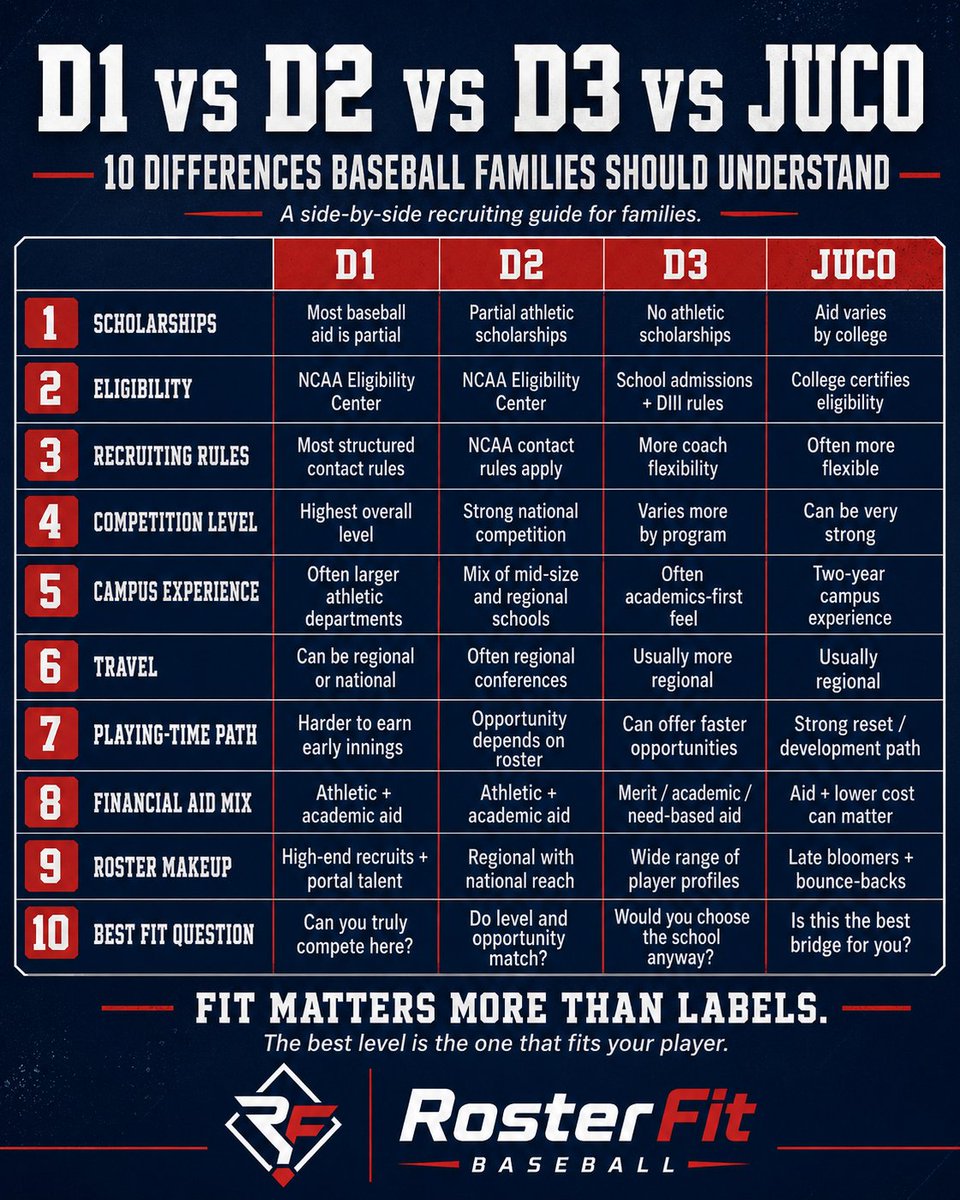
Most families start college baseball recruiting backwards.
Camps. Showcases. Dozens of coach emails.
All before knowing which schools are realistic.
Before spending thousands trying to “get seen,” ask:
Which college programs are actually worth targeting?
Fit matters more than labels.
Study the roster.
Understand the path.
Find the place where your player can actually grow, compete, and thrive.
Learn more about how NCAA recruiting actually works:
https://t.co/Aocy1MnTAz
If your player has a chance to play college baseball after high school, that is already a huge accomplishment.
The real question is not:
“Is D1, D2, D3, or JUCO good enough?”
It is:
“Which environment actually fits him best?” 🧵
The best level is not always the highest level.
The best level is the one where your player has the right combination of:
- Baseball fit
- Academic fit
- Opportunity
- Development
- Long-term upside
The mistake is choosing a level based on the label.
Families should look at:
- Metrics
- Academics
- Financial fit
- Roster need
- Playing-time path
- Development environment
- Campus experience
JUCO is not always the backup plan.
For late bloomers, bounce-backs, players who need more reps, or players who need more time to develop physically, JUCO can be a very smart bridge.
Sometimes the best path is not the most obvious one.
D3 does not offer athletic scholarships.
But that does not mean it is “less serious.”
A high-academic D3 can be an incredible fit for a player who wants strong baseball, a great degree, and a college experience he would choose even without baseball.
D2 can be a great middle ground.
Strong competition.
Possible athletic aid.
Regional programs.
Real opportunity.
For some players, D2 is not a step down.
It is the right blend of baseball, school, money, and playing-time path.
D1 might have the highest overall level.
But it can also have the hardest path to early playing time.
A D1 roster spot is exciting, but families still need to ask:
Can he realistically compete, develop, and get on the field there?
We broke down the best academic D1 baseball schools here: https://t.co/ONuzNKyvbT And if you want a realistic target list for your player,
@RosterFitCo checks the 1,800+ college baseball programs and finds the 25 worth pursuing for your level.
Every baseball family says they want a “good academic D1.”
But most don’t realize how small that target actually is.
Elite school.
Division I baseball.
Realistic recruiting fit.
Admissions support.
Affordable cost.
That is a very narrow lane. 🧵
The question is not:
“What is the best academic D1 baseball school?”
The better question is:
“Which schools would actually recruit, admit, develop, and make financial sense for this player?”
That’s the list that matters.
A smart recruiting list should have reaches, targets, and safer fits.
Not just dream schools.
Not just schools with name recognition.
Not just places where the family would be proud to buy a sweatshirt.
For many players, the better fit may be:
High-academic D3.
Strong D2.
Selective NAIA.
JUCO first.
Lower D1 with a better roster path.
The goal is not the biggest logo.
The goal is the right opportunity.
So should strong students still look at academic D1s?
Yes.
But they should not build the whole list around them.
These are reach schools for almost everyone.
Even very good players.
Even very good students.
This is where families get misled.
“Good student + varsity player” is not automatically an academic D1 recruit.
At this level, the player usually needs real D1 tools AND an elite academic profile.
The non-Ivy schools on the list are different:
Stanford.
Duke.
UC Berkeley.
Those programs can offer athletic scholarships.
They also recruit at an extremely high baseball level.
That is why they are so hard to match.
That means baseball may help you get recruited, but it does not determine your financial aid package.
For one family, an Ivy can be surprisingly affordable.
For another, it can be full-pay.
Same roster spot. Very different cost.
And “D1 scholarship” does not mean what families think it means here.
7 of the top 10 are Ivy League schools.
The Ivy League does not offer athletic scholarships.
Aid is need-based only.
These schools ask a player to clear two brutal bars at the same time:
Can you play Division I baseball?
And can you get through admissions at one of the most selective schools in the country?
A lot of players have one.
Very few have both.