tldr:
- no-name indie art director got paid net $6.7k for a month worth of work on the movie obsession
- obsession was a low budget production but managed to be hugely successful and is projected to make $250 mil
- no-name indie art director is crying that she should have gotten paid more
i have a strong view on this:
since the movie is so successful, the producer could VOLUNTARILY choose to give a nice bonus to everyone who worked on the movie, but this is at his own discretion and if he does not do that, it's completely fine
a lot of employee level people cry that they don't get paid enough for their contribution to a project or company. they have no concept of risk.
let me use an example from a private company:
unless you are vc funded, the owner of the company takes his own after-tax savings to fund his company. that is a huge risk as over 90% of businesses fail
as an employee, no matter how instrumental you are to the success of the company, you are getting a salary to provide your work. you are getting paid, you have no risk.
risk is what justifies profit share, not "how much time you put into it", especially if you got paid for your time. if you work for free, you should get profit share, otherwise you are just a service provider
it's actually a very prominent communist view that "the workers should own the means of production". it sounds nice in theory, if 10 people are producing the goods, they should all get their equal share, but this is simply not how the real world works, otherwise no one would take the huge risks involved in starting your own business, they would merely let someone else take the risk and then get their share of the profits
but most artists who do commission work do not understand that. i think it's a mix of low iq and entitlement. i once worked with an artist and he created some work for me and i made A LOT OF MONEY from it, but i didn't even pay him a bonus either. i didn't like how entitled he was. also, he was completely replaceable, i came up with the concept, i directed him, he merely did the artistic part that i couldn't do but i could have hired anyone for that
also, if you are actually capable, you will most often get paid. real recognise real, if i come across someone capable, i pay them what they are worth. most artists are not capable, they have low skills and that's why they get paid exactly what the market deems fair
It is a misconception that being highly technical and intelligent is all you need to succeed.
The world is so full of slightly autistic, highly smart, highly technical people that never get what they want out of life.
That is because they fail to express what they want out of life or to bridge their interests with anyone that might be able to get them there.
Being able to communicate well is a rare gift, and is why the top at so many places is unfortunately over-indexed on people with great communication skill as opposed to great technical skill.
Wealth isn't so much about luck; it's about mindset.
You'll hear this time and again... because it's true.
And in the same way, consistent trading is about a mindset.
Consistent traders approach trading from the perspective of a mental discipline.
Everyone should have the experience of being depressed and hitting rock bottom at least once in their life.
I really think that it's an important part of growing up.
It cracks you open like a shell, destroys your ego, and teaches you a lot about yourself and life.
I consider myself lucky to have seen both sides - the traders that made fortunes and kept them when they retired but also the bright, young stars that had it all and made money for a long, long time before finally losing most, if not all of it.
It always ingrained in me that personal and financial fortunes can quickly change, no matter how much solid performance data you have behind you.
It taught me to respect risk, keep my ego in check and to adopt a simplistic outlook: Essentially all that matters is not the amount you’ve made to date but the amount you retire with. Anything else is just noise.
The key to making it is being able to reign in your ego, admit when the market has invalidated your thesis and move onto something else.
The best traders are able to change their mind and synthesize new information without previous bias.
Strong convictions loosely held.
the trenches feel pretty cooked atm, gonna lay out some data and my thoughts because i need someone smarter than me to tell me how it gets resolved
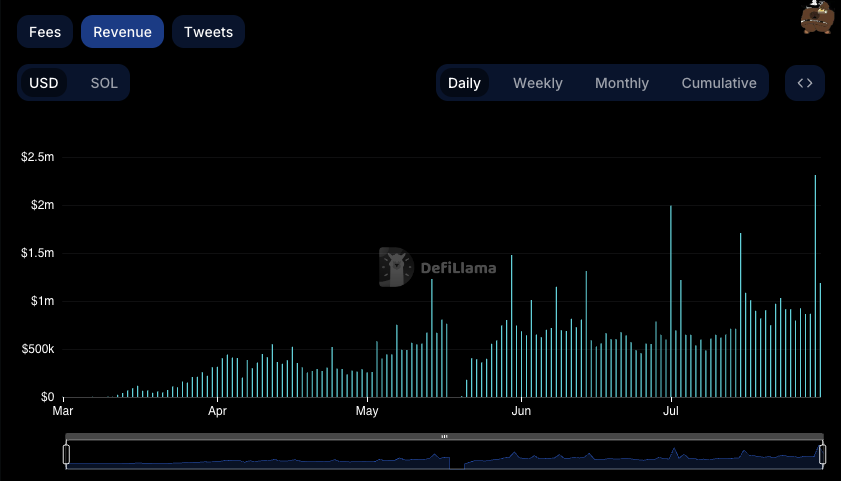
> pump fun hit an ath in daily rev yesterday at $2.3m
> cumulative revenue is just under $80m
> 1,567,948 coins have been launched since inception
> 6000 in the last 24h
on the neiro launch day nearly $1b in volume on just a few coins
this is getting dangerously close to the bome/slerf top we had in march, except in an environment with far less free flowing capital and a HUGELY dispersed network of coins
popcat 40m
wif 125m
mew 270m
neiro/NEIRO/nEiRo 900m
bome 922m
slerf 2.2b
currently: number of coins > amount of capital needed to sustain growth
all while large chunks of solana are leaving the ecosystem every day to infra providers, insiders and the few lucky ones
the daily rate of extraction on solana is huge, anecdotally the trenches have been seeing pretty monster volumes across the board on new coins lately (multiple daily occurrence's of $20m+ in the last week) yet very few coins are able to break 9 figs
the shitcoin landscape has become hyper efficient, there used to a financial barrier to entry for launching a coin as the deployer needed to seed liquidity, now the cost comes from the trenches themselves as traders fill the bonding curve
every time a pump coin fills the curve the LP is burnt, another stream of sol leaving the eco everyday - there is $65m of locked solana sitting between just the bome and slerf LP's
the main beneficiaries of the current environment are:
> pump fun
> any trading bot (most charge 1%)
> people that launch coins
if you assume even 50% of current transactions are ran through a trading bot then nearly $5m went to infra providers just on the neiro launch day
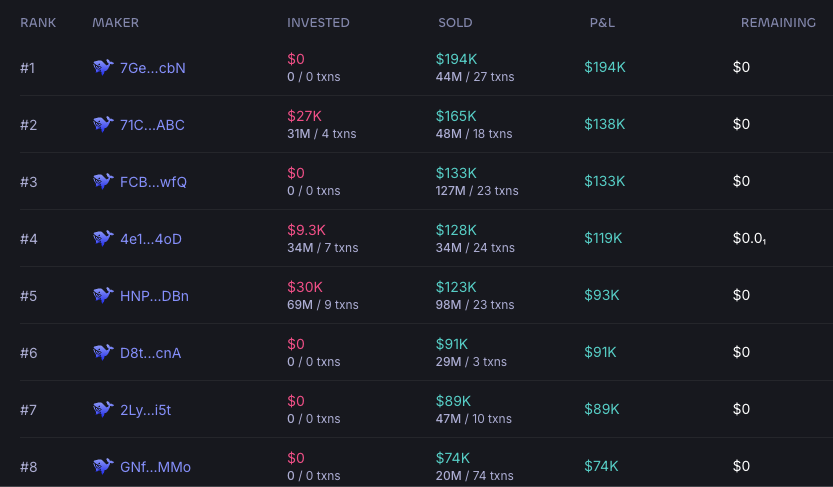
then you have countless coins where the top trader section on photon looks like this:
the result is a rolling selection of 5-10 coins above $10m but below $100m mcap competing for attention until the next cohort comes along and vamps it and the liquidity, a new meta every few days instead of every few weeks or months
basically solana is getting sucked dry and i'm trying to figure out what the end game is here
but all i can really see are two scenarios:
1. it becomes so efficient and the rotations so violent that nothing new can survive, traders lose so much money and hope collectively that we see an extended low cap bear market and a full reset
2. we see enough new entrants and capital that we flip back to 'amount of capital needed to sustain growth > number of new coins', strong coins prevail and the playing field levels out again
Remember the rules:
If price goes down on a weekend, it's an illiquid scam move that'll go back up during the week
If price goes up on a weekend, it's smart money front running the incoming bullish flows during the week
“It’s too obvious so it won’t happen”
Even if it’s obvious, you’ll botch the execution(overlevered, second guess self, sit out, etc etc). Predicting isn’t hard, this game is really quite simple. The reason “obvious” things can happen is because most are emotional.
If you are insistent on trading for yourself, here’s my best advice:
- prioritise doing whatever you can TODAY to give yourself the best chance of making money TODAY.
- don’t try to solve problems you don’t have yet.
Rinse and repeat every day and you might just survive.
Market ranged for ages
Then broke down
Buying the breakdown in the short-term can be profitable because of all the liquidations + volatility increase
But bigger picture, the clearer signals will be:
1. Breakdown failure (buy)
2. Bearish continuation into HTF support (buy)
People make the mistake of treating trading as binary.
There is this fetishization of selling the top and buying the bottom.
They give themselves no margin for error and expend all their cash buying a single level, or sell all of their holdings in a single order.
The enlightened trader understands that giving yourself time to scale into positions and adjusting based on conviction is the path to profitability.
Don't let arbitrary entry precision stop you from putting on good positions.
It always comes down to context.
Practical example: $BTC when it reclaimed $32k.
That was a very strong signal, but if you waited for a perfect retest, you didn't get it.
The weekly candle closed at $34.5k - roughly 6% above the perfect retest level.
The next level of resistance (weekly range midpoint) was around $46k - roughly 33% higher.
Question: Is the extra 6% precision in entry worth missing a 33% move if you don't get it?
Alternatively: Is the expected value of buying $34.5k versus $32k significantly worse in this context?
In this example, I'd posit the answer is 'no'.
There is always a tradeoff if you try to be precise in your entry.
The main benefit is that better entries usually lead to better trade management, better R:R (whatever that's worth), and trading closer to your invalidation (very valuable).
The main detriment is that if you're too granular with your entry criteria, you risk missing big moves for a marginally better entry (i.e. no good reason).
Sometimes being precise is worth it, especially if you're dealing with lower time frames, small moves, and medium strength signals that occur relatively frequently.
Other times being precise is very costly, especially if you end up FUDing yourself out of excellent high time frame moves just because you didn't get the perfect wick entry 0.5% higher/lower than you planned.
One way to get around this is to split your signals up when you're dealing with low frequency, high time frame, high signal setups (i.e. the good stuff).
Entry 1: Systematic Entry. The priority here is just putting on a position. Sometimes that means market buying a strong weekly/daily close and having it retrace shortly after. But that's irrelevant - the main focus is acting on the high signal setup. You have to turn off your low time frame trader brain for this. As soon as the signal is generated - you act. This entry tends to be more conservative in sizing given the wider parameters.
Entry 2: Trader Entry. This is where you are a lot stricter with your entry criteria and emphasise precision. The goal is to get a better entry, more actively managed, with greater proximity to invalidation. This entry tends to be more aggressive in sizing given narrower parameters and more active management.
If you get a systematic entry but don't get a trader entry, you still have a position and acted on a strong signal.
If you get both, great - your average is likely better, you likely fully filled your risk allocation for that setup, and your trade management will likely be better too as you can manage the trader entry more actively without compromising the core setup (let's be real - how many times have we taken a high time frame swing, managed it on low time frames, made a bit of money, but missed making a lot of money on the setup due to impatience?)
Most importantly - you've acted on the setup in either case.
Getting good entries is great.
Missing great trades because you didn't get a perfect entry is wasteful.
Low frequency, high time frame, high signal setup = priority shifts to putting on the trade. A better entry is a luxury.
Medium-high frequency, low-medium time frame, medium signal setup = priority shifts to a better entry. A good entry is a prerequisite.
Prioritising correctly based on the setup, market conditions, and context is the real skill.
Great podcast here. Excellent point about alt price action. The price action is what you would expect of venture investments if the norm was for them to have liquid markets very quickly. Most venture investments outside of crypto go to zero before ever getting access to liquidity.
For the vast majority of crypto speculators
"Fundamentals" and "quality" don't matter.
Parallel execution layer-3 ZK compression VC coin versus ninth derivative of a dog coin.
Who cares?
You're probably not smart enough for the differences to matter, and those considerations are likely inappropriate for your investment time horizon anyway.
It's all about:
1. Flows
2. Liquidity
3. Momentum
4. Attention/mind share
When the industry shifts to a bear market we'll all lose a lot of money on everything anyway.
No long-term safe havens, irrespective of "quality".
So abstract away the fake fundamentals and focus on those 4 things if you're an intracycle profit maxi.