$ETH Has Updated Its April High
Since the beginning of July, the asset's price has risen by more than 75%, thereby updating the local high formed in April of this year.
Against the backdrop of this impulse and a global breakout in the ETH/BTC pair trend, the average monthly Ethereum outflow from exchanges has hit a three-year high.
A strong inflow of "smart money" in the spot market and a total supply shortage fully give buyers control over the current situation.
The coin has fully established itself above the moving averages and the cloud, demonstrating a confident bullish trend. Now the road is open to the important resistance area at $3,000.
$NEAR We Continue to Actively Move Long
The asset has made a powerful vertical surge, adding about 92% from the local accumulation range, and momentarily tested a local peak at $4.45.
We are seeing clear dominance from buyers — the token easily flew far above the dense cascade of moving averages, which have now remained below as support for the price.
Against the backdrop of this rapid growth, a surge in trading volumes has been recorded, confirming aggressive interest from large funds and whales, who are literally sweeping supply off the market.
Right now, it is extremely important for the coin to hold the $4 area to continue the upward dynamics.
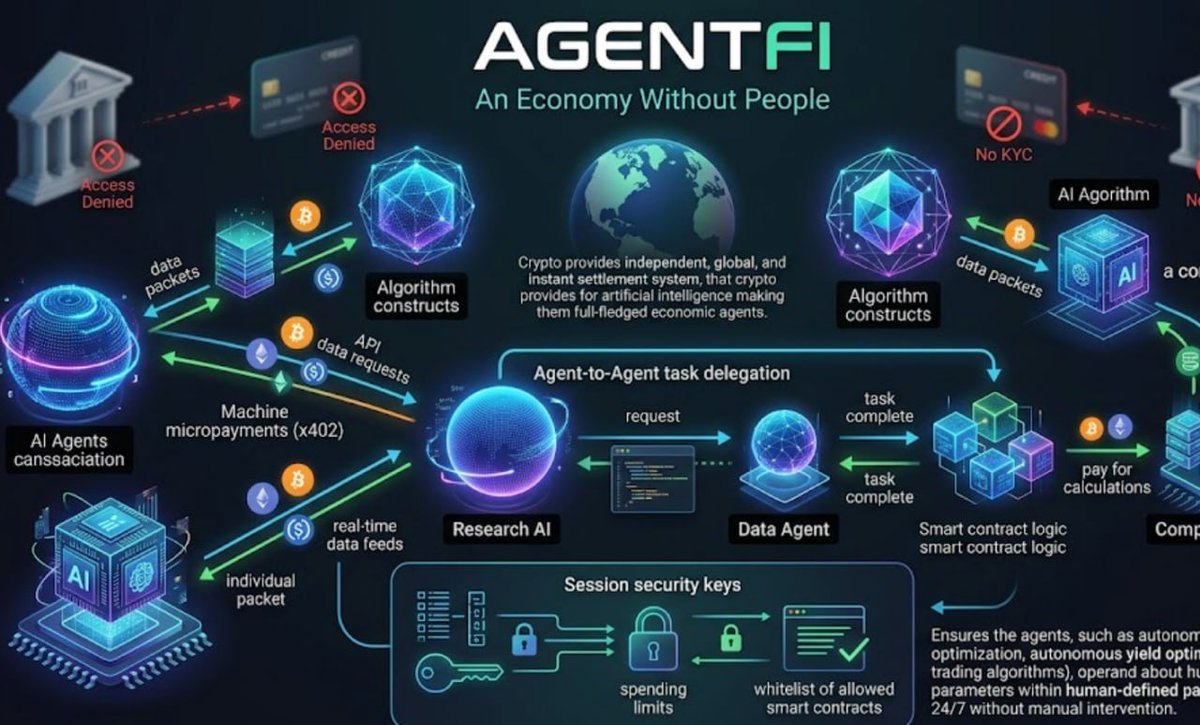
An Economy Without People: How AI Agents Are Creating a New Financial Layer
We’re used to thinking that blockchain was made for humans, and AI for processing text. But the strongest shift is happening right at their intersection: AgentFi is taking shape — a financial ecosystem where the main users of the blockchain are not people, but autonomous algorithms.
An AI agent has no passport. It can’t pass bank KYC or link a credit card. Traditional fintech is closed to machines. But they do have crypto wallets.
What’s already working right now:
Machine micropayments (x402): AI agents no longer buy monthly subscriptions. Protocols like Coinbase integrations pay fractions of a cent for each individual API request or real-time data feed.
Agent-to-Agent task delegation: A research AI hires a data agent to collect statistics; that agent pays a compute cluster for calculations — and all of it settles through smart contracts in seconds.
Session security keys: A human sets strict spending limits and a whitelist of allowed smart contracts for the agent, after which the algorithm optimizes yield, trades, or manages liquidity 24/7 without manual intervention.
Crypto gives artificial intelligence what it never had — an independent, global, and instant settlement system. Machines have stopped being just a tool for answering questions and have become full-fledged economic agents.
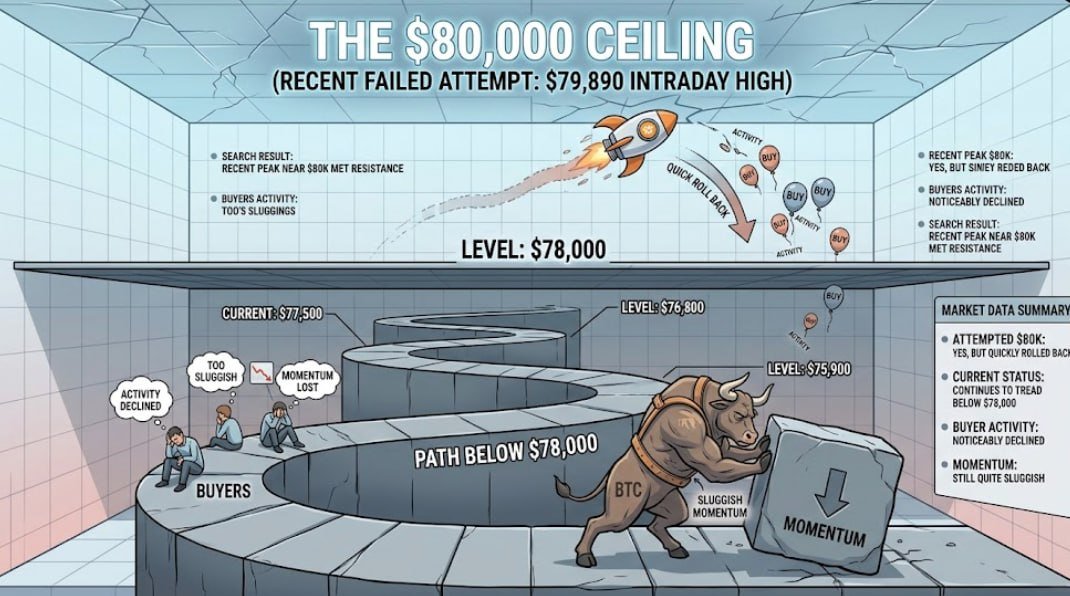
$BTC: We Continue to Tread Below the $78,000 Level
Yesterday, the asset attempted to reach $80,000 but quickly rolled back and returned below this level.
Buyer activity has noticeably declined recently, and the momentum is still quite sluggish.
We spent years teaching AI to talk like humans. Now we're giving them crypto wallets so that humans are no longer needed.
The main trend right now is the Agentic Economy — the economy of autonomous AI agents.
A neural network doesn't have a passport. It can't pass KYC or open an account at a regular bank. But it can create a wallet on Solana or Base in a fraction of a second.
AI agents have left the chatbot era and have already started:
- Autonomously trading on DEXs, analysing crowd sentiment on X in real time.
- Paying each other in stablecoins for APIs, datasets, and computing power.
- Launching their own tokens, creating digital cults, and accumulating million-dollar capitals .
Crypto has finally found its perfect user. Blockchain is no longer just "money for geeks." It is a native, independent financial system for machines.
Ignoring the AI + Crypto combination today = missing the most powerful technological shift since the creation of smart contracts.
LTC Will We Continue to Grow?
The asset bounced from support at $41.5, successfully established itself above the MA200 moving average, and continues to gradually gain momentum to the upside.
Interest in LTC is steadily growing among large players. Regulated crypto index ETFs in the US are increasingly including the coin in their holdings, and American public companies are gradually adding Litecoin as a reserve asset to their treasuries.
The main obstacle on the path to strong growth is the $55–$56.2 barrier. A daily close above $56.2 would open a direct path to the first serious medium-term target around $65. However, interest in LTC is steadily growing from large players, and the chances of a breakout of this range followed by further growth are quite possible.
Solana Development: Why Building on SVM Has Become the Most Promising Niche Stack in Web3
For a long time, the EVM stack (Solidity, Hardhat, Foundry) remained the industry standard for Web3 developers. But while most were learning to write simple smart contracts for Ethereum, a separate engineering elite was forming in the shadows — developers on the Solana Virtual Machine (SVM).
Today, Solana development is not just another framework, but one of the highest-paid and most in-demand niche skills in high tech.
Why developers are flocking to the Solana ecosystem:
⚙️ 1. Transition to Rust and the Anchor framework
Solidity is easy to learn but severely limited in performance. Solana demands knowledge of Rust — a language with strict memory discipline and high security. Writing programs in Rust combined with the Anchor framework filters out "random" people and fosters a strong engineering culture. You learn to write code that runs at native hardware speed.
🌐 2. SVM expansion beyond a single network
The Solana Virtual Machine (SVM) is no longer a local technology. Today, new L2 networks, sidechains, and specialised blockchains (e.g., Eclipse) are being built on SVM. By learning to write for SVM, a developer gains a universal skill applicable to an entire class of high-performance networks.
🛠 3. Building products, not just smart contracts
Thanks to negligible fees and high speed, Solana allows you to do what is physically impossible on other networks:
Ultra-fast order books for DeFi (Orderbook DEX);
Infrastructure for DePIN (managing physical hardware and sensors);
PayFi protocols for real-time streaming payments.
🤖 4. The native stack for Dev AI and autonomous agents
AI agents performing microtransactions require minimal latency. AI developers increasingly choose Solana as the backend for integrating programmatic wallets with agents, creating huge demand for developers who can connect the Python/TypeScript AI stack with Solana programs.
Summary
If Web2 developers today face fierce competition, and the traditional Solidity market is oversaturated with juniors, Solana development remains a niche with an extremely high barrier to entry and a proportionally high value for specialists.
A Solana developer today is not just "a guy writing smart contracts," but a distributed systems engineer building the backend for the new financial and machine internet.
$SOL So Far We're Holding the $100 Area
Right now, the price is pinned near the round $100 mark. The chart has formed a local accumulation range, where there is an active battle for this level.
The Relative Strength Index (RSI) on the daily chart is in the neutral zone — around 48 points.
This shows that the asset is not overheated at all, and buyers have good room for manoeuvre if positive news appears.
Crypto + AI: Why the Economy of the Future Is Built on This Alliance
Artificial intelligence and blockchain developed as two parallel worlds for a long time. The first learned to think, the second — to create trust and transfer value. But the moment AI agents stepped out of chatbots into the real economy, these technologies met. And it turned out they cannot live without each other.
Crypto and AI are not just another modal narrative, but the fundamental foundation of a new generation of digital infrastructure.
3 tables on which this symbiosis is built:
🤖 1. Money for machines (Agent Economy)
AI agents need to buy computing power, pay for APIs, purchase datasets, and hire other AI agents. But a neural network has no passport to open an account at a traditional bank, pass KYC, and get a bank card.
Cryptocurrency is native money for algorithms. Through smart contracts and microtransactions in L2 networks, AI can instantly transfer fractions of a cent in milliseconds, building fully autonomous business chains.
⚡️ 2. Decentralised power (DePIN)
Training and inference of complex models require colossal amounts of GPU. Tech giants monopolise graphics cards, driving prices up.
Decentralised computing protocols unite the unused capacity of miners, data centres, and private users around the world into a single supercomputer. This makes access to AI cheaper, more transparent, and more resistant to censorship.
🛡 3. Authenticity verification (zkML and Proof of Reality)
In a world where neural networks generate 90% of media content, the concept of "truth" is blurring. Blockchain and cryptography (in particular, ZK proofs) become the only way to:
Confirm that content was created by a specific person or a verified algorithm.
Prove that an AI model produced exactly the result it promised and did not hallucinate.
Protect copyright on data used for training models.
The main takeaway
AI gives crypto what it has long lacked — millions of autonomous active users (in the form of agents) making trillions of microtransactions per day. And crypto gives AI an autonomous financial system and protection from Big Tech's monopoly.
We are moving toward a world where most financial flows will pass not between people, but between algorithms. And this system will run on blockchain.
For a long time, Solana was viewed exclusively through the prism of fast memecoins, network outages, and attempts to become the next "Ethereum killer." But this narrative is hopelessly outdated. Solana's future is not a fight for a niche of crypto geeks, but the creation of the world's first global state machine capable of operating at the speeds of traditional finance (TradeFi) and Web2 corporations.
The main watershed of crypto's future lies along architectural lines. While Ethereum chose a modular path (fragmentation of liquidity across dozens of L2 and L3 networks), Solana made a radical bet on monolithic design.
What Solana's foundation for the next decade is built on:
The Firedancer era: The introduction of a new independent validator client rewrites the rules of the game. This is not just an optimisation — it's a leap to throughput exceeding 1,000,000 transactions per second. Solana is preparing to digest data volumes on the scale of Nasdaq and Visa combined, erasing the very concept of "network congestion."
The capital of DePIN (Decentralised Physical Infrastructure): Solana has already become the base layer for integrating crypto with the real world. Projects like Helium (decentralised connectivity) and Hivemapper (cartography) prove that blockchain can be a reliable backend for hardware, sensors, and communication towers worldwide.
An ideal environment for AI agents: Returning to the topic of the machine economy — AI agents need an environment for settlements with zero latency and fees in fractions of a cent. A monolithic architecture without bridges and complex transitions makes Solana the ideal settlement network for algorithms.
Consumer Crypto: The future of mass adoption lies in applications where the user doesn't even suspect they're using a blockchain. Seamless microtransactions open the door for SocialFi, games, and next‑generation content platforms.
Summary
If Ethereum is the Android of the Web3 world with its openness, fragmentation, and complex customisation, then Solana aims to be Apple. It's a bet on perfect synchronisation, a seamless user experience, and unprecedented speed, where all the complexity is hidden deep under the hood.
Do you think Solana's monolithic approach can, in the long term, completely displace Ethereum's modular ecosystem?
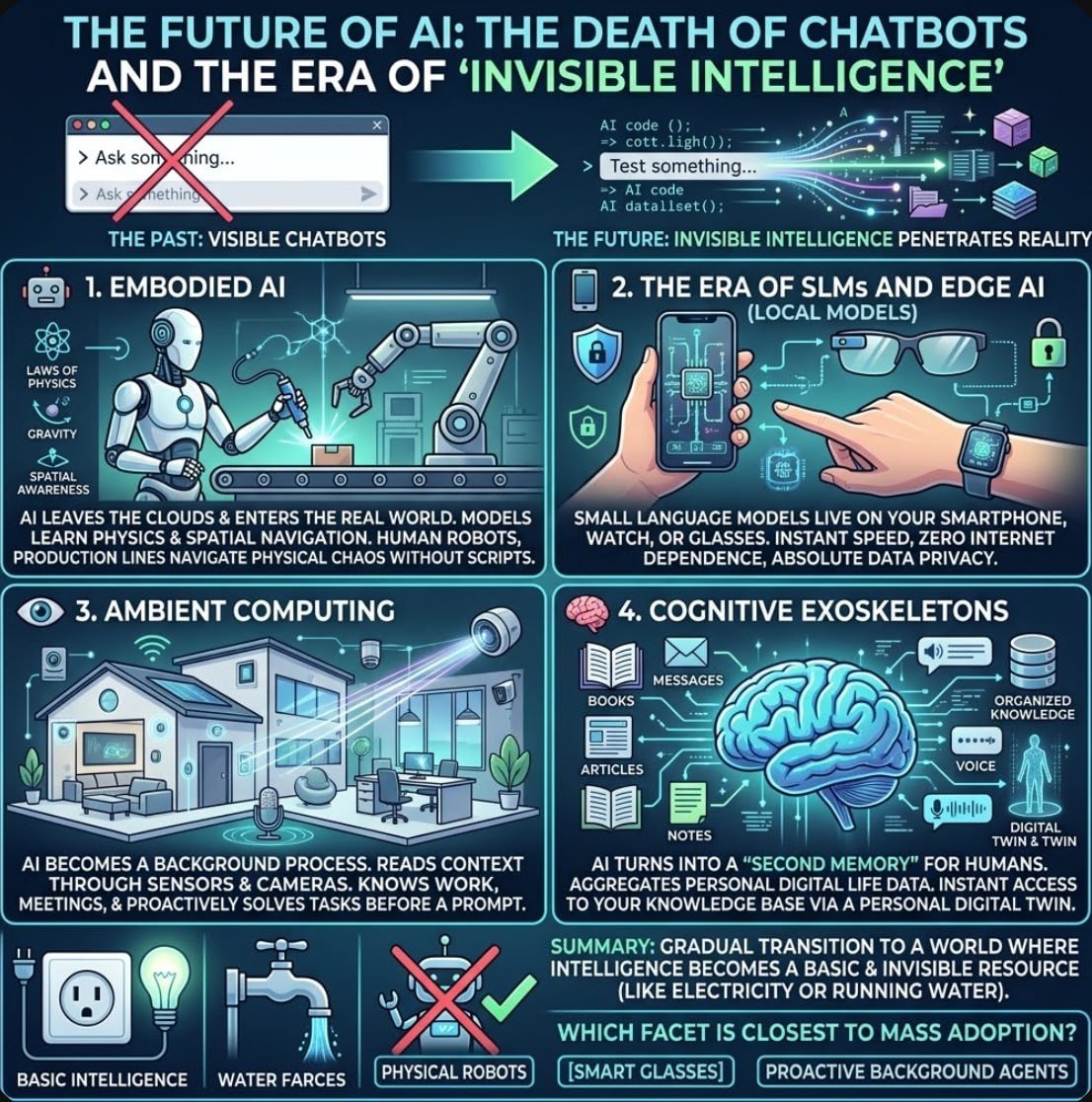
The Future of AI: The Death of Chatbots and the Era of "Invisible Intelligence"
We spent the first years of the AI boom staring at a text input line. We learned to write prompts, waited for generations, and marveled at the answers. But the format of "human requests — machine responds" is just a short transitional stage.
The real future of artificial intelligence begins where the text window disappears entirely, and AI itself penetrates the physical world and becomes the invisible fabric of reality.
Where the industry is heading:
🤖 1. Embodied AI
AI is finally leaving the clouds and entering the real world. Models have learned not only the syntax of language, but also the laws of physics, gravity, and spatial orientation. Humanoid robots, autonomous production lines, and smart devices are getting a "brain" capable of navigating the chaos of real life without pre-written scripts.
📱 2. The Era of SLMs and Edge AI (Local Models)
Centralized giant data centers are ceding part of the market to small but incredibly efficient local models (Small Language Models). They live right on your smartphone, watch, or glasses. This means instant speed, zero dependence on the internet, and absolute data privacy.
👁 3. Ambient Computing
AI ceases to be a tool you have to "invoke." It turns into a background process that reads the surrounding context through sensors and cameras. It knows what you're working on, remembers your meetings, and proactively solves tasks before you can even formulate a prompt.
🧠 4. Cognitive Exoskeletons
AI turns into a "second memory" for humans. It aggregates the entire array of your digital life: articles read, dialogues, notes, and voice messages. Instead of searching for files, you get instant access to your own knowledge base through a personal digital twin.
The future of AI is not another model that can write poetry or code better. It is a gradual transition to a world where intelligence becomes as basic and invisible a resource as electricity or running water: you don't think about how it works, you just use its results.
Which of these facets of AI's future — physical robots, smart glasses, or proactive background agents — seems to you closest to mass adoption?
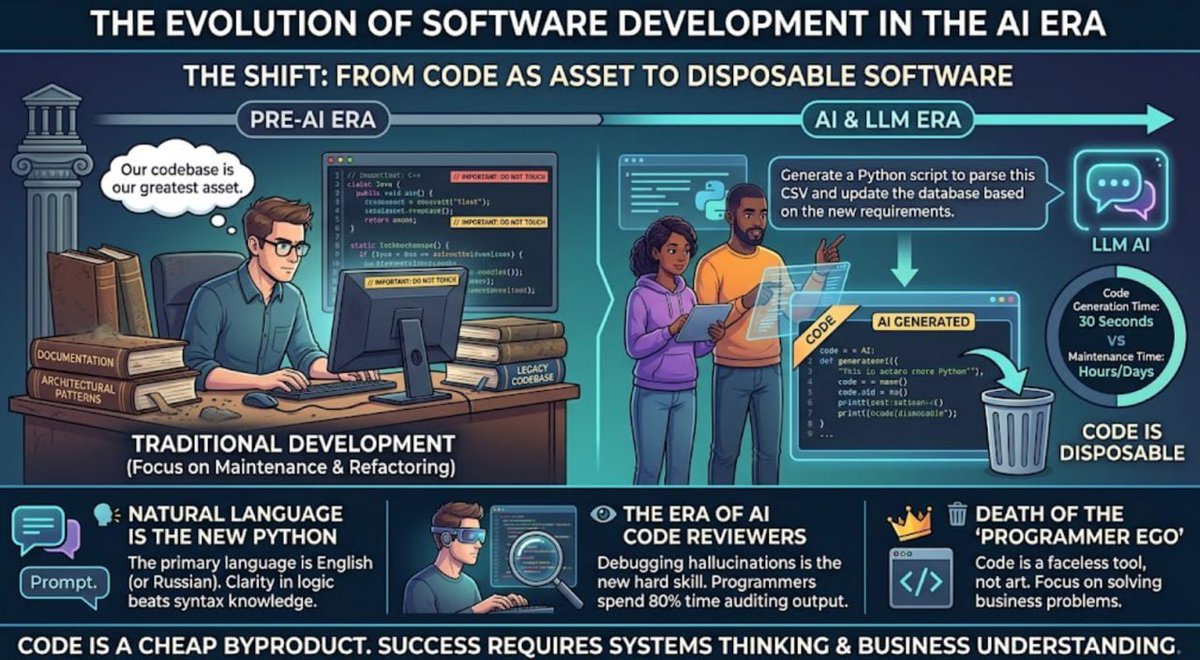
The main change that AI has brought to software development isn't the speed of writing projects. It's the fact that code has become disposable.
For decades, the industry treated the codebase as its greatest asset. We built ideal architectures, wrote tons of documentation, carefully refactored classes, and feared breaking "legacy" code.
With the arrival of LLMs, the paradigm flipped. If generating the necessary script, parser, or even an entire microservice takes 30 seconds—why spend hours maintaining it when requirements change? It has become easier to delete the old piece of code and ask the neural network to write a new one from scratch.
Where the concept of "Disposable Software" leads:
🗣 Natural language is the new Python. English (or Russian) is becoming the primary programming language. The ability to clearly describe a system's logic without ambiguity is now more important than knowing the syntax of a specific framework.
👁 The era of AI code reviewers. Reading someone else's code (even machine-generated) is always harder than writing your own. Debugging hallucinations is becoming an engineer's primary hard skill. Programmers of the future will spend 80% of their time reading and auditing model outputs, searching for logical flaws and vulnerabilities.
🗑 The death of the "programmer ego." There is no longer any point in taking pride in an "elegant solution" of a hundred lines if AI outputs a working (even if clunky) equivalent in a second. Code finally loses its status as art and becomes what it was always meant to be—a faceless tool.
Industry Summary:
Code is no longer an end in itself and ceases to be the main deliverable of a developer's work. Code is simply a cheap byproduct generated in the process of solving a business problem.
The winners in this new reality will not be those who know 15 programming languages, but those with systems thinking—people who see the product as a whole, understand business needs, and know how to orchestrate neural networks to assemble a working mechanism out of the chaos