That 30 minutes in a corporate hotel room between the last conference session and dinner with your colleagues will have you questioning your entire existence
A powerful scene in the Odyssey happens when Odysseus finally returns to Ithaca after twenty years of war and wandering.
You would expect the story to end with celebration, with the hero coming home, the family reunited, and order restored.
Homer does something far stranger.
Odysseus arrives disguised as a beggar, because Athena warns him that the palace has been taken over by more than a hundred suitors who have been living there for years, eating his food, drinking his wine, and pressuring his wife Penelope to marry one of them.
They believe Odysseus is dead and in their minds the kingdom is already theirs.
So the king of Ithaca walks through his own halls dressed in rags while the men stealing his house sit comfortably at his tables. They mock him, throw scraps at him, and one of them even strikes him, and Odysseus takes it. That is the remarkable part, because the same man who blinded the Cyclops and survived twenty years of disasters now stands quietly while strangers insult him in his own home. Homer tells us his heart burns inside his chest and that he wants to attack them immediately, yet he restrains himself and waits.
Instead of striking, Odysseus studies the room carefully. He counts the men, watches their habits, and quietly observes which servants remain loyal and which have betrayed him. The hero of the Odyssey does something most people cannot do, which is delay revenge until the moment is right.
Eventually Penelope announces a contest and brings out Odysseus’ great bow, declaring that she will marry the man who can string it and shoot an arrow through twelve axe heads lined up in a row. One by one the suitors try and fail, because none of them can even bend the bow. Then the beggar asks for a turn. The suitors laugh at first, but the bow is eventually handed to him.
Odysseus takes it in his hands and strings it effortlessly. Homer says the sound of the bowstring tightening rings through the hall like the note of a swallow. Then he places an arrow on the string and sends it cleanly through all twelve axe heads.
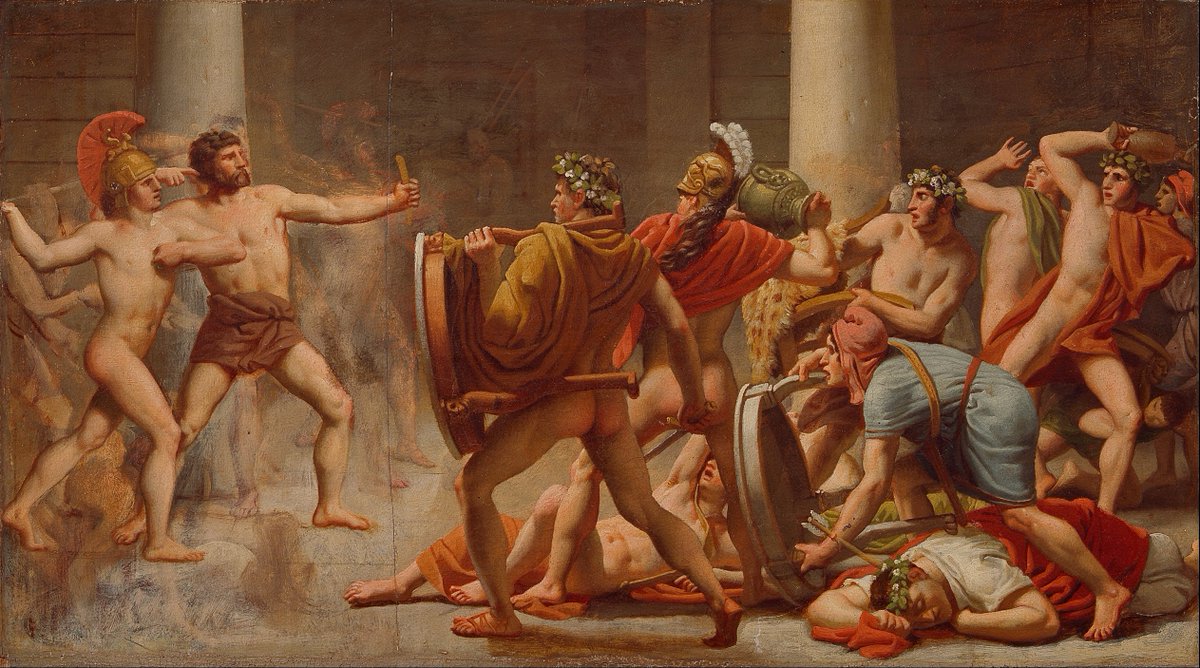
In that moment the beggar disappears. Odysseus turns the bow toward the suitors and reveals who he is.
What follows is one of the most brutal scenes in Greek literature. The doors are sealed and the suitors realize too late that they are trapped inside the hall. Odysseus, his son Telemachus, and two loyal servants begin killing them one by one. There is no escape, no mercy, and no negotiation. The men who spent years consuming another man’s house die inside it.
It is a violent ending, but Homer wants you to understand something important. The real danger to Odysseus was never just the monsters and storms on the long journey home. It was the possibility that someone else might take his place while he was gone. When Odysseus finally returns, he reminds everyone in Ithaca of a simple truth: a man’s home is not truly his unless he is willing to fight for it.
@ebenezerDN Great point of view, I’ll push it one step further. It’s not just taste and vision that is lacking - it’s also proximity to real unsolved problems. In the west the same problems are being tackled now as before, but there’s only marginal headroom for new value to be unlocked
@ArmanHezarkhani I work at one of the large consultanciea. Lovable slide decks are a game changer. For trainings, workshops, non client sensitive work - I will never make a deck from scratch again. The output is top notch once the deep thinking is done and 10x better if you have a designer’s eye
We’ll soon have this collective realisation on a much grander scale. The pool of value that ai companies are aggressively pursuing to automate…isn’t as large as we like to think. And that’s even before you consider the countless hurdles that make most enterprises unserviceable.
@vanschneider Love it. The private garden: nurtured, cultivated to bear public fruit. So excited about the potential of My Mind being a powerful data future source that forms part of my personal “context layer” that feeds my GPT
I think about this often - how the solutions builders gravitate towards building most are for productivity/efficiency.
Understandable, but I’m excited for the phase where people with more diverse lived experiences realised they're empowered to solve problems only they can see
@JJEnglert Love this approach. If you’re an ideas guy - the biggest risk is shiny new toy syndrome. Wanting to build out and talk about your newest idea (which we always view through rose tinted glasses). Ruthless focus wins everytime - been saying “no” to myself a lot more!
The curdles of its essence brew in the deepest parts of our beingness, sometimes wafting to consciousness with enough silence. Its voice is calm, changeless, eternal.
The spirit is steady, quiet, & deep in its basin of effulgent all-knowing finitude. It is timeless and thus doesn’t have a past or future. It is now. Existing in a realm beyond man-made attributes of space and time.
@theAyoAlfonso You’re not wrong. The soft merging has already begun. Anybody who’s 10x’d their effeciency/effectiveness over the past two years by leveraging AI tools, likely has a new formed connection to AI that is hard to articulate because it’s never existed before