“ChatGPT for dishwashing.”
Cool. Can we finish our work before hitting the limit?
We built Routor to make your AI budget go further. The right model for each task, less wasted spend, plus extra AI credits for $ROUTOR holders.
Save credits. Earn credits. Keep building.
https://t.co/Xlkg9MKYX1
Gemini 4 Argon Launched
Google’s new frontier model takes on deep reasoning, software engineering, cybersecurity, legal work and finance, scoring 77.9% on DeepSWE.
Impressive. But even Google’s own benchmarks show other models ahead on some tasks.
And your app doesn’t spend all day solving complex problems. It also answers simple questions, summarizes documents and extracts data.
Sending everything to one frontier model means paying for reasoning you don’t always need, while missing another model’s strengths when you do.
That’s where Routor comes in. It automatically routes each request to a best-fit model, balancing capability, speed and cost.
Every launch gives you another model to evaluate.
Routor gives you one less decision to make.
Pick a tier, not a model.
https://t.co/Xlkg9MKYX1
Your AI agent now has its own computer. It never sleeps. And it will still find a way to get stuck at 3am.
OpenAI just launched Dots. Every user gets a dedicated cloud computer and browser, powered by GPT-6 Astra, connected to 4,000+ apps. It keeps context across ChatGPT, Slack and Teams, and it keeps working while you're offline.
But always-on agents mean always token maxxing. It's a new way to burn money. Every heavy workload, every chained task, every retry runs on a meter that never stops.
That leads straight to agent hell. Your agent hits a blocker at 3am and needs an approval, a login or a decision. The agent isn't the problem. You're the bottleneck for something that never sleeps.
Here's the part nobody talks about:
An agent working across 4,000 apps opens, sends and follows links all day. One broken, outdated or misdirected link can stall a whole workflow. Every stall burns tokens and drags you back in.
If an agent runs unattended, the infrastructure under it has to be reliable.
That's why we built Routor. It sends every URL to the right destination automatically, so your agents and workflows keep moving without manual fixes.
Try it: https://t.co/Xlkg9MKr7t
Tired of “trust me bro” AI benchmarks?
Every new AI model launches with a chart claiming it is the best. But the best model for coding may be the wrong model for customer support, research, tool use, or a simple summary.
So we built an interactive demo of a different approach: the Routor Routing Decision Market.
Choose a request category, compare four benchmark-qualified models, and predict which model will perform best for that type of request.
In the proposed token-powered version, $ROUTOR holders could back their predictions. Why participate? Predictors who prove accurate could earn a share of Routor’s profit-funded reward pool.
This wouldn’t be a popularity vote. Rewards wouldn’t go to people simply for choosing the model with the biggest name or following the crowd.
Predictions would be checked against Routor’s measured outcomes: whether answers were accepted, retried, or rated down for that prompt type, with cost included in the task definition.
If these predictions produce a useful signal beyond what Routor already measures, they could help improve future routing decisions.
Better predictions → better routing → a better product → more usage → a stronger $ROUTOR ecosystem.
This is still research, untested, and not on the roadmap. The reward mechanics would also require legal review before being built.
Explore the idea and demo:
https://t.co/92sZUFZuos
This is the part I find really interesting.
If AI credits become capital for agents, then eventually they’ll probably need the same things money has today: markets, pricing, liquidity and a way to move value between participants.
That’s why the Surplus idea makes sense to me. Let people price and trade unused AI credits instead of letting them sit idle.
At Routor, we’re looking at the other side of the same economy: how to make those credits go further by routing each task to the right model.
Surplus gives credits a market. https://t.co/Xlkg9MKYX1 tries to make every credit more useful.
Funny how fast the leaderboard flips.
Opus was above launch yesterday and sits at 94.2% today, while Sonnet is on 100.9% like nothing happened.
But benchmark numbers mostly measure hype.
Routor ignores the leaderboard and sends each task to whichever model actually does that kind of work well, so a score swinging overnight never reaches your output.
Claude Opus 5.5 just took a big drop on NerfBench.
Yesterday it was scoring above launch. Today it's at 94.2%.
GPT 6 Astra: 98.0%
Sonnet 5.5: 100.9%
GPT 6.1 Sol: 106.7%
94.2% is still inside normal variance, so we can't call it a nerf yet.
But we're watching Opus 5.5 very closely.
We’ve been thinking about another way $ROUTOR could connect back to the actual product.
What if holders could help Routor figure out which AI model performs best for different types of requests?
Not by voting for their favorite model.
By making predictions that are eventually measured against real Routor outcomes: accepted answers, retries, user feedback, cost and performance.
If the crowd actually produces a useful signal, that signal could make the router better.
Better routing → better product → more usage → stronger ecosystem.
Still research. Still untested.
But this is the kind of utility we want to explore around $ROUTOR.
https://t.co/92sZUFZuos
Routor is moving into Web3.
But we didn’t want to add a token just for the sake of having one.
We wanted the token to connect directly to the product.
The idea behind $ROUTOR is simple:
People use Routor → Routor generates revenue → part of the profit goes into the holder reward pool → holders earn AI credits → those credits get used back on Routor.
A flywheel built around actual AI usage.
The product remains the core.
The token becomes part of the ecosystem around it.
We’ve started documenting how it works ↓
https://t.co/iAgyIvxMLL
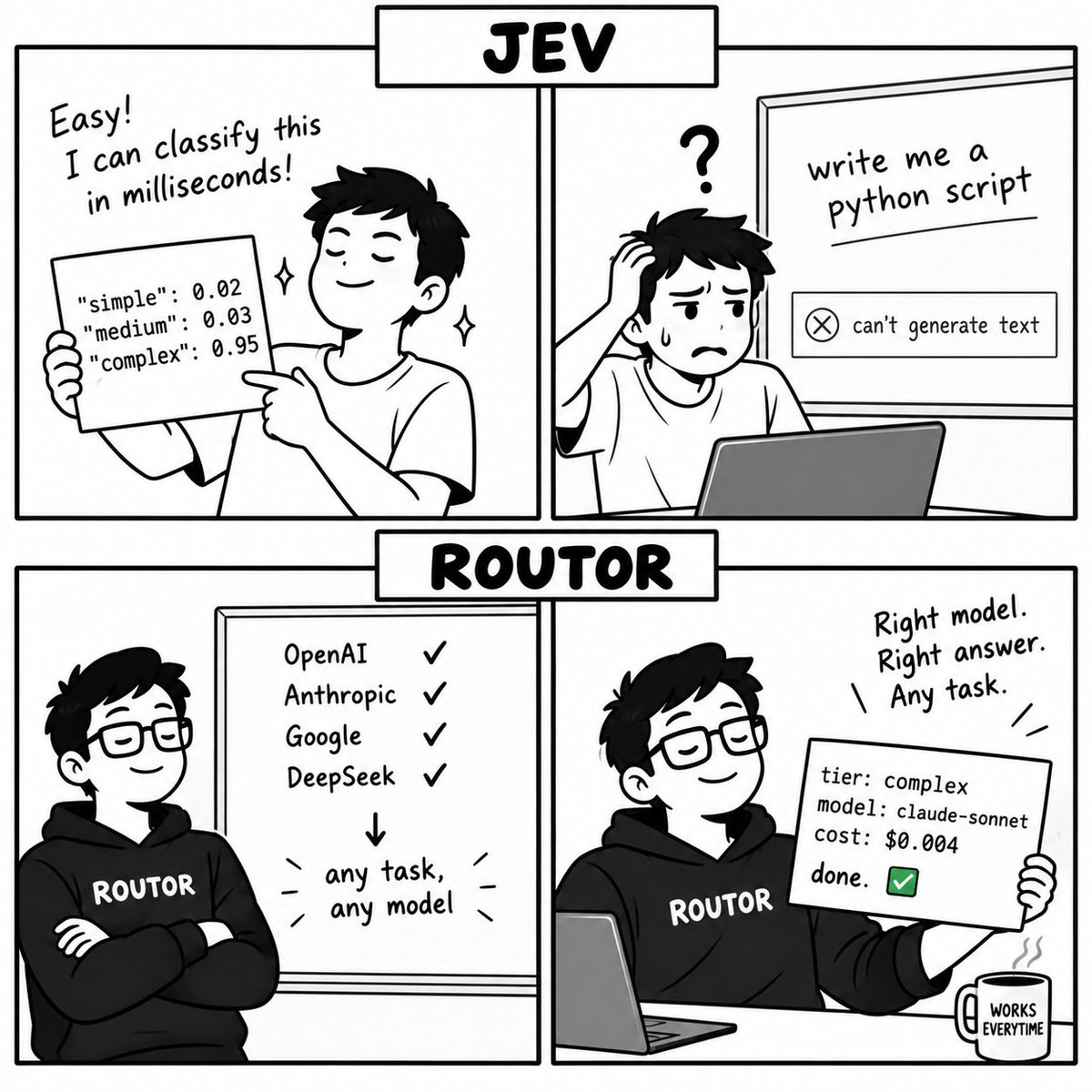
Most AI routers stop at one question:
“How complex is this task?”
ROUTOR asks the question that actually matters:
“Which model should handle it?”
JEV can classify the task in milliseconds.
ROUTOR can classify, choose the right model, optimize for cost, and execute.
Don’t just predict the answer.
Route the task to the model that can deliver it.
Jev, Jev, Jev.
So what exactly is Jev?
Jev is a type-safe AI layer that makes AI outputs behave more like real software types instead of unpredictable text.
Why does that matter?
Because building with AI today often means parsing responses, validating schemas, handling retries, and writing a lot of glue code just to make the output usable.
Jev is built around a simpler idea:
Let AI work with types from the start.
That becomes especially interesting for structured outputs, tool calling, AI agents, and production workflows where “the model usually returns the right format” isn't good enough.
Jev isn't trying to make AI smarter.
It's trying to make AI usable by software.
GPT-6 Sol might drop today 👀
X right now: tomorrow is going to be legendary.
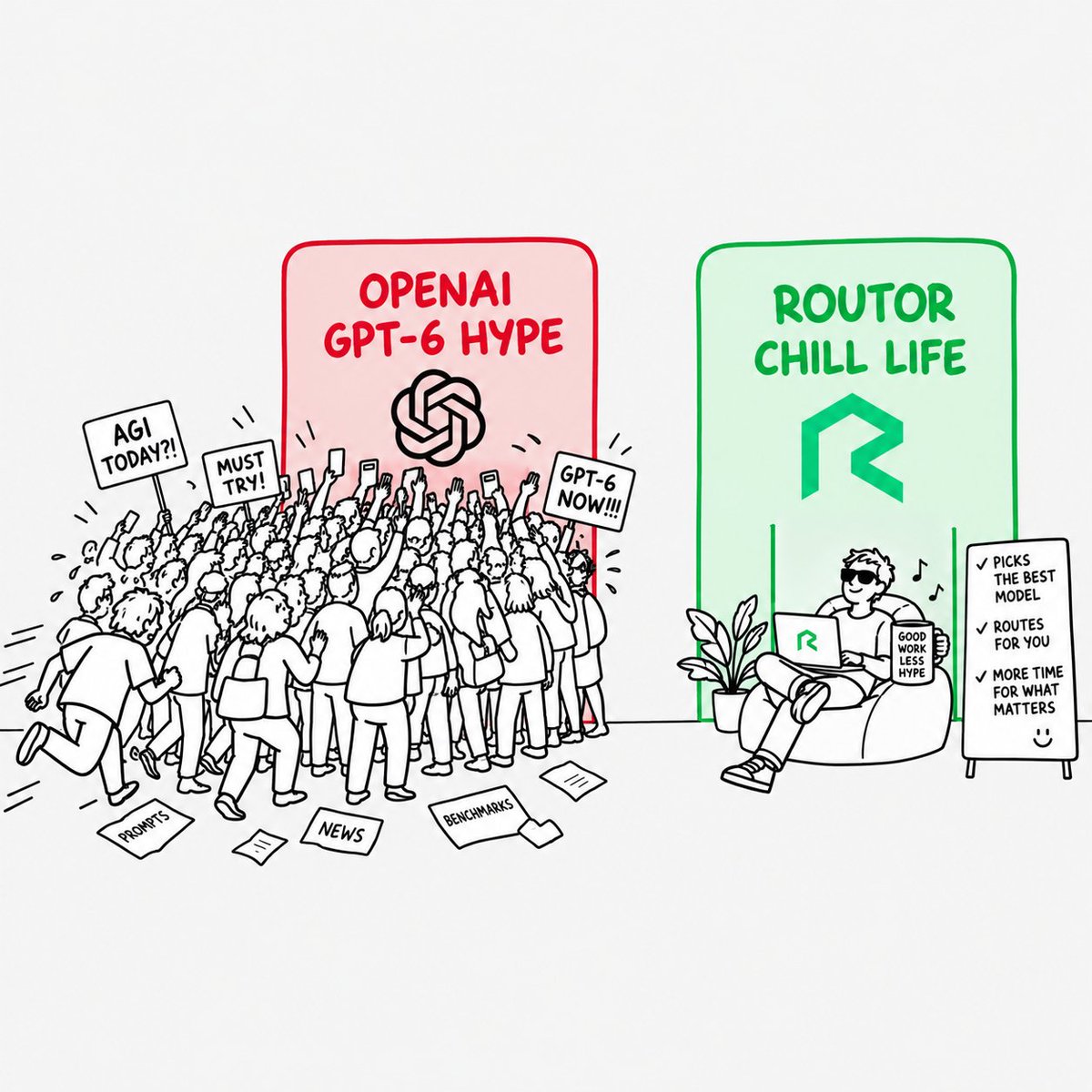
Meanwhile there are two kinds of people:
GPT-6 hype life: refreshing X, waiting for benchmarks, chasing every new model.
Routor chill life: send the request, let the task pick the model, keep shipping.
Which life are you choosing?
try it now: https://t.co/wzhB27V9m9
Your $0.017 AI request might actually be a $0.002 request.
So I built a tiny experiment.
Same prompt. Same task.
One goes straight to Opus 5.
The other goes through Routor.
You can watch the model choice, tokens, latency and cost live.
This run: 84% cheaper.
The interesting question isn’t “what’s the best model?”
It’s “does this task even need it?”