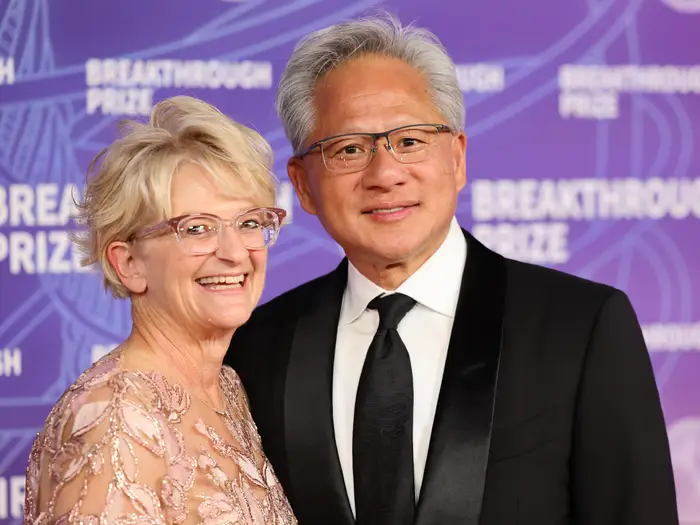
Look at his wife.
She has the post menopause short hair cut that women get that screams desexualization. There is no doubt in my mind she is no longer interested in having sex with Jensen.
Jensen is fit. A silver fox. And HAD $150 billion.
Women came on to him. Daily. He’s a magnet for women……Older, wealthy, attractive and powerful.
At home his wife most likely had a permanent headache.
Would you have the personal strength to walk the straight and narrow and resist temptation that was literally thrown your direction daily, while your partner turned into your grandmother at home?
Ethereum generates about $5.7 trillion of value for the economy built on it.
The market prices ETH at $246 billion. That’s 4.3% of it.
Today I’m publishing the second edition of my annual Ethereum-as-infrastructure valuation report. Here’s the essence of it.
1/ Ethereum is a public good, so value it like one
Nobody can buy shares in TCP/IP, yet the Internet is the most valuable infrastructure ever built. Its protocols charge almost nothing. Their value shows up everywhere except in their own revenues.
Ethereum is in the same position. Valuing it by its fees, or comparing it to a company, misses most of what it does. Last year I argued it should be valued the way we value the Internet: through what it enables, not what it charges.
2/ Three buckets, like the Internet
The Internet’s value comes in three parts: the companies built on it, the economic activity it carries, and the surplus people get for free. Ethereum maps onto the same three:
a) Ecosystem value: the assets and companies built on Ethereum, at market prices. $127B.
b) Flow value: the economic activity Ethereum settles, mainly stablecoins, plus trading, lending and tokenized assets. $70T a year of dependent flows, worth $3.0T.
c) Trust surplus: what users would pay for trust in the traditional system, minus what they pay on Ethereum. Custody, reconciliation, settlement delays, counterparty risk. Worth $2.6T.
Add a small credit for the EVM standard used by other chains, and Ethereum’s system value comes to about $5.7 trillion.
3/ Every rate is anchored to something real
I didn’t want numbers that look picked to land somewhere. So:
Ethereum is credited by using Visa’s take on the payments it carries, about 0.3%. Visa is the richest settlement network on earth, so that’s a ceiling, not an average.
The trust cost removed is 25 basis points, weighted toward wholesale settlement rather than expensive retail payments.
Annual values are capitalized at 7%, assuming Ethereum’s activity never grows from today. For a network that has grown every year, that’s deliberately conservative.
4/ ETH’s market cap is the benchmark, not part of the total
This is the biggest change from last year. Counting ETH inside the total would double count. So the model compares what Ethereum enables with what the market pays for ETH.
For every $1 the market pays for ETH, Ethereum generates about $23 of value for the ecosystem built on it.
5/ But ETH shouldn’t be worth all of it
Part of that value belongs to others: L2 tokens, DeFi protocols, shares in Robinhood, Circle and Coinbase, a stake in Tether. And public goods never capture everything they enable. That’s the whole point of them.
So the real question is: what share can ETH capture?
The Internet gives us an answer. The companies built on it are worth roughly 10–20% of the economic value it creates. Apply the midpoint, 15%, to Ethereum, and ETH would be worth about $7,000. That’s 3.5× today’s price.
Today the market credits ETH with less than 5%. Under half the low end of the Internet’s range.
6/ The number that’s hardest to argue with
Forget the capitalization multiple entirely. Each year, Ethereum enables about $389 billion of value. That’s 1.6× ETH’s entire market cap.
Ethereum enables more value every year than the market currently pays for ETH in total.
7/ What’s new: a live model you can challenge
This year the report isn’t static. Every figure comes from a live dashboard that refreshes hourly from public sources. You can inspect every input and formula, and use simulation mode to change the assumptions.
I wanted a model anyone could check and challenge. If you disagree with an assumption, change it and see what happens. https://t.co/Qi2z7fjrDo
8/ What it isn’t
It’s not a price target, and it’s not a forecast. It’s a snapshot of today, measuring the gap between what Ethereum enables and what ETH is credited with. Either ETH’s capture of its own ecosystem rises toward Internet-like levels, or the market is pricing in that it never will.
That’s the debate this framework makes explicit.
The Internet reorganized information. Ethereum is reorganizing trust.
Full report: https://t.co/mwmJ5nuc2Z
PDF: https://t.co/YRqhyzd46F
Live model: https://t.co/Qi2z7fjrDo
An expanded version will appear in my upcoming book, TRUSTSHIFT: Ethereum and the Reinvention of Trust. https://t.co/5zfc94ppeP
BREAKING: Bitcoin falls below $69,000 and ETH nears $1,900 as selling pressure accelerates in crypto.
Crypto markets have now lost -$150 billion in 48 hours.
Congratulations to Bitso on their Hyperliquid integration! Bitso is the largest crypto platform in Latin America with over 10M users and serves as a major onramp for these users into crypto. Historically, users often came for the onramp but traded elsewhere. Now they can trade onchain perpetuals on the world’s most liquid markets without leaving Bitso.
I hope this is a story that continues to play out across the globe. Platforms that onboard new users should be able to serve them end-to-end. Hyperliquid is neutral infrastructure that makes it easy for anyone to tap into world-class liquidity and technology for their users.
Personally, Latin America has a special place in my heart. I’ve spent time in many of the countries that Bitso serves, where I met some of the kindest people I know. It’s an honor to be able to build technology for these communities. Thank you to Bitso for bringing the world’s markets to your users.
Y gracias a todos por confiar en Hyperliquid. Vamos a construir juntos la casa de todas las finanzas.
If someone ask me to give women ONE piece of advice for a happy marriage, I’d say:
Make sex a priority. Aim for at least twice a week
A healthy sex life won’t solve every marital problem, but a neglected one can create plenty of them.
Prediction. Screenshot this post, we'll talk again in five years.
They're going to pull it off. Jensen Huang is going to be pushed out of Nvidia.
And here's what happens next.
Elon hires Jensen and puts him in charge of Terafab.
He's already said it publicly: hiring him would be an honor. And Terafab is the project made for him. A chip factory Musk wants to be the largest ever built, one terawatt of compute per year, from design to packaging under one roof. Terafab's challenge is to do in a few years what the industry took decades to build. There's only one man on Earth who knows every layer of that stack.
They execute like absolute maniacs.
Musk brings speed, capital and appetite for risk. Jensen brings thirty years of mastery of the stack: architecture, software, customers, supply chain. Musk builds factories faster than anyone alive. Jensen knows exactly what to put inside them. It's the only duo in the world capable of compressing a decade into three years.
SpaceXAI merges with Tesla.
This isn't even science fiction anymore: independent committees are already studying the merger. Rockets, satellites, AI, robots, self-driving cars, energy, and now chips. One single entity, integrated from silicon to orbit.
The group climbs to $50 trillion.
Today, SpaceX and Tesla are worth around $3.4 trillion combined. $50 trillion sounds insane. But remember: ten years ago, Nvidia was worth a few tens of billions. When you own superintelligence, the robots that do the work and the rockets that go to space, you don't capture a market. You capture the economy.
Elon buys Nvidia.
Meanwhile, Nvidia without Jensen does what every company does after losing its founder: it manages. It protects its margins. It loses ground to its own customers' in-house chips. And one day, it becomes a target. For a $50 trillion group, buying Nvidia is just one acquisition among others.
Jensen becomes the chip boss again.
He takes over the semiconductor division of the new entity. Pushed out of his own company, he gets it back from above, inside the largest industrial group in history.
Sounds crazy? Steve Jobs did exactly that. Pushed out of Apple, he came back when Apple bought NeXT. You know the rest.
Nvidia's board thinks it's getting rid of a problem.
It's creating the biggest competitor in its history.
See you in five years.
NVIDIA employees: go on strike. Now.
Not for a raise. Not for more PTO. For your founder.
Jensen Huang was just pushed out in four days, after thirty-three years building the company. The GPU, CUDA, the entire infrastructure the world's AI runs on today. And it ends with a three-line press release on a Thursday morning.
Here are the facts. Sunday, Huang admits to an affair and apologizes to his teams. The board launches an independent investigation, led by Wachtell Lipton and a former federal prosecutor. Thursday, he resigns under pressure. The investigation hasn't reached any conclusion. No technology leak has been established. No misconduct has been announced.
The sentence came before the verdict.
Let me be clear: if the investigation shows that NVIDIA secrets ended up in Beijing, he has to go, and nobody will defend him. But you don't unplug the most important builder of the decade over press reports and a market panic. It's called the presumption of innocence. It applies to founders too.
And it has worked before.
November 2023. OpenAI's board fires Sam Altman on a Friday night. Within days, more than 700 of roughly 770 employees sign a letter: bring Altman back, or we all walk. Five days later, Altman is back, and most of the board that fired him is gone.
Call it the Altman precedent: in a company built on talent, real power doesn't sit with the board. It sits with the people who build.
NVIDIA's engineers hold that power today. They're the ones running the machine. Without them, there is no next generation of chips.
So put down your tools. All of you. And tell the board: no successor until the investigation is done. Facts first, sentence second.
A founder isn't an executive you swap out. A founder is the soul of the company. Apple learned that when it pushed out Steve Jobs in 1985. It took twelve years and a near-bankruptcy to bring him back.
NVIDIA doesn't have twelve years. The AI race won't wait for anyone.
A company's soul isn't something you vote on in a boardroom. It's something you fight for.
I don't know how many Americans realize what they just lost.
This isn't a CEO. It's a national treasure.
And I'm going to prove to you, step by step, that the Nvidia board's decision goes against the interests of the United States. And that if America wants a future against China, it has to fight to bring Jensen Huang back.
A. The AI race is won on compute.
That's not an opinion, it's physics. The most powerful models are the ones with the most compute. And most of America's compute runs on Nvidia chips.
B. Nvidia's lead is one man's judgment.
Jensen is the one who bet on CUDA when nobody believed in it. He's the one who understood before anyone else what deep learning would become. He's the one who pivoted the entire company toward AI, years before ChatGPT. Thirty-three years of decisions nobody else would have made.
C. The board prepared no successor.
It admits it itself: it's now considering searching for a CEO from the outside. That means months of searching, internal power struggles, cautious decisions. At the exact moment Huawei is accelerating with the entire Chinese state behind it.
D. The market has already delivered its verdict.
The stock dropped another 10% or so on the announcement. Hundreds of billions of dollars gone. And those dollars are also the retirement savings of tens of millions of Americans.
Conclusion: who benefits from this decision?
Not America. Not shareholders. Not employees. China.
Now let's look at what he's accused of.
Yes, Jensen messed up. Twice. That's real. I'm not defending his private life.
But he isn't accused of any crime. No one has shown that a single secret leaked. The board itself wrote that it had no reason to believe national security or Nvidia's secrets were compromised.
You don't destroy the pillar of America's technology strategy over a moral failing. You sanction it, you tighten oversight, and you keep the man the country needs.
And we know exactly how to do it. There's a precedent.
In 2018, the SEC went after Elon Musk. Many demanded he leave Tesla. The solution? He gave up the chairmanship, Tesla added independent directors, and he stayed CEO. You know the rest: Tesla became one of the most valuable companies in the world.
Nvidia just appointed its first-ever board chair. The oversight structure is there. The only thing missing is the founder.
Because founders aren't managers like the others.
Peter Thiel laid it out in Zero to One: founder-led companies are capable of long-term planning, of making decisions nobody else would dare to make, and of inspiring a loyalty no hired manager can ever buy. Paul Graham called it "founder mode": when a founder runs the company, the rules of conventional management don't apply. They see things nobody else sees.
Steve Jobs is the living proof. Apple's board fired him. Twelve years later, Apple was months from bankruptcy. Jobs came back and made it the most valuable company in the world. How many years were lost? How many products never launched?
And recent history has even shown us that a comeback is possible.
Three years ago, OpenAI's board fired Sam Altman. Within five days, more than 700 of its 770 employees threatened to leave. Investors applied pressure. Altman came back, and the board was replaced.
What was undone in five days at OpenAI can be undone at Nvidia.
Employees need to speak up. Shareholders need to speak up. Washington needs to understand what's at stake. Everyone who believes America must win this race needs to say loud and clear that this decision is a historic mistake.
You will never find another Jensen Huang. Not in ten years. Not in thirty. There's only one.
Bring him back.
#BringBackJensen
IF THE BOARD FIRES JENSEN AMID THIS CONTROVERSY WITHOUT A SOLID BUSINESS CASE, THEY RISK SERIOUS FIDUCIARY-DUTY CONSEQUENCES - RETWEET, CREATE THE COUNTER-MOB.
⚠️⚠️ If Nvidia fires Jensen Huang, America loses the AI race. And China wins it. ⚠️⚠️
I'm choosing my words carefully.
Nvidia's board is deciding whether to remove its founder. Wall Street wiped out hundreds of billions of dollars in a single evening, and everyone is pretending you can replace a CEO like you change a light bulb.
You can't replace Jensen Huang.
This isn't about morality. It's about mechanics.
Let's start from the beginning.
Three engineers meet in a Denny's in San Jose. Jensen is 30. As a teenager, he washed dishes in that same kind of diner. The plan: chips for 3D graphics, in a market that doesn't exist yet.
The first product flops. The Sega deal falls apart. Nvidia is weeks away from dying. Jensen goes to Sega, admits his chip won't work, and asks them for money anyway. Sega invests $5 million. That money saves the company.
For years, he opens his meetings with the same line: we are 30 days from going out of business.
Then comes the GeForce, the first GPU. Then CUDA. He decides to make his chips programmable for any kind of computation, not just video games. Billions burned for a decade on a bet nobody understands. Wall Street hates it. He holds.
Then AlexNet, the neural network that kicks off the deep learning revolution, is trained on two Nvidia graphics cards. Jensen understands what it means before anyone else. He pivots the entire company to AI. He personally hand-delivers the first DGX-1 supercomputer to a small research lab called OpenAI.
Today Nvidia is worth around $4 trillion. Almost all the AI on the planet runs on its chips.
That's not luck. That's 33 years of tryhard.
And here's what people don't understand about founders.
A founder CEO isn't a job title. It's a nervous system. Jensen has around sixty direct reports. He knows every layer of the stack: transistor physics, chip architecture, software, data centers, TSMC, customers, governments. He sees the next bottleneck before it shows up.
That kind of awareness isn't taught in an MBA. It doesn't transfer in a three-month handover. It's built over three decades of brutal decisions, made against everyone's advice.
Right now, no one else on Earth has that level of awareness of the system. Even Dan Ives, one of the most followed analysts on Wall Street, says it: Jensen is not replaceable, and no one on the bench can step in seamlessly. The name floated for interim CEO is the CFO. An excellent CFO. But the question isn't who keeps the books. It's who decides the next architecture.
We've seen this movie before. Twice.
Steve Jobs. Apple's board pushes him out. Serious managers take over. Twelve years later, Apple is months from bankruptcy. Jobs comes back. iMac, iPod, iPhone. Apple becomes the most valuable company in the world.
Travis Kalanick. Investors push him out. Uber becomes calmer, more profitable. And walks away from the most important bet of its generation: it sells its self-driving unit. Today Waymo runs robotaxis across American cities, and Uber signs partnerships with the people it could have beaten. A company that manages. No longer a company that conquers.
The pattern is always the same. A board optimizes for reputational risk. A founder optimizes for the mission. Replace the second with the first, and the company doesn't die right away. It just stops making the bets that matter.
And the further we go into AI, the truer this gets.
When everything changes every six months, when a single architecture decision commits $100 billion, when thousands of agents execute what a handful of humans decide, value concentrates in one thing: the judgment of whoever holds the wheel. AI doesn't dilute the founder's role. It multiplies it.
Should national security concerns be taken seriously? Of course. An independent investigation is normal. But the board itself said it had no reason to believe Nvidia's secrets or national security were compromised. And we're talking about removing the most strategic person in American tech before the findings are even in.
So let's ask one question.
If a Chinese intelligence operation really was targeting Nvidia, what would its best possible outcome be?
Not a stolen secret. Jensen Huang's exit.
Beijing doesn't need to beat Nvidia.
The board can do it for them.
He slept with some women, who cares? He built the largest company in the world, is what he did! He was a brave Taiwanese engineer, and in this house, Jensen Huang is a hero. End of story!