Economist @coface, covering North America and the #crudeoil market. Formerly covering #Africa. Views expressed here are my own.
Tweets in English & French.
Le risque #social et #politique est au plus haut en France et ailleurs selon notre Économiste @RubenNizard. Sur la dernière décennie, de nombreux événements ont illustré un #mécontentement grandissant au niveau international...
👉 Retrouvez l’article sur https://t.co/o5AJxXUpQn
Beyond the repercussions of the war in 🇺🇦, global monetary tightening and multiple constraints on Chinese growth paint a gloomy outlook. In the short term, the economy seems to be settling into a regime of #stagflation (almost no growth and rapidly rising prices coexist).🧵👇
#Ukraine: prospects for a rapid resolution of the war seem increasingly unlikely. As #sanctions against #Russia continue to pile up, a return to the pre-war situation seems illusory, even in the event of an early end to the conflict. More in our study: https://t.co/cHamIY8ok0
Has the global #retail industry returned to normal? That's the subject of our latest study, available for free here -> https://t.co/tLNuHUy8wb and also of this thread⏬
Des bonnes nouvelles pour 2021 ? 🤞 Le plan de relance américain devrait avoir un impact positif sur le #commerce international cette année. Plus d’infos sur @AgefiFrance : https://t.co/6dHSCDIoUq (paywall)
I am happy to share with you @coface's latest focus on the U.S. trade deficit!
Our analysis notably suggests that the $1.9 trillion #AmericanRescuePlan, could contribute up to $56 billion to a record trade deficit.
https://t.co/YWCWgEgBPm
#trade#ARP#Biden#recovery
Suite à l'annonce de l'élection de @JoeBiden, les questions sont nombreuses pour connaître les positions du président-élu sur la relance, la fiscalité, la politique commerciale, ou l'environnement. Quelques éléments de réponse: https://t.co/YiKpHOCtRt
Joe Biden has pledged to restore a more multilateral approach, which could help improve relations in the coming months, but will not resolve long-standing trade issues. Tensions with China will persist, while new free trade agreements are unlikely to be adopted any time soon.
The European Commission's decision to impose retaliatory tariffs on U.S. goods as part of the dispute over subsidies to planemakers was a reminder yesterday that trade tensions will not disappear overnight after Joe Biden's election.
https://t.co/lKzlflJA2P
Join me for a #webinar about 2021 Thursday, November 5 from 11 AM-12:30 PM EST. I’ll be teaming up with @bdemourafernan1 and Patricia Krause to discuss #USElections2020, #Brexit and the latest on Latin America. You can sign up here: https://t.co/MZ3SbdAIbL
Ahead of the #US presidential #elections2020, @RubenNizard, Coface’s North America economist, takes a look at both candidates’ campaigns & the risks associated with the election. For more info on the #UnitedStates, check out:
⏺️ https://t.co/aCvOukTzzp
⏺️ https://t.co/Gzrv4ZSDyI
Interesting focus by @BrookingsInst on the resilience and recovery of regional #trade in East Africa, with Kenyan exports growing sharply in the last months. https://t.co/qo4X9H7BVR
@coface published its Barometer for Q3 2020 with updated forecasts and assessments. This quarter release also includes the annual update of our Political Risk Index, showing that the #US is particularly vulnerable to civil unrest as #Election2020 looms!
https://t.co/APAoT2B604
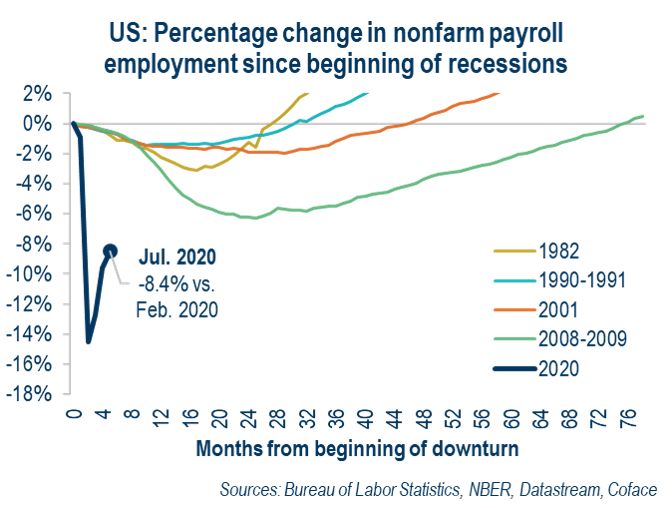
Data released this morning by the @BLS_gov showed brisk but slower progress in the recovery of the labor market in July. Progress is even slower beyond temporary furloughed employees. #Employment was still 8.4% lower than in February. #longroadtorecovery
One month after #cusma entered into force (on July 1st), #tariffs on Canadian alumin(i)um are back! #Canada had retaliated to punitive tariffs in 2018/19, it is likely to do so again.
BREAKING: The administration of U.S. President Donald Trump has implemented a tariff of 10 per cent on aluminum products imported from Canada. https://t.co/fKQX2ZwWyq
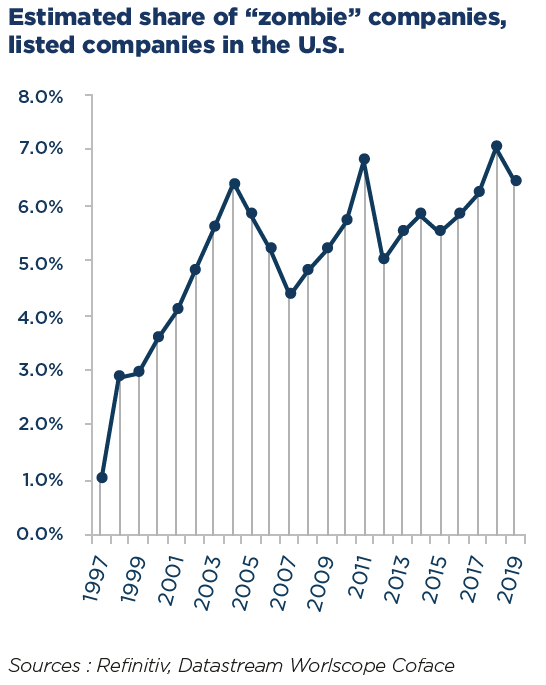
Based on a sample of listed companies, @coface estimates the share of #zombie firms was, at least, 6.4% at the end of 2019. The upward trend is likely to be exacerbated amid the #COVID19 pandemic.
For more information, check out our latest Coface Focus: https://t.co/ZCe52iH8th
Business bankruptcy in the US amid #COVID__19 has been trending downward. Our latest publication explains why this is a misleading development!
https://t.co/ZCe52iH8th
The Great Shutdown is coming to an end and activity is starting to pick up. But, containment measures will leave a legacy and Coface expects the recovery to be gradual.
https://t.co/mEzXj61hCx
In North America, we forecast the US GDP will fall by 5.6% and that of Canada by 6.5% in 2020. In 2021, GDP would recover by 3.3% and 4.5% respectively.