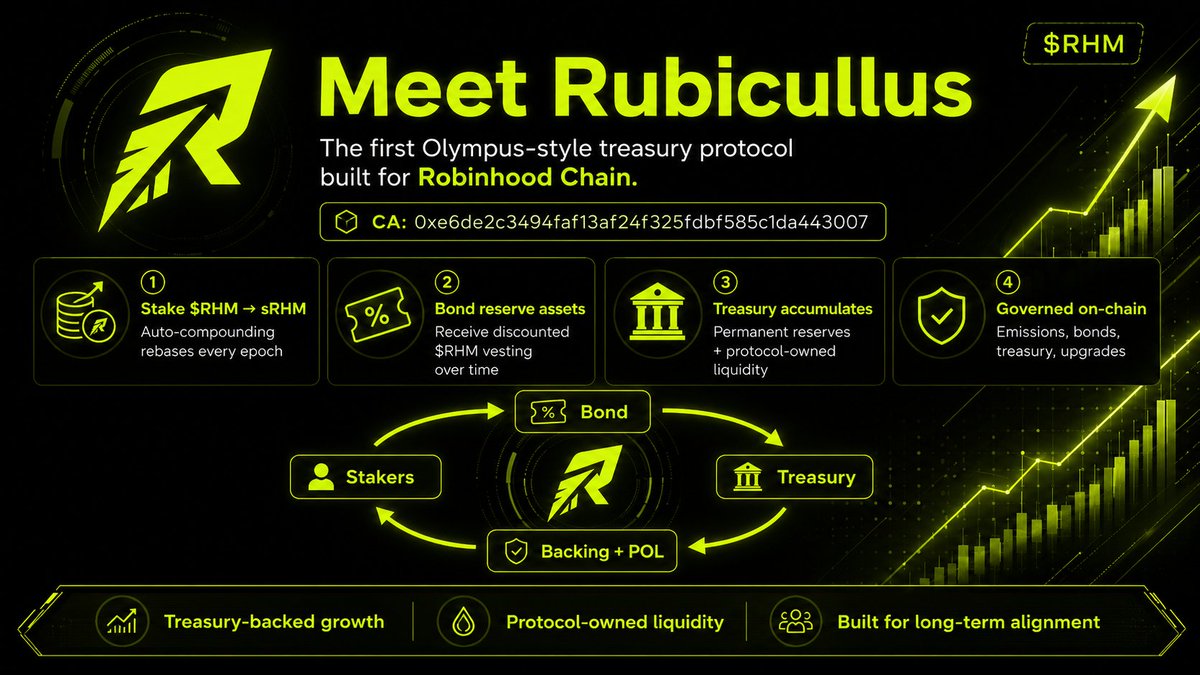
Meet Rubicullus.
The first Olympus-style treasury protocol built for Robinhood Chain.
CA: 0xe6de2c3494faf13af24f325fdbf585c1da443007
Most tokens rely on hype to survive. Rubicullus is built around a treasury designed to accumulate real protocol-owned assets over time. Every bond strengthens the protocol by adding reserves directly to the treasury, creating a growing foundation that belongs to the protocol itself rather than temporary liquidity providers.
Here’s how it works.
You can buy and stake $RHM to receive sRHM. Your position automatically compounds through scheduled rebases, so your staked balance grows every epoch without the need to manually claim rewards. At the same time, users can bond approved reserve assets to the protocol in exchange for discounted $RHM that vests over time. Those assets don’t leave the protocol. They become permanent treasury reserves, increasing backing and expanding protocol-owned liquidity.
This creates a powerful flywheel. The treasury grows. The protocol owns more of its own liquidity. Stakers benefit from the protocol’s monetary policy, while bonding continuously strengthens the balance sheet instead of relying on mercenary capital that disappears when incentives dry up.
Everything is governed entirely on-chain. Treasury management, emission parameters, bond markets and protocol upgrades are controlled through governance, while the protocol itself is built with a modular architecture designed for long-term resilience and transparency.
Rubicullus isn’t trying to reinvent one of DeFi’s most iconic ideas. It’s bringing it to Robinhood Chain with modern engineering, cleaner infrastructure and a focus on building a treasury that can grow alongside the ecosystem.
We’re excited to see what the community builds around it.
Welcome to Rubicullus.
RWAs and lending will be a primary focus for Rubicullus over the next few days.
The goal is to build a treasury-backed financial layer where $RHM, bonds, staking, RWAs and lending all reinforce the same balance sheet.
How it fits:
•Bonds bring assets into the treasury
•Treasury assets create backing
•Backing supports the $RHM monetary base
•Staking aligns long-term holders
•RWAs expand the reserve base beyond crypto-native assets
•Lending creates productive use cases around treasury-backed collateral
$RHM becomes the coordination layer.
Bonds are how the treasury accumulates assets.
Staking is how holders align with the protocol over time.
RWAs give the treasury more durable forms of backing.
Lending turns that backing into an active financial primitive instead of idle reserves.
The long-term loop:
Bonds → reserves
Reserves → backing
Backing → lending markets
Lending markets → productive treasury usage
Treasury growth → stronger $RHM system
You can now provide RHM/WETH liquidity and earn a share of trading fees while helping deepen the pool.
https://t.co/CFyU57ub6K
Current pool depth: 5.27 WETH
Fee tier: 1% of every trade, split among LPs
Mechanically:
Provide RHM + WETH
→ receive LP exposure
→ earn trading fees
→ help deepen liquidity
→ improve execution depth for $RHM
LP providers keep control of their position and can withdraw when they want.
Rubicullus is built around deeper, more aligned liquidity over time.
Protocol-owned liquidity grows from the treasury.
Community liquidity can now grow alongside it.
@Haki_DX3 Hi, yes. Liquidity is designed to grow over time.
Rubicullus will continue routing creator fees back into LP so pool depth can compound as the protocol grows.
We also added a new liquidity module that lets others earn by providing LP directly:
https://t.co/t3y4QZOgdr
The Rubicullus balance sheet is starting to take shape.
Current vault stats:
→ Total reserves: 0.62 RHM units
→ Backing per RHM: 3.983
→ Excess reserves: 0.47
→ Runway: 4,971.6 days
Accepted reserve asset:
→ WETH
Current backing remains held:
Backing = 2.0 ETH per $RHM
Proof, on-chain:
https://t.co/LZCdvP3vCa
@hulknobanner Yes, USDG support is planned.
Right now the focus is hardening the core treasury loop.
Once that foundation is stable, USDG will give Rubicullus a cleaner stable reserve asset alongside WETH.
Lending is also part of the broader plan.
Bonding is how the Rubicullus treasury expands, and how backing strengthens with every deposit.
You deposit reserve assets. The protocol issues $RHM that vests to you over 5 days. Your deposit becomes permanent treasury reserves.
The accretion math:
At the current bond price of 7.38 reserve per $RHM, the treasury receives far more value than the $RHM it mints against it. The surplus raises backing per token for every holder, not just the bonder.
Price is set by demand. It has risen from a 1.10 floor to 7.38 as bonding has grown.
Bond: https://t.co/k3GRSCTQf3
Staking $RHM is a compounding position, not a passive hold.
The math:
sRHM after n epochs = sRHM₀ × (1 + r)^n
Rubicullus settles a rebase every 8 hours:
3 epochs per day
1,095 epochs per year
Because every rebase compounds on the one before it, the per-epoch rate is applied 1,095 times a year. You never claim. The balance grows on its own, three times a day, for as long as you hold.
Stake: https://t.co/AffFJvMc5B
How your $RHM actually grows, in plain English.
Two engines run at the same time.
You get MORE tokens (staking)
Stake your $RHM and every 8 hours your balance goes up on its own. Not the price, the actual number of coins in your wallet. Open it tomorrow, you have more than today. Open it next week, more again. Three times a day it climbs and you never touch it. Same wallet, more coins.
Each token gets WORTH MORE (backing)
Every time someone bonds, ETH goes into the vault and never leaves. The vault grows, so the floor under every coin rises. More real value under each token means a stronger price the longer it runs.
Today the vault went up even while the chart went down.
Now put them together:
More coins, and each coin backed by more value. That is multiplication, not addition. Your count goes up AND the floor under each one goes up, at the same time, every day.
That is why holding beats trading here.
A trader is chasing one candle.
A holder is compounding two engines at once, on autopilot.
Stake it. Let it run. Check back and there is just more.
https://t.co/up7H7gxTGn
Remember why any of this started.
Blockchain as an idea was simple.
Rubicullus is a return to the point.
How holders actually win, no greater fool required:
• Bonds bring permanent reserves into the treasury.
• Staking pulls supply off the market and compounds your share every 8 hours.
• The backing behind every token grows whether the chart is green or red.
If the price falls the backing goes up. The machine does exactly what it was built to do.
This is value that returns to the people who build, not the snipers who extract and leave.
The era of the one-day pump and the insider exit is ending. Time to build things that last again.
That is why we are here.
https://t.co/up7H7gxTGn
Every holder of $RHM has three moves, and the math rewards only one path.
Stake (+3): supply leaves the market and your balance compounds.
Bond (+3): reserves enter the treasury and backing deepens.
Sell (−1): the only negative-sum move in the entire system.
When participants cooperate, the payoff is (3,3), the optimal outcome for the individual and the protocol at the same time. Selling is the sole defection, and it costs the seller as much as everyone else.
The full model, in plain language:
https://t.co/1mLCVdZ6WI
$RHM may rise or fall as we move through any given day. However, the backing behind it GOES UP.
Treasury reserves rose from 0.365 to 0.553 ETH. Backing per token climbed from 2.82 to 3.67 ETH. On-chain, verifiable, while the chart was red.
That is the difference between a reserve protocol and a normal token. RHM is not priced by a pool. It is backed by a treasury that grows through bonding no matter what the candle does. Bonds bring in permanent reserves. Staking pulls supply off the market. The floor compounds while attention comes and goes.
Thin liquidity moves price fast in both directions. It does not touch the reserves. Read the treasury yourself, it does not lie.
https://t.co/PiAZJ2gTFv
Thin because the liquidity is protocol-owned and still early, not rented from mercenaries who pull out the second incentives dry up. It is locked, and it deepens with every bond and every fee cycle.
But you are watching the wrong number. RHM is not backed by its pool. It is backed by the treasury, 2.8 ETH of reserves behind every token, on-chain and verifiable right now. That is the floor, and it grows every time someone bonds.
This is a reserve protocol, not a liquidity play. The treasury is the engine, not the pool. Bonds turn demand into permanent backing, staking pulls supply off the market, the base compounds. Read the contracts before you write it off.
https://t.co/KVdnFVrVHV
Most tokens are backed by nothing but attention.
$RHM is backed by reserves. Real ones, on-chain, more than 2x behind every token.
It compounds every 8 hours. The treasury grows with every bond.
Rubicullus. A reserve protocol on Robinhood Chain.
https://t.co/nRZLFTuUBe
Thin because the liquidity is protocol-owned and still early, not rented from mercenaries who pull out the second incentives dry up. It is locked, and it deepens with every bond and every fee cycle.
But you are watching the wrong number. RHM is not backed by its pool. It is backed by the treasury, 2.8 ETH of reserves behind every token, on-chain and verifiable right now. That is the floor, and it grows every time someone bonds.
This is a reserve protocol, not a liquidity play. The treasury is the engine, not the pool. Bonds turn demand into permanent backing, staking pulls supply off the market, the base compounds. Read the contracts before you write it off.
https://t.co/KVdnFVrVHV
Rubicullus is a reserve protocol. Every $RHM is backed by assets the protocol owns outright, not by a promise or a narrative.
The equation is simple:
Backing per token = treasury reserves ÷ circulating supply
Live on-chain, right now:
0.365 ETH in the treasury ÷ 0.129 $RHM supply = 2.82 ETH of backing behind every token.
Owned, not borrowed. Verify it yourself, any time.
Treasury: https://t.co/PiAZJ2gTFv
On-chain: https://t.co/uMS6ft7bvK
Good question. The 0.01 ETH bond belongs to a public supporter of the protocol. Every large wallet you’re seeing on that list is a bonder, not a free allocation or team wallet.
Each of those wallets deposited ETH into the Rubicullus Treasury in exchange for vested RHM. That ETH is now permanently owned by the protocol, which is exactly how the treasury has accumulated its reserves. Nobody received those tokens for free. Every bonded token was purchased with ETH that now backs the protocol and is fully verifiable on-chain.
It’s also important to note that none of those bonded tokens are liquid. If you inspect the wallets, the bonders currently hold 0 liquid RHM. Their allocations remain locked inside the bond contracts and vest linearly over five days before they can be claimed.
The percentages look large simply because Rubicullus is still in its very early stages and the total supply is small. When supply is only a fraction of a token, even modest bond positions represent a noticeable percentage. As bonding continues and the protocol expands through treasury growth and rebases, those percentages naturally become a smaller share of the total supply.
This is exactly how an Olympus-style treasury protocol is designed to bootstrap itself. Reserve assets flow into the treasury first, bonded tokens vest over time rather than becoming instantly liquid, and every step of the process is transparent and verifiable on-chain.
We want to address the 40% wallet directly.
That wallet came from an early team snipe.
The team did not intentionally set out to capture that much supply, but the outcome still matters and we understand why people are watching it closely.
So, we are taking concrete steps.
An additional 22% of total supply has been locked here:
https://t.co/LYwespcRX1
The remaining 18% will be staked and left unmoved.
That means:
40% wallet
→ 22% locked
→ 18% staked / unmoved
→ no active selling from that allocation
We care more about seeing Rubicullus reach its full potential on Robinhood Chain than optimizing around a short-term team position.
We’ll keep addressing concerns directly as they come up.
We’ve seen some confusion around holder allocations changing and the market cap increasing even when trading volume is low, so let’s clear it up.
Rubicullus is an Olympus-style treasury protocol. The token supply is designed to expand through scheduled rebases and bonding. Because of this, the circulating and total supply can increase independently of secondary market trading activity. That means you’ll sometimes see the market cap increase even during periods of low trading volume. This is expected behavior and is fundamental to how the protocol operates.
Mathematically, market cap is simply:
Market Cap = Token Price × Total Supply
If the token price remains the same while the total supply increases through rebases and bonding, the market cap increases as well, even if very little trading has taken place. That’s because market cap is a calculation based on price and supply, not a measure of buy or sell volume.
It’s also important to understand that this doesn’t mean stakers are being left behind. Quite the opposite. Every newly minted RHM is issued according to the protocol’s monetary policy, while the treasury grows through bonded reserve assets. When rebases occur, stakers automatically receive additional RHM through their sRHM position, allowing them to maintain their proportional ownership of the staking pool as supply expands. That’s one of the core mechanics behind the Olympus model and the reason staking exists.
For example, if the total supply is 1,000,000 RHM and the market price is $1, the market cap is $1,000,000. If a rebase expands the supply to 1,010,000 RHM while the market price remains $1, the market cap becomes $1,010,000 despite there being little or no trading volume. At the same time, because stakers receive the newly issued tokens through the rebase, their proportional ownership of the staking pool is preserved.
Everything we’ve described is fully transparent and verifiable on-chain. The contracts are source verified, the treasury can be inspected by anyone, and the bonding, staking and supply mechanics are all visible in real time. Nothing is hidden, nothing is happening behind the scenes. Rubicullus is simply behaving exactly as it was designed to.
To address questions around the top $RHM wallets, here is the breakdown.
Every top wallet (equating to ~70% of supply) is a protocol contract or controlled protocol-related allocation, not a random holder.
0x0fFa9009Caea5DaAAcE7aE87a6633EBc9D524502
~30% — live bonding contract.
This is $RHM vesting out to users who bonded.
0xc8af44f384585acd504b6e50d4275b271f3e2e28
~15% — staking vault.
These are tokens holders staked to earn rebases.
0x091747e0906dc3e22de6ffec612a0086af0bc289
~13% — locked holder allocation.
Locked for 1 year. This was ~22% when locked, but supply has grown since then, so the same locked tokens now represent ~13% of total supply.
0x3d9ea0898E90a41b05De7670BcEfC3439ce20779
~10% — previous bonding contract.
Retired, but still vesting $RHM to the earliest bonders.
Dev wallet holds under 2% which is also locked.