I found one of my old charts.
(The updated "blow-off" is in the next thread)
It compares Canada’s private credit boom with Japan’s private credit boom before its 1991 peak.
The similarity is striking.
Japan’s private credit boom ended in one of the most famous balance-sheet recessions in modern history.
Asset prices collapsed. Banks weakened. Households and businesses shifted from borrowing to debt repayment.
Economic growth stagnated for decades.
Canada’s private credit path followed a very similar pattern.
This is the point most people miss:
Canada did not simply have a housing bubble.
Canada had a private credit supercycle.
For decades, credit expanded faster than the productive economy.
Household debt rose.
Mortgage credit exploded.
Real estate became the national collateral machine.
Rising home prices made the system appear wealthier, safer, and more stable than it really was.
That is exactly how credit bubbles work.
🍂 In Economic Autumn, debt feels like wealth.
❄️ In Economic Winter, debt is revealed as a claim on future income.
Japan reached its private credit peak in 1991.
Canada kept extending the cycle through falling interest rates, mortgage expansion, financial deregulation, policy support, and a cultural belief that real estate could not fall nationally.
But extending a credit cycle does not eliminate the risk.
It usually increases it.
The real danger begins when credit growth slows, because the entire system has been built around rising collateral values. Once real estate stops rising, the feedback loop reverses.
Households pull back.
Banks tighten.
Asset prices weaken.
Collateral falls.
Debt becomes harder to service.
The economy shifts from expansion to balance-sheet repair.
That is the Japan lesson.
And it may be Canada’s lesson now.
This is why I continue to argue that Canada’s housing problem is not just about supply. Supply matters, but the deeper issue is the supply of credit.
When private credit reaches Japan-style extremes, the question is no longer whether the boom was real.
The question becomes:
Can Canada avoid the bust that usually follows?
History says that is unlikely.
Schumpeter would call this Creative Destruction 🔥.
The inflated, debt-dependent structure must eventually be cleared so capital can be redirected from speculation back toward productive growth.
That is painful.
But it is also how a new Economic Spring eventually begins.
@RichardDias_CFA The fact that the Liberal party are still holding the baton shows this is all their doing. If the Cons had won last year there would be hysterics that they had caused it. Wonder how the narrative will be spun now.
U.S. Farm Bankruptcies Surge +46% as Fertilizer Costs Squeeze Farmers:
The American Farm Bureau Federation reported 315 Chapter 12 bankruptcy filings in 2025, up from 216 in 2024 and the third consecutive annual increase.
The Midwest got hit hardest with 121 filings, a +70% jump.
The Southeast followed with 105, up +69%.
Together, those two regions accounted for more than two-thirds of every farm bankruptcy in the country.
Fertilizer prices are pouring gasoline on the fire.
Urea, the most widely used nitrogen fertilizer on the planet, has ripped +87% year-to-date and trades near $720 a tonne.
For corn growers who depend on nitrogen, this is a dire situation.
Many farmers are reporting they will cut the amount of fertilizer they use, shift from corn toward less nitrogen-dependent soybeans, or just take the yield loss.
Farms are under pressure.
@6ixbuzztv Air Canada continue to fly into their main hubs of LaGuardia and Newark. JFK was a minor hub for AC with connections to international flights (i flew through there in January). They have a tiny presence. I expect this fuel issue is an excuse to close a loss making hub.
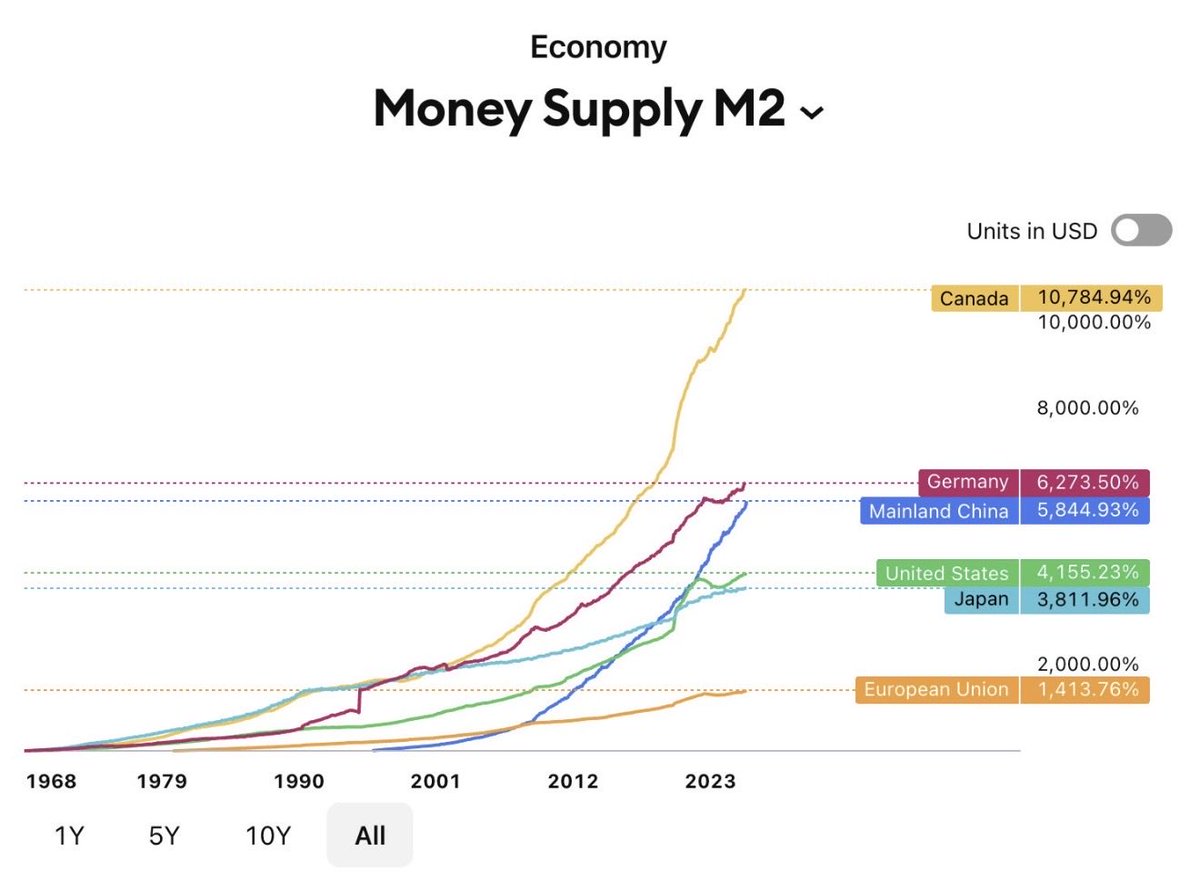
🚨 LOOK AT THIS CHART
Money supply (M2) growth since 1968:
🇨🇦 Canada: 10,784%
🇩🇪 Germany: 6,273%
🇨🇳 China: 5,844%
🇺🇸 United States: 4,155%
🇯🇵 Japan: 3,811%
Canada printed more money than every major economy on earth.
Every other country started levelling off.
Canada’s line goes VERTICAL.
This is why your dollar is worthless.
This is why homes cost $1 million.
This is why groceries doubled.
This is why food bank visits hit 2.2 million.
This is why your savings buy less every single year.
It’s not “global inflation.”
It’s a printing press that never stopped.
IT’S THE CANADIAN PESO.
The government devalued YOUR MONEY to fund spending it couldn’t afford.
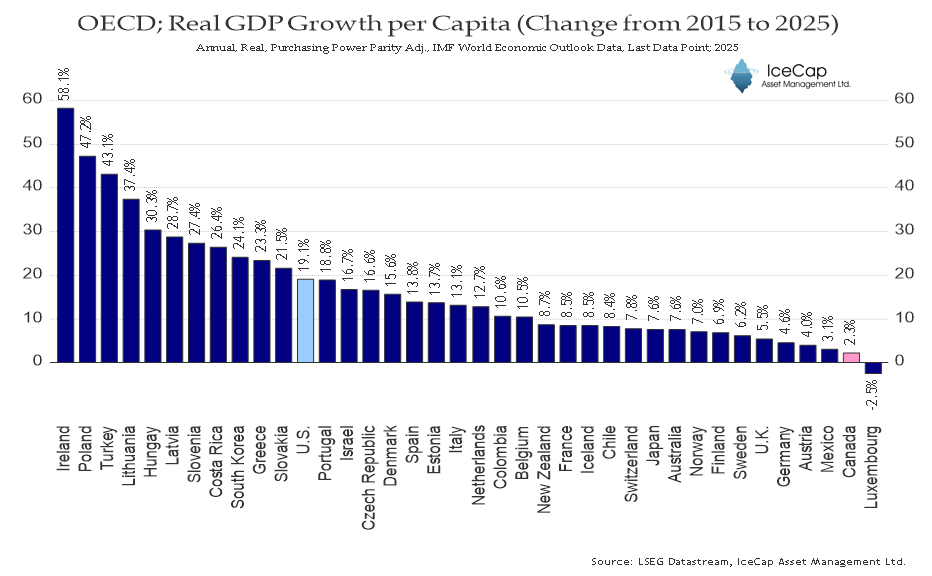
¡Ay, Caramba! The WORST Real GDP per Capita growth in the OECD. (Luxembourg is not a real country - sorry)
Maybe, and hear me out now, we should consider a different economic philosophy.
This is still not getting the attention it deserves. Absolute insanity. Any business considering investing in BC is out of their mind until this gets resolved.
@ManyBeenRinsed If a daytime flight coming back from Europe - wake early so you are tired for the flight. Eat in lounge before flight (if you have access). Good eye mask and ear plugs/headphones. Sleep as much as possible on flight. Arrive home and stay up until normal bedtime. Beat jetlag.
Aboriginal title across most of Metro Vancouver. Unpacking the jaw dropping backroom deal with First Nations legal expert Tom Isaac. https://t.co/ViJlB4cgE1
@SteveSaretsky Seems like the first nations will eat each other up arguing their piece of land before anything else happens. But means more limbo for homeowners. When will the Fed jump in and stop this madness?
There is an enormous scandal brewing at @IRB_Canada. Canadians are being screwed by massive fraudulent asylum claims, and it all relates to terrible incentive structures.
The thread below is email correspondence from a whistle-blower employee.
1/
Are you kidding me?! It is really not that complicated!
High taxes, government overreach, endless stream of anti-industry regulation, regressive immigration policy, and the brain dead Malthusian ethos that underpins all of it.
Oh and the media that runs cover for all of it.
I can’t take the economic illiteracy of the BC NDP anymore! They’re an anchor on this country.
“If we’ve got tens of billions of dollars to spend, I think we should spend it on a refinery, and we should develop oil products for Canadians and for export, instead of being reliant on American and Chinese refineries to do it for us.”
https://t.co/OoYK1o063S
I have posted this in the past...
🇨🇦 Canada, 🇬🇷 Greece, 🇯🇵 Japan — Same Problem, Different Timelines
All three nations share the same underlying flaw:
Debt growth has outpaced real economic productivity.
The difference is how long they can delay the inevitable reckoning — and what form it takes.
🇯🇵 Japan — The Slow-Motion Reckoning
Debt: Over 250% of GDP — highest in the world.
Why it lasts: Japan borrows in its own currency, and most debt is held domestically (by its own citizens and the Bank of Japan).
Consequence: No sudden default, but 30+ years of deflation, stagnation, and demographic decline.
Endgame: Silent erosion of wealth through currency debasement and shrinking real growth — a long, cold winter.
🧊 Japan didn’t escape the reckoning; it just stretched it across decades.
🇬🇷 Greece — The Fast-Motion Collapse
Debt: Around 180% of GDP before its crisis.
Why it collapsed: Greece borrowed in a currency it couldn’t print (the euro). When confidence broke, it couldn’t devalue or print its way out.
Consequence: Yields spiked to 63%, mass defaults, bank runs, and social upheaval.
Endgame: Austerity, bailout, and loss of sovereignty to outside institutions (ECB/IMF/EU).
Greece faced a fiscal reckoning abruptly — because it had no monetary escape valve.
🇨🇦 Canada — The Hybrid Time Bomb
Debt profile: Sovereign debt moderate (~100% GDP), but private and household debt extreme (~220% GDP).
Why it’s vulnerable:
Foreign investors hold ~36% of federal debt — unlike Japan, Canada depends on global confidence.
A heavily credit-driven economy (real estate, banking, consumption).
Rising yields quickly hit homeowners, banks, and tax revenues.
Consequence: A credit-to-fiscal feedback loop — as private debt deflates, public debt surges to absorb the losses.
Endgame: Not a Greek-style default, nor a Japanese stagnation — but a stagflationary squeeze: falling real estate, weak growth, rising funding costs, and eventual currency debasement to stabilize the system.
⚖️ Canada’s reckoning will likely be financial first, fiscal second — a drawn-out hybrid of Japan’s stagnation and Greece’s funding stress.
🧭 In Simple Terms
Country Crisis Speed Root Cause Monetary Control Likely Outcome
🇯🇵 Japan Slow Public debt Full control Deflation & stagnation
🇬🇷 Greece Sudden Public debt No control (Euro) Default & austerity
🇨🇦 Canada Medium Private debt → Public debt Partial control (foreign funding) Credit deflation, stagflation, currency devaluation
Bottom Line:
Every debt-driven system meets its reckoning.
Greece hit the wall.
Japan froze in time.
Canada will inflate and devalue its way through — the illusion of control masking a real loss of purchasing power. 💣💵❄️