Or maybe Dr Cheptinga Kipkurui should have been the main speaker at the Health Summit? He wrote:
TO ALL KENYANS
SUBJECT: UNDERSTANDING SHA & NESP - THE TRUTH, THE CHALLENGES, AND THE WAY FORWARD
FROM: Dr. Cheptinga K. Philip - Chief Nephrologist, MTRH & Lecturer, Moi University
DATE: 19TH AUGUST 2026
Wakenya Wenzangu,
Salama.
I write this not as a politician. I write as a doctor who treats your mothers, fathers, children and neighbors every day at MTRH. I have buried patients who died not of disease, but of delay.
Let us talk honestly, respectfully, and together. Because health is not about government or hospitals. It is about YOU.
PART 1: WHAT IS SHA AND WHAT IS NESP? LET US START WITH FACTS
1. SHA - Social Health Authority
This is the new health insurance for all Kenyans. It replaced NHIF in October 2024.
Goal: Universal Health Coverage - that no Kenyan should be denied treatment because of money.
As of Aug 2025: 25.2 Million Kenyans registered, now 32 million have registered.
SHA has paid KSh 56.4 Billion to hospitals.
2. NESP - National Equipment Service Program
Launched August 2025 by President William Ruto. A 7-year program.
Goal: Put modern machines in public hospitals without counties paying upfront.
How: Private companies called "Vendors" bring CT scans, MRI, Dialysis, Xray, theatre tables,Anaethesia machines, Cath lab, Lab machines. They install and maintain them.
Payment: SHA pays the vendor every time a patient uses the machine.
Progress: Sh7.3 Billion already spent. 213 hospitals in 43 counties have new equipment.
NESP is a good idea. SHA is a good idea. The intention is right.
PART 2: WHY ARE PUBLIC HOSPITALS STRUGGLING? THE 100% vs 5% vs 0% PROBLEM
This is where the pain is. Let me explain simply:
SCENARIO A: PRIVATE & FAITH-BASED HOSPITALS
They Serve : They Receive : Their Burden
20-30% of Kenyans : 100% of SHA payment They choose patients. No emergency mandate.
SCENARIO B: PUBLIC LEVEL 5-6 HOSPITALS - KNH, MTRH, COUNTY REFERRALS
They Serve : They Receive : Their Burden
70-80% of Kenyans + All emergencies + All referrals 5% after:
90% goes to NESP Vendors
5% goes to KEMSA drug debt
Public Hospitals Pay 100% of all costs: Electricity, Water, Food for patients, Fuel, Cleaning, Casual workers, Salaries, Medicine, and Service of the government machines, buy consumables,
Example with real numbers - Annexe 2
- CT Scan: SHA pays 6,900. Vendor gets 6,210. Hospital gets 690.
- Dialysis: SHA pays 10,650. Vendor (Yes, the private companies) gets 8,660. Hospital gets 1,990.
- MRI Service Contract: Costs 5 Million per year. Hospital gets 1,100 per scan.
Question: Can 690 pay electricity, radiographer, cleaning, and machine service? No.
PART 3: THE CAPITATION KILLER - "WE WORK FOR FREE"
For basic services like Xray, Ultrasound, Lab tests, OPD, SHA uses "Capitation".
How it works:
1. SHA pays a NESP Vendor 100% to provide Xray machines.
2. You come to Public Hospital with SHA card.
3. Hospital does the Xray, but gets 0 shillings.
4. But Hospital must still pay: Rent, security, Radiographer salary, electricity, room, cleaning.
We are paying 100% to provide a service we are paid 0% for. No business, no hospital, can survive like this.
That is why queues are long. That is why machines are off. That is why our computers, scanners, our ICT systems are slow.
That is why our oxygen supplies is eratic and costs lives. That is why our leaders, Senators, MPs shift the blame on poor services to Governors, Board and Management over poor services.
PART 4: FROM NHIF 36 BILLION TO SHA 5%
Under NHIF, public hospitals were owed over KSh 36 Billion, Payment was late, to public Hospitals, but at least the full amount was supposed to come.
Under SHA, payment is faster. But we only receive 5%. The rest goes away first to vendors and DHA, KEMSA.
So we moved from "dying of debt" to "dying of arithmetic".
PART 5: WHY ARE DRUGS AND DIALYSIS CONSUMABLES MISSING IN LEVEL 5-6?
Toxic Debt and Men's Mental Health: A Deeper Dive
June marks Men's Mental Health Awareness Month, yet much of the discourse often skirts the real issues. Conversations typically revolve around failing family relationships, lack of social support, and men succumbing to alcohol. While these are valid concerns, they often merely scratch the surface.
At the heart of the matter lies the societal expectation that men must be providers. This role, coupled with a glaring lack of personal financial planning education, sets the stage for disaster. When a man loses his job or his business flounders, the immediate reflex is to seek solace in debt. Unfortunately, in many African societies, patient capital and affordable debt are rare commodities. Instead, debt vultures—predatory microfinance institutions—proliferate, offering loans at usurious rates. These come with enticing names like "logbook loans" and "mobile loans," targeting vulnerable men who, in desperation, dig themselves deeper into financial holes.
The resulting toxic debt is a significant yet under-acknowledged driver of depression among men. Addressing men's mental health must start with equipping them with financial literacy. Men need to master the art of financial planning, learning how to manage both abundance and scarcity. They must also recognize the need to build personal wealth and develop robust social safety nets.
Societal expectations must evolve. In today's era of workplace equality, where women are equally earning, the stigma around women contributing to household finances must be eradicated. Men should no longer bear the burden of being sole providers. Additionally, men need to establish secure peer lending mechanisms to shield themselves from predatory lenders. Joining circles and groups, living below their means during good times, and accepting that it’s okay to lack are crucial steps.
Ultimately, simplifying life is essential. Many are not poor because they lack, but because they desire more. Toxic debt is a leading cause of men's depression, and addressing it requires a fundamental shift in financial education and societal expectations.
Let's start the conversation today.
The Marshmallow experiment and the case for delayed gratification.
When Austrian born American Psychologist Walter Mischel conducted the Marshmallow experiment in the 1960s to young kids barely 4-5 years old, I doubt even him had any idea just how groundbreaking and profound his findings would turn out to be.
The experiment was pretty simple. A researcher would sit in a room together with a young kid , barely 4-5 years old.
They gave them a single marshmallow (stabilized corn syrup form loved by kids( akin to tamu tamu) . They would then present them a deal.The kid could either eat the marshmallow immediately or they could wait for a few minutes . The researcher would leave the room and upon his return, if they waited,he would treat them with an additional marshmallow ( a reward for their patience).
The researcher would then leave the room for around 15 minutes and monitor the kid remotely. As you can imagine, when a kid is 4, their willpower is as strong as that very marshmallow. So for most of these kids, this was torture. Especially since kids also don’t have a sense of time .
Some of the kids didn’t even bother. They consumed the marshmallow with immediacy. Others waited, and really struggled with the marshmallow and gave in at different durations of the 15 minutes. But a few of them actually waited for the 15 minutes and gained an additional marshmallow.
The researcher would then follow closely all the kids on the experiment for a number of years afterwards and he noticed an exciting correlated trend .
Most of the kids who waited longer tended to also seemingly become more successful later on in life. They tended to pass their exams, avoid drug abuse, and show better indicators on both health and life success in general.
This led him to reach the conclusion that the ability to delay instant gratification at an early age may actually lead to greater life success later on.
That self control and willpower, are more critical in life that actual IQ . That as a parent, your biggest lesson you can impart on your kid is to teach them the value of self control and patience.
While I find it amazing that a study revealed this insight, I am convinced that this ideation is not simply an academic construct.
The truth is that life in general presents a lot of reward for those who are willing to sacrifice their immediate short term satisfaction for a greater future gain.
The small pain of regularly going to the gym, studying often, avoiding junk binge eating and staying clear of alcohol and drugs all result in much significantly greater rewards later on.
Your fullness of your life tomorrow, is in a manner, greatly determined by the sacrifices you make today. And who you are today , is a total of the ‘marshmallows’ you ate or avoided in the yesteryears.
My question today to you is, we are all that kid in the room. What is the marshmallow ahead of us ? Is it worth a binge or can we afford to wait?
NB If you enjoy these threads I normally write( I try to churn out one daily), you may even love me more in person, at your organization. I am a speaker, facilitator and teacher - I conduct executive team buildings , and speak/teach on diverse topics from organizational communication, innovation, leadership, culture change and strategy. My sessions are very interactive, fun and worth your while. (Safaricom, Palladium, Copia , KQ , etc cannot be wrong) . Send me an email , [email protected] or whatsapp (not call) +254 703 360 360 and let’s discuss your opportunity. As you can imagine, if you can RT this message, it may reach someone on the timeline who may be interested. Thank you in advance.)
Shalom!
I have heard Karen Nyamu’s ill informed remarks on taxation and was besides myself with embarrassment on her behalf .
People are surprised that someone who they view as as a bit knowledgeable in her position can spew such foolishness. There is actually a full explanation for her behavior.
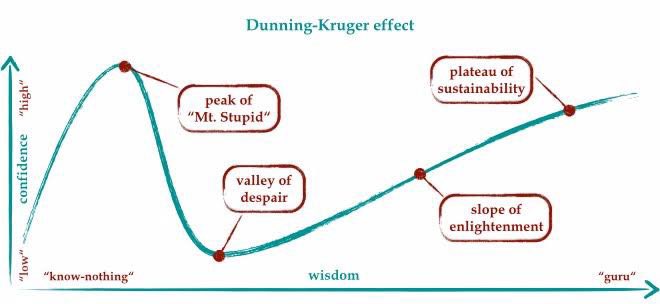
It’s called the Dunning Kruger analysis of the confidence - competence bias.
The theory basically posits that the gaining of a little knowledge inflates one’s confidence in that area irrationally. But as you become even more informed, your confidence is tempered with the stark reality that the more you know , the more you realize you actually don’t know (there is much more to know).
Your confidence lowers even as you gain more knowledge till it even reaches a dip level where you start feeling like you have an imposter’s syndrome .
But as you gain even more knowledge, and enlightenment , your confidence starts rising , but this time backed by fact.
However , this confidence , might never rise to the peak of your previous ignorance peaks.
In short , yes , ignorance may be risky but a little knowledge is a very very dangerous thing.
Problem is that , in this country , we elect these cocky fellas with little competence /knowledge but buckets loss of charisma and confidence to high office .
And we wonder why ultimately we only end up with empty debes making the loudest voice.
The Dunning-Kruger effect creates this cognitive bias where people with low ability at a task or knowledge of a topic overestimate their ability, while those with high ability underestimate their own.
Karen Nyamu’s limited knowledge makes her unaware of her incompetence, leading her to speak confidently on a subject she is ill
In essence, her misplaced confidence, based on limited knowledge, illustrates the peril of having just enough information to be dangerously self-assured without possessing the expertise to back it up.
Karen Nyamu is the ultimate proof of our leadership mistakes as a country. Unfortunately, she is good compared.
We elect confidence, not competence.
Here is her brief remarks captured in this tweet below 👇🏾
( https://t.co/gKOomZo5pV)
My late dad, Eric Sissey, was a literature major from the University of Nairobi.
As you would expect, he was a bibliophile. He ammased a lot of books .
However, our tastes rarely collided meaning a lot of the books he collected weren’t a lot , my cup of tea, then.
Except a specific one.
Among my collection today, I remain with his copy of Ngugi’s seminal work, Decolonising the Mind- his last written book in English language.
He bought this book 34 years ago.
It is his only book in my possession but it is really badly tattered.
In May next year, it will be 20 years since his passing .I am hoping to have the book restored before then.
Any leads to someone who can help me restore this particular book within Nairobi ?
Will greatly appreciate.
RT widely.
Cc @NuriaBooks@BonneyTunya@bonifacemwangi@Ramah_Nyang@nyanchwani@wgkantai
Welcome to Ireland where people get away with racism! This little black girl broke my heart. Don’t skip this post without leaving a million heart for her. Make her famous…