Lecanemab improves amyloid biomarkers but worsens neuronal/synaptic biomarkers. Should we question whether successful amyloid removal improves the biology that matters most? My take on the new study: https://t.co/6SVRvY4lHY
Behold the triumph and joy of books: bibliophiles and readers across the world can celebrate this delightful moment....
An old Syrian man who had escaped the vile Assads and their Human Slaughterhouse state returns from exile after their downfall to uncover and recover his hidden library.
He takes an axe to the wall and out of the dust and plaster emerges.... his books, treasures of freedom, totems of openmindedness everywhere....
@abdalhadea
Failure to recognise PSP-Parkinson's in the early 90s has now been replaced by overdiagnosis based often only on questionable slowing of vertical saccades or mild midbrain atrophy.
The diagnosis should never be raised as a possibility only as a clinical certainty @Ed_Jabbari
Research for the sake of research: sophisticated analytics to show that patients are different from one another. By publishing such papers, we fuel an academic culture that rewards paper counts over knowledge that ultimately matters to patients.
https://t.co/7nDH5SLzXF
Use of the antiseizure drug valproate by fathers before conception is not associated with neurodevelopmental disorders like autism or ADHD in their children, according to a new study published in @GreenJournal.
Read more: https://t.co/a3PXcb1wt8
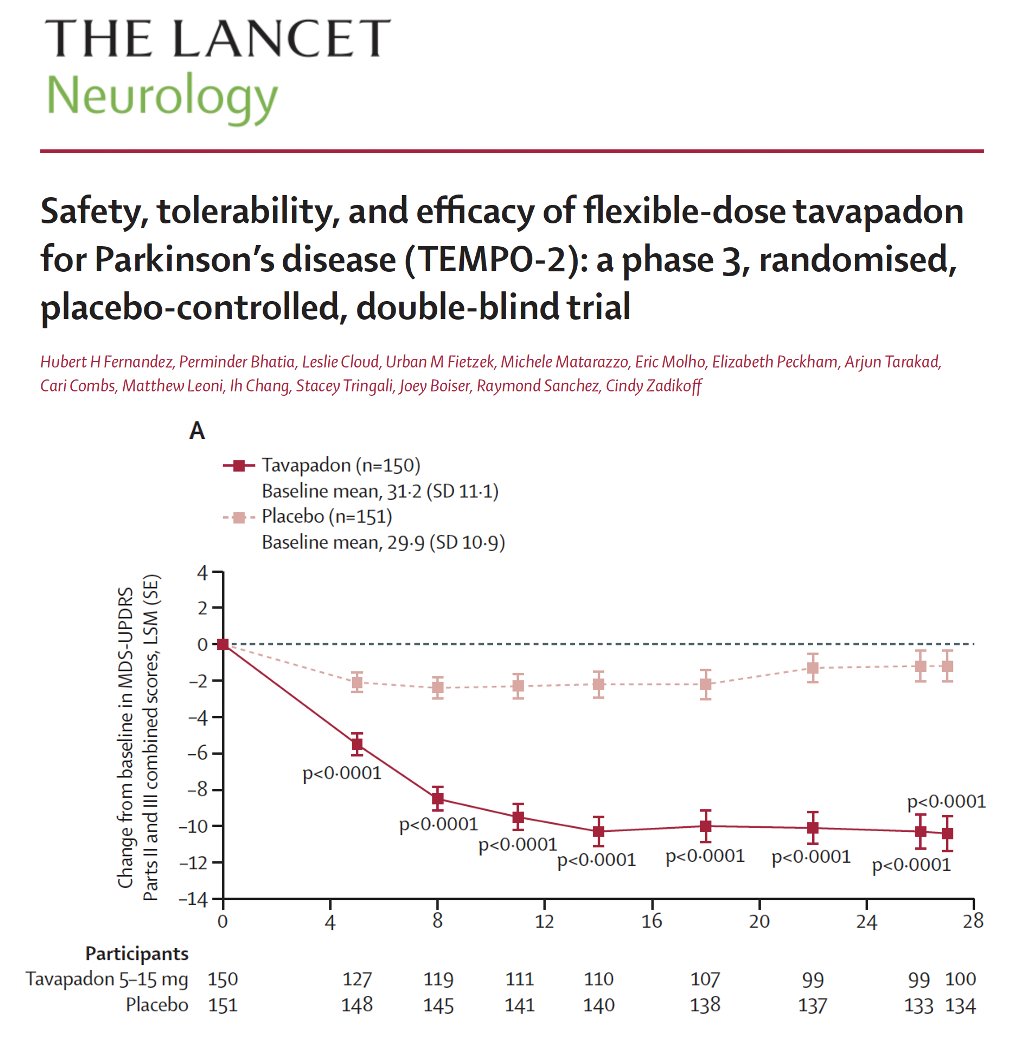
Could Tavapadon reshape early Parkinson’s treatment? Could selective dopamine signaling be the next step forward? A dopamine receptor agonist is a medication that stimulates dopamine receptors in the brain to help improve movement. Unlike currently available dopamine agonists that primarily target D2/D3 receptors, Tavapadon selectively targets D1/D5 receptors, an approach designed to preserve motor benefit while potentially reducing some troublesome side effects. Fernandez and colleagues describe in a new paper in The Lancet Neurology evaluating Tavapadon in early Parkinson's disease.
Key points:
- Tavapadon significantly improved motor symptoms and activities of daily living compared w/ placebo in folks w/ early Parkinson's disease, and benefits emerged as early as 5 weeks.
- Tavapadon was generally well tolerated, though nausea, headache and dizziness were more frequent than placebo, and adverse events were most common during dose titration.
- Rates of somnolence and impulse control disorders were low, suggesting a potentially differentiated safety profile compared w/ currently available dopamine agonists, though longer follow-up is still needed.
My take: We have been waiting for a new dopamine agonist strategy that attempts to separate motor benefit from some of the side effects that have limited the use of older agents. The results are encouraging; however this is not a home run yet. The study lasted only 27 weeks, and we still need long-term data on durability, tolerability, dyskinesias and impulse control disorders. If these findings hold up over time, Tavapadon could become an important new option for treating early Parkinson's disease.
Here are 5 points that resonated w/ me:
1- This study reminds us that innovation in Parkinson's disease is not limited to disease modifying therapies. Better symptomatic treatments can meaningfully improve daily life.
2- A once daily medication that improves motor function while maintaining a relatively low rate of sleepiness and impulse control disorders would be welcome news for many folks and their health care providers.
3- The titration period mattered. Many side effects occurred early, suggesting that careful dose escalation and close follow-up will be important if this therapy enters routine clinical practice.
4- We should avoid comparing this drug directly to older dopamine agonists until head-to-head studies are completed. Cross trial comparisons can be misleading.
5- The next chapter will be the most important one. Long-term extension studies will tell us whether the early promise of Tavapadon translates into durable benefit and an acceptable long-term safety profile.
https://t.co/gp3w3Ke6iO
A fascinating new video case just dropped in Tremor and Other Hyperkinetic Movements, and what resonated with me was how an extraordinarily common and generally well-tolerated medication, lansoprazole, can precipitate a movement disorder that could easily be misdiagnosed. Kumar and Sharma describe a 62-year-old man who developed jerking of the arms and head beginning approximately six hours after his first 15-mg dose of lansoprazole; examination revealed both positive and negative myoclonus, including asterixis, and the movements completely disappeared within two days of stopping the drug. Watching the accompanying video is particularly instructive because, at first glance, many practitioners might label these movements as “tremor.” This is exactly why phenomenology matters. Tremor is an oscillatory, generally rhythmic movement, whereas myoclonus consists of sudden, brief, shock-like movements that may result from muscle contraction (positive myoclonus) or an interruption of ongoing muscle activity (negative myoclonus); asterixis is an important form of negative myoclonus. Jerky appearing tremor can be myoclonus. The teaching point is to resist naming every shaking or jerking movement a tremor and instead ask: Is it rhythmic or irregular? Is there a sudden muscle contraction or a brief lapse in posture? Is the movement stimulus-sensitive, action-induced, positional, or present at rest? The differential diagnosis should include tremor, myoclonus, asterixis, dystonic movements, dyskinesia, tics, seizures and functional movement disorders, followed by a careful search for metabolic, toxic and medication-related causes. In this case, blood counts, electrolytes, toxicology testing, kidney and liver function were unrevealing, while the striking temporal relationship to lansoprazole and rapid resolution after withdrawal supported an idiosyncratic drug reaction. Although PPIs are considered quite safe, neurological complications have occasionally been reported, and PPIs can also produce hypomagnesemia, another potential pathway to neurological symptoms. Perhaps the most practical lesson is one we repeatedly encounter in movement disorders: before ordering another scan or adding another medication, define the phenomenology and review the medication list, including seemingly innocuous drugs and anything that was recently started, stopped or dose-adjusted. Sometimes the diagnosis is hiding in plain sight in the medicine cabinet.
https://t.co/iwUSDkjdKv @tremorjournal
Updated again (at bottom):
>be Jason Arday
>get diagnosed autistic at 3
>claim non-verbal until 11
>claim partial deafness in one ear & being taught to sign
>claim you couldn't read until 18, but still leave school w/ two GCSEs
>claim joining pro snooker tour at 10, one year before you could speak
>claim you came out of a football academy & played pro
>claim you were on Seven Up, a series that tracked a group of seven year olds as they grew up, airing first 21 years before you were born
>have the BBC confirm you weren't on the show because you’re not a time traveller
>claim 30 marathons in 35 days, the last 9 on a broken leg swollen to twice its size
>claim to have run 600 miles in six days, when the men's record is 650
>have no recorded race time anywhere because why bother
>have nobody in the ultra community ever hear of you
>say £5.5m raised for 70+ charities by 2024
>tell a funeral directors' convention in New Orleans the ultras (no record again) raised £5m
>submit a 401-page PhD on reflective practice w/ 100+ passages matching another student's 2009 thesis
>have 188 sentences come back identical or near identical, odds
>carry over her copy-editing errors
>get the PhD anyway
>lift quotes into papers & present them as interviews you conducted yourself
>get a full chair at Glasgow by 2021
>get Cambridge at 37, youngest black professor in 900 years
>guest edit the Today programme
>collect honorary degrees from Solent, Anglia Ruskin & St Mary's
>have a Cambridge autism professor circulate “URGENT PLEASE SIGN ANTI RACISM LETTER"
>write to a minister claiming knife threats, assault, spitting, rape & death l threats, bananas, bullets in the post, corrosive substances & mutilated animals
>photograph none of it
>claim a masked man w/ a knife cornered you in the faculty twice
>appear on no CCTV either time
>tell nobody AT THE TIME
>claim a severed pig's head arrived at your parents' house
>claim police traced it to a butcher who sold a “whole hog" that morning
>have the butcher say no officer ever came in
>have the Met say the whole account is categorically incorrect
>call it "a modern day lynching" on a podcast in Sept 2025
>give a keynote in April 2026 about a playbook conservatives use to hunt black academics
>get cleared in March 2026 by a panel you asked to weigh the "war on critical race theory"
>blame the copied text on autistic mimicry & on a supervisor who left & one you never even met
>turn 600 miles in six days into twelve days
>get Solent to delete the running claims
>get 13,000 signatures & three Cambridge college heads to vouch for text they never read
>have Cambridge call it a "vile smear campaign"
>have a ghostwritten memoir to be released August 27
August 4 and 5 Update:
>list installing water points in South America & Africa for WaterAid, which has webpage "Why we don't send volunteers abroad"
>publish a 2018 paper claiming focus groups w/ 32 black & minority students
>have interviewees' quotes match ones an epidemiologist
>have your article's structure follow his too
>get a correction instead of a retraction
>quietly delete 18 of the 31 quotes
>get a second paper corrected in 2024
>list yourself as a visiting professor at Glasgow
>have Glasgow say never a visiting professor here
>list yourself as a visiting professor at Ohio State's Office of Diversity & Inclusion
>have Ohio State say we have no record
>have that office turn out to have shut in 2025
>have Anglia Ruskin edit your citation page the day Cofnas piece dropped
>have your publisher scrub the money out of your bio a year before it broke
>have Scotland Yard investigate the reporter who emailed you questions about your record
>have officers tell him to stop asking because your mental health was affected
>have Cambridge open an investigation into your qualifications & honorary appointments
>have Jesus College open its own
>resign same day, w/ immediate effect
>put the resignation letter out through the Good Law Project
>have the letter come back 100% AI
Agradecido pelas memórias. Passei a infância a apoiar uma selecção que jogava bonito e não ganhava, depois fiquei adulto e apoiei uma selecção que ganhou sem jogar bonito. Nunca tinha experimentado a coerência que mostrámos neste ciclo, e isso não tem preço, obrigado e abraço!