Celtics fan here. I have rooted against New York teams since 1967. Am mildly rooting for the Spurs. All it will take for me to root for the Knicks is for the crowd to humiliate the orange pedophile on national TV.
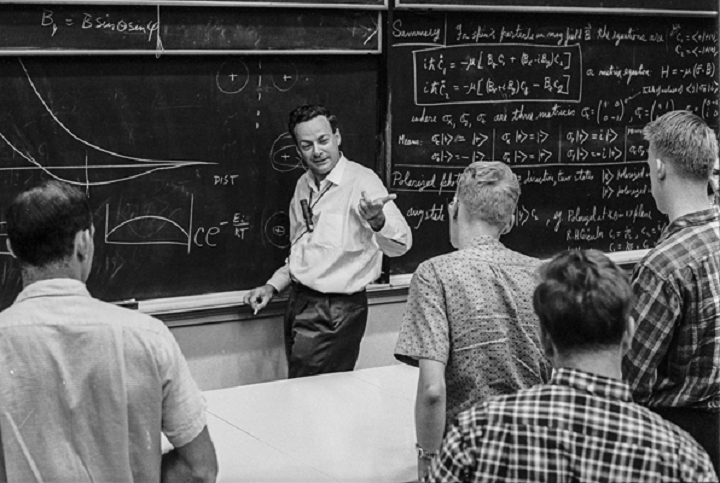
In 1964 a soon-to-be Nobel laureate walked into a Cornell auditorium and spent seven evenings explaining the nature of physical law to a general audience. Bill Gates paid the BBC out of his own pocket to keep those recordings on the internet forever.
His name was Richard Feynman, and the lectures are called The Character of Physical Law.
He was 46 years old when he gave them. He would win the Nobel Prize in physics the following year for his work on quantum electrodynamics. The BBC filmed every session. The tapes then went into distribution at universities through the 1970s, disappeared in the 1980s, and stayed lost until Gates licensed them for a Microsoft research project in 2009 specifically so they would never go offline again.
Here is the framework buried inside those lectures that changed how I think about knowledge itself.
In the final lecture of the series, titled Seeking New Laws, Feynman stops the philosophy and tells the room exactly how scientific discovery actually works. Not in metaphors. In three sentences.
He says in general we look for a new law by the following process. First we guess it. Then we compute the consequences of the guess to see what would be implied if the law we guessed is right. Then we compare the result of the computation directly to nature, to experiment, to observation, to see if it works.
And then he delivers the line that has outlived him by forty years.
If it disagrees with experiment, it is wrong. In that simple statement is the key to science. It does not matter how beautiful your guess is. It does not matter how smart you are, who made the guess, or what his name is. If it disagrees with experiment, it is wrong. That is all there is to it.
Read that again slowly.
He is not describing physics. He is describing the only intellectually honest way to hold any belief about the world. The method is indifferent to credentials, indifferent to elegance, indifferent to how much you want the idea to be true. Reality is the only referee, and reality never explains its rulings.
The second thread running through the whole series is the one Feynman kept circling back to across all seven nights.
He argued that the deepest beauty of a physical law is not in what it depends on but in what it refuses to depend on. Newton's law of gravitation works the same way on a falling apple, a moon in orbit, and a galaxy at the edge of the observable universe. That is not a detail. That is the entire point. A law that only works in one place is not a law. It is a coincidence. The test of a real generalization is whether it survives contact with situations its inventor never imagined.
The part that hits hardest comes in the opening lecture on gravitation.
Feynman is walking the audience through how Newton assembled the theory, and he pauses to say something most scientists never say out loud.
The importance of a physical law, he tells the room, is not how clever we were to find it. It is how clever nature was to pay attention to it. The universe did not have to be lawful. It did not have to reward pattern recognition with deeper pattern. The fact that it does is what makes science possible at all, and it is a standing miracle no one has ever explained.
Feynman ends the final lecture with a warning almost everyone misses.
He says the principles we now have may still be wrong in places we have not noticed. He suspects, out loud, that space being continuous is one of them. He offers no replacement. He just marks the edge where his own confidence runs out and tells the audience that honest uncertainty is the correct default for anyone actually trying to find the truth, instead of defend a position.
Sixty years later the full series still streams for free. Seven hour-long lectures. The best of Feynman at the peak of his powers, filmed before he was famous to the general public, speaking to a crowd that was never supposed to understand physics at this level.
Bill Gates kept them online because he understood what most people still miss.
A three-sentence method for testing any belief against reality is worth more than most of what graduate school teaches in three years.
Dear MAGA,
Just out of curiosity: If president Biden had banged porn stars, cheated on multiple wives, lied 30,000 times, singlehandedly and unilaterally started a war, released 5,000 Talibanis, bombed a school, bungled the Covid response, added trillions to the deficit, claimed windmills cause cancer, abandoned veterans, bombed 8 countries in one year, altered a weather map with a Sharpie, praised Allah in an Easter message, slept through numerous meetings, threatened to bomb another nation back to the Stone Ages because 'they're animals', violated the Constitution’s emoluments clause, sided with Vladimir Putin over U.S. intelligence agencies, revealed highly classified information to Russian officials in the Oval Office, and golfed when dead service members returned home, would you think it was okay and support his right to do so?
If not, then why let Trump get away with it?
A community college professor taught the same study skills lecture for 30 years, and the video quietly became one of the most watched educational recordings on the internet.
His name is Marty Lobdell. He spent his career as a psychology professor watching students fail not because they were lazy, but because nobody had ever taught them how their brain actually works under the pressure of learning something hard.
The lecture is called "Study Less Study Smart." Over 10 million views. Passed around in Reddit threads, Discord servers, and university study groups for over a decade. And the core insight buried inside it has been sitting in cognitive psychology research for years, waiting for someone to explain it in plain language.
Here is the framework that completely changed how I think about effort.
Your brain does not sustain focus the way you think it does. Studies tracking real students found that the average learner hits a wall somewhere between 25 and 30 minutes.
After that, efficiency doesn't just decline. It collapses. You're still sitting at your desk, still looking at the page, but almost nothing is going in.
Lobdell illustrated this with a student he knew personally. She set a goal of studying 6 hours a night, 5 nights a week, to pull herself out of academic probation. Thirty hours of studying per week. She failed every single class that quarter.
She wasn't failing because she lacked effort. She was failing because she had confused time spent near books with time spent actually learning. The 25-minute crash hit her at 6:30pm every night. She spent the next five and a half hours sitting in the wreckage of her own focus and calling it studying.
The fix sounds almost too simple. The moment you feel the slide, stop. Take five minutes. Do something that actually gives you a small reward. Then go back. That five-minute reset returns you to near full efficiency. Across a six-hour window, the difference is not marginal. It is the difference between thirty minutes of real learning and five and a half hours of it.
The second thing he taught destroyed something I had believed about how memory actually works.
Highlighting feels productive. Going back over your notes and recognizing everything feels like knowing. But recognition and recollection are two completely different cognitive processes, and your brain is very good at making you confuse them.
You can see something you've read before and feel completely certain you understand it, even when you couldn't reconstruct a single sentence from memory if the page were blank.
He proved this live in the room. He read 13 random letters to his audience. Almost nobody could recall them. Then he rearranged the same 13 letters into two words: Happy Thursday. The whole room got all 13 without effort.
Same letters. Same count. The only thing that changed was meaning.
The brain stores meaning. Not repetition. The moment new information connects to something you already understand, the retention changes entirely.
This is what the cognitive psychology literature calls elaborative encoding, and it is the mechanism underneath every effective study technique.
The third principle was the one that hit me hardest, and the one almost nobody applies.
Lobdell cited research showing that 80 percent of your study time should be spent in active recitation, not passive reading. Close the material. Say it back in your own words.
Teach it to someone else, or to an empty chair if no one is around. The struggle of retrieval is where the actual learning happens. Reading your notes again is watching someone else do the work.
His parting line has stayed with me longer than almost anything else I have read about learning.
He told the room that if what he shared didn't change their behavior, they hadn't actually learned it. It would just live in their heads as something they had heard once and felt good about.
He was right. And most people leave every lecture exactly like that.
The students who remember everything aren't putting in more hours.
They stopped confusing the feeling of studying with the fact of it.
You’re never out until you’re out.
Play the game in front of you. Not the game you wanted to happen. Not the game that just happened. Not the game you hoped would happen. But the game that is happening.
It's a remarkable lesson for basketball, for all of sport, and really, for all of life.
In the Elite 8 of the NCAA tournament, the UConn Huskies came out flat against the No. 1 seed Duke.
The Huskies trailed by 15 at halftime.
No. 1 seeds were 134-0 all time in the NCAA tournament when leading by 15 or more points at halftime.
That’s across the entire NCAA tournament history. Every round. Every year.
UConn had every reason to give up. But they simply refused. Most people check out when the odds turn against them. But UConn never stopped playing to win.
Their big man Tarris Reed Jr. put the Huskies on his back. He played incredibly on both sides of the ball.
The Huskies cut the lead to 13. Then to 11. Then to 7. Then to 5. And then, in the final seconds of the game, they cut the lead to two.
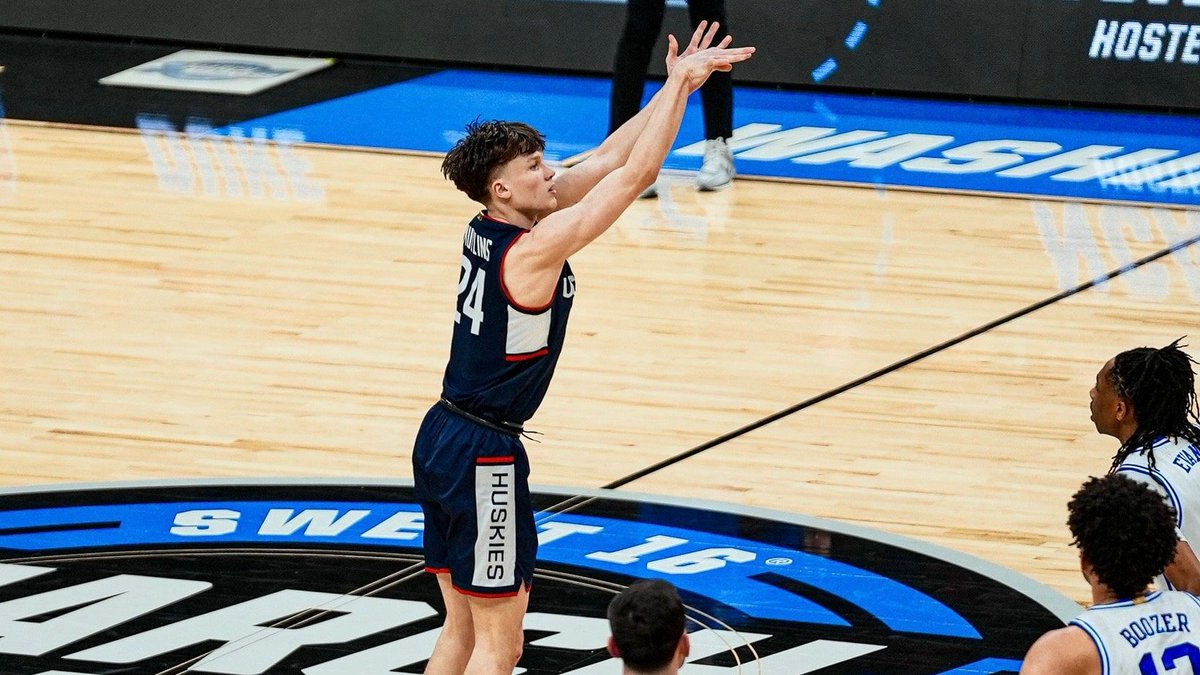
Duke inbounded the ball, UConn pressured and forced a turnover. With less than a second on the clock, Braylon Mullins—who had shot 0 for 4 from three—put up a deep 3 from the logo, and nailed it.
UConn 73. Duke 72.
134-1.
After the game, UConn coach Dan Hurley said this about Mullins:
"The courage. You have a young man, he's a rare human being. The toughness about him, to take the shot, on a tough shooting night, but he was due."
It was an off night. And yet with everything on the line you have no choice but to pull the trigger. Shooters shoot. That's confidence in the process.
March Madness is an ultimate test of emotional regulation. Over 3 weeks and 6 games, nothing ever goes to plan.
You prepare. You practice. You visualize. Then stuff happens.
The difference between those who collapse and those who rise? How they respond, especially when things don’t go their way.
What's true in basketball is true in life.
It's easy when everything is going your way. But things will go wrong. You'll fall behind. The score won't look good. Most people check out when the odds turn against them.
UConn never stopped playing their hardest.
Not when they were down 19. Not when they were 1 for 11 from three. Not when history said it was over.
It’s called having a next play mentality:
You can't control what already happened. You can't control the score. You can only control the next play.
One stop. One bucket. One possession at a time.
That's how you erase a historical deficit against the No. 1 team in the country. It's how you work through the biggest challenges in life too.
Excellence does not mean control. It does not mean perfection. It means refusing to quit on yourself when the situation looks hopeless. It means trusting your preparation even when nothing is falling.
It means playing the game in front of you. Not the game you wanted. Not the game you hoped for. The game that is happening.
Stay in the arena. Play the next play.
Just going to keep posting this to counter the ridiculous bullshit until someone makes me stop.
The Special Counsel investigation uncovered extensive criminal activity
•The investigation produced 37 indictments; seven guilty pleas or convictions; and compelling evidence that the president obstructed justice on multiple occasions. Mueller also uncovered and referred 14 criminal matters to other components of the Department of Justice.
•Trump associates repeatedly lied to investigators about their contacts with Russians, and President Trump refused to answer questions about his efforts to impede federal proceedings and influence the testimony of witnesses.
•A statement signed by over 1,000 former federal prosecutors concluded that if any other American engaged in the same efforts to impede federal proceedings the way Trump did, they would likely be indicted for multiple charges of obstruction of justice.
Russia engaged in extensive attacks on the U.S. election system in 2016
•Russian interference in the 2016 election was “sweeping and systemic.”[1]
•Major attack avenues included a social media “information warfare” campaign that “favored” candidate Trump[2] and the hacking of Clinton campaign-related databases and release of stolen materials through Russian-created entities and Wikileaks.[3]
•Russia also targeted databases in many states related to administering elections gaining access to information for millions of registered voters.[4]
The investigation “identified numerous links between the Russian government and the Trump Campaign” and established that the Trump Campaign “showed interest in WikiLeaks's releases of documents and welcomed their potential to damage candidate Clinton”
•In 2015 and 2016, Michael Cohen pursued a hotel/residence project in Moscow on behalf of Trump while he was campaigning for President.[5]Then-candidate Trump personally signed a letter of intent.
•Senior members of the Trump campaign, including Paul Manafort, Donald Trump, Jr., and Jared Kushner took a June 9, 2016, meeting with Russian nationals at Trump Tower, New York, after outreach from an intermediary informed Trump, Jr., that the Russians had derogatory information on Clinton that was “part of Russia and its government’s support for Mr. Trump.”[6]
•Beginning in June 2016, a Trump associate “forecast to senior [Trump] Campaign officials that WikiLeaks would release information damaging to candidate Clinton.”[7] A section of the Report that remains heavily redacted suggests that Roger Stone was this associate and that he had significant contacts with the campaign about Wikileaks.[8]
•The Report described multiple occasions where Trump associates lied to investigators about Trump associate contacts with Russia. Trump associates George Papadopoulos, Rick Gates, Michael Flynn, and Michael Cohen all admitted that they made false statements to federal investigators or to Congress about their contacts. In addition, Roger Stone faces trial this fall for obstruction of justice, five counts of making false statements, and one count of witness tampering.
•The Report contains no evidence that any Trump campaign official reported their contacts with Russia or WikiLeaks to U.S. law enforcement authorities during the campaign or presidential transition, despite public reports on Russian hacking starting in June 2016 and candidate Trump’s August 2016 intelligence briefing warning him that Russia was seeking to interfere in the election.
•The Report raised questions about why Trump associates and then-candidate Trump repeatedly asserted Trump had no connections to Russia.[9]
I remember when my Republican colleagues blasted Barack Obama over $400M tied to hostages and an old debt with Iran.
Now, under Donald Trump, sanctions relief on 140M barrels of Iranian oil could net Tehran up to $15 BILLION — while the U.S. is at war.
Where’s the outrage now?
The same idiots who think Trump, who dodged the draft five times, knows how to win a war also think Trump, who declared bankruptcy six times, knows how to run the economy.
That’s what Trump Derangement Syndrome actually looks like.
After October 7, Israel was told not to respond, because it might make Hamas “hate us more.”
Only a couple of weeks later, Israel was told to stop fighting and leave 251 hostages behind, because our response was “disproportionate.”
Last June, after Israel preemptively struck Iran, following years of warning that we would never allow a nuclear threat, the world was outraged again.
And now, after years of warnings and despite a war and countless attempts to reach agreements, Iran continues to advance its nuclear program and deadly missiles, so the United States and Israel acted before Iran could carry out its threats.
Well, I’m glad we didn’t wait for the world’s permission to defend ourselves.
Because, newsflash: the world was never going to give it.