There are rivers of air in our skies, and planes ride them
There are rivers of air in our skies, and planes ride them. They're called jet streams, narrow bands of wind about ten kilometres (6 miles) up, right where airliners cruise, and they blow from west to east, sometimes faster than 400 km/h (250 mph). That's why flying east is quicker than flying west on the same route. A plane heading east from New York to London rides inside the river and gets carried along, while the plane going back west swings north to stay out of it, so in winter the westbound flight takes about an hour and a half longer. Between Tokyo and Los Angeles the difference is more than two hours. On one stormy night in February 2020 the river over the Atlantic was so strong that a British Airways jumbo crossed from New York to London in 4 hours 56 minutes, moving over the ground at 1,327 km/h (825 mph), faster than the speed of sound up there, without ever breaking the sound barrier.
Next time one direction of a long flight takes longer than the other, you'll know why.
How clean is the air you breathe in your country?
Over the past 12 months only 3 countries with over a million people stayed under the WHO limit. Nepal, China and Bangladesh breathed the dirtiest air, New Zealand the cleanest.
How clean is the air you breathe in your country?
Over the past 12 months only 3 countries with over a million people stayed under the WHO limit. Nepal, China and Bangladesh breathed the dirtiest air, New Zealand the cleanest.
This is every single hurricane, typhoon and cyclone since 1851. None has ever crossed the equator. One came within 80 km: Cyclone Agni in 2004. Red lines are the strongest.
This is every single hurricane, typhoon and cyclone since 1851. None has ever crossed the equator. One came within 80 km: Cyclone Agni in 2004. Red lines are the strongest.
Almost all the earthquakes ever recorded have happened along these lines. The big one around the Pacific is called the Ring of Fire. This is every earthquake of magnitude 5+ since 1900, all 107,158 of them. Have you ever felt one?
Almost all the earthquakes ever recorded have happened along these lines. The big one around the Pacific is called the Ring of Fire. This is every earthquake of magnitude 5+ since 1900, all 107,158 of them. Have you ever felt one?
Ever been stuck in traffic that just cleared, with no crash and nothing on the road? In 2008, researchers in Japan put 22 cars on a circle and asked drivers to keep a steady speed. A jam appeared anyway. It starts with one driver braking a little.
Everyone is talking about Voyager 1 being one light-day away, but do you know what that means?
A light-day is not a time, it is a distance: how far light travels in one day, about 25.9 billion km (16.1 billion miles). Light crosses it in a day. Voyager 1 needed 49 years, and a jet airliner would need 3,283.
#voyager1 #lightyear #space #astronomy #science
Ever been stuck in traffic that just cleared, with no crash and nothing on the road? In 2008, researchers in Japan put 22 cars on a circle and asked drivers to keep a steady speed. A jam appeared anyway. It starts with one driver braking a little.
One beam of sunlight, followed at true scale. It gets through the planets in a few hours, slips past Voyager 1, the farthest thing we've ever sent out, and then the real emptiness starts. Watch how long it takes to reach Andromeda, the next big galaxy over.
One beam of sunlight, followed at true scale. It gets through the planets in a few hours, slips past Voyager 1, the farthest thing we've ever sent out, and then the real emptiness starts. Watch how long it takes to reach Andromeda, the next big galaxy over.
Everyone is talking about Voyager 1 being one light-day away, but do you know what that means?
A light-day is not a time, it is a distance: how far light travels in one day, about 25.9 billion km (16.1 billion miles). Light crosses it in a day. Voyager 1 needed 49 years, and a jet airliner would need 3,283.
#voyager1 #lightyear #space #astronomy #science
What would you hear if a jumbo jet flew over your city faster than sound? 🔈🔈
Past 1,225 km/h (761 mph) its noise piles up into a sonic boom. The first one hits one spot about 6 times louder than Concorde's, then a 54 km wide strip of booms follows the plane over 33 million people.
The US now plans to lift its 1973 ban on supersonic flights over land.
#sonicboom #aviation #supersonic #physics #science
This is what our sky looks like now.
20,346 satellites over your head, and 11,189 belong to one company. In 1957 there was just one, a Soviet ball that went beep. This month China passed Russia for second place. Who owns the sky in 10 years?
Real launch and re-entry dates, old orbits estimated, sped up.
Music: Rimsky-Korsakov, Flight of the Bumblebee (public domain).
#satellites #starlink
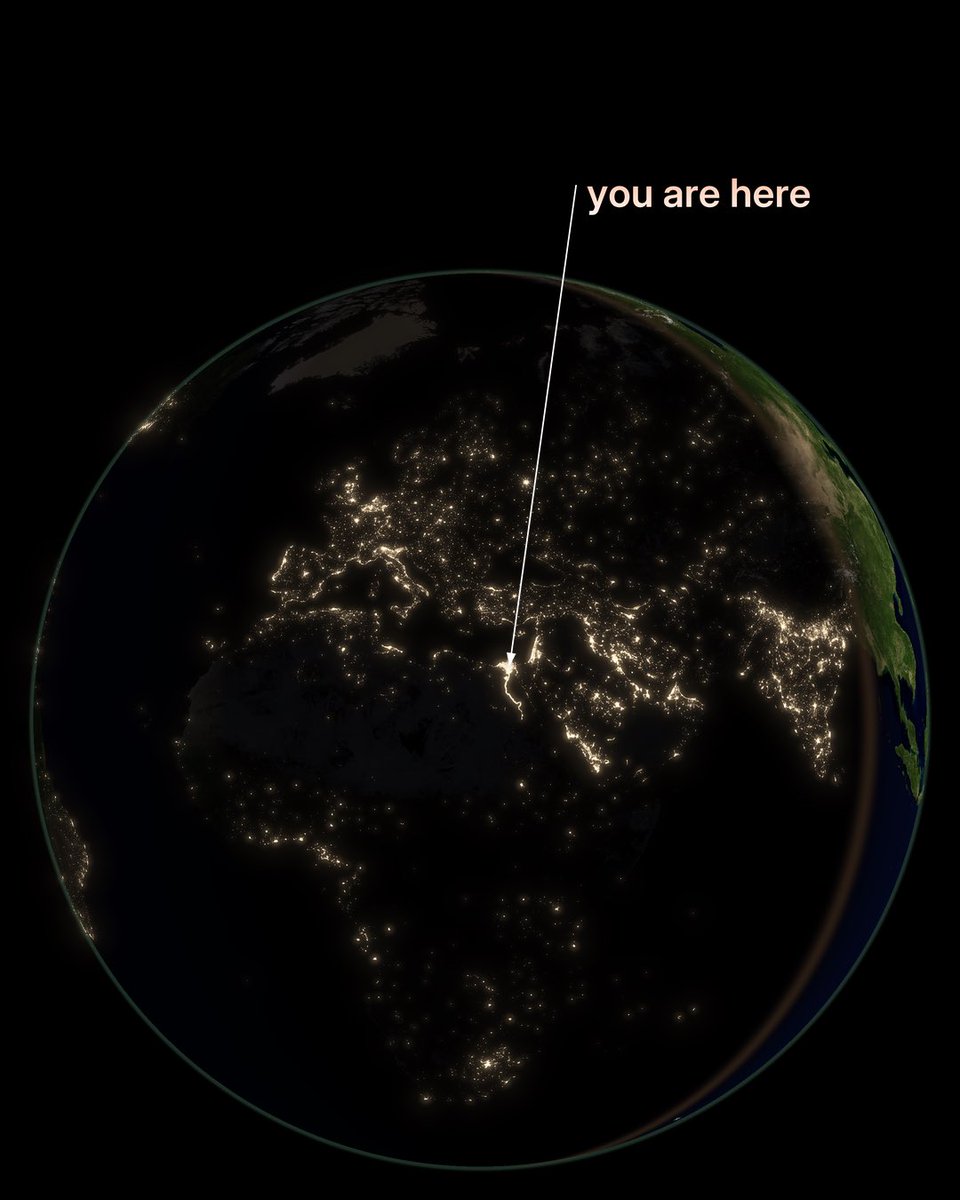
A galaxy of hundreds of billions of stars, one ordinary star, one tiny speck going round it, and in that tiny speck is you, worrying about taxes and rent
Do you know what those white lines behind planes really are? Most people think they're smoke, but they're actually clouds that the plane makes as it flies.
Burning a kilo of jet fuel produces more than a kilo of water, which leaves the engine as hot, invisible vapour. Up at cruise height the air is around −55 °C, so the vapour cools quickly as it mixes in, and about 30 metres behind the engine it freezes into tiny ice crystals. That's why you can see a small clear gap between the engine and the start of the white line.
What happens after that depends on how much moisture is in the air up there. If it's dry, the ice turns back into vapour within a few seconds and the line disappears. If it's damp, the ice keeps growing by pulling water out of the surrounding air, and the trail can spread for hours into a thin sheet of cloud several kilometres wide. By then almost all of the water in it has come from the sky rather than from the plane.
So when you look up and see a short line that fades quickly, the air up there is dry, and when you see one that lingers and spreads, it's damp.
This is my own simulation, not real footage. The engine shot is slowed down 10 times and the time-lapse runs about 400 times faster.
Music: Debussy, Arabesque No. 1 (public domain).
#contrails #clouds #airplane #science #sky