🧠 New Research ideas! Are LLMS making equity markets more efficient? Here's the number.
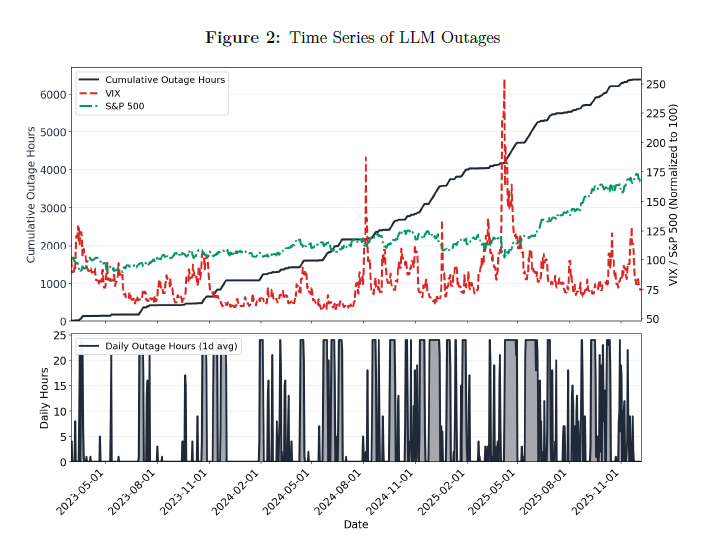
Lu, Xu, and Vulicevic (2026) use outages at major LLM providers as natural experiments to isolate the effect.
When LLMs are available, next-day return predictability drops by 46–61%. When providers go down, predictability roughly doubles or triples, as if the clock ran backward.
The mechanism: LLMs process public information faster and on a larger scale, compressing the window for slow arbitrageurs.
The pace at which public information gets priced in has visibly accelerated over the past two years. This paper puts a clean number on what I'd been observing informally.
The implication for systematic managers is direct: any signal that relies on slow information absorption is decaying faster than it did five years ago.
📄 Lu, Xu, Vulicevic: https://t.co/K5OVBiU74g
→ More research like this in my newsletter: https://t.co/Xtg63h9wiS
Investors should pay attention to what people are saying on social media about stocks. They just need to learn to separate the substance from the noise, or sentiment from attention. See the latest from @RunjingLu et al. https://t.co/C4cK3FpuKB #RetailInvestors#DayTrading
🚨 New working paper with @w_mullins_@RunjingLu and @marinaniessner "Market signals from social media"
In it, we develop market-level daily sentiment & attention series from a "bottom up" approach (aggregating firm signals), showing novel dynamics.
https://t.co/0mFmowVzTB
🚨 Just 10 days remaining to submit your paper to the 1st PhD Conference in Economics & Finance at @ImperialBiz , which will take place on April 25-26. Don't miss out 👀
Visit https://t.co/8lbFGNiLXA to submit your application. #EconTwitter
The Social Signal (new draft Dec 15).
Some big changes with @RunjingLu, @marinaniessner and @w_mullins_ We incorporated a bunch of great suggestions from a spate of presentations (and an anonymous referee).
https://t.co/5l1AiELvWH
Does an inventor’s political identity influence their productivity?
In a new paper, Joseph Engelberg, @RunjingLu, @w_mullins_, and Richard Townsend examine the impacts of the '08 and '16 US presidential elections on Democrat and Republican inventors.
https://t.co/BvZYR0QJdk
📢📢 Attention #Econ#JobMarket candidates on the market this fall - Apply to receive feedback on your J.M materials and spiel:
Call for applications : https://t.co/YpXCATbf1v
Fill out this form by **October 7**: https://t.co/f0HpkPEss0
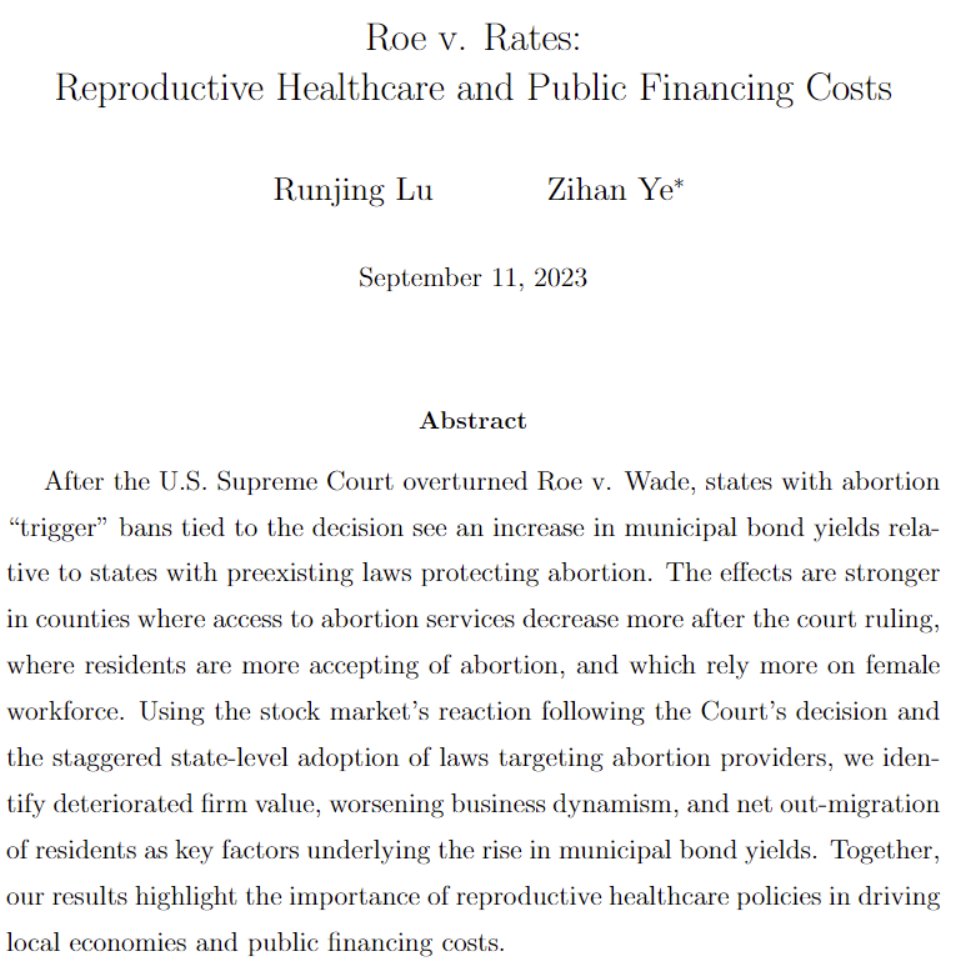
(4/4) We identify deteriorated firm value, worsening business dynamism, and net out-migration of residents as key factors underlying the rise in municipal bond yields. More details👇
https://t.co/YXMrFkQr9z
🚨New paper🚨
I am excited to share my new paper, "Roe v. Rates: Reproductive Healthcare and Public Financing Costs" with Zihan Ye!!
https://t.co/YXMrFkQr9z
(1/4)
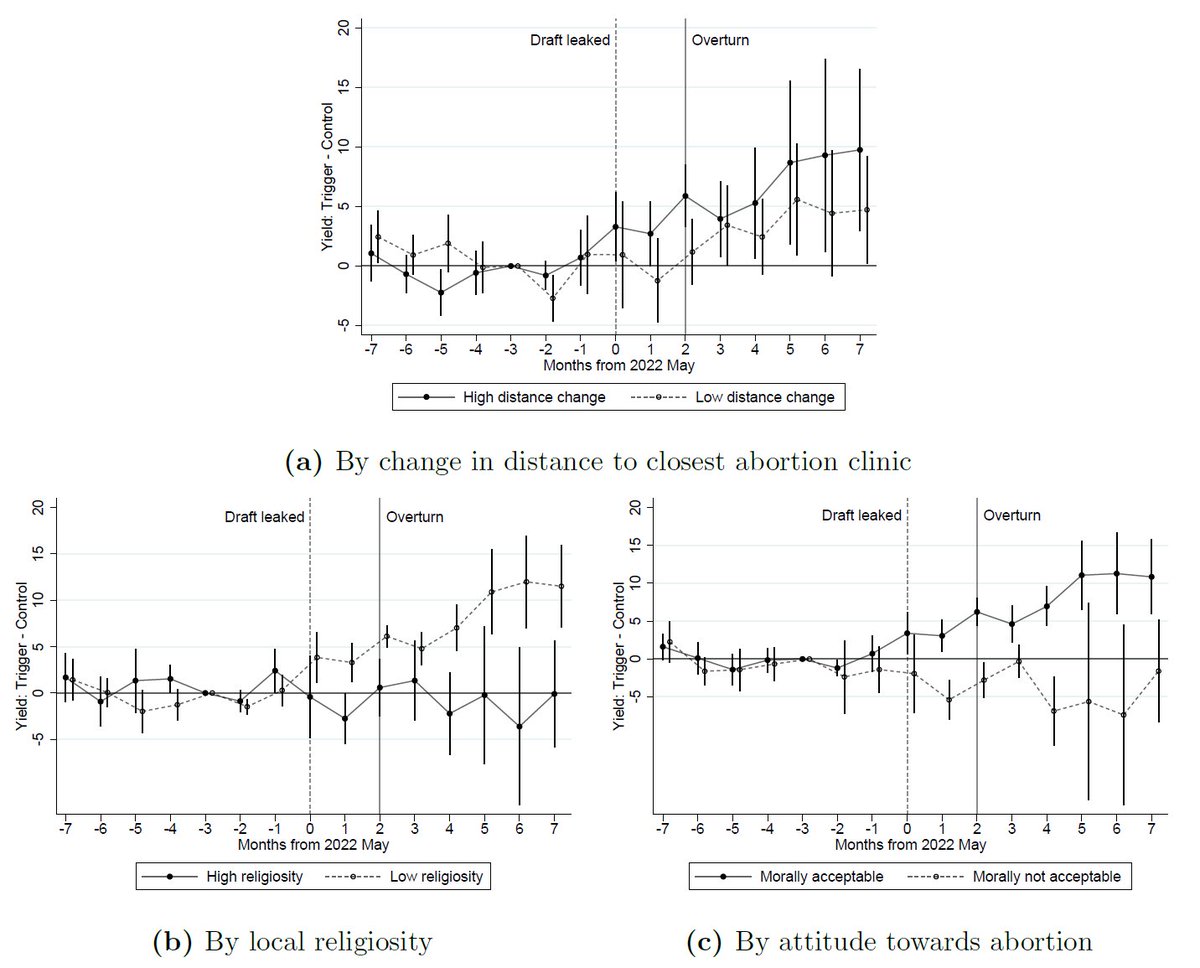
(3/4) The effects are stronger in counties where access to abortion services decrease more and residents are more accepting of reproductive healthcare.
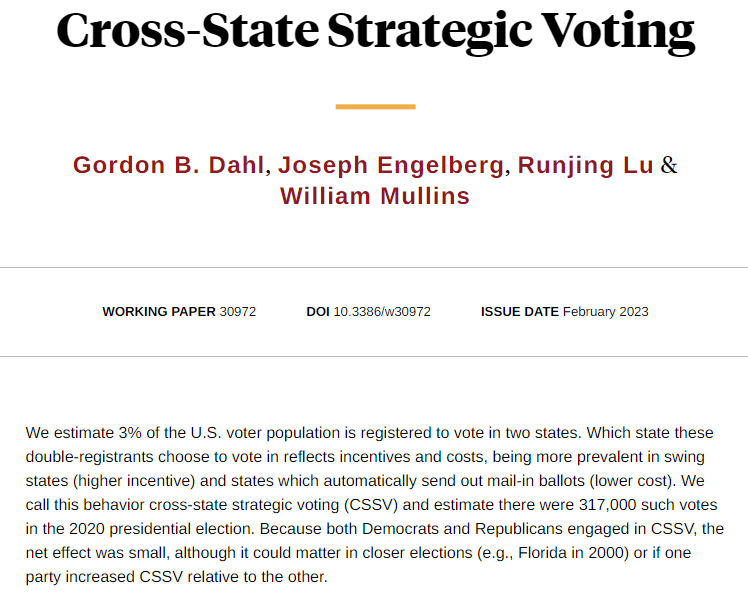
Three percent of US voters are registered to vote in two states. Their voting reflects incentives and costs, being more prevalent in swing states and auto-mailed ballot states, from Gordon B. Dahl, Joseph Engelberg, @RunjingLu, and @w_mullins_ https://t.co/FNu8fzSZMo
Republicans start more firms than Democrats. 6% of Republicans and 4% of Democrats become entrepreneurs. This partisan entrepreneurship gap is time-varying with election cycles, from Joseph Engelberg, @jorgeguzmancbs, @runjinglu, and William Mullins https://t.co/nIhKzlmWCF
Deeply honored to win the Midwestern Finance Association award for Best Paper in Corporate Finance together with my great co-authors Joey Engelberg, @RunjingLu, and Will Mullins, for our paper Partisan Entrepreneurship. https://t.co/rBD8oTVq8F
📢@EliraKuka & I have been working on round 2 of Adopt a Paper📢
Last year we matched 123 papers by junior economists to top scholars in their field. Info on round 1: https://t.co/Hsniu0dpBb
This year we are excited to expand to Canada & Europe.
Launching round 2 tomorrow!
A notice for folks on *either side* of the #EconJobMarket: the AEA has just made three recommendations:
1) Employers are asked to wait until Thurs Dec 2, 2021 to extend interview invitations.
Why? So they can receive and consider job candidates' signals on Dec 1.
1/3