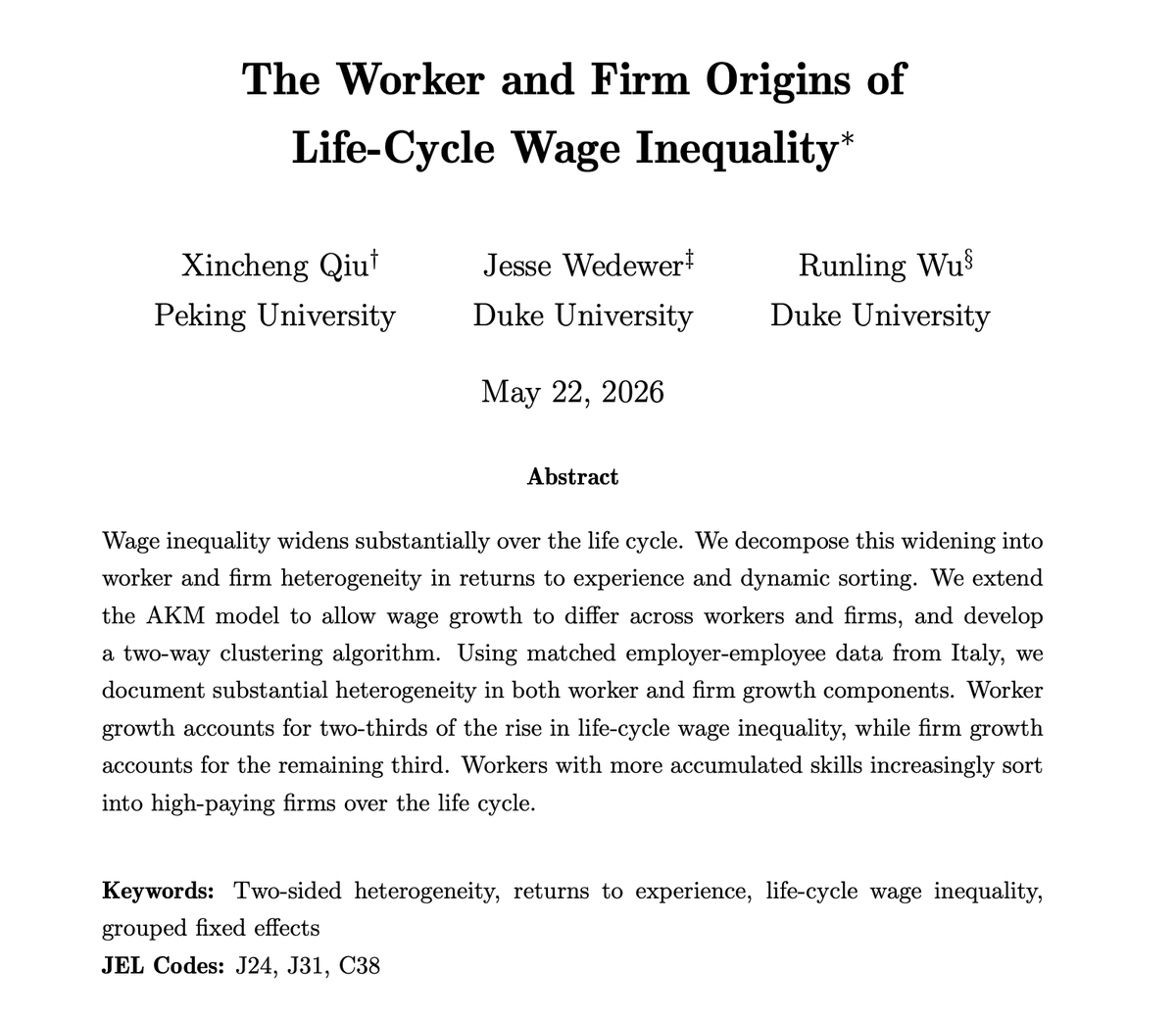
(1/13) 🚨 New paper alert 🚨
"The Worker and Firm Origins of Life-Cycle Wage Inequality" (with @XinchengQiu and Jesse Wedewer @DukeEcon)
Draft available here: 🧵⬇️
https://t.co/XmAVt0YLrg
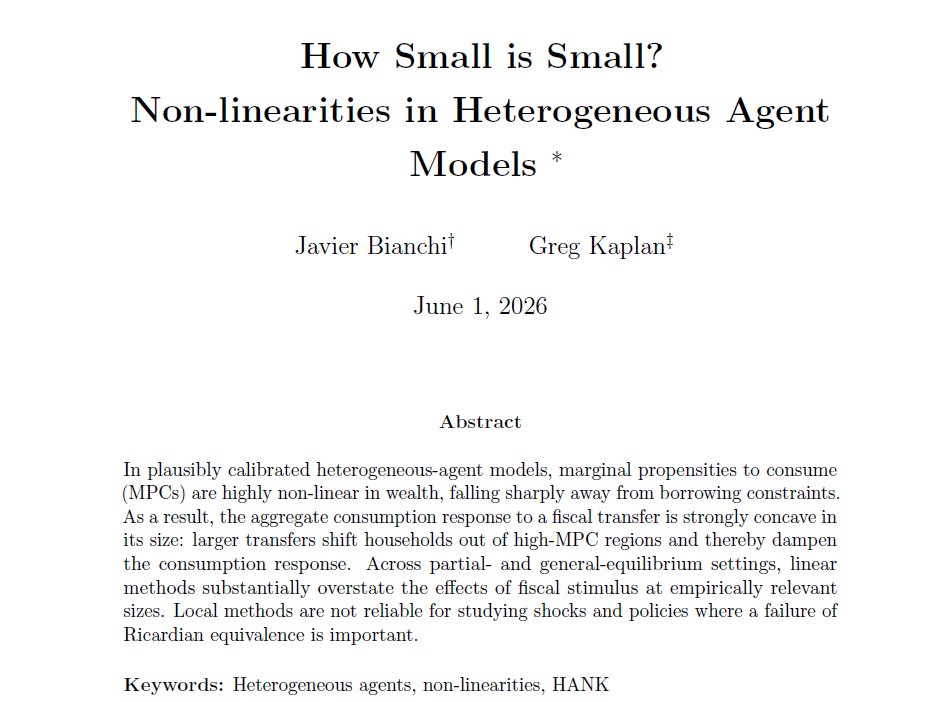
📢 New paper w/ @GregWKaplan 🧵1/10
How small is “small” for local-linear methods to deliver reliable answers in heterogeneous-agent models of fiscal stimulus?
Our answer: very small.
Great pleasure to present my keynote "Natural Language and Labor Markets" at the Berlin Labor Economics Workshop @DIW_Berlin.
I explored how NLP, LLMs, and GenAI help measure previously unobservable concepts such as worker rights or educational content.
Thanks for having me!
Very happy to be in Amsterdam for the SaM Annual conference 2026!
Haomin Wang will present our paper "Household Search and the Equilibrium Gender Pay Gap", joint with Leo Kaas and @chiaralac
Looking forward to an exciting programme and many great chats on search and matching!
Analyzing intergenerational mobility of wealth and income across US counties, highlighting spatial differences due to factors such as house prices and the Great Recession shock, from Ariel J. Binder, Max Risch, and @john_voorheis https://t.co/DVVFPKhtpz
(1/13) 🚨 New paper alert 🚨
"The Worker and Firm Origins of Life-Cycle Wage Inequality" (with @XinchengQiu and Jesse Wedewer @DukeEcon)
Draft available here: 🧵⬇️
https://t.co/XmAVt0YLrg
(1/13) 🚨 New paper alert 🚨
"The Worker and Firm Origins of Life-Cycle Wage Inequality" (with @XinchengQiu and Jesse Wedewer @DukeEcon)
Draft available here: 🧵⬇️
https://t.co/XmAVt0YLrg
(12/13) Our framework opens several avenues.
One natural application: decomposing the college wage premium over the life cycle. Does it grow because graduates accumulate human capital faster, work at firms offering steeper returns, or sort into better employers?