Your brain deletes most of your ordinary days. It keeps almost every minute of a night alone in a foreign city. What's happening there is actually one of the more beautiful things about how your nervous system works.
Your brain is a prediction machine. When it can predict everything, like your commute, your kitchen, your same six streets, it stops recording. That's why whole months at home just vanish. But put yourself somewhere it can't predict anything and the system flips. Every sign, every smell, every crosswalk registers as new information. Dopamine tags all of it as worth keeping. This is why one week abroad feels longer in memory than a month at home. Your brain literally kept more of it.
The second thing happening is quieter. At home, some part of you is always tracking how you're being perceived. Your boss, your friends, the people who knew you at 22. In a city where nobody knows your name, that entire system goes offline.
And when it goes offline, the bandwidth doesn't disappear. It gets redirected inward.
That's the "realizing how far you've come" part. Your brain is finally recording again, the self-monitoring is off, and you're far enough away from your life to see the whole shape of it at once.
You spend years too close to your own life to see it. Then one night you're crossing a street on the other side of the world, and you finally have enough distance to look.
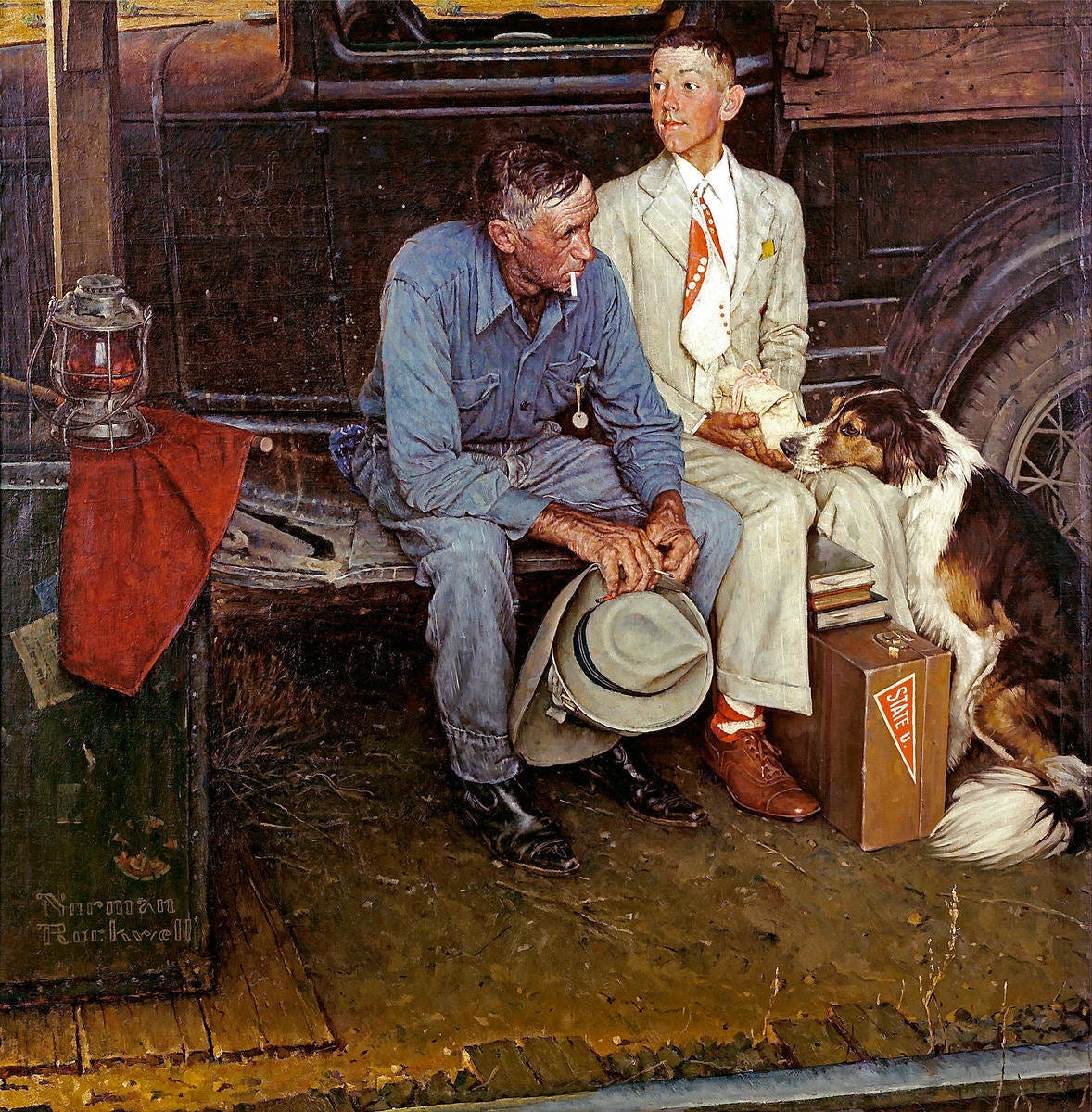
This is one of the most beloved paintings in America, and it puts its finger on something we all pass through, first as the child, and one day as the parent left behind...
The painting is Breaking Home Ties, by Norman Rockwell, on the cover of the Saturday Evening Post in 1954. A father and his teenage son sit side by side on the running board of a battered farm truck, waiting at a railway stop. A single track runs along the bottom of the picture. A ticket pokes from the boy's pocket. His suitcase is stacked with schoolbooks and wears a "State U" pennant. The train is coming to carry him off to college, away from home, for the first time in his life.
Everything is in the way they sit.
The son sits upright, scrubbed and dressed in his best, eyes fixed on the horizon, on the track, on the future rushing toward him. He is already half gone. For him that train is the beginning of everything.
His father sits beside him in worn work clothes and scuffed boots, looking the other way, down the line, as if he cannot bear to watch it arrive. The same train means the opposite thing to him. For the son it is the start of a life. For the father it is the day the house grows quieter, the chair at the table sits empty, and the person he built his world around walks out into a life that no longer has him at its centre.
Look at his hands. He is holding two hats. His own battered one, and resting on top of it, his son's crisp new one, held carefully together, because it is the last small thing he can still do for the boy...
And then the dog, its head laid in the son's lap, gazing up, refusing to look away. Rockwell knew exactly what that was for: "The father couldn't show how he felt about the boy's leaving," he said. "The dog did."
It has moved people for 70 years because every leaving is a beginning for one person and an ending for another. The child steps out into the world, as they should. And someone stays behind, watching them go, and loving them enough to let them go anyway...
A Good Year with Russell Crowe and Marion Cotillard . . . Crowe’s character going from a workaholic top stock broker in the UK to becoming the heir to a French vineyard in Provence.
It completely bombed at the box office but for me it’s one of those vacation films that’s needed every once in a while and it has some of my favorite actors on the big screen.
From Ansel Adams to Rebecca Norris Webb, we trace the symbiotic relationship that the parks and photography have developed over 150 years. https://t.co/2deOI7Kd4l
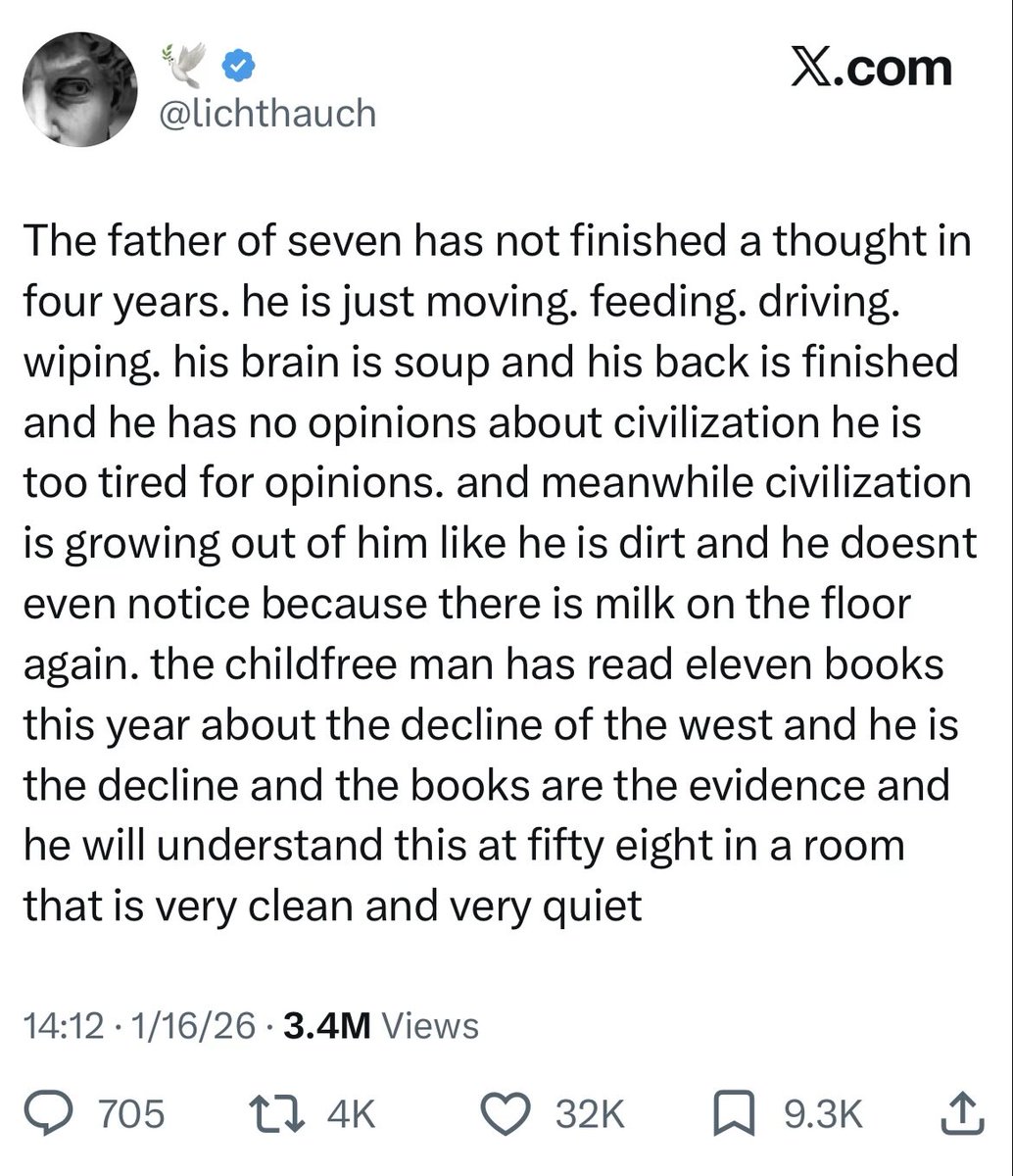
There are guys who sit in their houses in frisco TX and they watch landman and whenever landman drinks they drink and they wear a cowboy hat in their living room and they laugh when landman laughs. The wife sits with the son in the nursery all painted blue and thinks about blood
Many people would be blown away by the number of immigrants who drive beat-up Camrys, wear old jeans, and own a dozen properties with low debt and a $50M net worth.
Won’t find them at the private jet terminal, and they’ll walk past your first-class seat, happily settling in 34A
This 100%. People just aren’t aware of the amount of red tape involved in the building process. I’d say more than 50% the reason why stuff looks like dog meat these days is because building codes basically require it or to balloon your budget by 10x to meet code and do something nice.
Yesterday, I adopted the oldest, sickest, most broken dog in the shelter. I’ll never forget the look in his eyes. When I walked up to his cage, he didn’t even look up—he was used to being ignored. Curled up in the corner, he had accepted his fate. The volunteers kept asking me, “Are you sure about this one? Are you sure?” Without hesitation, I said, “YES! This is my dog.” When the cage was opened, three other animals fell out, but I went straight to him. Suddenly, he looked up at me as if he were seeing an angel. I wrapped him in my arms and whispered, “You’re going to be happy again.” He fell asleep in my lap—perhaps the first peaceful sleep he’d ever known.
Give them a chance. Give them love. They need us.
The beauty of becoming an old man man is that you become invisible. You can wear anything you want, you can cut your hair or not cut your hair. Trim your mustache or just let it grow wild.
Nobody notices and nobody cares. You're incognito and you're not coming back.
Other problem with NPR is that they cultivated a creepy vocal style that is basically the voice used by passive-agressive adult authority figures when you get in trouble as a kid.