We're in a new phase of the conflict. Confirmed ship strikes in the Gulf have risen from zero in early February, before the war, to 22 in the last 14-day period. Yes, significant volumes are getting out, but moving oil from the Gulf is becoming increasingly difficult.
Posts on Chinese social media have urged residents in the 3 northeast provinces to stockpile food and protective supplies, with some warning of possible future lockdowns. Separate anonymous claims circulating on X allege plague cases or deaths in Shanghai and Chongqing linked to recent Russia travel. These reports (rumors?) follow the Oct. 2 death of a lab worker at Russia’s Irkutsk Anti-Plague Research Institute from pneumonia of undetermined cause. WHO notes the diagnosis remains unconfirmed and that Russian officials stated no recent plague cases were registered in Irkutsk Oblast. No official Chinese announcements have confirmed related cases in the Northeast, Shanghai, or Chongqing.
Confirmed Iranian strikes on ships in the Strait of Hormuz are at their highest level since the start of the war. Europe and other democracies need to be careful about overextending themselves via oil inventory releases. 1/2
Destroying Iran’s power infrastructure would likely precipitate a water and food crisis, destabilizing a nation of 92 million individuals. In addition, the Khamenei regime would almost certainly respond by further targeting GCC energy and water infrastructure. 1/3
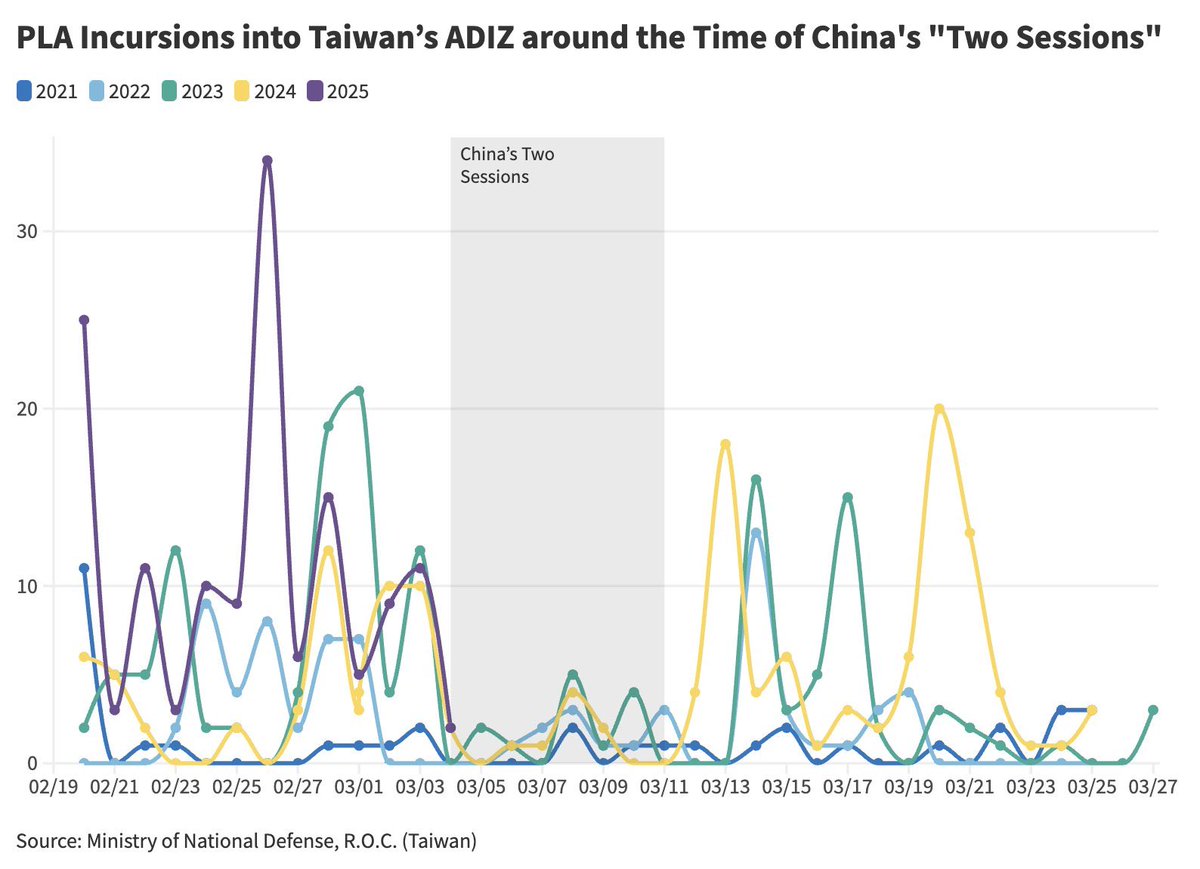
This isn’t mysterious. PLA air incursions into Taiwan’s ADIZ drop to/near zero around the time of the annual “two sessions” every year.
I made this graph last year:
I just read the Trump administration's National Security Strategy. Five initial thoughts:
1) Where's the geographic focus? A little all over the place...
- Western Hem is discussed first
- Europe gets the most mentions
- Asia gets the most pages, but nearly all about China
It’s way too easy for CN AI firms to legally access banned AI chips outside China without buying them, which neuters export controls. Some non-Chinese data center operator can buy them with intention to be captive data center for Chinese AI lab without breaking any law
H200s are better inference chips than B30As — the very chip that Trump blocked Nvidia from selling to China.
No advanced AI chips for America’s adversaries.
PRC messaging on ties with Russia is shifting from “fundamental interests of the two peoples” (人民根本利益) to “generational friendship” (世代友好). Worth keeping an eye on this framing.
1/2
The US peace plan is a hot mess. But Ukraine can’t reject it outright. So here’s how they could respond, taking what’s good in the draft (there is some) and fixing what they must to move forward. @ACEurasia@ACEurope@dmarusic
https://t.co/lJZygi150k
The European response seems on target: accept the initiative broadly but make clear it needs work. Diplomacy may be moving to a responsible level with @SecRubio and key Europeans catching up to the problematic Witkoff-Dmitriev channel.
WSJ just dropped another strong investigation on how China is exploiting loopholes in U.S. export controls. To summarize what is happening and the loopholes that China is exploiting:
1️⃣ Nvidia ships Blackwell AI chips to Aivres Systems, a U.S.-based company that is 100% owned by China-based Inspur Electronic, which is on the U.S. Entity List. (This is 100% legal, because the only place that Chinese companies face no restrictions on buying AI chips is if they buy them inside the United States)
2️⃣ Avires ships these AI chips to an Indonesian cloud provider, Indosat, which is majority-owned by a joint-venture between a Qatari company and a Chinese company. (This is 100% legal, because there are no restrictions on AI chip shipments to Indonesia or most other countries unless the company is majority owned by a China-based company, which Indosat technically is not)
3️⃣ Avires identifies a China-based client for Indosat, INF Tech, which is banned from purchasing AI chips but is interested in renting access to these chips from Indosat. INF Tech rents access to the Indosat-owned chips that Avires originally purchased, and uses them to develop and run advanced AI systems. (This is 100% legal, because there are virtually no restrictions on China-based companies renting access to banned AI chips from companies located outside China, including from U.S. cloud providers, even though the export of the chips themselves to China-based companies is banned)
All of these loopholes can and should be closed. Commerce should: (1) ban the sale of AI chips to Chinese companies located in the United States by issuing an ICTS regulation prohibiting these transactions; (2) require a US export license for any sale of large numbers of AI chips to untrusted companies in Southeast Asia at a minimum, and potentially to a larger set of countries; and (3) close the remote access loophole that allows Chinese companies to circumvent export controls by renting access to AI chips instead of buying them, by prohibiting the use of AI chips by China-based companies to train or provide inference for any advanced AI models.
If we’re serious about controlling compute as a strategic resource, all of these steps are necessary.
https://t.co/VxQNN2uCeT
Great report on the national security threat from TikTok, and short-form video in general. These damage cognitive development in the West, while China protects its kids.
Australia is the best model for USA: delay to 16
https://t.co/G5vuOtcY3M
via @AtlanticCouncil writers: