The Russia Program at GW is a university-based analytical center at @IERES_GWU. Views expressed here do not necessarily reflect the views of GW University.
📍 How Returning Veterans Are Driving a Surge in Violent Crime in Russia
➡️ https://t.co/vR8p7A6nPa
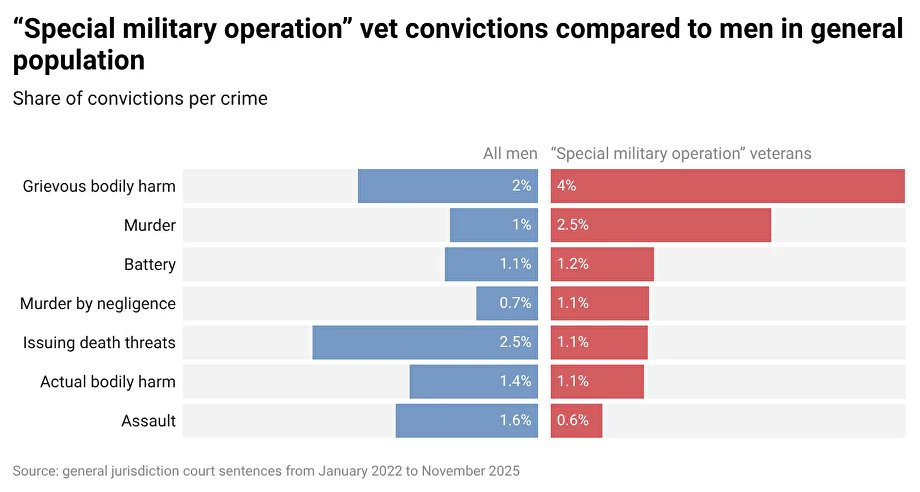
A new CEDAR study for The Russia Program finds that nearly 8,000 veterans of Russia’s war against Ukraine have been convicted of civilian crimes since 2022 — a growing share of them for violence.
🔹 Scale: ~8,000 convictions linked to war participants since 2022; about 7,000 were veterans who had already returned home.
🔹 Rising yearly totals: roughly 350 cases identified in 2022, 2,500 in 2023, and 4,700+ in 2024 (2025 figures are incomplete so far).
🔹 Violence & domestic abuse: 900+ veterans prosecuted for violent crimes; 423+ victims killed (including fatal traffic cases). The dataset includes 52 domestic-violence cases targeting partners, children, and other relatives.
🔹 Disproportionate severity: veterans are prosecuted for murder/attempted murder 2.5× more often than men overall, and 2× more often for assaults causing grievous bodily harm.
🔹 Repeat offenders & pardons: at least 2,139 convicted veterans had prior convictions; 656 were pardoned by presidential decree after being recruited from jail to fight.
🔹 Leniency in courts: about one-third of veterans receive more lenient sentences than comparable civilians, often getting fines or labor penalties instead of prison.
The report also stresses these are minimum estimates: not all cases reach court, not all verdicts are published, and data from occupied territories is largely unavailable.
Read full analysis: https://t.co/vR8p7A6nPa
New from The Russia Program: a study of Russia-related lobbying in U.S. congressional disclosures shows that American companies—not Russian-affiliated clients—dominate lobbying around sanctions, trade, and Russian state interests.
https://t.co/2ipbD3AMkv
Join us for an online conference launching the latest special issue of Demokratizatsiya, exploring the Global South’s evolving relationship with Russia after 2022. Moderated by Marlene Laruelle.
Register here: https://t.co/8KyE0jozyN
📝We’ve published the full Digital Methods School tutorial series on YouTube.
AI and prompt engineering, text analysis, and methods for tracking narratives and bot networks on Telegram and VK.
Watch here: https://t.co/r3ckeynk1r
📍 New research. How does the Kremlin decide which cultural initiatives deserve support — and which values that support should promote?
➡️ https://t.co/9wUtEKTQWP
Why does a failed revolt from 1825 still trouble the Kremlin?
Igor Torbakov traces how the Decembrists became a lasting symbol of moral resistance to autocracy—and why Putin’s regime now works to suppress that legacy while rehabilitating Nicholas I.
https://t.co/scMAjKYSBY
📢 Join our digital methods training school! The next series of online trainings starts next week.
We provide hands-on training to turn digital traces into reliable empirical evidence—without requiring specialized technical skills.
https://t.co/mW2I3an4Ar
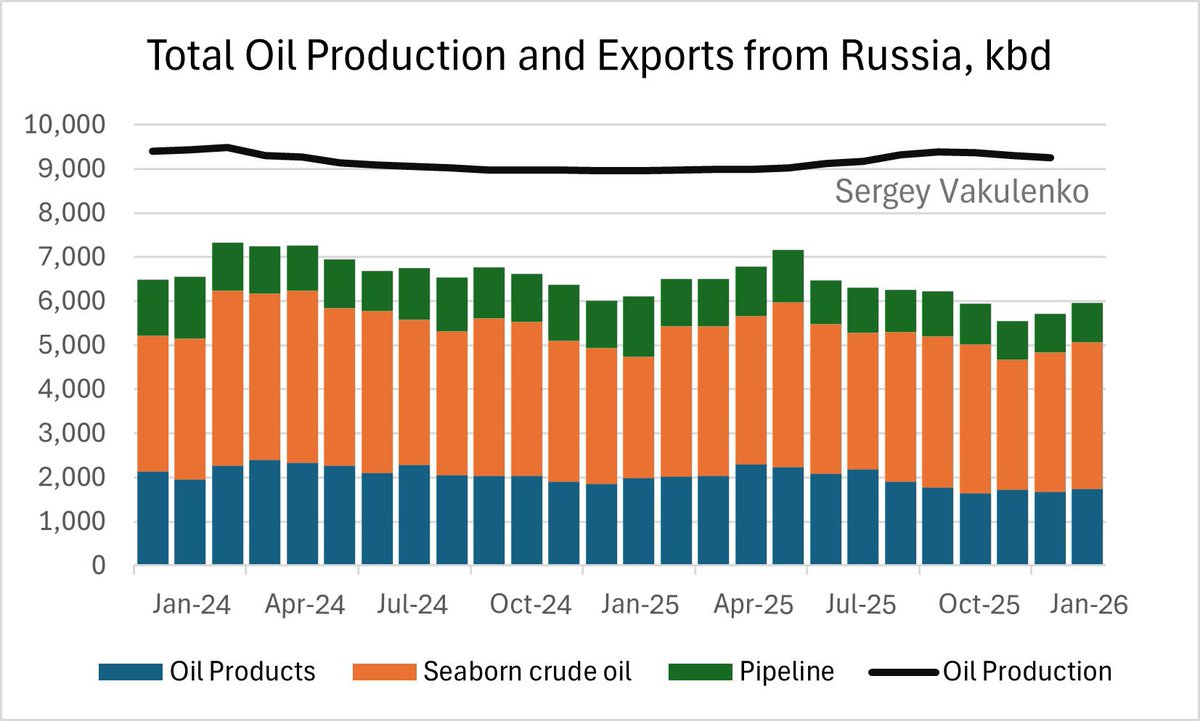
Russian oil exports have fallen — but not dramatically.
In the observable data, exports dropped from ~7.15 mb/d in June to ~5.54 mb/d in December, then rebounded to ~5.95 mb/d by February. The swing is real, but it’s hard to explain by production alone, and seasonal fuel-oil use doesn’t come close to accounting for the full gap.
Source: Sergey Vakulenko / Telegram
📍 Russians’ attitudes toward China, the US, the EU, and Ukraine (January 2026)
Since late last year, Russians’ views of China, the United States, the European Union, and Ukraine have remained largely unchanged. China continues to enjoy consistently positive perceptions throughout the entire period of observation.
🇺🇸 Attitudes toward the US are more mixed: just under half of respondents view it negatively, while about a third say they view it positively. The US image improved last year amid attempts to negotiate an end to the war in Ukraine.
🇪🇺 🇺🇦 By contrast, perceptions of the EU and Ukraine have remained predominantly negative over the past four years.
🇨🇳 In January 2026, a majority of respondents said they had a generally positive view of China (83%). One in three (33%) reported a positive view of the US, one in five (21%) of the EU, and one in six (16%) of Ukraine.
📍 New research. Trump’s Peacemaking Rhetoric: Hope, Polarization, and Disillusionment
➡️ https://t.co/56CUIjbnw0
New research from The Russia Program shows that Donald Trump’s peacemaking rhetoric initially raised expectations of a swift end to the Russia–Ukraine war, but ultimately deepened polarization rather than advancing peace.
▪️ Early optimism was high: Before Trump took office, large majorities in both Russia and Ukraine believed peace depended on his intervention.
▪️ Expectations collapsed quickly when bold promises failed to produce tangible results.
▪️ Polarization increased: Russian public opinion shifted toward greater support for continuing the war, while Ukrainians became more committed to full territorial liberation and less open to compromise.
▪️ Trust in Trump as a mediator remained low, with many viewing him as biased or driven by U.S. interests.
▪️ Media framing mattered: Russian state media promoted selective visions of “peace,” reinforcing skepticism toward direct negotiations with Ukraine.
➡️ https://t.co/56CUIjbnw0
🚨 New research. Outsourcing Social Policy, Controlling Civil Society: Russia’s Presidential Grants Fund
➡️ https://t.co/kyc7ocP1O5
Russia’s Presidential Grants Fund has become the main source of NGO financing since 2017. It fills real social-service gaps and provides rapid crisis support, but it also centralizes state control over civil society.
Most funding goes to a small group of established NGOs, while new or independent groups rarely break through. As foreign funding has been restricted, PGF now shapes which projects — and which narratives — are allowed to thrive, often aligning with government priorities.
The result: a civil society that exists, but largely on the state’s terms.
Heading to the 2025 ASEEES Convention in DC?
Join GW’s IERES for an evening reception celebrating our community of scholars & professionals! Cosponsored by ASEEES—come reconnect, meet new colleagues, and chat with IERES faculty, staff, and visiting scholars. Snacks, desserts & drinks (cash bar) provided.
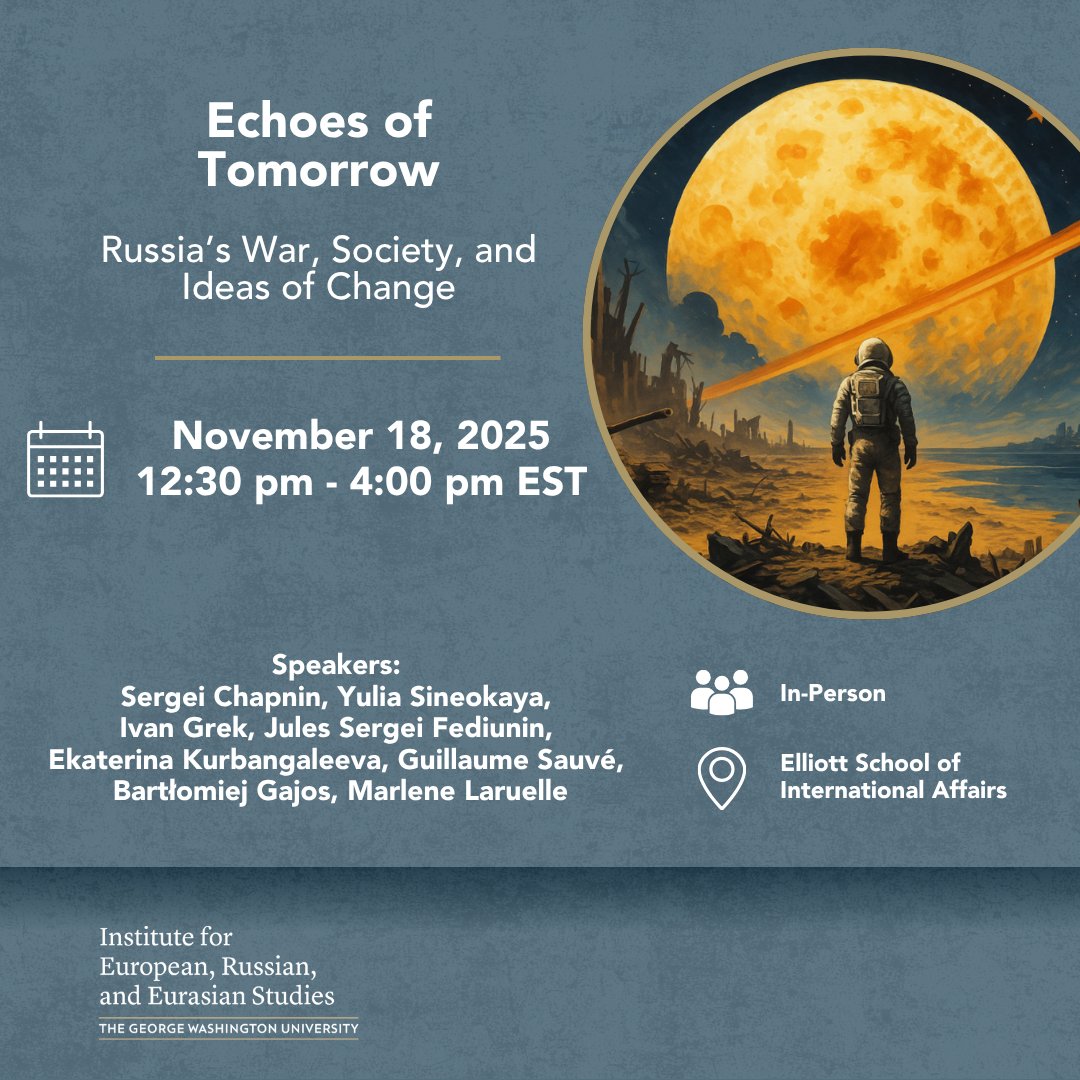
Join us for Echoes of Tomorrow: Russia’s War, Society, and Ideas of Change on Nov 18 at George Washington University (1957 E St NW, Washington DC) — a deep dive into how war, society and vision converge in Russia today.
With round-table and panel sessions exploring ideas of the future, conservatism, war demography, economic shifts & anti-war petitions.
Free and open to all.
Register here: https://t.co/hOgqLwPRM5
@IERES_GWU
Attending the 2025 Association for Slavic, East European, and Eurasian Studies (ASEEES) Annual Convention in Washington, DC?
Join the @IERES_GWU for an evening reception celebrating our vibrant community of scholars and professionals. Cosponsored by ASEEES, this event is a wonderful opportunity to reconnect with colleagues, make new connections, and engage with IERES faculty, staff, visiting scholars, alumni, and colleagues worldwide.
And don’t forget to stop by the IERES booth (#213) in the Exhibition Hall! Meet our faculty and staff, explore our latest research, publications, and events, and learn about opportunities for scholars and students to study and collaborate with us at IERES.
Register here: https://t.co/7MOMzmvLCU
Satinsky Archive reminds us: Western business built much of 1990s Russia’s modern economy — even as politics pulled apart. Peter Gerwe, Henrik Winther, Fred Berliner, Joel Schatz, Paul Heth & Derk Sauer all helped shape media, finance, food, and culture.
https://t.co/8VWnqDEA15
Don’t miss RIMA Fest 2025 — a global gathering on digital memory, truth & resistance.
📅 Nov 8-9 | 🌍 Hybrid: Berlin · NYC · Online
Details 👉 https://t.co/f1YEiipfIK
📢 Join us at the next CORUSCANT seminar in Paris!
🗓️ Wed 19 Nov, 4–6PM (Condorcet Campus + online)
Dr Annamaria Kiss (Queen Mary University of London) will discuss how Russia framed and used foreign fighters in its discourse and policy on Syria.
Discussant: Dr Anne Le Huérou.
Register here to attend online: https://t.co/oM605fx7jS
More details here: https://t.co/jLEbdvxgMU
Estimating the Real Size of Russia’s Mobilization Reserve
Based on publicly available data, the size of Russia’s mobilization reserve appears to be far smaller than some official estimates suggest.
According to Kommersant [1], the government allocates around 14 billion rubles annually to fund the mobilization reserve. Meanwhile, News .ru [2] reports that reservists receive between 4,000 and 10,000 rubles per month.
If we divide the total annual funding by these monthly payments, the number of reservists ranges from roughly 116,000 to 291,000 people. This calculation does not account for training costs, bonuses, or other additional payments, which would further reduce the figure.
Even allowing for these variables, the data indicates that the mobilization reserve is nowhere near the 2 million people mentioned by some lawmakers [2].
[1] — https://t.co/N8xsH2Kifh
[2] — https://t.co/E1MRhODBFQ
In “Illiberalism, Putin & the Politics of Religion,” Marlene Laruelle unpacks how the Kremlin fuses nationalism, Eurasianism & Orthodox identity to undergird its illiberal project—and what that means for Russia’s future & the war in Ukraine.
Listen here
https://t.co/0nHDdRvBrT
📢 Event: From Russia with Love — Corruption & Sanctions Bypass in the Ukraine War
Russia’s invasion of Ukraine has fueled new corruption and sanctions-evasion networks. Join experts to explore how regime elites move money, bypass restrictions, and how civil society pushes back.
✅ Register here: https://t.co/jijpHLcAF9











![RussiaProgram's tweet photo. Estimating the Real Size of Russia’s Mobilization Reserve
Based on publicly available data, the size of Russia’s mobilization reserve appears to be far smaller than some official estimates suggest.
According to Kommersant [1], the government allocates around 14 billion rubles annually to fund the mobilization reserve. Meanwhile, News .ru [2] reports that reservists receive between 4,000 and 10,000 rubles per month.
If we divide the total annual funding by these monthly payments, the number of reservists ranges from roughly 116,000 to 291,000 people. This calculation does not account for training costs, bonuses, or other additional payments, which would further reduce the figure.
Even allowing for these variables, the data indicates that the mobilization reserve is nowhere near the 2 million people mentioned by some lawmakers [2].
[1] — https://t.co/N8xsH2Kifh
[2] — https://t.co/E1MRhODBFQ](https://pbs.twimg.com/media/G33kFlsWUAE97GW.jpg)


