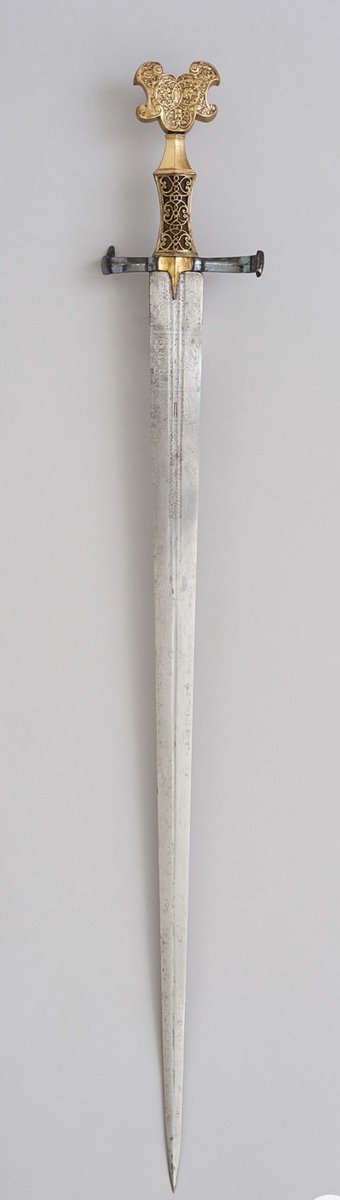
👑⚔️Etched & Gilt “Knights of St. Peter “ Ceremonial Swords Gifted by the Pope to Charles V & his grandfather and Holy Roman Emperor Maximilian I (1459-1519) in 1509.
The two swords were solemnly presented by Pope Julius II della Rovere on January 24, 1509 to an imperial essay, on the occasion of the admission of Maximilian I and his grandson, the later Charles V, to the St. Peter's Knighthood.
The attribution of the goldsmithing/decoration to the so-called "Master Ercole" is stylistically based on another group of swords, which are decorated in the blade etchings with similar characteristic small-figure scenes.
This master could be the Jewish goldsmith Salomone da Sesso, who called himself "Ercole dei Fidelis" after his transfer of faith.
Kunsthistorisches Museum Vienna
Material/technology:
Iron, etched, fire-gilded; brass, fire-gilded; wood; textile; enamel
Sword: L 94.5 cm x W 17.5 cm x Blade w 4.5 cm
Weight: 1.2 kg
Sheath: L 75.8 cm x W 5.8 cm x D 1.5 cm
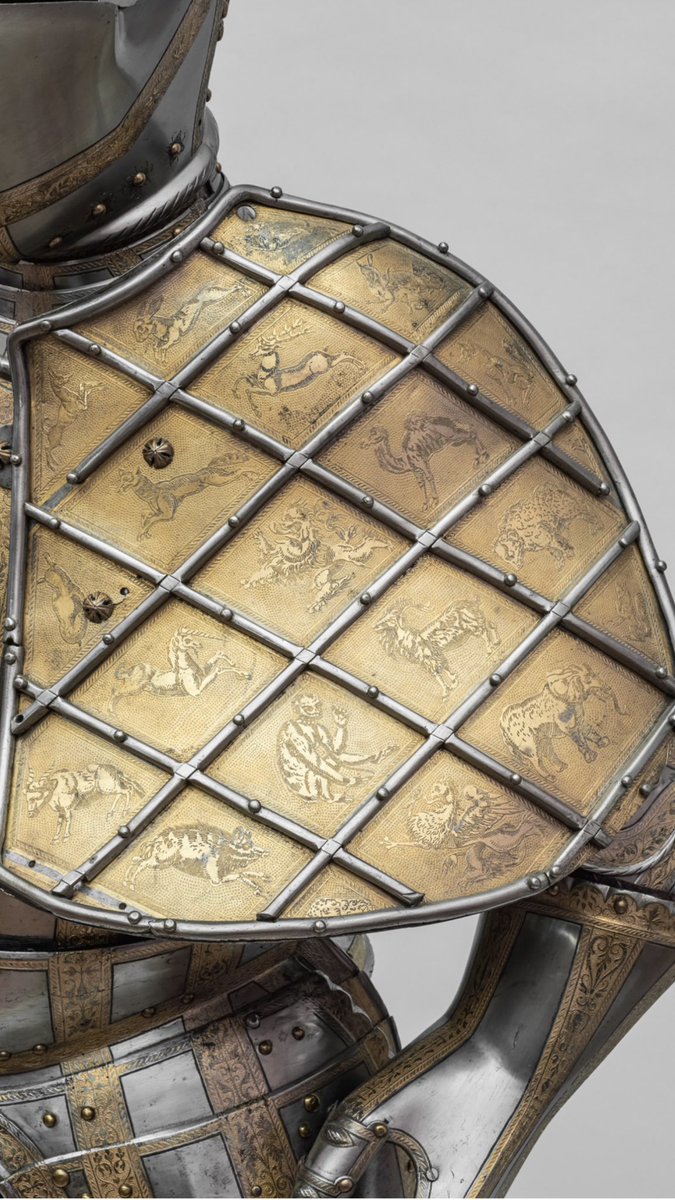
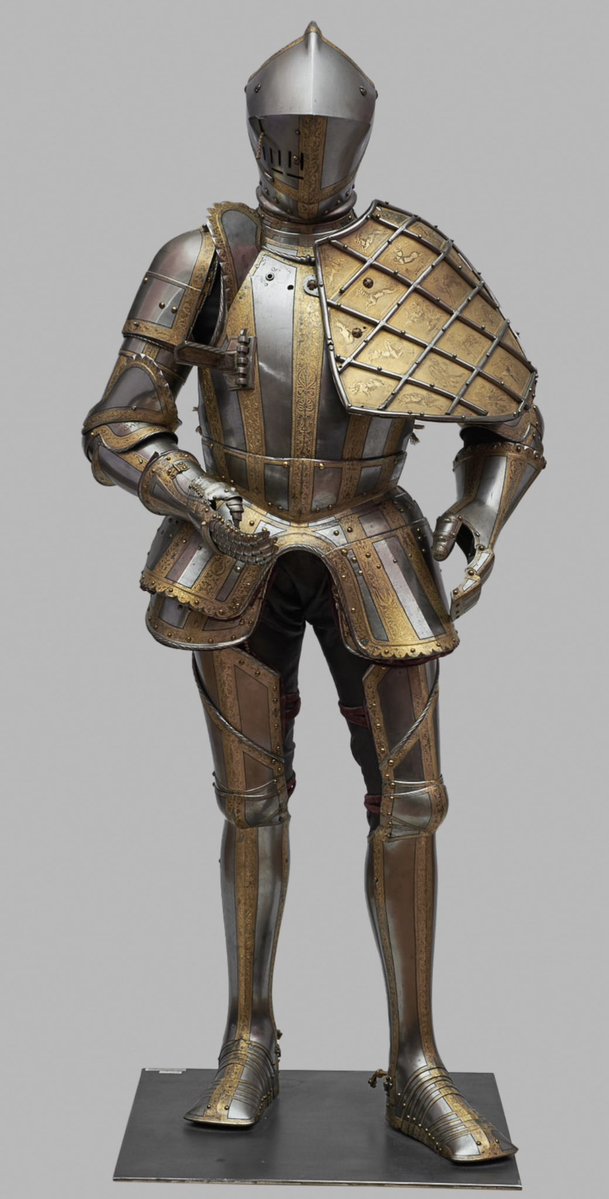
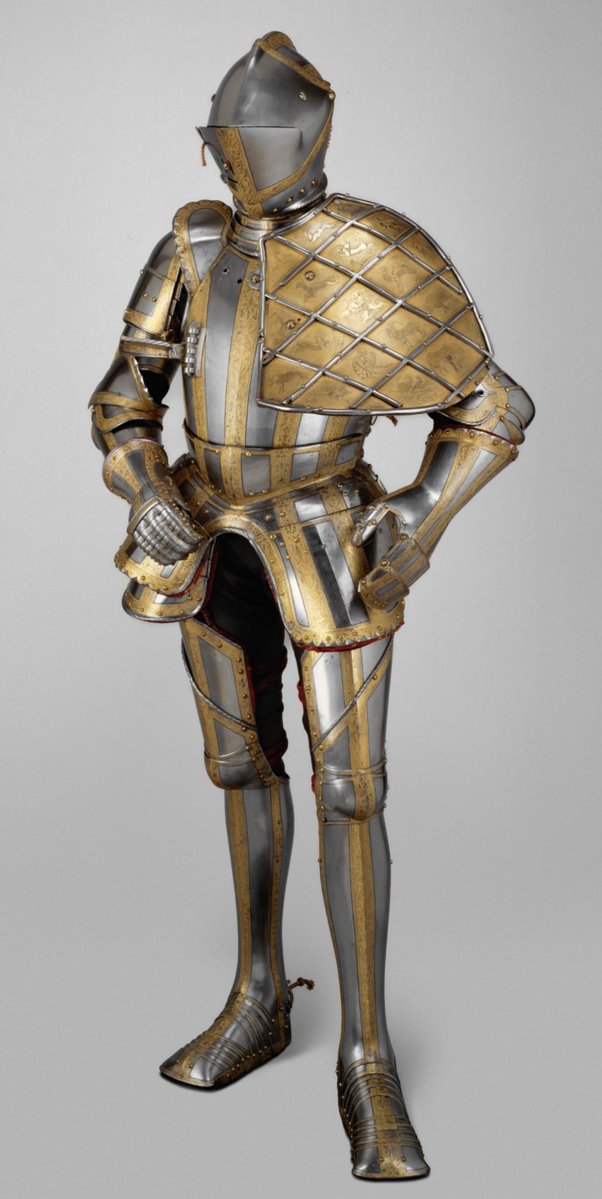
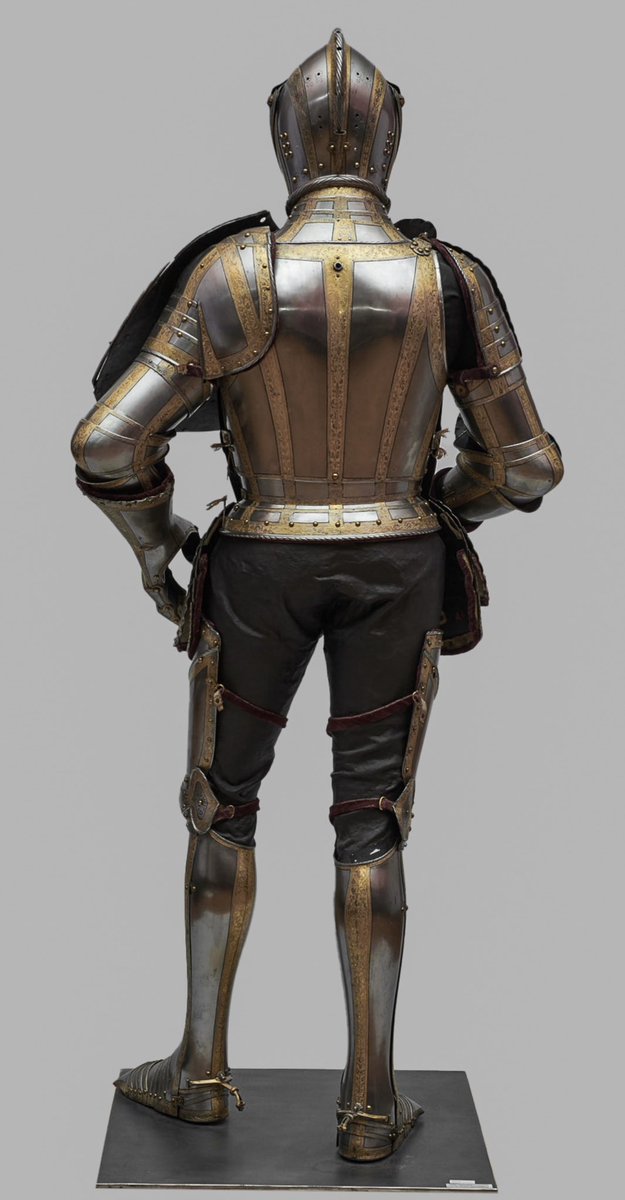
🇩🇪👑Etched & Gilt “Royal” Garniture of Maximilian II Habsburg (1527-1576, Holy Roman Emperor 1564-1576) made in Augsburg by Matthäus Frauenpreiss ca. 1550
In 1548, Emperor Ferdinand I ordered a large garniture for his eldest son, Maximilian.
The reason for this commission was presumably Maximilian’s upcoming election as King of Bohemia.
As the Bohemian estates were greatly weakened following the imperial victory over the Protestant princes in the Battle of Mühlberg in 1547, Ferdinand had no trouble forcing through the election of his son.
Matthäus Frauenpreiss the Elder, an armourer from Augsburg, was contracted to design and produce this garniture.
Jörg Sörg the Younger, a specialist also working in Augsburg, executed the etched and gilt decoration.
Known today as the Royal Garniture of Maximilian II, it comprises numerous individual pieces that could be assembled and configured as required – for combat on horse or on foot, for the field, or for different types of jousting.
These two armours are the most important extant pieces of this garniture.
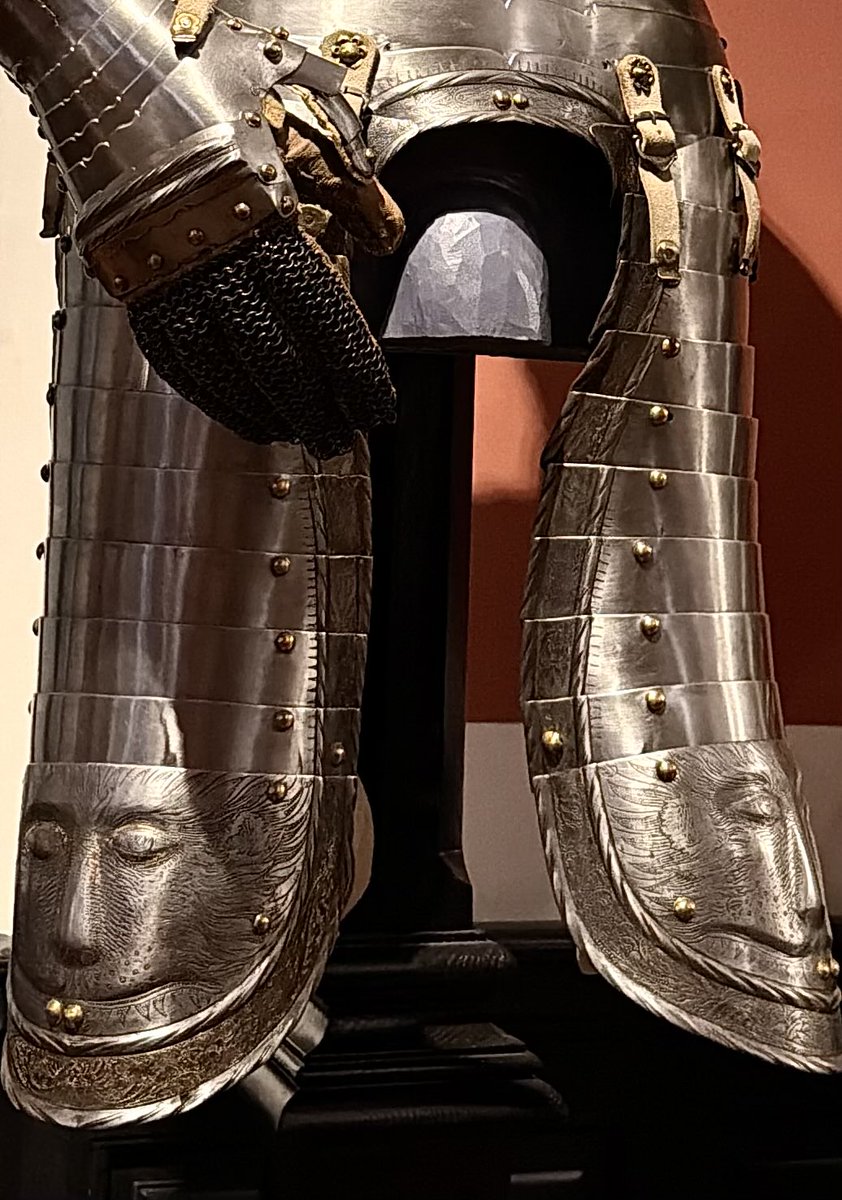
They were designed to be worn for combat on foot (incl. a tonlet piece, 2nd pic) and for the joust; the foot combat configuration at the tilt (barrier) is specialized for this specific purpose-the articulation lames on the inner arms and the tonlet (plate skirt) added extra protection specific for this purpose-you wouldn’t see these on field armors.
Additional pieces are now dispersed among various museums, including collections in New York, Baltimore, Paris, St Petersburg, Florence, and London.
The two armours were housed in the imperial armoury in Vienna. In 1678, the armour for foot combat was described as a ‘white cuirass with gilt bands and a tonlet, a close helmet with a grill visor’ (weißer khüriß mit vergulten strichen und einen khempfschurz, ein ganz helmblin mit ein gätterten vißier).
At the time it was displayed together with a ‘small lion skin and the moth-eaten skin of a muskrat’ (kleine lewenhaut und ein zerfreßne bißemkaz heütl).
In 1750, the two armours were moved to the imperial arsenal on Renngasse in central Vienna, where the armour for foot combat was erroneously displayed as made for Emperor Ferdinand II.
🇮🇹⚔️Beautiful Italian Halberd possibly for a Guardsman of Florence ca. 1570
•Dimensions: L. 8 ft. 8 7/8 in. (266.4 cm); L. of head 22 1/16 in. (56 cm); W. 7 1/2 in. (19 cm); Wt. 5 lbs. 8 oz. (2494.8 g)
🇮🇹⚔️Italian Halberd ca. 1560
MET Museum NYC
•Dimensions: L. 9 ft. 6 3/4 in. (291.4 cm); L. of head 32 1/4 in. (81.9 cm); W. 11 in. (27.9 cm); Wt. 6 lbs. 7 oz. (2920 g)
More Landsknecht armor from the Imperial Armory in Vienna
Armor of Kaspar von Frundsberg, imperial field commander, decorated with a lion’s head and what look like grotesque masks, a decorative motif popular in Renaissance art and armor. During the early 16th century, armorers experimented with human faces, exaggerated expressions, mythical creatures, and other imaginative designs, demonstrating the armorers’ creativity and skill, and also the wearer’s status and power.
Kaspar von Frundsberg was the son of the famous “Father of the Landsknechts,” Georg Frundsberg (both depicted in the illustration in my picture). Kaspar served under Emperor Charles V. In 1525, he fought at Pavia, and in 1526 at Milan.
And then there is this Landsknecht armor, with its puffed sleeves, a masterpiece of German armor-making craftsmanship (Kolman Helmschmid, Augsburg, 1523). It belonged to Wilhelm von Rogendorf, a military commander and diplomat of Emperor Charles V. In the 1520s, he commanded the Emperor’s bodyguard in Spain. In 1529, he defended Vienna during the Ottoman siege.