You are surprised that the thing made to try and replace Merry Christmas, has Christmas themed art.......
Here's an article showing that people prefer Merry Christmas to happy holidays.
https://t.co/XWR3I2PMhL
Here's another.
https://t.co/K1YBqNpQDC
(There's none more recent because even corporate America calls it Christmas now in ads)
I've included a screenshot talking about Britain because this was never a controversy there and they have never had a problem saying their version "Happy Christmas." (This whole "happy holidays" crap only happened in America. Thats anime literally says "Merry Christmas")
@CyricZ42@Cardinalinpain Well the characters were at a Christmas party, celebrating Christmas, interacting with a Santa, and literally said "Merry Christmas."
I'm not sure how the intent can be confused here.
@Necrofamicon@Cardinalinpain Did you google "happy holidays" and think that pictures saying that means its more common than "Merry Christmas?"
This isn't a insult, this isn't a joke. Do you have brain damage?
Its hilarious when they claim its about cultural equivalancies yet they wouldn't dare change things in Doctor Who.
What if someone doesn't understand the 4 paragraphs of nuance as to why french fries are called chips?
No one in America eats beans on toast or bangers and mash, it should be changed to pb&j and chicken and waffles.
*EXTREMELY LOUD INCORRECT BUZZER*
This was an example made because localizers kept screaming that they had to add Skibidi Toilet to dialogue a character had in Umamusume: Pretty Derby because not everything is 1:1 and "Localization is about making sure the cultural understanding is the same.
People pointed out that the characters literally are celebrating Christmas and say "Merry Christmas." Yet it was changed to happy holidays despite everyone in the world, except the most militant western leftists, calling it Christmas regardless of religion.
The average consumer of anime and Japanese media has always wanted as accurate as possible to the original. Full stop.
The average consumer of non-american media has always wanted it to be as accurate to the original as possible as well. I dare someone localize and change Dr. Who.
People got angry at old censorship and old localizations that changed things from rice balls to jelly donuts and cigarettes to lollypops. So they're going to be angry now when the changes have become just as egregious only politically motivated instead of child censorship motivated.
The problem is there are are easy, literal, translations that should always happen. "Konnichiwa" is always "hello." "Merry Christmas" is always "Merry Christmas." But the changes aren't being made for accuracy to the cultural equivalancies or the literal accuracy, they are being made for the political beliefs of the localizer. Some going so far as to turn innocuous statements like a friendly greeting into something political by adding dialogue. Furthermore for the moments where you absolutely can't translate it 1:1 they don't have to shove "Skibidi toilet" or western political nonsense into it.
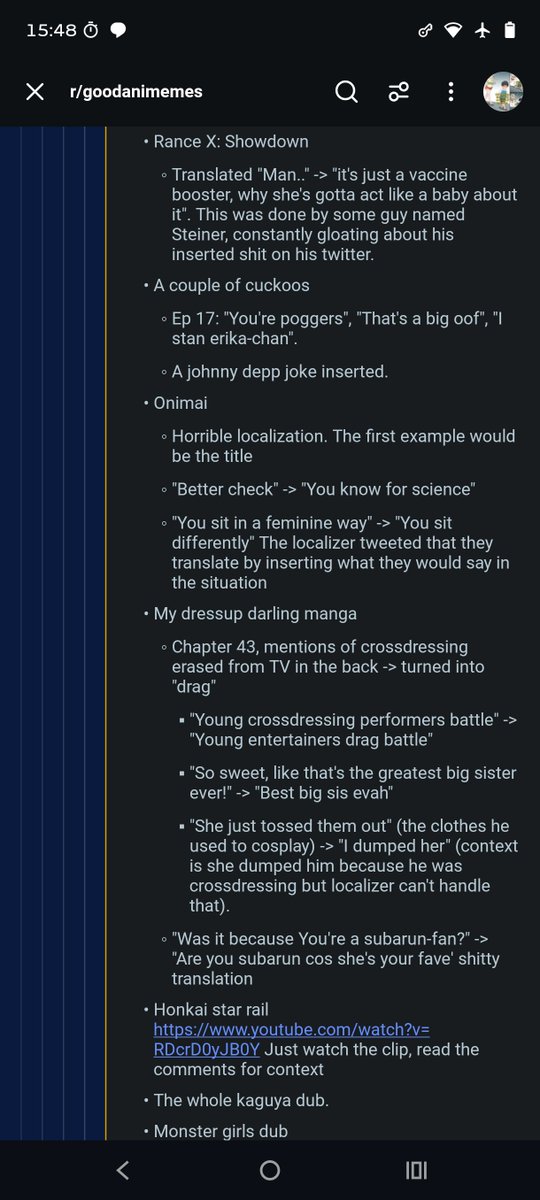
I would honestly love if I had the time and energy to learn every profession that i find fault with, most of them are for the same reasons of people not being impartial when they should be. Unfortunately I am only blessed to have traveled and lived in Asia because I went to college for other things and now work wherever my current 6 month contract dictates at pretty crazy hours. But I will include some images of localizations issues so you can get an idea what the fuss is about. You have no obligation to look through them but there are common occurrences and themes.
But itadakimasu is religious for some today. I know people raised Catholic that recite the prayer for supper out of habit despite being athiest. And Merry Christmas isn't religious for large portions of the west, let alone the world.
So which is it and why do the localizers break their rules when it comes to these phrases? If they care about the literal then Merry Christmas stays the same. If they care about the cultural then both itadakimasu should be the changed.
This is the double standard and you can't deny it exists. How many anime characters have religious iconography on them despite not being religious characters, would you have them censored?
To reiterate, It is religious in origins and people do still use it for religious reasons today. Though I don't think it should be changed from simply meaning "let's eat."
The most recent discourse started because they added "Skibidi toilet" zoomer humor dialogue to a character in Umamusume: Pretty Derby. This doesn't fit the dialogue in literal translation; the literal translation wasn't extremely hard to translate and would simply leave the character saying "Turbo" at random (completely in line with anime characters) and a random Japanese slang word that means nothing (also not an anime issue).
Localizers defended this by stating that they needed to change it to fit Western, specifically American, culture so that the average non-weeb would understand.
However they don't change "itadakimasu" to "Grace" when the entirety of the western world would understand it despite no one knowing why they say "itadakimasu" unless they are a weeb. They also do change "Merry Christmas" to "happy holidays" when Christmas has taken over the vast majority of the world.
Unfortunately we cannot avoid overcomplicating the argument. As without the origin, the argument isn't as relevant. It's what my hang up is. They don't actually care about localizing for western audiences, they care about localizing for their tiny social bubble.
You can't even make a valid cultural equivalence claim without having to explain the nuance nowadays.
The nuance is:
IF localizers care about localizing to target their western audience better, then it does seem odd that it never once ever gets localized to something akin to grace. There seems to be a large anime constituency that is very Christian, so why not?
I am not actually advocating for it though as I prefer just thanks for the food/etc., it's just a sake of argument type of thing. Localizers often cite how they need to make Western adaptations, so it holds water to suggest injecting occasional Western religious phrases FROM THEIR PERSPECTIVE (nuance).
If anything they seem to specifically despise any Christian phrases even when they are apparent, which seems odd and polarizing (translating Merry Christmas to Happy Holidays. Is Christmas offensive or something?)
This is a typical straw man situation though. It's easier to attack the original tweet if he pretends the person who wrote it is advocating for every character to be explicitly Christian, even though the original tweet made no such claim at all.
Also, do we need to be quoting small accounts over mundane takes? If I had a platform the size as yours, I wouldn't do that for etiquette sake.
I've said it before so I won't give you another five paragraphs like I did the other person.
I don't think they should change it to be grace. But it is closer culturally than the other options. This argument started from localizers claiming to care about the cultural when they think word for word is impossible while retaining the same message. But when the character's say literally "Merry Christmas " and it's literally Christmas, they changed it to happy holidays. Its a double standard that relies entirely on the political beliefs of the localizer and has nothing to do with the literal or cultural equivalents.
The original start of this argument stems from localizers not changing it when with its cultural origins and modern use so close that it would be more accurate to have them say "Grace" or something similar then it would be to just say "thank you for the meal" or "lets eat."
To make a point, I don't have any issue with what they do translate it as and don't think its an actual issue for it to not be grace. I have a problem with the double standard that ties into similar issues like them changing Merry Christmas to Happy holidays.
They claim to care about the cultural reasons and similarities when translating over but they don't actually do that when it would be something they politically disagree with. This issue is exacerbated when you look at the changes they make that they didn't have to (adding mansplaining, changing cross-dressing characters to trans, or references to the patriarchy) all while calling you a Nazi or ignorant for not liking it.
@pheenman@MakiSkin@gaiaslastlaugh "broader social and historical context" and it literally was thanking deity for the meal and people still do it for that reason.