🚀 Introducing https://t.co/2VHVxxYmt6!
After years of building and refining my own sports models, I've launched a new home for my analytics & projections.
🏈 NFL: Projections, matchup analysis, betting edges & player props.
🏒 NHL: Projections, team comparisons & rankings.
I’ve used versions of this approach across my NFL and NHL models.
One of the more surprising things we’ve found is that the biggest projected betting edges aren’t always the best opportunities.
Sometimes they’re exposing weaknesses in the model itself.
That’s exactly the kind of thing you want to uncover before risking money.
Save this and try it with your own historical predictions.
Follow @Rusty_Bill for more AI prompts and lessons from building sports models.
Why the f*ck aren’t more people doing this with Claude?
If you’re building your own sports prediction model:
1. Open Claude
2. Upload your historical predictions and actual results
3. Paste this prompt: 👇
“I want you to audit my sports prediction model using the historical data I’ve uploaded.
Your goal is NOT to find winning bets. It’s to identify where my model is reliable, where it’s consistently wrong, and what I should test next.
Start by identifying the data available, including prediction dates, projected outcomes, actual results, model probabilities, market odds, and model versions.
Then:
1. Check prediction accuracy. Compare projections with actual results. Break down errors by player, team, market, and model version where sample sizes allow.
2. Test probability calibration. Group predictions into probability ranges and compare how often those outcomes actually occurred with how often the model predicted they would occur.
3. Audit the biggest edges. Group historical predictions by the size of their disagreement with the market. Determine whether larger projected edges actually produced better results.
4. Look for recurring weaknesses. Test whether errors are concentrated in certain teams, players, market types, projection ranges, or situations.
5. Compare against simple benchmarks. Determine whether the model outperformed basic historical averages and available market-implied probabilities.
6. Recommend five specific experiments. Rank them by potential impact, available evidence, and ease of testing.
Important rules:
- Use only the uploaded data. Never invent missing statistics.
- Separate predictions recorded before games from anything calculated afterward.
- Do not use information from future games to evaluate historical predictions.
Report sample sizes and uncertainty.
- Distinguish prediction accuracy from betting profitability.
- Do not recommend changing formulas based on a small or cherry-picked sample.
- If the data is insufficient to perform a test, explain exactly what is missing.
Finish with a table showing each finding, supporting evidence, confidence level, and the next test you recommend.
Do not modify my model or its data. This is a read-only audit.”
@Johnneff1 Yep. TEs, RBs, Daniels. They probably still go to Mumpfield and Atwell but the numbers are just a bit too inflated.
Overall projecting a pretty slow, run heavy approach. We will see.
🏈 Packers vs. Rams: Players I’m Looking to FADE 📉
My NFL receiving prop model is showing some interesting edges for tonight’s game.
Here are 3 of the highest-ranked plays, along with the projections and numbers behind them. 👇
All three are showing positive estimated EV according to my receiving prop model.
With the injuries and lineup uncertainty tonight, I’d be especially cautious. These are model estimates, not guaranteed edges.
Full NFL projections and top props:
https://t.co/220wzMgrbH
3. Tutu Atwell UNDER 1.5 receptions (+131)
Model projection: 1.41 receptions
Model probability: 59.9%
Projected EV: +0.384u per 1u risked
Atwell has averaged just 1.7 receptions on 3.7 targets over his last 3 eligible games.
The model projects 2.45 targets tonight, with a median of 1 reception.
🏈 Packers vs. Rams | Wednesday Night Football
My NFL model has the Rams winning a close one tonight, but with all the injuries, this is a low-confidence projection.
Projected score: LA 24.0, GB 22.2
• Rams win probability: 55.6%
• LA -2.5: 50.6% chance to cover
• Over 44: 54.6% probability
The model and market are almost identical on the spread, with a slight lean toward the Over.
Not a game I’d put much confidence in with all the uncertainty surrounding the lineups.
What is the appropriate time to start Thanksgiving Dinner?
I told my wife 2-3pm. She told me I was crazy. That’s when my family has always had it!
Who is correct here?
🏒 Golden Knights vs. Oilers | NHL Preview
Only one NHL game tonight, and my model is showing an edge on Vegas.
Projected score: VGK 3.75, EDM 3.28
• Vegas win probability: 58.9%
• Model fair odds: -143
• Best available: -113 at BetRivers
• Projected total: 6.47 goals
Still refining the NHL model, but this should be an awesome game tonight.
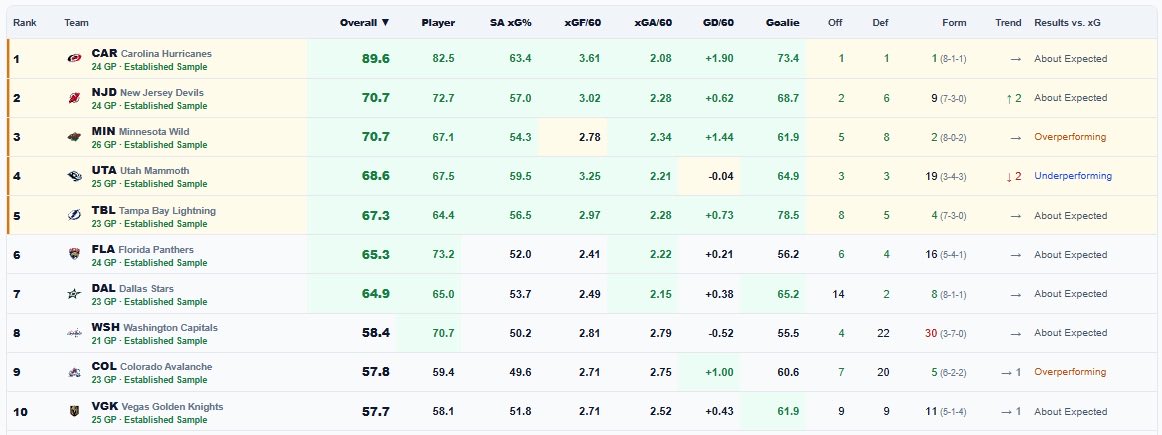
🏒 My latest NHL Top 10 team rankings:
1. Carolina Hurricanes
2. New Jersey Devils ⬆️
3. Minnesota Wild
4. Utah Mammoth ⬇️
5. Tampa Bay Lightning
6. Florida Panthers
7. Dallas Stars
8. Washington Capitals
9. Colorado Avalanche
10. Vegas Golden Knights
Carolina continues to separate itself from the rest of the league with an 89.6 rating.
New Jersey is up two spots to #2, while Utah sits at #4 despite its underlying numbers suggesting the Mammoth have been underperforming.
These rankings are based on my model’s underlying team metrics, not just wins and losses. What would you change?
Full breakdown below. 📊
Figured I’d reintroduce myself since we have a few new followers.
I’m a small business owner who enjoys building things, especially sports prediction models and AI tools.
I’ve spent the last 6 years building and refining my own sports models, starting with NHL and eventually expanding into NFL and PGA. More sports to come.
I share my projections, betting results, AI prompts, and what I’ve learned along the way. The good, the bad, and the experiments that didn’t work.
Outside of that, I’m a big sports fan, enjoy playing golf, and occasionally find myself at a poker table.
Always looking to connect with others interested in sports analytics, AI, betting, or building businesses.
Give me a follow and don’t be afraid to reach out!