We're all surrounded by clutter, and it's not particularly our fault, it's a historical phenomenon, downstream of the Industrial Revolution and the Consumer Value System. Nevertheless it is our problem.
@PrinceVogel I often think about how idealistic people never enter corrupt fields due to "Morality Drain," but I hadn't thought about how there exists a "Playpen Virtue Institute" other end to that motivational landscape.
What are framing devices for? Well, the feeling they offer the audience is called "catharsis." That's when you're really confused and scared for a moment, but when the story pulls back out, you feel around, and discover you seem to be unharmed after all.
https://t.co/Ymw2STqR5m
@landosembery Bruce Sterling, a really obscure one. I'm a big fan of his talks I have a thread of them here.
https://t.co/2ecoxONqnh
https://t.co/WHDearTAOC
@xenoaesthetics if you make freedom an absolute then there is no incremental step towards it.
ime freedom can arrive gradually by the lifting of small but real constraints
Never Renovate
Some people go crazy renovating their homes. After having done this for a few months, I understand why:
1. It trains you to be hyperaware of errors. Your contractors are inevitably going to try to cut corners, and you want to both get your fair money's worth and have your vision executed, so you have to really pay attention, to things that normally you never would: was that scratch there before? Is this cabinet level?
Of course, once you're trained in this way, your hypervigilance extends to everything, even far outside your contractors' work: there's a half-inch gap between the doorframe and the floor? Sacrilege! (Doesn't matter if it's been there for 40 years.) A home is a complex thing with lots of detail, so inevitably, no matter where you look, the flaws will be endless.
2. But the other thing you learn is that whatever problems you see, you can fix them! Don't like it? Tear it out and do it again. If renting, you treat things as fixed -- but a house turns out to be shockingly malleable. Literally everything can be changed. You can move lights, pipes, doors, tear out walls, there are no limits.
These are the two core learnings of doing renovations, and combined, they are very dangerous: for people who are not used to saying "good enough, whatever", this becomes an endless perfectionist loop. They'll have you changing stuff forever until you either run out of money or sanity.
Worse, you'll find that changing one thing often implies changing another thing. I have a painting that looks like it's not level even though it is. Why? It's not aligned with the doorframe. Why? The doorframe itself isn't level. Why? The floor itself isn't level because it's 100 years old. But you can't live there while you're redoing the floors, of course. This is a scope-creep, yak-shaving classic: all you wanted was to hang your painting straight and now you live in a storage unit. Beware.
Very well said. Also if you try to do the opposite of this everyone hates you because they think they're losing money.
What we need is a trend of flippers offering houses in "Immaculately Gutted Condition," so you can see everthing.
The problem is that making a house more salable is poorly correlated with making a house more liveable or better. Their effect is often just to increase prices while making the houses dramatically worse in ways you don't discover until after move in.
Now that all fiction is either historical fiction, fantasy fiction, or science fiction (the present doesn't last long enough to be a setting anymore) perhaps we should start splitting genres by the shape of the plot instead of the setting.
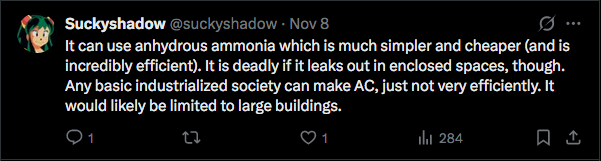
HVAC is a historical anomaly it will not be around for long. We haven’t figured out how to do it well AT ALL. Fans, and buried pipes, and thermal mass. Heat pumps are … just not gonna last long. I do believe we can make much more efficient fireplaces and woodstoves though.
The biggest problem really does come down to the efficiency mandates, and some designs. Same with Furnaces. To make them more efficient, we have to move BTUs better, to move BTUs better, we need to minimize the amount of material between the two mediums. That means thinner heat exchanging surfaces with high thermal transfer rates and more surface area... but thinner materials corrode faster, and leak more easily. Then you have the life of a fully hermetic compressor, with the odds of your refrigerant being phased out by the time it needs to be replaced, effectively making the cost of swapping the compressor the same as replacing the whole system.
@JesseTayRiver Here's a millwright's trailer that I was really impressed by, did a thread of the highlights, you might enjoy. I wonder if you have a good way to store vacuums?
https://t.co/xXvY05uM2t