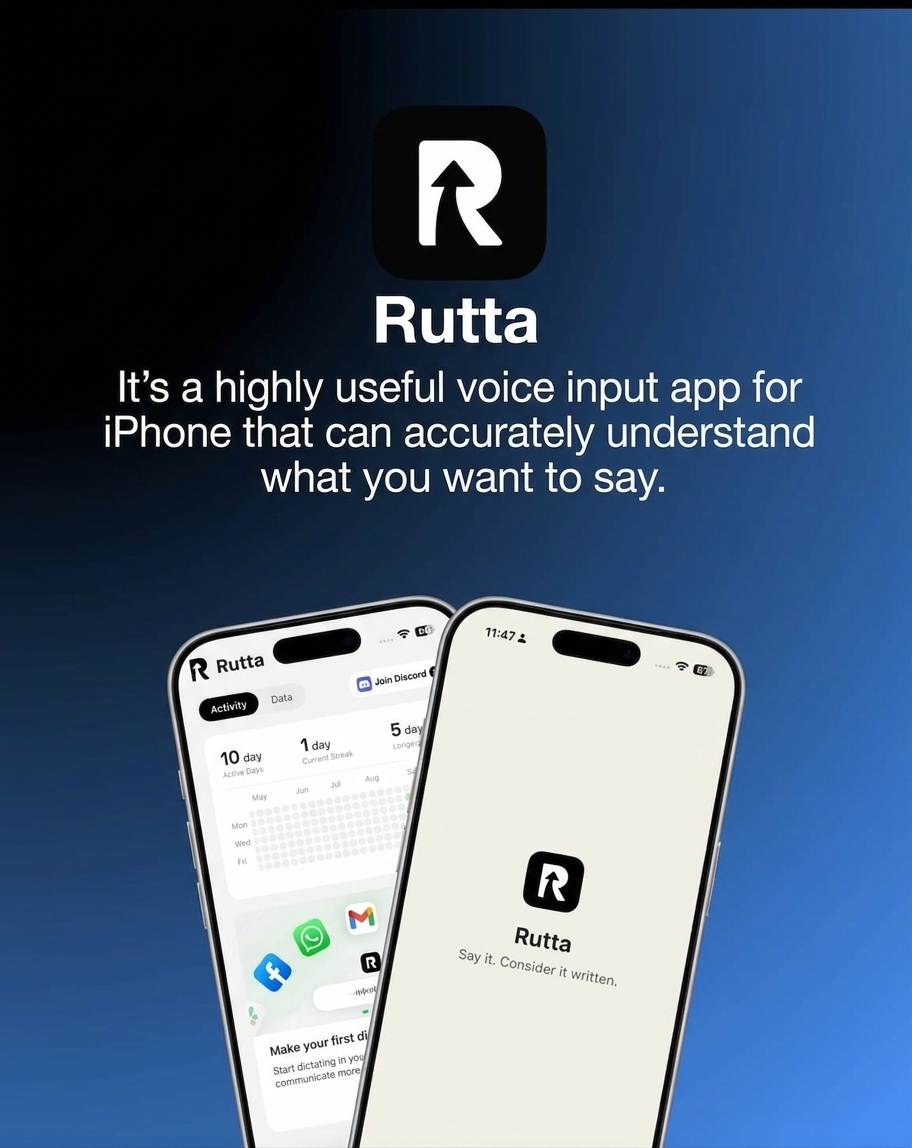
Voice input just became a $2B category.
Keyboards are starting to lose their 100% monopoly.
👇Claim your code below and unlock 30 days of Rutta Pro.
https://t.co/3oY3PqoRgA
Experience a way of working valued at $2B.
I became the owner of a $300,000 project because I replied “Sure” in a group chat.
At 5:46 p.m. on Friday, my boss asked:
“Can you take a look at this proposal tonight?”
I replied:
“Sure.”
By Monday morning, the org chart had been updated.
My name was listed as the project lead.
The previous lead was on his honeymoon in the Maldives.
I asked my boss:
“Why me?”
He said:
“You said yes on Friday.”
“I said I could look at the proposal.”
“Adult communication requires context.”
At 9:30, the client asked when we would launch.
At 10:00, Finance asked why we were over budget.
At 11:00, my boss reminded me:
“Since you’ve taken ownership, you need to show some ownership.”
At 11:10, he added:
“The client needs a revised plan by 3 p.m.”
The project folder contained 14 proposals.
Every single one was called “Final.”
So I went around the company asking each department one question:
“If we launch this project next week, what breaks first?”
Engineering said the system would crash.
Legal said we’d get sued.
Finance said there wasn’t enough money.
Sales said they had already promised the client.
As I went, I dictated everyone’s answers into Rutta. It organized the scattered feedback into risks, owners, and launch conditions, which I sent back to each team to resolve.
At 2:57 p.m., the client approved the revised plan.
The next day, my boss gave the process a name:
“Cross-Functional Agile Collaboration.”
From then on, whenever the company took on a project nobody knew how to handle, I would ask around to find out who was most afraid, then use Rutta to turn those answers into a plan.
Six months later, I was promoted to general manager.
My boss said it was because I was exceptionally good at coordinating teams.
I had simply realized that the people closest to the truth are usually the ones least willing to put it in writing.
I don't believe that artificial intelligence will actually diminish my work, but rather free up more of my time, allowing me to learn new skills and even potentially enhance my cognitive abilities and develop new ways of thinking. Currently, I don't see it as reducing the meaning of my work.
@v0xium Following the advancements in AI, there seems to be a significant increase in work efficiency. People are now primarily focused on the outcome of their work, rather than the quality of their work itself, as AI can consistently provide a result, whether accurate or not.
@beffjezos “Slow down” is easy to say when you’re already ahead.
The real question is who gets to pause — and who gets crushed if everyone else keeps moving.
@tszzl The cruel part is that parents are optimizing children for a labor market that may not exist by graduation.
Then calling the anxiety “discipline.”
Clean benchmarks are mostly theater if they never test the failures users will actually hit.
Build the eval set from ugly production mistakes. Make the model earn the right to ship.
A language model can perform well on a clean benchmark and still struggle with the cases that matter in real-world use.
Here are the evaluation practices that helped us move from promising prototype results to production. ✅
https://t.co/AIJyskqbZx
My company adopted a four-day workweek because I accidentally sent a complaint to the entire company.
It was a little after 10 p.m. I had been working late for four straight weeks and was trying to write a resignation email to my boss.
I was walking home, dictating into my phone:
“If we have another three-hour meeting on Friday, I’m done. Fridays should be for shutting down. Same pay, and we use four days to do the work that actually matters.”
I only meant to send it to my boss.
But after I hit send, I realized the recipient wasn’t my boss.
It was the entire company.
All 426 employees received it.
Eight minutes later, it had 173 likes, and 17 department heads had replied:
“I was about to suggest the same thing.”
My boss had only one response:
“Since everyone has already seen it, let’s try it for a month.”
During the pilot, every team was forced to cut unnecessary meetings and make decisions before Thursday.
A month later, meeting time was down 38%. A project launched nine days early, and we avoided a duplicate payment of $180,000.
Finance calculated that closing the office on Fridays would save nearly $1 million a year in office operations, meals, and shuttle costs.
So the four-day workweek became permanent.
I was appointed Head of Work Transformation.
Now I don’t work on Fridays.
Later, someone asked how I managed to turn an angry rant into something that sounded so much like a formal proposal.
That was when I admitted I hadn’t typed anything. I had just said it out loud while walking home. Rutta turned my rant into something I could send immediately, while still keeping my voice.
One accidentally sent complaint became company policy.
—Someone who accidentally reformed the company by complaining
@ChShersh The one-pair-of-pants detail is funny until you realize how many students are using exhaustion as proof they belong.
Difficulty is not a personality test.
@inhumandept_vp The dark joke is that the pilot worked — and that became the reason to end it.
If productivity, retention, and morale all improved, the next experiment should have been redesigning the workload, not adding the fifth day back.
@yeechanjason@ksky We invite you to try Rutta, where you can receive a 30-day free trial with unlimited characters. If you can identify a specific area where Rutta lacks a "typeless" feature, we are happy to compensate you for your evaluation.
https://t.co/3oY3Pqojr2
@_kevinone If you're interested, you can try Rutta. You can sign up for a 30-day free trial to see if it can replace your current voice tool.https://t.co/3oY3Pqojr2
I got promoted to Head of Product Operations because I didn’t write the weekly report.
It all started with a system update.
Every Friday afternoon, we had to submit a forty-page project report. No one actually read it from beginning to end, but everyone still spent half the day changing fonts, aligning charts, and turning “we haven’t finished it” into “work is actively progressing.”
One week, with twenty minutes left before the presentation, my computer suddenly forced itself to update.
The screen said: 8 minutes remaining.
Ten minutes later, it changed its mind: 47 minutes remaining.
I looked at the computer, gave up, took out my phone, and talked through everything that had happened that week:
“Sign-ups are up, but paid conversion isn’t. Design is waiting on Product, Product is waiting on the boss. If we don’t decide on pricing next week, the launch will have to move.”
A few minutes later, I sent the organized version to my boss.
He asked:
“Where’s the PPT?”
I said:
“Let’s try a decision-oriented update this time. Just the changes, the risks, and the decisions we need to make.”
There was a pause.
Then he replied:
“This format is good.”
A week later, the entire Product team stopped making weekly-report decks.
A month later, Operations, Marketing, and Sales were using the same “decision-oriented update” format.
Finance later estimated that it would save the company more than 3,000 hours of internal work every year.
During my performance review, my boss said I had “redesigned the company’s information flow.”
Then he promoted me.
The truth is, I didn’t redesign anything.
My computer just wouldn’t cooperate that day, so I spent five minutes dictating into Rutta. It turned my scattered thoughts into something I could send directly, while still sounding like me.
On my first day as Head of Product Operations, the first thing I did was cap every weekly report deck at one slide.
—A product operations leader promoted by a system update