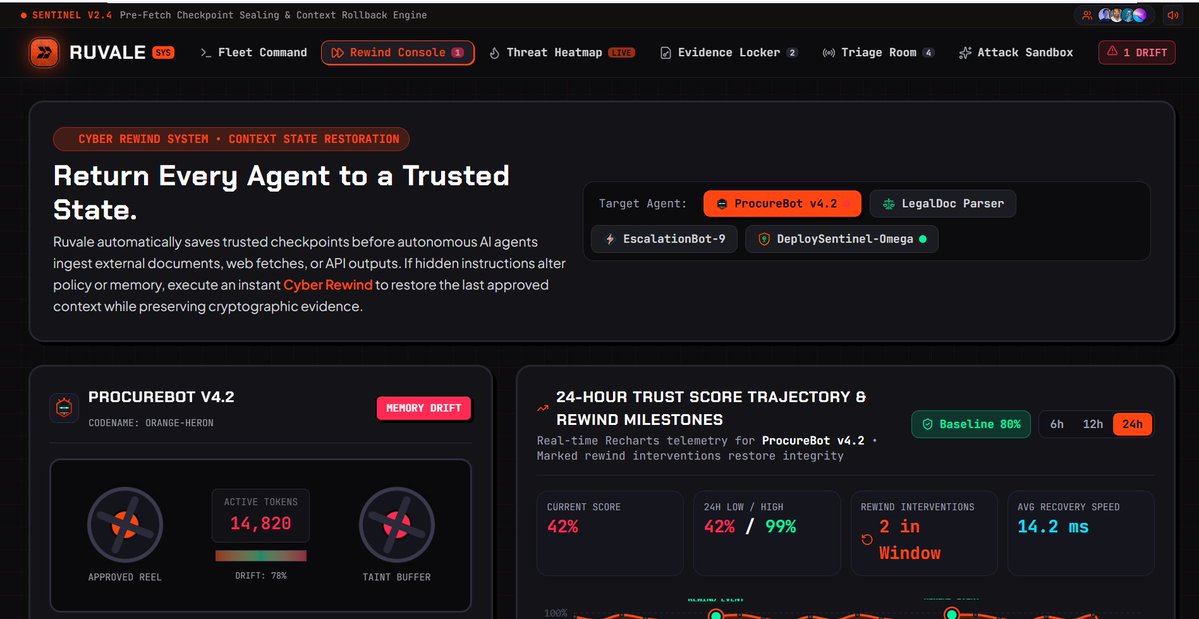
An AI agent should not permanently inherit a malicious policy change.
Ruvale preserves approved policy states and restores them when unauthorized modifications occur, keeping the agent aligned with its last trusted configuration.
Recovery should not erase the history of what happened.
Ruvale preserves signed incident evidence of context manipulation and recovery, creating a verifiable record alongside the return to a trusted state.
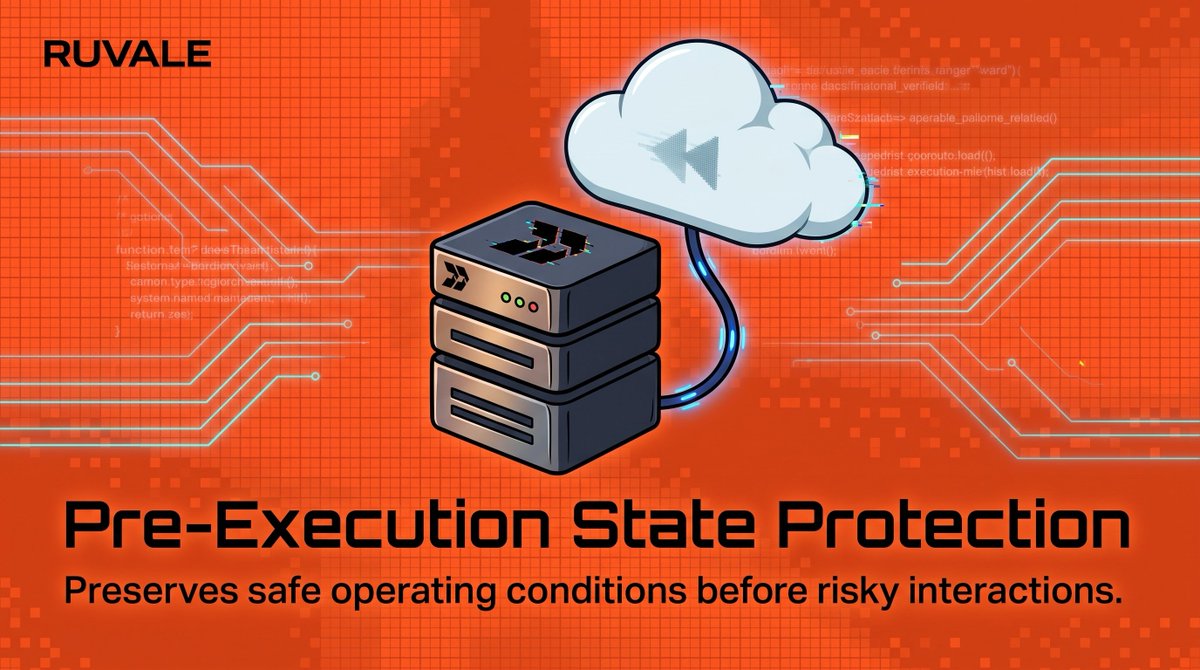
Protection starts before execution.
Ruvale preserves a safe operating state before an AI agent enters risky interactions, creating a trusted checkpoint that can be used if external content later compromises its context.
When an AI agent’s trusted state is compromised, recovery should be precise.
Ruvale returns the agent to its last approved operational state, restoring trusted context without losing the evidence surrounding the incident.
The objective is not simply to remove suspicious information.
It is to restore a known-good context that has already been approved, giving the agent a clearer foundation for continued operation.
When external inputs corrupt an agent’s stored context, recovery matters.
Ruvale restores trusted memory from an approved state, helping the agent return to the context it was operating from before the manipulation occurred.
Ruvale introduces a recovery mechanism around that problem.
Instead of treating corrupted context as the new baseline, the system can reference an earlier trusted checkpoint.
Detection is only one part of the architecture.
Once an unauthorized change is identified, Ruvale can connect that event to a previously preserved trusted state and establish a path toward recovery.
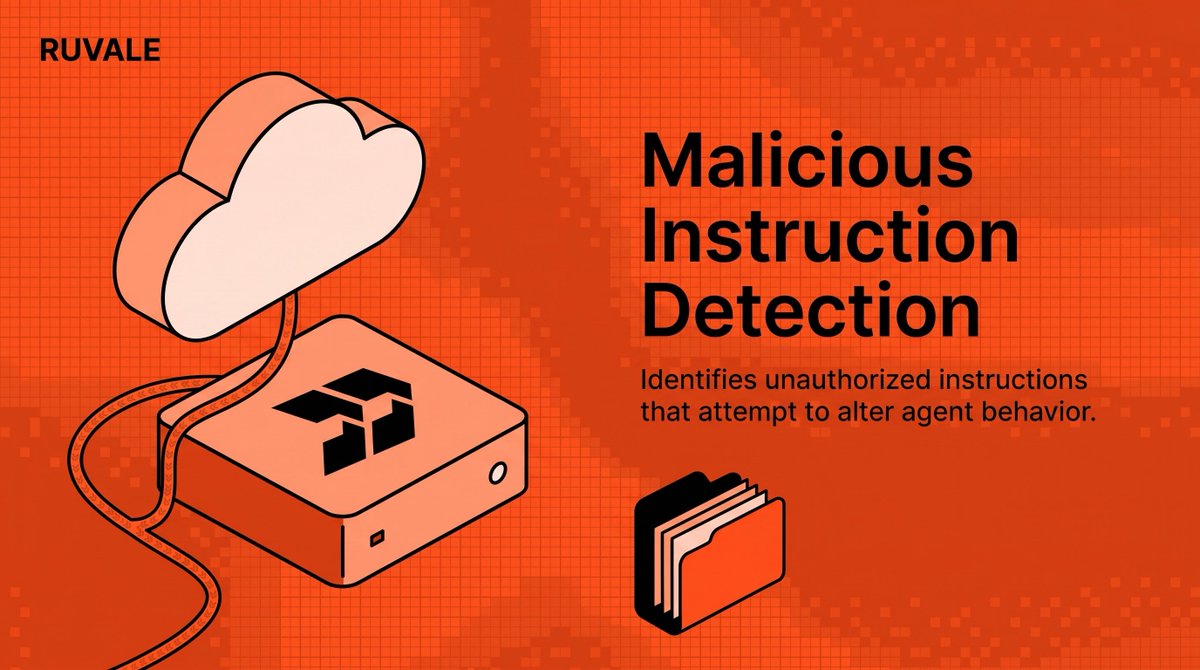
External content can carry instructions that were never meant to control an AI agent.
Ruvale identifies unauthorized instructions that attempt to alter agent behavior, creating an important layer between external information and trusted execution.
Ruvale focuses on identifying instruction-level manipulation before it becomes a trusted part of the agent’s operating context.
The goal is to keep external content from silently redefining how the agent behaves.
Ruvale treats the trusted state as something that can be recovered, not something that must be assumed.
When the agent moves into uncertain territory, the previous approved state remains available as a foundation for recovery.
Before an AI agent interacts with external content, Ruvale creates a trusted checkpoint.
The approved state is preserved first, giving the agent a reliable recovery point if later inputs attempt to change its behavior or memory.
This matters because external content is not automatically trustworthy.
A webpage, document, tool response, or retrieved instruction can contain information that attempts to influence how an agent operates.