‘BACKROOMS’ director Kane Parsons says he would get “no enjoyment” out of using generative AI on any project — “It defeats the purpose entirely for me.”
“I think I'm in the same boat as most well-adjusted people. If I could snap my fingers and make generative Al disappear forever, I probably would.”
(Source: https://t.co/LA3K1o9KjK)
It's hard to believe, but the very first photograph of the Andromeda Galaxy was taken on December 29, 1888, by astronomer Isaac Roberts 🛰
Now compare: an image of the same galaxy from a similar angle, taken by the Hubble Space Telescope in 2013.
The IRON MAN (1994–1996) animated series famously switched from hand-drawn animation to CGI during Tony Stark’s suit-up sequence, a showcase for the then-new 3D technology that felt cutting-edge at the time.
The faces of the athletes from the great Roman mosaic, found in the Baths of Caracalla in Rome, are shown in great detail, The floor mosaic adorned the exercise area. The mosaic was discovered in 1824 and is now in the Vatican Museums.
The Baths of Caracalla were among the largest public bath complexes in the Roman Empire, covering roughly 27 acres and capable of accommodating an estimated 6,000 to 8,000 visitors per day. Built between 212 and 216 CE under Emperor Caracalla, the baths included libraries, gardens, gymnasiums, swimming pools, and elaborate halls decorated with marble, sculpture, and mosaics.
The mosaic shown here decorated the palaestra, or exercise court, where athletes trained before bathing. Unlike many idealized Roman artworks, these faces display remarkable individuality, with distinct expressions, hairstyles, and features that may have been inspired by real competitors. The mosaic's craftsmanship is extraordinary, composed of thousands of tiny tesserae assembled to create lifelike shading and depth.
When excavations uncovered the mosaic in 1824, it provided historians with one of the most detailed surviving glimpses of how Romans depicted athletes nearly 1,800 years ago. Today, the work is preserved in the Vatican Museums.
The Baths of Caracalla consumed so much water that they were supplied by a dedicated branch of the Aqua Marcia aqueduct, one of the longest and most important water systems in ancient Rome.
#archaeohistories
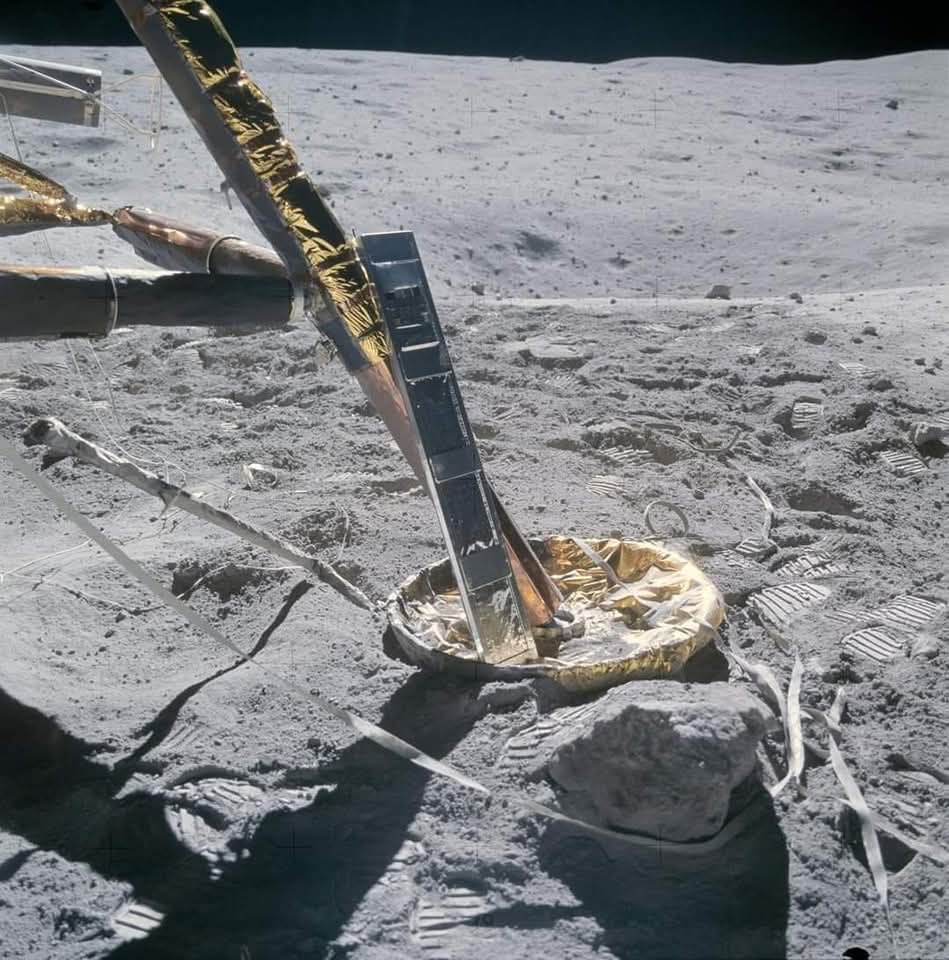
On April 22, 1972, during the Apollo 16 mission, astronauts John Young and Charles Duke repositioned the Cosmic Ray Detector (CRD) by moving it to the +Y strut of the Lunar Module Orion. This clever adjustment shielded the sensitive instrument from the blistering heat of the intense lunar sunlight, ensuring it could continue gathering valuable data.The photograph also captures stunning evidence of the mission’s remarkably precise and gentle touchdown: the folded contact probe tucked neatly beneath the lander and the near-total absence of skid marks, testament to a buttery-smooth landing on the powdery regolith.While Young and Duke ventured out to explore the rugged, ancient Descartes Highlands on the Moon’s surface, Ken Mattingly remained in lunar orbit aboard the Command Module Casper, conducting observations and managing orbital experiments.Apollo 16 placed a strong emphasis on geological exploration and cutting-edge scientific investigations. The mission dramatically advanced our knowledge of the Moon’s highland regions, revealing insights into the violent impacts, ancient processes, and cosmic history that shaped the lunar surface billions of years ago.
Image Credit: NASA
Thinking about the Jurassic Park (1993) stop-motion test where velociraptors hunt Barbie and Ken dolls in the kitchen.
Somehow it feels even creepier than the finished scene in the actual movie.
In 2005, a 200-foot-long pink plush rabbit named “Hase” was placed on Colletto Fava mountain near Artesina in Italy’s Piedmont region and deliberately left there.
Created by the Austrian art collective Gelitin, the enormous knitted installation was intended as a surreal landmark for hikers to discover, climb over, and interact with, while gradually being reclaimed by nature. With no upkeep or restoration, it was left exposed to wind, rain, and the passage of time.
Over the course of two decades, the giant figure slowly deteriorated, transforming from a striking mountain installation into a fading, weather-worn presence in the landscape.
This is believed to be the earliest known aerial photograph of New York City, captured in 1906 by photographer James A. Hart from a hot air balloon high above the city.
This image is widely regarded as the first known aerial photograph of New York City. It was taken in 1906 by photographer James A. Hart, who photographed the rapidly expanding city from a hot air balloon high above Manhattan.
The photograph provides a remarkable glimpse of New York in the early 20th century, long before towering skyscrapers came to dominate the city’s skyline.
“Final Grades” from The Wire (2002) is where the tragedy of the entire show sinks in. Bodie realizing “This game is rigged, man. We like the little bitches on a chessboard” hits so hard because deep down he still wanted to believe the rules meant something
Michael B. Jordan casts 2 fellow Wire favorites in Creed spinoff series: ‘Men I have looked up to'
Andre Royo and Wood Harris are set to star in Prime Video's "Delphi." https://t.co/ksPErVOAMq
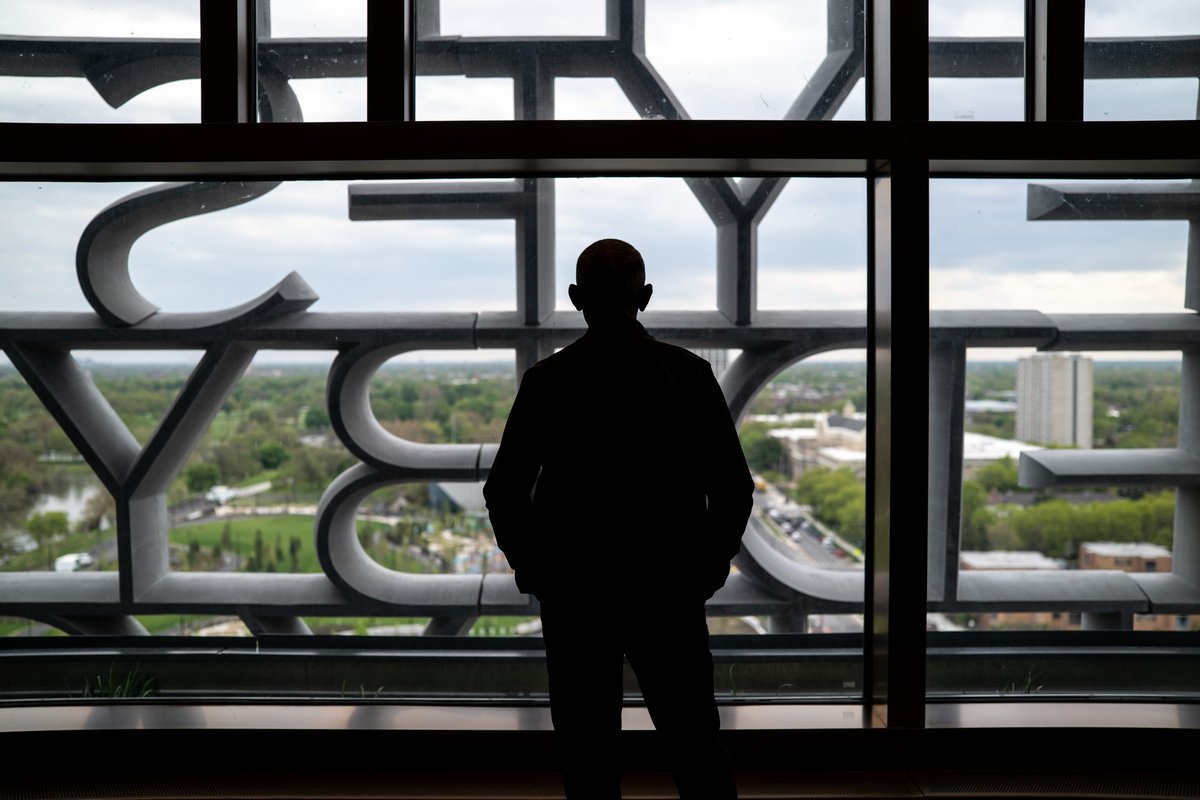
Michelle and I can’t wait for you to visit the Obama Presidential Center!
Starting on June 19, the Center will be open to the public, and you’ll be able to check out the Museum along with public spaces like a new branch of the Chicago Public Library with a reading room, a two-acre playground, a fruit and vegetable garden, and more.
Tickets available at https://t.co/ahkDMKalIn.
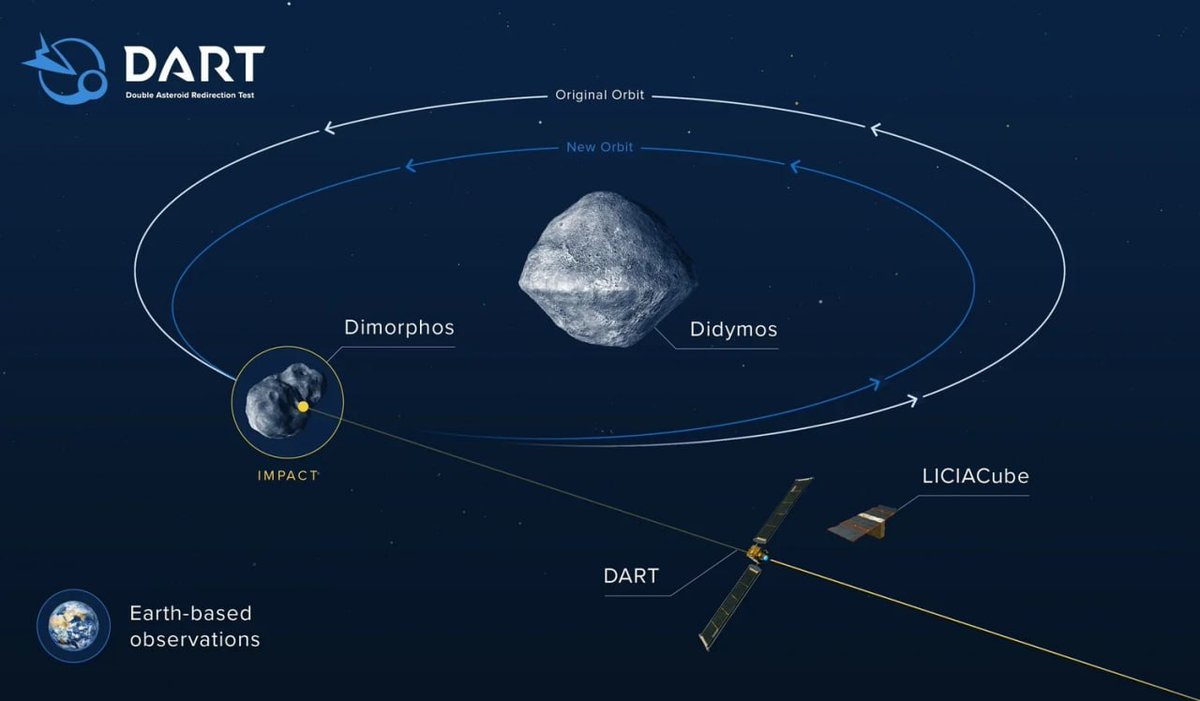
A new study has shown that the DART spacecraft's collision with the moon asteroid Dimorphos in September 2022 had more significant consequences than previously thought.
The impact not only altered Dimorphos's trajectory around its larger companion, Didymos, but also shifted the orbit of the entire binary system around the Sun.
Didymos and Dimorphos are gravitationally bound and orbit a common center of mass, forming a so-called binary system. Therefore, any change in the motion of one asteroid inevitably affects the other. Analysis showed that their 770-day orbital period around the Sun was shortened by a fraction of a second after DART impacted Dimorphos. This marks the first time a human-made object has significantly altered the trajectory of a celestial body around the Sun.
The mechanics of this effect are as follows: when DART collided with Dimorphos, the impact ejected a huge cloud of rocky debris into space. As these fragments escaped the asteroid, they generated thrust. The more debris ejected, the stronger the thrust. According to new data, the momentum gain factor was approximately two. This means the ejected rock doubled the impact force generated by the spacecraft itself.
Previously, astronomers determined that Dimorphos's 12-hour orbit around Didymos was shortened by 33 minutes. Now it turns out that the amount of ejected material was so large that it altered the orbit of the entire binary system around the Sun—by approximately 0.15 seconds. This is a minor change in orbit, but over time, even a small deviation can lead to a significant change in trajectory.
It is important to emphasize that Didymos never threatened Earth. However, this tiny change in orbital velocity provides crucial evidence of the effectiveness of kinetic impactor impactors. This method could be used to deflect potentially dangerous objects if they are ever detected on a collision course with our planet.
To prove that DART impacted both asteroids, and not just the small Dimorphos, scientists needed to measure Didymos's orbit with exceptional precision. To do this, in addition to radar and other ground-based observations, they used the stellar occultation method. This involves tracking the moments when an asteroid passes directly in front of a distant star, blocking its light for a fraction of a second. Such observations provide highly accurate data on the speed, shape, and position of a celestial body.
This task is extremely complex: astronomers must be in the right place at precisely the right time, deploying multiple observing stations several kilometers apart to track the asteroid's predicted path in front of a specific star. This work is highly dependent on weather conditions and often requires travel to remote regions with no guarantee of success. Amateur astronomers from all over the world played a key role in this effort. Between October 2022 and March 2025, they managed to record 22 such stellar occultations.
Fortnite is seemingly accepting refund requests for the D4vd cosmetics
A user requested a refund through Epic Games support on September 18, and it was confirmed and processed earlier today.
(via u/NickSaysHenlo & @x103p)