Left my transport business to go all in on TikTok Shop 🚀
Sharing the exact frameworks that scale stores to $100k+
Follow if you're serious about TikTok Shop 👇
There's a creator I've been watching for 18 months.
Talented. Consistent. Genuinely skilled at making content.
Month 1: Starts a UGC portfolio. Pitches 20 brands. Lands 2 deals. $400 total.
Month 3: Portfolio improves. Pitches 50 brands. Lands 6 deals. $1,200 that month.
Month 6: Builds a rate card. Pitches 80 brands. $2,800 that month.
Month 9: One brand pulls their budget. Four clients disappear in one week. Back to $800.
Month 12: Rebuilds again. $3,200 that month. Still pitching 60+ brands to sustain it.
Month 18: Still pitching every week. No recurring income. No compounding. No equity.
Every month, the work restarts from zero.
I watched someone else during the same 18 months.
Month 1: Set up a TikTok Shop print-on-demand store. Picked one product. Sent 20 free samples to creators.
Month 3: 8 active affiliates. $4,000 per month. Old videos still converting.
Month 6: 15 affiliates. $22,000 per month. The operator hadn't filmed a single video in weeks.
Month 9: Added one product. $31,000 per month.
Month 18: Same system. Affiliates recruited 12 months ago still driving sales. Still compounding.
The UGC model is about trading time for income, one pitch at a time.
The TikTok Shop model is about building a system that compounds.
After running a business for years, I've seen both versions of this play out.
Only one of them ends with real leverage.
You can make $3,300 per day if you have:
1. A phone
2. Wi-Fi
3. A product that passes 3 filters
Here's how one person I've been watching went from complete scratch to $1,000,000 in total TikTok Shop sales, earning more per day than most people earn in a month:
He didn't start with a following.
He didn't start with ad money.
He started from zero. The only thing he had was the right structure.
How $3,300 per day gets built:
The product generates $100,000/month. Broken down:
$100,000 / 30 days = $3,333/day.
But that number isn't coming from one viral video.
It's coming from 400+ affiliate videos posted every week by creators he's never met.
Each creator posts content. Each sale pays their commission.
The money comes in first. He pays out after.
The math:
5 affiliates posting 3 videos/week = 15 new chances per week to reach a buyer.
20 affiliates posting 3 videos/week = 60.
100 affiliates posting daily = a content machine that never stops.
He's not making the content.
He's building the relationships that make the content.
After watching dozens of these builds, the daily rate isn't the surprising part.
The surprising part is how simple the underlying logic is once you stop trying to go viral yourself.
The model in the free guide breaks down exactly how this affiliate flywheel gets built.
Comment PDF below, and I'll send it to you.
It's painful to watch people grind harder in 2026.
Not because hard work doesn't matter.
Because discipline applied to the wrong structure doesn't produce results.
It produces a better version of stuck.
I've been watching someone who qualified for two US Olympic team trials in swimming.
Less than 0.01% of all swimmers ever do that.
5am alarms for years. 20+ hours in a pool every week. World-class discipline.
He applied that same discipline to online business:
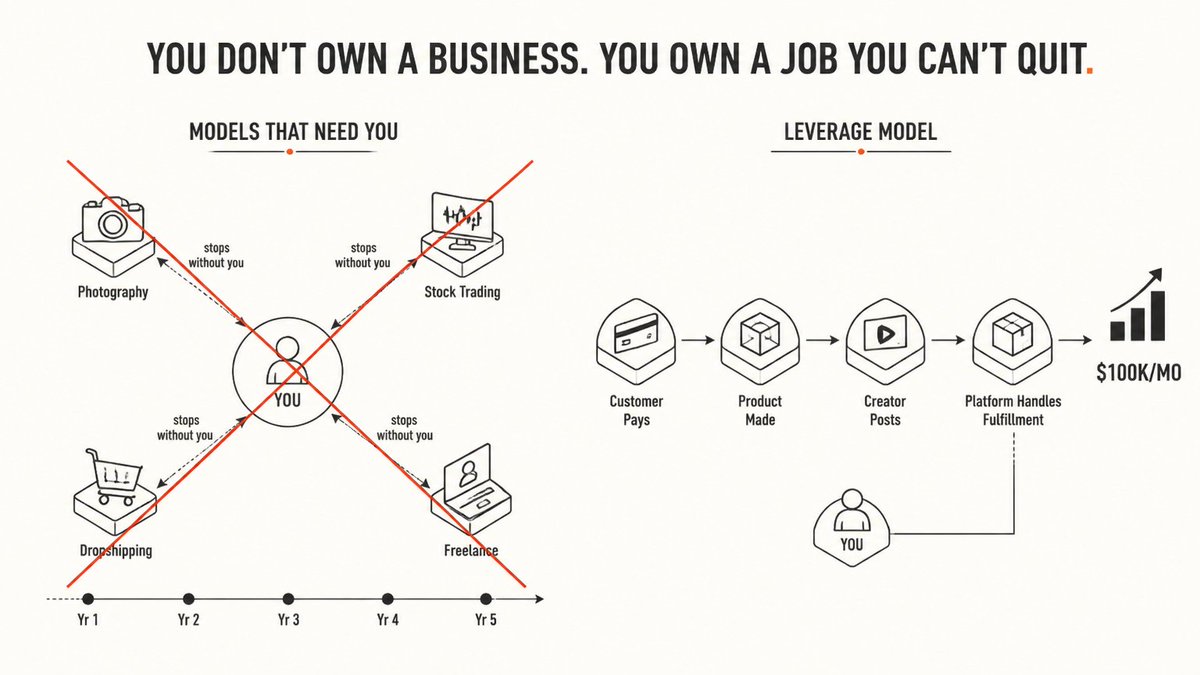
Year 1: Photography. Outworked every photographer he knew. Income stopped the day the camera stopped.
Year 2: Stock trading. No discipline problem. No system problem. Wrong model entirely.
Year 3: Dropshipping. Worked the store every day. Still required his attention to keep running.
Year 4: A few thousand lost. A few thousand more. Each model needed him to be the center of it.
Year 5: Still grinding. Still stuck. Olympic discipline. Zero leverage.
STILL NOT WORKING.
Not because he didn't deserve it.
Because the models he was running couldn't pass without him in the middle.
You don't own a business. You own a job that you can't quit.
That's the problem. And no amount of 5am alarms fixes it.
The inflection wasn't more discipline. It was a different structure.
A model where the product gets made after the customer pays. Where creators post video for a commission. Where the platform handles checkout, fulfillment routing, and traffic distribution.
He's now at $100,000 per month.
Same discipline. Different vehicle.
I'm not saying grind is wrong.
I'm saying grind aimed at the wrong structure never gets you out. It just keeps you very busy going nowhere.
Comment PDF below, and I'll send it to you.
"My products aren't selling. What's wrong with my content?"
I've seen this exact situation four times in the past week.
Hint: It's not a content problem.
You're actually one product swap from a complete turnaround.
Here's what the gap between views and sales is actually telling you:
When you get views but no sales, your content is working. Your product isn't.
The content pulled someone to the page.
The product didn't close them.
Those are two completely different problems and almost everyone fixes the wrong one.
The sellers I've watched who break $10,000/month in under 90 days don't have better content.
They have products that pass 3 filters before a single video is posted.
The Mandatory Three:
1. Wow factor or solves a visible problem
If you could find it on a shelf at Walmart, it won't pop on TikTok. It's too normal.
The product needs to make someone say "wait, what is that?" within 2 seconds.
2. Easy for affiliates to film
Affiliates won't post about things they can't demonstrate naturally.
If it takes 30 seconds of explanation before the product makes sense, affiliates skip it.
The best products show themselves.
3. Proven demand, but low creator saturation
Over 1,000 creators already promoting it? Too competitive, move on.
Under 100 creators, steady sales data? That's the entry point.
75% of TikTok Shop stores fail in the first 90 days.
The reason is almost never content quality.
It's almost always product selection.
I've watched sellers switch products mid-store and cross $10,000/month within 3 weeks of the switch.
What product are you currently promoting, and does it pass all three?
I found a 23-year-old who lost $20,000 across 5 failed businesses,
started TikTok Shop from a dorm room with $2,000,
and hit $800,000 in his first 5 months of 2026 at a 55% profit margin.
And he finally broke down exactly what the structure looks like.
Here's the sequence he used:
Step 1: Eliminated the inventory risk first
He connected Printify. Print-on-demand means the product doesn't get made until the customer pays.
No upfront capital. No warehouse. No units sitting in a room waiting to be wrong.
His $2,000 wasn't spent on stock. It was spent on tools and time.
Step 2: Let affiliates carry the marketing
98.97% of his revenue came from TikTok Shop affiliates posting videos for him.
He never made a single video for this store himself.
In one week: 425 videos posted by affiliates. 24 live streams.
He paid out $30,000 in commissions that week, out of revenue already received, not upfront.
Step 3: Used the platform as the store
No Shopify subscription. No payment processor. No checkout to build.
TikTok handles all of it. Their affiliate center finds creators. Their algorithm pushes products.
But here's what most people skip over in this story:
He posted 50 videos before his first sale.
Almost quit.
Then made $8,000 in the 2 weeks after that first sale came in.
Then lost money on the next four products because he got overconfident and skipped the validation step.
The losses built the product framework he uses now.
The system didn't come from the win. It came from the losses after the win.
I've been watching this type of build long enough to recognize when structure is doing the work.
This one passes every test I've seen.
The framework he uses is in the free guide.
Comment PDF below, and I'll send it to you.
Most people asking "is it too late for TikTok Shop?" are asking the wrong question.
The question isn't whether the window is open.
The question is whether you'll recognize it before it closes.
Here's what I keep seeing when I watch this space:
TikTok Shop is not Amazon FBA in 2024.
It's Amazon FBA in 2015.
In 2015, people said Amazon FBA was already competitive.
Too many sellers. Too crowded. Too late.
The people who ignored that and built anyway?
Some of them still run $500K/month businesses from the systems they built that year.
Right now:
$30,000,000 flows through TikTok Shop every single day.
A billion dollars every week moves through this platform globally.
TikTok's cut is 8%, which means their entire business model depends on sellers making money.
And the sellers? Fewer than 7,000 print-on-demand stores exist on TikTok Shop currently.
Amazon has hundreds of thousands.
The sellers I've watched enter in the last 6 months:
One built to $60,000/week.
One hit $100,000 in the first month.
One crossed $1,000,000 in total sales in under a year.
None of them are in glamorous niches.
None of them started with an audience.
The window that feels competitive right now is the same window that people called competitive in 2015 on Amazon.
The ones who said "too late" in 2015 were still saying it in 2018.
The ones who said "let's find out" are still running those stores today.
You can build a TikTok Shop at $100,000 per month.
Nobody talks about the one question that tells you whether what you're building right now will ever get you there.
Here's the test, and the exact setup that passes it:
The 3-day test:
Take 3 days completely off from your current income source.
If the money stops, you don't own a business. You own a job you haven't been able to quit yet.
I've watched people apply this to every model I've seen:
Photography: stopped the moment the camera wasn't moving.
Freelancing: clients wait, income waits.
Stock trading: pure speculation, no staff, no fulfillment, nothing running.
Dropshipping: orders need management, ads need checking, everything waits for you.
Each one failed the test. Not because the person failed. Because the structure failed.
Now apply it to TikTok Shop with the right setup:
Day 0: Open a seller account. Free. No LLC required.
Day 1: Connect Printify. Products get made only after a customer buys. You carry no inventory risk.
Day 2-7: Post 1 video/day and set up your first affiliate outreach templates.
Days 8-30: Affiliates are posting content for you. Each sale pays their commission out of revenue already received.
After day 30, here's what's running while you're away:
Printify fulfills. TikTok processes payment. Affiliates post. Algorithm pushes.
You're not in the middle of it.
The test is the framework. If you're building something that needs you to be there every day, you're not building toward freedom. You're building a better-paying version of a job.
The structure either passes or it doesn't.
$60,000 per week. Built slower than almost everyone I've watched.
Sustained $100,000 months. Simple giftable products.
No agency. No team. No ad budget at launch.
A TikTok Shop seller I've been tracking. Here's what the slower build actually looked like.
Most people assume the fast starters are the ones who last.
This one built methodically. One product at a time. One affiliate relationship at a time.
Here's the structure he used:
1. Saturation check before anything else
Not "what looks viral?" but "what has proven demand and low creator count?"
Over 1,000 creators already promoting a product? Skip it.
Under 100 creators with steady sales? That's the entry point.
Running this filter meant he never competed on a crowded shelf.
2. Content in-house first
Before any affiliate touched the product, he posted daily himself.
7-second videos. Simple demonstrations.
Not because the videos would go viral.
Because TikTok watches whether you believe in your own product before it pushes it anywhere.
3. Affiliate outreach after organic traction proved out
Once the data showed people were buying, he started recruiting creators.
DM by DM. Sending samples before asking for anything.
He built a roster of creators who already believed in the product.
4. No paid scaling until the foundation held
No ads. No campaigns. Nothing that cost money before the organic model worked.
When the system was converting, he amplified it.
Not before.
After running a transport business for years, I always thought the fast movers were the ones who won.
This case changed how I look at it.
The $60,000 weeks were the compounding of that flywheel.
Not a sprint. A system.
Comment PDF below, and I'll send it to you.
TikTok Shop is quietly producing consistent income for people nobody would expect.
Most people haven't noticed because the earners aren't posting about it.
They're not on YouTube explaining their journey.
They're not building an audience around being a "TikTok Shop success story."
They're running stores.
Three people I've been watching closely:
A woman raising 4 children while working a full-time corporate banking career.
$25,000 per month. The system runs while she's at work.
She didn't build a personal brand. She built a product-affiliate operation.
A seller running simple, giftable, seasonal products.
$60,000 per week. The kind of product you'd see in a supermarket and not think twice about.
Not a tech product. Not a viral sensation. Something boring, filmable, and evergreen.
A person who came in after losing $20,000 to a scam.
Zero TikTok Shop experience. Zero following. No advantage.
$250,000 in the first 3 months. Over $1,000,000 in total sales.
None of these people are building content empires.
None of them went viral for being a TikTok Shop operator.
They're just running a system that the algorithm rewards, quietly, consistently.
After running a business for years, I know what sustainable income looks like.
It doesn't announce itself. It compounds.
The ones treating TikTok Shop like a business rather than a content strategy are the quiet ones doing six figures.
The ones treating it like a personal brand play are the ones with bigger audiences and smaller results.
The platform doesn't care about your brand. It cares about conversion.
That is a feature, not a bug.
Comment PDF below, and I'll send it to you.
You can quietly destroy your TikTok Shop margin with one commission setting most sellers never change.
Nobody talks about how the two-rate commission system actually works, and what it costs to ignore it.
Here's the exact setup and why it matters before you run a single campaign:
What most sellers know:
There is one commission rate. Affiliates earn X% on every sale. Simple.
What actually exists:
There are two separate commission rates in TikTok Shop:
Rate 1: Open collaboration rate.
This is what an affiliate earns when they drive a sale organically.
Their video performs. Someone buys. The affiliate gets their cut.
Let's say you set this at 20%. Fair for organic traffic they generated themselves.
Rate 2: Shop ads commission rate.
This is what an affiliate earns when GMV Max is the thing pushing their video to customers.
The algorithm found the buyer. You paid the ad budget. The affiliate's video just happened to be the one running.
Here's the problem when sellers don't set Rate 2:
GMV Max runs. Drives a sale through an affiliate's video.
The affiliate earns 20% open collaboration commission.
Plus you paid for the ad budget to generate that sale.
You're paying twice for the same conversion: once in ad spend, once in full commission.
The fix takes 2 minutes in Affiliate Center:
Open collaboration tab. Click the pencil icon on your product.
Set a separate shop ads commission rate. Typically around 10%, roughly half your organic rate.
Why half?
Organic sales: the affiliate did the work of finding the buyer. 20% is earned.
GMV Max sales: you paid to push their video to the buyer. 10% is fair. The work was yours.
One operator I've been watching: runs 20% open collab, 10% shop ads commission.
The 10% gap on GMV Max sales is the difference between a profitable ad campaign and a campaign that looks like it's working but isn't.
The setting is there. Most sellers never change it.
Are you running separate commission rates for organic affiliate sales and GMV Max sales?
$220,000 in a single month.
One store. One niche. No ad agency. No team.
Here's the daily rate math and what it takes to build the same model.
The daily rate:
$220,000 per month = $7,333 per day.
From a print-on-demand store running on affiliates.
Month 2 of the same store: $20,000. Month when it crossed $220K: system had been running for months.
What you actually need to start:
1. A phone and a TikTok Shop seller account (free)
2. A Printify account (free to connect)
3. AI tools for product design (free tier available)
4. A small sample budget to seed your first 10 affiliates
That's the entire input list.
What the $220,000 month actually looked like operationally:
The operator wasn't managing a warehouse. Printify handles every order.
The operator wasn't running a content team. Affiliates were posting.
The operator was managing the affiliate relationships and ensuring new products entered the pipeline.
The timeline for this result:
Month 1: product selected, store live, first affiliates seeded, first sales.
Month 2: $20,000. System working at baseline. Affiliates building familiarity with the product.
Later months: compounding. Old affiliate content still converting. New affiliates added. Sales layer on top of sales.
A second seller I've been watching:
Month 3, starting from zero: $10,000 per month.
Not from running ads. From 8 active affiliates posting consistently after receiving samples in month one.
The comparison:
$7,333 per day from a store that compounds without daily operator content creation.
A $150,000 per year corporate salary = $411 per day, requiring 8 to 10 hours of daily presence to maintain.
The difference is not intelligence or hustle.
It is whether someone built a system where other people's content drives the income, or stayed in one where their own time is the only input.
This is the model in the free guide.
Comment PDF below, and I'll send it to you.
Delete the follower growth strategy.
Delete the engagement rate obsession.
Delete the content consistency pressure.
TikTok Shop affiliate pays $2,400 per referral with one commission link.
It's not glamorous. But if you set up the product research system this week, you could close your first commission before August.
Here's what TikTok Shop affiliate doesn't require:
Follower count:
The most bookmarked TikTok Shop content I've seen, 8,993 saves, 154,000 plays, was posted by someone with no significant following.
The algorithm didn't push it because of who posted it. It pushed it because of what it said.
"Start with zero money" is a hook that works regardless of how many followers the poster has.
Engagement rate:
TikTok Shop commission comes from sales, not impressions.
You can have 200 followers and 1 product that converts at 8%. Your income is the math from those conversions.
You can have 100,000 followers and a product that doesn't convert. The income is zero.
Engagement rate is a vanity metric if the product doesn't close.
Content consistency:
The creators doing $2,400 months from TikTok Shop affiliate commissions are not posting 7 days per week.
They found 1 to 2 products that convert. They post content that demonstrates those products.
When the product converts, old content keeps earning. Consistency is compounding, not obligation.
The model that works is not the content model.
It is the distribution model.
The product is the asset. The content is the delivery mechanism.
Are you approaching TikTok Shop more like a content business or a distribution play?
Most TikTok Shop sellers who lose money on GMV Max will never understand why.
It's not the algorithm.
It's not bad luck with creatives.
It's not the wrong niche.
It's the number they typed into the target ROI field on day one.
Here's what the break-even calculation actually looks like, and why almost nobody runs it first:
The inputs you need before touching any campaign setting:
Retail price: how much your product sells for.
COGS: what the product costs you to produce.
Shipping: whether it's on the customer or absorbed by the seller.
TikTok referral fee: typically 6%.
Shop ads commission rate: the commission affiliates earn on sales driven by GMV Max.
This last number is one most sellers don't know exists.
There are two commission rates:
Open collaboration rate: what an affiliate earns on a sale they generate organically. Let's say 20%.
Shop ads commission rate: what an affiliate earns when GMV Max is pushing their video to customers.
This rate should be lower. You're paying for the traffic now. The affiliate is getting a free ride on your ad spend.
Set it at roughly half your open collaboration rate. Around 10%.
Without this: you're paying for an ad AND paying a full 20% commission on the same sale. Margin destroyed.
With this in place, run the break-even formula:
A seller with a $30 retail product, $6 COGS, $4 customer shipping, 6% TikTok referral fee, and 10% shop ads commission:
Balanced target ROI: 2.3
Aggressive target ROI: 3.1
Set your target below break-even and every sale loses money.
Set it above at 1.5x break-even and the campaign only spends when it's profitable.
The break-even formula is not complicated. It takes 10 minutes.
Most sellers skip it because they're eager to launch.
The ones who skip it are the ones telling everyone GMV Max doesn't work.
Sellers who lose money on GMV Max almost always made this mistake on day one.
$2,000 per day. 2-week-old store. First product ever.
$13,800 before 10AM. Third month in.
$100,000 per month. Month 4. No ad agency.
Three sellers I've been tracking. Same system. Different timelines. Here's what they all have in common.
Nathan, 2 weeks in:
$2,000 per day from a store that had been live for 14 days.
Not a lucky viral moment. A product that passed validation before launch. An affiliate network seeded from day one.
The system was built right before it was built at all.
Josh, 3 months in:
$13,800 in sales before 10 in the morning. $15,000 average days becoming consistent.
After watching this for a while, I understand what $15,000 days look like operationally.
Not 15 hours of work. A store where affiliates are posting daily and the pipeline is full.
Vince, month 4:
$100,000 per month. Month four.
Most people spend month 4 still trying to figure out product selection.
Vince was past $100,000 per month because the product validation happened in month one.
What all three results have in common:
1. The product was selected before launch, not changed after launch
Every seller here started with a product that had proven demand. Not a product they liked.
The market signal came first. The launch came after.
2. Affiliates were the distribution, not the seller's own content
Nathan, Josh, and Vince did not go viral personally.
Their affiliate networks drove the traffic while they managed the operation.
The sellers with no following who outperform content creators: this is how.
3. The system compounded from month one
Month 4 is not when they figured it out. It is when the compounding showed up on the dashboard.
The real work happened in weeks 1 and 2. Month 4 is the result of that.
I've been watching this long enough to say with confidence:
The timing gap between starting right and seeing $100K months is about 90 days.
The gap between starting wrong and quitting is about the same.
This is the model in the free guide.
Comment PDF below, and I'll send it to you.
Most TikTok Shop affiliates have no moat.
They don't realize it because the commissions are hitting.
The content is performing.
The sales are coming in.
Everything feels like it works.
Until it doesn't.
Here's what I keep watching happen:
One algorithm shift changes which video formats get pushed.
The content that was converting last month stops converting this month.
The affiliate doesn't know why. The income drops 60% in two weeks.
Or: a product gets pulled from TikTok Shop. Suspended. Category restricted.
The affiliate who built their income around one product category starts over.
Or: a seller with deeper pockets enters the same niche.
Raises commission rates to 35%. Poaches the best affiliates with bonus structures.
The original affiliate loses their best distribution partners.
None of this is rare. I've watched all three happen repeatedly.
The problem is not bad luck. The problem is concentration.
One product. One platform. One niche. One creator identity.
It all feels like momentum. It is actually a single point of failure.
Here's what the protection looks like, before you need it:
Day 1: Build across 2 to 3 product categories, not one. If one gets pulled, the others continue.
Day 30: Get your top 5 affiliates into a relationship, not just a transaction. Commission is a lock-in. Relationship is a moat.
Day 60: Start capturing email from your affiliate traffic. The platform doesn't own your list. You do.
Day 90: Run a second product niche in a completely separate campaign. Diversification is not a bet against your current success. It's the structure that makes success durable.
The commissions feel stable right now.
That is not the same as the system being stable.
Build the moat before you need it.
Comment PDF below, and I'll send it to you.
Delete your content calendar.
Delete your posting schedule.
Delete your personal brand strategy.
TikTok Shop pays per transaction. Not per post.
It's not the most exciting model. But if you build the product-affiliate system this month, you could see your first commission before July ends.
Here's why the calendar, schedule, and brand strategy don't apply:
Content calendars assume you are the content creator.
In a TikTok Shop affiliate system, you are the product operator.
The affiliates post. You manage the product and the relationship.
One operator I've watched hasn't filmed a single video for his store in 6+ months.
$260,000 last month.
Posting schedules assume consistent daily output from one creator.
When 10 affiliates each post 3 videos per week, you have 30 pieces of content per week entering the algorithm.
You alone posting daily can't compete with that volume. The schedule belongs to the affiliate network, not you.
Personal brand strategy assumes your audience is the distribution channel.
TikTok Shop's affiliate distribution model means the creators already have the audiences.
You don't need to build one. You plug into theirs.
The moment you become the only person creating content for your store, you become the bottleneck.
You cap yourself at what you can personally produce.
The system model has no ceiling because the affiliate network scales independently.
The boring version: manage the product. Brief the affiliates. Maintain the relationships.
Let the network do what networks do.
The part most people miss: the work that actually matters is not the content.
It's finding the right product and building the right affiliate team around it.
What's the one part of the TikTok Shop model that confuses you most from the outside?
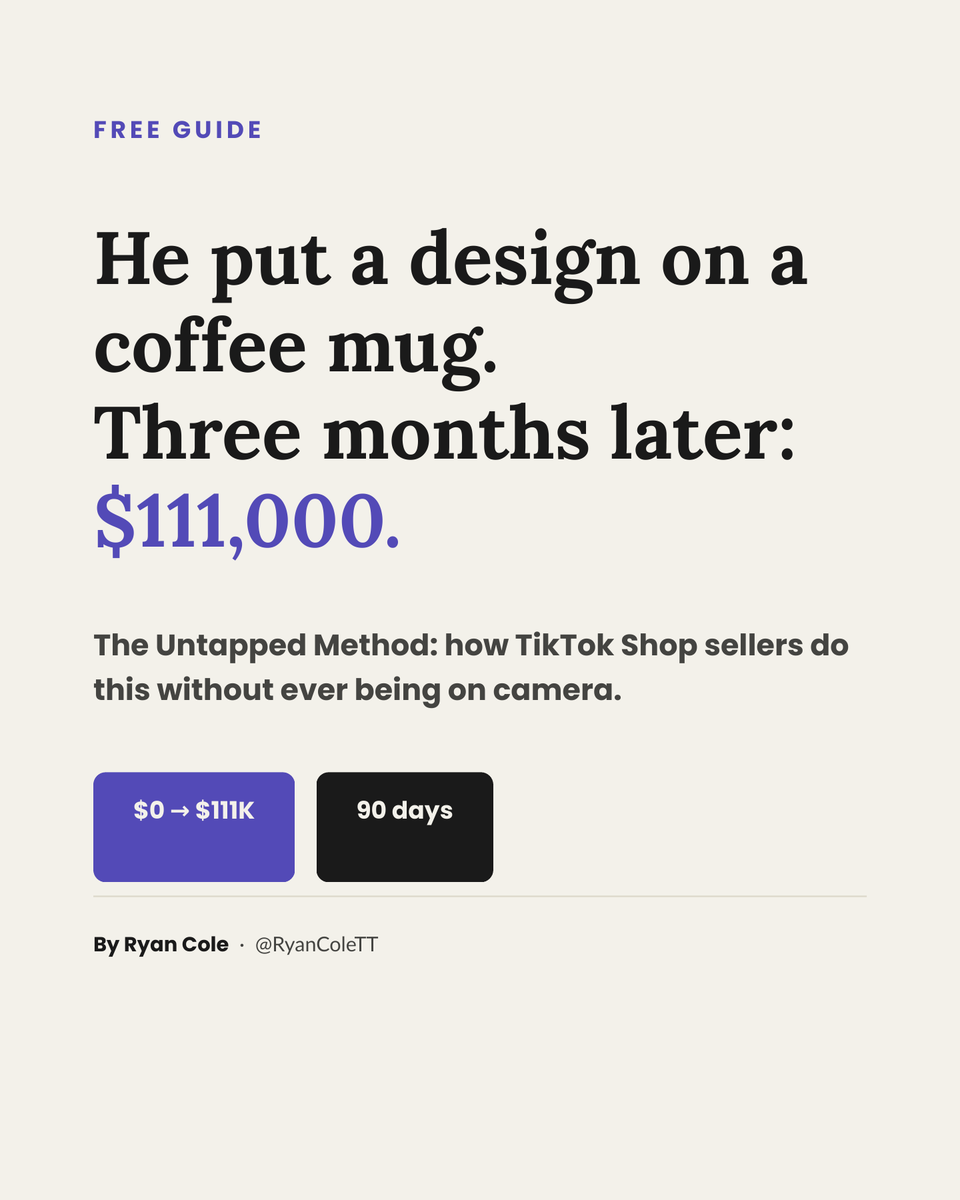
$111,000 in 3 months.
From a college dorm room.
A product that had been ignored on TikTok Shop while a competitor sold millions on a website.
Here's the daily rate breakdown on a result most people assume requires experience.
The math:
$111,000 in 90 days = $1,233 per day.
From a 22-year-old whose father earned $15 to $20 per hour running a landscaping business.
What Matt actually needed to start:
1. A phone
2. A TikTok Shop seller account
3. One observation that nobody else had acted on
The observation:
He spent 3 to 4 months on t-shirts going nowhere.
Then he noticed mugs barely existed on TikTok Shop while shirts were saturated.
A competitor was doing millions in sales on a website with the same design. No TikTok listing.
He listed it on TikTok Shop.
First mug video: 10,000 views. 3 units.
He thought: "That's interesting."
Three videos later: 1.3 million views. Hundreds of units.
The GMV Max stage:
Ran the campaign on a large budget with a high target ROI.
Conversion was already confirmed. The campaign scaled what was already converting.
"Basically been decently consistent ever since."
His own words on time:
"If I basically stopped working for the rest of the month and just posted 5 videos a day, which takes 15 minutes total, I'd still do $20,000 to $30,000 by end of month."
The comparison:
$1,233 per day from an observation about an unsaturated product category.
$15 to $20 per hour from skilled landscaping work that stops paying the moment you stop working.
The difference is not talent, education, or connections.
It is whether someone found a system that pays per transaction versus one that pays per hour.
This is the model in the free guide.
Comment PDF below, and I'll send it to you.
I ran a transport business for years.
I traded my time for contracts. The business ran as long as I ran it.
The moment I stepped away, the income stopped.
I know what that model feels like from the inside.
I've also tried generating income through freelance work.
You build skills. You pitch clients. You deliver. You invoice.
Then you start again.
The effort is real. The compounding is not.
I've watched the people chasing hourly income in every format:
Agency work. Consulting. Side contracts. UGC pitching.
Every version of the same structure: you stop, it stops.
The only model I've watched consistently compound without requiring daily operator presence is TikTok Shop affiliate.
Here's the structural difference:
Freelancing: you deliver, you get paid, work resets tomorrow.
UGC brand deals: you film, you invoice, you pitch again next month.
Running a service business: revenue tracks hours worked, not system performance.
TikTok Shop affiliate:
You promote a product. Commission income tracks every sale, including sales from content posted 6 months ago.
An old video goes viral today. You earn commission on every unit sold.
You didn't do anything different today. The system did.
The real problem wasn't effort. I worked hard in every version of this.
The real problem was structural. Every model I tried reset when I stopped.
After years of watching this closely, I have one opinion I hold with real conviction:
The fastest path to income that compounds without resetting is not a better skill set.
It's a better model.
Which model did you try before you found TikTok Shop?
If I was forced to build a TikTok Shop from zero to $5,000 per month in 30 days, starting with no inventory and no following, here's exactly what I would do in order:
Week 1: Infrastructure
Days 1 to 3: Find one product that passes all three tests.
Does it create an emotional reaction in the first 1 second of video?
Can a creator film it in under 12 seconds in one location?
Can 30 different content angles be made from this one product?
If it doesn't pass all three, it doesn't qualify.
Days 4 to 7: Set up the store.
TikTok Shop seller account. Connect Printify. List the product at $19 to $25.
Use AI to generate 5 designs. Upload the top 2. Product live before the end of the week.
Total setup time: one afternoon.
Week 2: Content Volume
Post one video per day, every day, no exceptions.
TikTok tests new sellers to see if they produce in-house content before leaning on affiliates.
7 to 12 seconds. No hashtags. Simple captions. Copy formats that are already converting in the niche.
This is not about going viral. This is about earning the platform's trust and building a content history.
Week 3: Affiliate Leverage
Find a competitor with proven sales. Use Calata to identify their top-performing affiliates.
DM 20 to 30 creators per day. Send free samples to the ones who respond.
Include a creative brief with every sample: the 2 to 3 angles that convert, the hook to lead with.
10 active affiliates posting 3 videos per week = 30 additional videos per week.
Week 4: Turn on GMV Max
Only after organic traction is confirmed. Only after affiliates are posting consistently.
Set target ROI at 1.5x your calculated break-even. Start at $100 per day budget ceiling.
Keep adding new videos every day. The campaign needs a constant fresh supply.
The conservative math at 30 days:
10 affiliates x 15 videos = 150 videos
8,000 average views = 1.2M total views
2% click to store = 24,000 visits
3% convert = 720 orders
$14 average profit = $10,080 per month
That is the floor. One video catching fire changes the trajectory entirely.
A 19-year-old I've been watching applied this sequence from a college dorm room.
$171,000 in sales. Semester still in session.
Most people spend 3 weeks on Week 1. That's why they never reach Week 4.
$67,000 in 30 days.
68% profit margin.
A product in a niche most people would say is "too divisive to sell."
A TikTok Shop seller I've been watching closely. One viral video. One month. Here's the full breakdown.
The backstory most people don't know:
Before any of this, Ryan lost $20,000 to a business scam.
Zero experience with TikTok Shop. Zero inventory. No brand.
He came in with the one thing the algorithm doesn't care about: willingness to start.
How the $67,000 happened:
1. The niche that most sellers avoid
Political products. The category most people write off because of engagement risk.
The insight: passion buyers drive purchases AND rage commenters drive algorithm reach.
"All publicity is good publicity when it comes to anything you're selling online."
The algorithm doesn't distinguish between a positive share and a furious comment. Both push the video.
2. One video hitting 3.9 million views
Not a polished production. Not a paid promotion. An affiliate video.
Ryan sent samples to creators already posting in the political product niche.
One creator posted. 3.9 million views. The system was ready when the traffic came.
3. The math behind 68% margin
No warehouse. No inventory carrying cost. No ad spend.
Printify handles fulfillment automatically. Commission goes to the affiliate.
The seller captures the margin between production cost and retail price.
68% margin at $67,000 revenue month one.
After running a business for years, I've seen how leverage is supposed to work.
Most people wait for the perfect niche, the perfect product, the perfect moment.
Ryan started after losing $20,000 and had his best month in 30 days.
The model doesn't require perfect conditions.
It requires starting in the right system.
This is the model in the free guide.
Comment PDF below, and I'll send it to you.
I'm convinced.
The entire conversation about AI for online business is missing the point.
It's not about which tool is best.
It's not about which prompt generates the most product ideas.
It's not about replacing creativity.
The sellers I've watched use AI most effectively say the same thing:
"AI is a vehicle. It is a system. It is not a strategy. It is a multiplier of what you are already doing."
Here's what that means in practice:
An operator I've been following did $150,000 in 28 days.
AI handled 90% of the product development.
Not by replacing the system. By running inside it.
The sequence didn't change: find demand, build product, recruit affiliates, scale.
AI compressed the timeline at every step.
Product research: 30 minutes instead of 3 days.
Design: 60 seconds instead of a graphic design contract.
Outreach follow-up: automated sequences instead of manual chasing.
The mistake I keep seeing:
Someone discovers AI. Spends a week generating business ideas.
Produces 200 concepts. Implements zero.
Concludes AI is overhyped.
The tools aren't the problem. The missing variable is the system they're supposed to operate inside.
AI running inside TikTok Shop's demand engine produces $150K months.
AI running without a system produces a long list of untested ideas.
The multiplier doesn't create anything if there's nothing to multiply.
Comment PDF below, and I'll send it to you.