I've wasted tens of thousands of dollars on fancy dashboards and business intelligence tools.
And they ALL break.
People stop trusting the data and using it altogether.
But I've seen $2M - $5M companies go to $10M - $20M after implementing one thing they can build in half a day…a CEO Dashboard.
Here’s how you can build one yourself 🧵
My first product was a 28-page ebook about homemade baby food.
I didn't write it.
I'd never even made baby food (or even changed a diaper).
I was 19.
It's also the reason I stopped trying to be original.
Here's what happened...
While I was in college, I started a side business building websites to make some extra money. Unfortunately for me, my first client (a lactation consultant) couldn't pay her bill.
Instead, she handed me this ebook she'd written and said, "See if you can do anything with it."
Gee… thanks.
But I figured, “What do I have to lose?”
So I built a simple, ugly, one-page site and priced the ebook at $14. ($0.50 a page seemed fair.)
A few days later, I woke up to a sale. One sale.
And the only thought in my head was, "What if I had a hundred of these?"
So I went and made a hundred of these.
Different topics (all underserved niches)…same simple, ugly sales page.
A headline
Some bullet points
An order form… over and over and over again.
By my early 20s, my little publishing empire was doing $250K/yr, and I still hadn't invented a single thing. I just noticed what people were looking for, published an ebook on the topic, and built an ugly website to sell it.
I tell this story because I talk to a lot of founders who are stuck, and they're stuck because they think the next stage of growth requires a brand-new idea.
Meanwhile, they're already sitting on a proven one…
…the one that got them where they are now (just underoptimized because they’re “bored” with it.)
If that's you, here's what I'd do instead…
Take the thing that already works and figure out how to DOUBLE DOWN on it.
And if you don’t know how to do it, ask someone.
Stop asking, “What’s new?”
Start asking, “How can I scale the old?”
Under $1M, the question is “How much did we MAKE?"
Over $1M, the question has to become "How much did we KEEP?"
Most founders never make the switch, and it costs them.
Here's why...
Growth is a fire, and fire eats fuel.
More people.
More inventory
More ad spend
More payroll…
Every new log you throw on is more cash out the door, and revenue will happily climb as the bank account gets smaller.
If you've ever wondered why a growing business still leaves you with nothing at the end of the year, that's your answer:
You're still measuring the fire when you should be measuring the fuel.
That’s why the number I watch the closest isn't revenue…it's distributable cash.
“How much money the business could actually pay out to its owners right now if it wanted to?”
If that number's going up, the business is healthy.
If it's flat while revenue climbs, something's wrong, and I'll know about it weeks before payroll would've told me.
P&Ls lie. Cash doesn't.
And if you want to move that number on purpose, I'll give credit where it's due, because the fix came from my buddy Mike Michalowicz and his book Profit First.
Most of us do the math the way we were taught:
REVENUE - EXPENSES = PROFIT
$1,000,000 - $950,000 = $50,000
In other words, profit is left over after you’ve spent everything you’re going to spend (which most of the time means profit is $0… not even $50K).
Flip it:
Revenue - PROFIT = Expenses
Shoot for at least 20%, and the formula becomes:
$1,000,000 - $200,000 = $880,000
REVENUE - PROFIT = EXPENSES
Make profit the FIRST bill you pay, not the last, and you’ll have the fuel you need to fund your scale.
In my 27 years of building businesses, I’ve had companies where I made more money at $2M than I did at $5M.
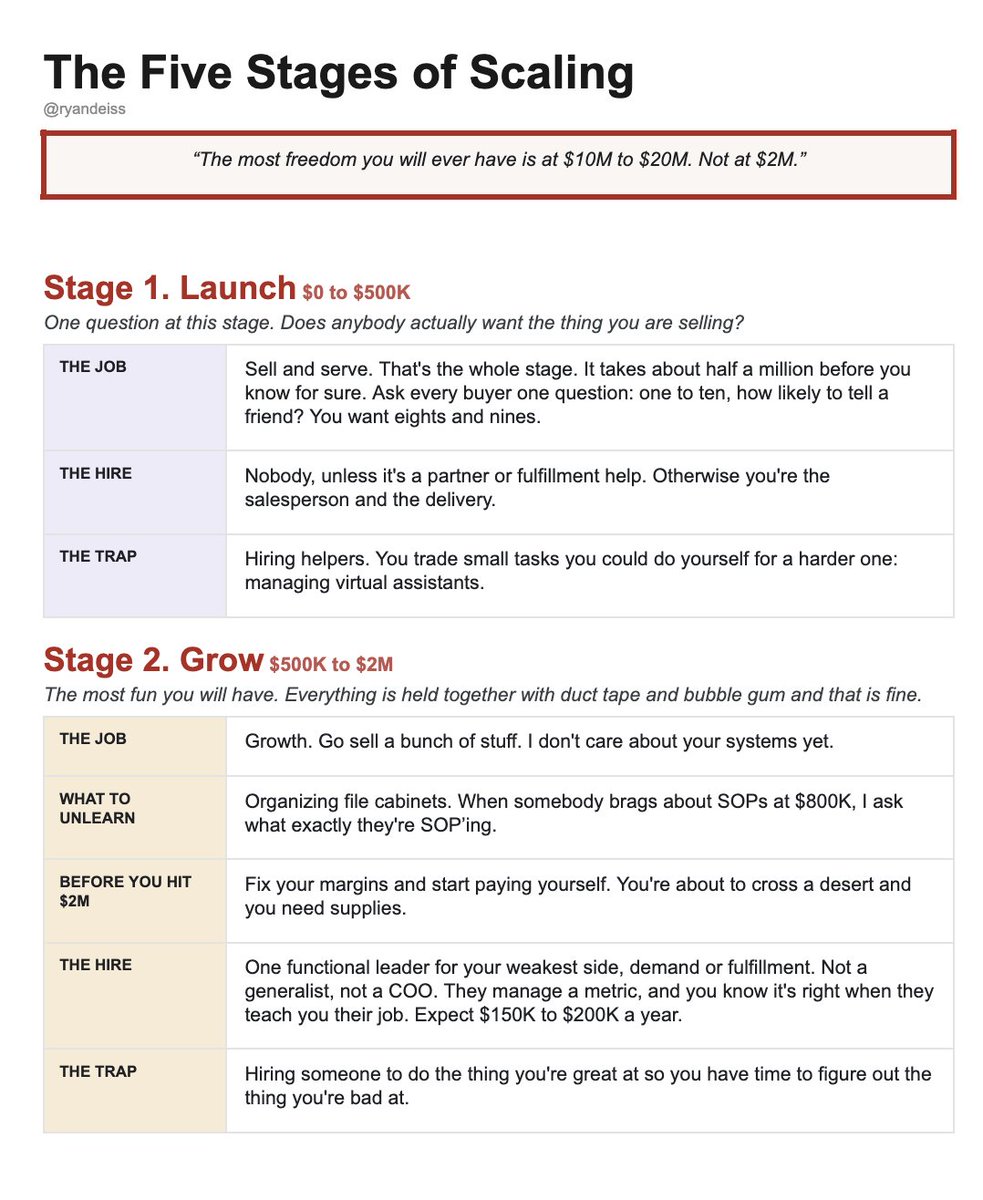
@realcolegordon asked me why on his show, so I mapped it out. Five stages, each with a different job... and a different way to screw it up!
More below…
https://t.co/BQLI94LDFh
Ryan Deiss has been in business since 1999.
8 companies to 8 figures… 4 exits… and now a $200M portfolio.
Everyone in our industry wants to do what he does.
Take equity in your best clients, build a portfolio, and get leverage.
And almost nobody makes it work.
So we broke down why most people fail at it, what he looks at before he partners with any business, and the one thing you should never do for your portfolio companies.
Check out the full episode below 👇
00:00 Going All In on YouTube Content
04:56 Why Attribution Data Lies to You
09:06 Shutting Off $150K/Month in Ads
13:20 Owning Your Voice Instead of Chasing Best Practices
17:44 Building the Portfolio: What Makes the Buy List
23:32 The Real Reason Deals Get Unstuck
25:38 Scalable's Three-Tier Client Model
30:30 Avoiding Resentment in Equity Partnerships
36:39 The 0% Success Rate of Rushing Deals
43:56 Tracking Cash Distributions, Not Vanity Metrics
55:20 Launch to Scale: The Five-Stage Framework
59:04 Why "I Need a COO" Is Usually the Wrong Answer
1:05:07 The $5M to $20M Phase
1:32:50 What Actually Makes a Business Sellable
1:42:20 Where AI Is Actually Moving the Needle
1:50:52 27 Years in Business: The Real Secret
I nearly broke my business because I didn't know how to pay myself.
Good month: I'd splurge and take out too much.
Bad month: I'd panic and stop paying myself altogether.
2+ bad months? Now I’m scared I can’t even pay my mortgage much less cover payroll.
Fortunately, the fix is simple...
It’s 5 bank accounts (and every $10M+ business needs all five)
1. Operating. Keep one month of OPEX… no more.
2. Tax Savings. Fund this one first. (They have missiles)
3. Emergency Account. Keep 3 months of fixed OPEX.
4. Future investments. Save for known, planned expenses.
5. Distribution. This is where all the excess cash should waterfall.
If that last account isn’t getting bigger, that’s a problem. Fix it.
A broke founder makes desperate decisions.
This is one of the easiest ways to help make sure you never end up as one.
If you're a founder running a $2M-$20M business, take the free CEO Time Audit.
5 minutes, and you'll get your CEO Efficiency Index and see exactly where your time is going.
https://t.co/32u4LEc2h3
I got 10+ hours a week back on my calendar...
…and it took me 5 minutes to figure out where they were hiding.
(Not 5 minutes to fix it. 5 minutes to find it. The fixing took a little longer.)
Here's the backstory…
Most founders I talk to aren't short on vision…they're short on hours.
Their calendar is packed with stuff they shouldn't even be doing, but they’ve been doing it so long they forgot it’s someone else’s job.
That was me.
I would've told you I had a pretty good handle on my time, but when I actually tracked it, the data said otherwise.
That’s why I built the CEO Time Audit. It's a simple tool that shows you where your time is actually going, how effectively you're leading, and what needs to come off your plate FIRST if you want to scale without burning out.
You’ll get:
- Your time leaks (the ones you've stopped seeing)
- Your red flags
- Your CEO Efficiency Index
Thousands of founders have run it, and most find the same thing I did: 40%+ of their week is going to work that isn't theirs to do.
You can't scale a company while you're buried in other people’s tasks.
I just wish I'd had this 10 years ago…
Profit isn't something you “earn”...
...profit is something you DECIDE.
And since most entrepreneurs never decide, they never get paid.
Here's what I mean…
Every business learns the same formula:
Revenue - Expenses = Profit
It’s accurate, but also unhelpful.
For most businesses, that number always lands somewhere right around $0, because expenses have a way of expanding to fill whatever room you give them, and "whatever's left" has a way of being nothing.
Same thing happens with your own paycheck.
You pay everyone else first, then wait around to see if there's anything left for you. (Usually there isn't.)
I learned to flip the formula from Mike Michalowicz's book Profit First, and it's one of the few things I've implemented almost word for word across every company in our portfolio.
Here’s the RIGHT formula for calculating profit:
Revenue - PROFIT = Expenses
Decide the margin first. Take it off the top.
Whatever's left is what you're allowed to spend. (Your own pay works the same way. Set it, pay it early, and make the business figure out how to afford it.)
And if you’re thinking, "We can't afford that right now…"
…that’s exactly the point.
You can't afford NOT to.
Margin doesn't show up once you get bigger. Growth eats margin, it doesn't create it.
If you can't create profit at $2M, you won't magically make it appear at $10M.
@dennishegstad Agree. I would still never launch software without a great developer on the team, but being able to show rather than attempt to describe is a game-changer.
I just got off a call with a panicking CEO...
Q1 and Q2 were the best quarters in the company’s history.
Then he made 3 hires he didn’t need.
Now sales are down, and he’s back to closing deals himself.
I've watched this exact sequence play out more times than I can count…
…and it has almost nothing to do with the hires.
“Why did you decide to hire those 3 new people?” I asked.
"Things felt like they were moving too fast. I wanted to get ahead of it."
And there it was.
This CEO didn't think he panicked. He thought he was being proactive.
(He called it planning, but it was really just a form of panic in disguise.)
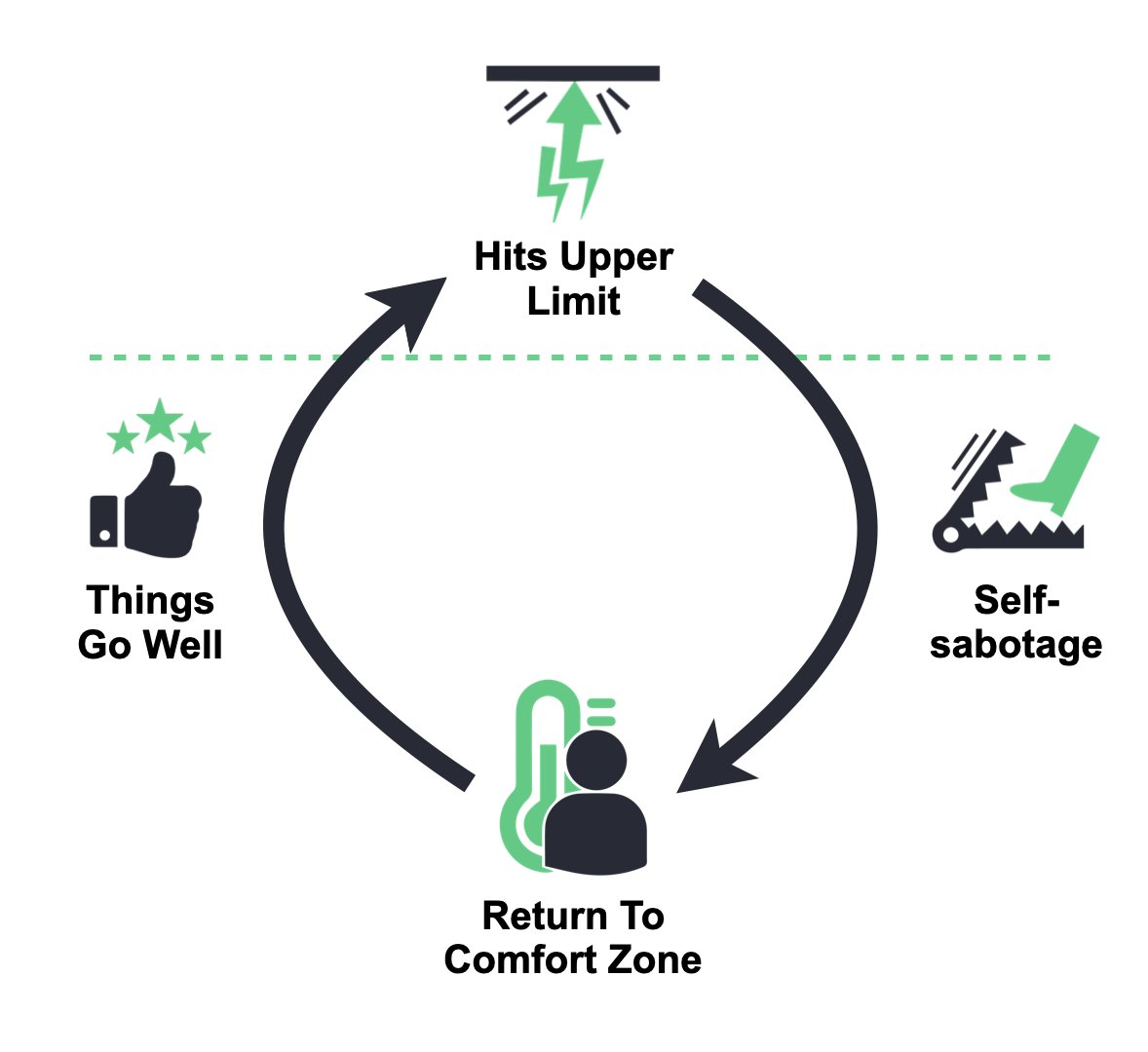
Gay Hendricks has a name for this “panic.” He calls it the Upper Limit Problem.
Every one of us has an internal thermostat for how much success we're comfortable with.
Get above it, and we start quietly turning the dial back down. Never on purpose… we just somehow manage to find our way back to the number that feels normal.
And for most founders I know, the "normal" number is the one where they're still indispensable.
So if your business keeps growing right up to a ceiling and then stalling out, don't look at the market.
Look at what you did the last time things started going well.
Then go find the bottleneck that makes you feel necessary…and remove it.
@T2XFactor Two things:
1) a company scorecard (that creates alignment) and…
2) a weekly scorecard review meeting (that creates accountability)
Combine alignment with accountability and you’ll have your Navy.
Dear founder: did you know your job evolves FOUR times as you scale?
The 4 Phases of a Founder's Job
│
├─ Phase 1: The Inventor
│ ├─ You create the thing
│ ├─ The product
│ ├─ The service
│ └─ The idea that didn’t exist before you
│
├─ Phase 2: The Driver
│ ├─ You sell it
│ ├─ Close deals
│ ├─ Write copy
│ ├─ Show up on calls
│ └─ Convince people it’s worth paying for
│
├─ Phase 3: The Builder
│ ├─ This is where most founders get stuck
│ ├─ You're managing the product building machine
│ ├─ Systems
│ ├─ Processes
│ └─ Hiring
│
└─ Phase 4: The Guide
├─ You come full circle
├─ Now you’re “inventing” the business itself
└─ The business has become "the product"
Phase 3 isn't sexy... but if you skip it, the business stalls out.