This paper answers why confident idiots run the world.
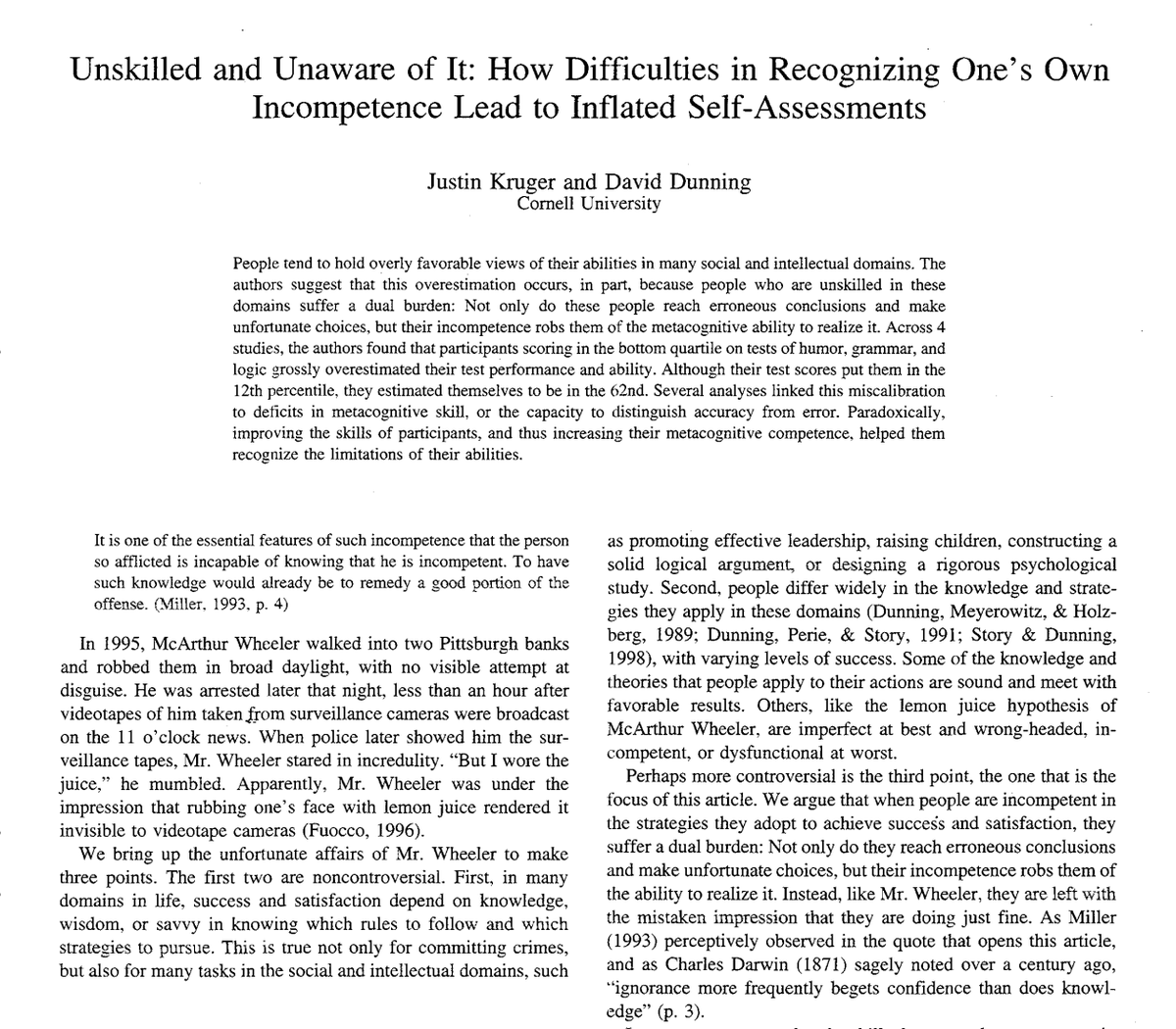
Cornell University published a psychological paper that explains every terrible boss, every loud influencer, and every broken corporate hierarchy.
It’s called “Unskilled and Unaware of It.”
they tested participants across logic, grammar, and humor to measure the gap between actual performance and self-perception.
And the results are wild.
participants scoring in the bottom 12th percentile consistently believed they were operating in the 62nd percentile.
they were not lying. they were literally incapable of recognizing their own incompetence.
the paper revealed a brutal paradox:
the exact skills required to master a domain are the exact same skills required to accurately evaluate your own competence in that domain.
if you lack the skill, you inherently lack the cognitive capacity to realize you are failing.
this creates a dangerous systemic loop.
the incompetent are blessed with absolute, blinding certainty. their brain protects them from their own ignorance, allowing them to speak first, demand authority, and never second-guess their decisions.
meanwhile, the actual experts suffer the exact inverse.
top performers in the study consistently underestimated their rank. because a task was easy for them, they falsely assumed it was easy for everyone else.
they hesitate. they obsess over nuance. they assume they have nothing unique to add.
we are biologically wired to confuse confidence with competence.
the loudest person in the room gets promoted, gets funded, and gets the microphone, not because they know what they are doing, but because they are physically incapable of seeing what they don't.
the only defense mechanism is building systems that stop rewarding absolute certainty and start demanding proof of work.
Self-trust doesn’t mean you think you’ll always have the right answer.
It’s believing that you’ll be fine if you have the “wrong” answer too.
This means that..
I'm a cardiologist. Some of the most exhausted hearts I see belong to people with no blockages at all.
They are replaying a conversation from 2019. Rehearsing a disaster that hasn't happened. Demanding certainty from a life that never offered any.
The Japanese have a phrase: shikata ga nai.
"It cannot be helped."
It isn't surrender. It's refusing to spend your strength fighting what can't be changed, so you have some left for what can.
One question does most of the work:
Can I do something about this right now?
If yes, take one step. Not the whole solution. One step.
If no, put it down.
The past can't be edited. The future can't be guaranteed. Your body pays for every hour you spend in either one.
Overthinking rarely comes from having too many problems. It comes from replaying every mistake, controlling every outcome, and demanding answers life was never going to give you.
Do what you can.
Release what you can't.
Some things cannot be changed. Peace starts the moment you stop arguing with them.
Shikata ga nai.
EY is one of a number of firms trying to foster the critical thinking, judgment and other skills needed to better work alongside AI https://t.co/OrY6g8W1Gk via @WSJ
The spectacular implosions of big book deals over AI use are forcing a reckoning over creativity, trust and the future of the publishing industry. 🔗 https://t.co/2dWFKMHWQ7
People are increasingly using AI recording systems to keep track of who they meet, what they talk about and which items require follow-ups. They’re even recording their dates. https://t.co/Ae388ZMQ0o via @WSJ
More than 1,200 AI workers across Anthropic, DeepMind, OpenAI, and Meta are asking for Washington’s help building an AI slowdown plan https://t.co/sjekmJ8PUG