Labor unions are losing influence with American workers. Only about one in ten workers belongs to a union, and union membership has fallen below 6% of the private sector labor force. But rather than rebuilding their appeal by persuading workers to join voluntarily, unions are increasingly trying to exercise power through a different channel: capital activism. https://t.co/VFJEGAi0Er
@realjakejacks You’re charming. I’m really surprised at the amount of people who dislike you on this website. Trump Jr. doesn’t endorse the elimination of our income tax without, Daddy green-lighting it. You should know that, genius.
Michigan doesn't need taxpayer-funded influencers—it needs policies that make people want to live, work, and stay here says @KaitlynBuss from the @detroitnews. Listen to the entire conversation here: https://t.co/w2wR22SGv3
You can call yourself whatever you want. But opposing the phase-out of the income tax in favor of keeping the current system, while rejecting a mechanism that pairs any sales-tax base expansion with required income-tax cuts, is a policy choice and not a conservative one. Conservatives have long argued that taxing income is more damaging than taxing consumption, and that a broader base allows lower rates. You’re free to disagree with A5 as the vehicle, but don’t pretend opposition to eliminating the income tax is the conservative position.
@harrisonjlang It’s okay. They never have been and half of these accounts are leftwing bots
and the other half are really angry with severe trust issues paired with being easily manipulated by leftwing bots.
3 Republican trifecta states still allow it. Shed or reduce some of your national overhead as needed and hire the best Republican lobbyists in these states to make it happen.🎯
Louisiana — Public employee strikes have been held legal under state court precedent.
Montana — Limited right (notably for certain groups like public health nurses, with notice rules).
Ohio — Permits strikes for many public employees after impasse procedures (with restrictions on essential workers).
@VickiKe23568660@JoeNicola You’re commenting and questioning me under my statements. I also answered your questions (again), point by point, separately and corrected your misinformation (again). Have a great day! YES on A5!
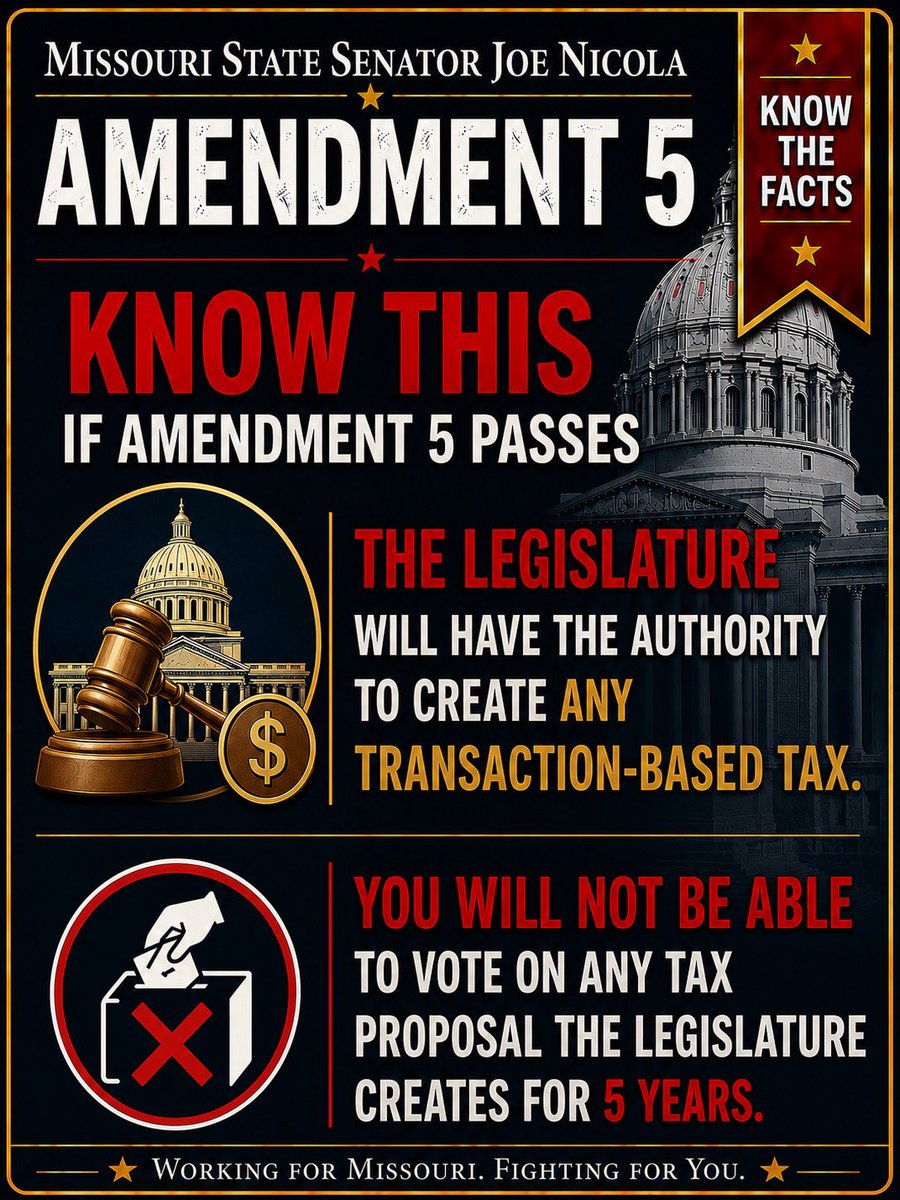
.@JoeNicola’s post is a partial truth. It highlights real powers amendment 5 grants the legislature, but frames them in a way that is incomplete, absolute, and omits the core purpose, conditions, and safeguards.
What Amendment 5 (from HJR 173 & 174) actually does:
Requires the General Assembly to phase out and eventually eliminate the state individual income tax based on revenue growth triggers. Once eliminated, the legislature is prohibited from reimposing a state individual income tax.
Allows the legislature to expand state and local sales and use taxes (or similar transaction-based taxes) to cover any goods and services. This overrides the current constitutional ban (in place since roughly 2015) on expanding the sales tax base to previously untaxed services/transactions.
Requires that any such expansion or rate increase be done for the purpose of reducing/eliminating the income tax and reducing local tax rates. The same legislation must offset the new sales tax revenue with a reduction in the top individual income tax rate that is at least substantially equal (dollar-for-dollar or close to it).
Creates a five-year window after the amendment’s effective date: expansions or rate increases enacted in that window are exempt from certain constitutional limits. After five years, those normal limits and voter-approval requirements return for further major expansions or substantial rate hikes.
Local governments must also roll back other local taxes (sales, property, or earnings taxes) to offset by 97% of any extra local revenue from the expanded base, with an explicit protection that school funding cannot be reduced.
Vicki,
It’s a real pleasure talking with someone like you. Facts matter. You’re right that many Missourians already pay little or no state income tax, and that a pure rate hike on the current narrow sales-tax base would be painful. That’s not in dispute and that’s not what Amendment 5 does.
The design question is whether the only alternative is a high rate on the existing base, or whether broadening the base (taxing more of the modern service and digital economy that currently escapes tax) can raise the needed revenue at a lower overall rate. Amendment 5 allows the second approach and requires that any new sales-tax revenue be matched by income-tax cuts of roughly equal value.
Tennessee’s high combined rate is often cited, but Tennessee also has no income tax and a different economic base. Missouri’s outcome would depend on how much base-broadening the legislature actually does versus how much it simply raises the rate. The amendment does not force a rate increase; it removes the current constitutional ban on expanding the base so that option exists.
You can still conclude this is the wrong vehicle and vote no. But the claim that the only possible result is “tax more things + higher rates with no offset” doesn’t match what the amendment actually requires. I’m a YES on A5.
@VickiKe23568660@JoeNicola You seem nice. I answered your questions point by point separately. And it’s always about Trump. Too bad you don’t trust him on eliminating the MO income tax.
Vicki, Here’s the actual structure of Amendment 5, not the spin:
1. How counties and towns are protected
If the sales tax base expands, local governments must roll back other local taxes (property, sales, or earnings) to offset 97% of the extra local revenue. School funding is explicitly shielded from those cuts. Locals don’t get to keep a windfall. They’re required to return most of it to taxpayers.
2. “Absolute control”
It’s not absolute. Any sales-tax expansion or rate increase has to be paired in the same bill with an income-tax cut of roughly equal value, and it has to be for the stated purpose of phasing out the income tax. After five years, the normal Hancock Amendment voter-approval requirements kick back in for major tax increases.
3. Regressivity
You’re right that pure sales taxes are more regressive than income taxes. That’s why the amendment requires the new sales-tax revenue to be used to cut the income tax dollar-for-dollar (or close to it). The net effect depends on how the legislature expands the base and how much rate increase (if any) is needed. A broader base with a lower rate is less regressive than a narrow base with a high rate.
4. We’re not Florida/Texas/Tennessee
Correct. Missouri doesn’t have their tourism base. That’s precisely why the amendment allows base-broadening (taxing more services and goods that currently escape tax) instead of simply jacking up the existing rate on a narrow base. Relying only on rate hikes would require much higher rates; expanding the base is the alternative.
5. How the state pays the bills
The amendment does not let the legislature eliminate the income tax and then leave a hole. Income-tax cuts are tied to revenue growth and any sales-tax changes must be offset by income-tax reductions of substantially equal value. It is designed as a tax shift, not a pure tax cut that blows a hole in the budget.
You can still oppose it on policy grounds, many do, but the claim that it hands legislators unchecked power to raise taxes without offsets or local protections isn’t accurate.