@nvidia was a $2 billion company when I joined as a young engineer in 2002. It has since grown more than 2,000X. As an entrepreneur, I know how hard it is to grow a company 2X. 2,000X is almost impossible to comprehend.
The remarkable thing is not valuation, but that its success was never supposed to happen. Not at this scale. @JensenHuang willed that one-in-a-million future into existence. As part of NVIDIA’s innovation team, I saw his belief in making the impossible possible.
Betting on a technology that might not deliver any commercial returns for years is hard enough. I know it as a founder. Now imagine sustaining that conviction for 20 years, through changing markets, skeptical investors, competing priorities, and countless chances to take the safer path. That takes unbelievable courage, time and time again. It’s founder-level conviction, not corporate leadership.
Conviction alone wasn’t enough. What struck me most about Jensen was the breadth and depth of his expertise: hardware, architecture, chip design, software, computing, AI, developer ecosystems, product strategy, markets, sales, and business models. Most companies would need a dozen world-class experts to match that.
But a committee of a dozen world-class experts doesn’t create groundbreaking innovation.
A committee might have optimized the GPU business with better chips, better margins, and more market share. But would it have spent decades investing in accelerated computing, building CUDA and an entire developer ecosystem, long before the commercial opportunity was obvious?
Then there’s the business model. Chip companies have historically faced enormous pricing pressure. They risk becoming interchangeable components, with device makers and cloud providers squeezing margins. NVIDIA turned that on its head. Through technology leadership, relentless innovation, software, and ecosystem building, it created pricing power no chipmakers ever had: gross margins above 70%, higher than Apple, Google, or Amazon.
Creating the technology, building the products and developer ecosystem, recognizing and enabling the AI revolution, and building a business model that captures this much value: any one of these would be a career-defining accomplishment for most entrepreneurs. Jensen drove all of them.
Today, much of the AI industry is built on the foundations NVIDIA created. That wasn't accident. It wasn’t inevitable. The more I’ve experienced entrepreneurship myself, the more I appreciate the sheer improbability of what he accomplished.
There is virtually no chance NVIDIA would be what it is today without Jensen Huang.
People can debate Jensen’s decisions, leadership, and judgment. None of those debates change what he built.
I believe history will place him among the rare individuals who fundamentally changed what humanity can do with technology. The core algorithms behind AI existed for decades. The compute Jensen built made them an industry. That deserves recognition.
So much change in venture.
Great write up by @colossusmag
I am putting together more of my thoughts on the opportunities - but I am convinced that many will require less capital as AI has reduced the cost of building.
Get in touch w perspectives.
https://t.co/T6oPuPGZ5N
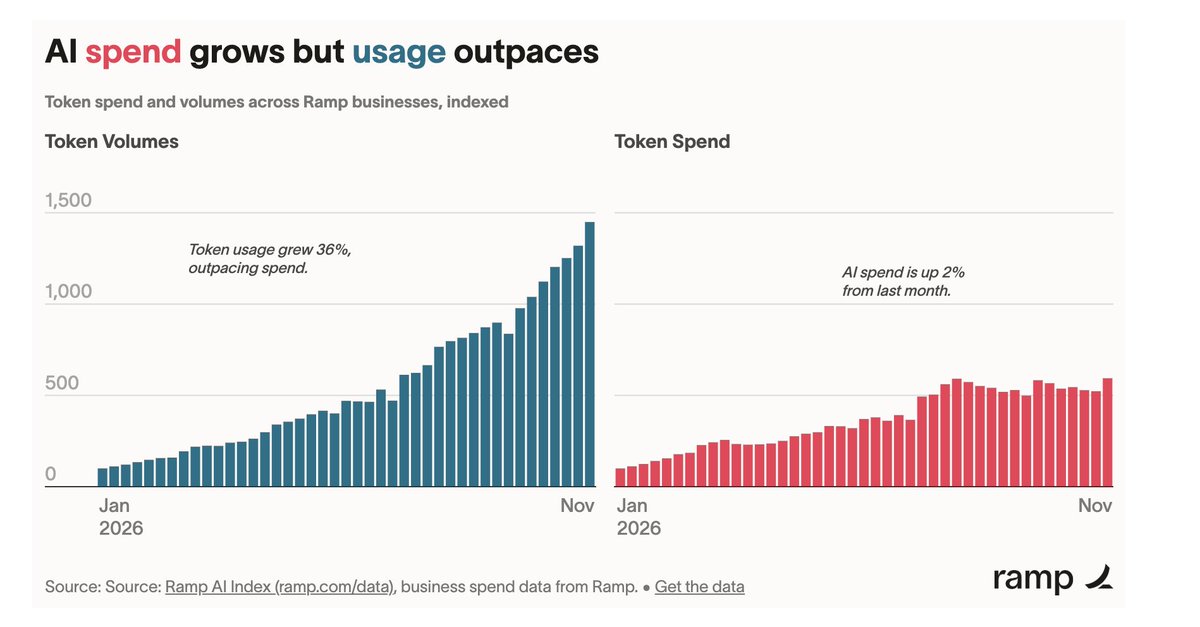
This is a great post by @arakharazian looking at @tryramp customer AI usage data.
First dataset I have seen where clearly coding (and maybe security) are driving spend. There is consumption outside of the dataset by venture backed AI companies but suspect this is an excellent representation of enterprise spend.
The real threat for the "AI trade" is whether the growth in other areas outside of coding can keep pace. Coding has left some very big shoes to fill - the good news is I imagine coding is going to keep growing substantially. Its still early days.
https://t.co/b1FUldD0Dk
Anthropic is truly an amazing business.
At the same time, in the roadshow Dario making claims that Anthropic will solve cancer, mental illness and heart disease among many is just not credible to me. What do you believe?
@DarioCpx This is a bad take. They are building their book. It will price at >$1.25T. I am not saying its worth that value - but the book appears to be strong.
@tcrawford@Microsoft Part of it must be the shift in their business to Azure which likely does not take as large of team to manage compared to many of their other products.
Many will dismiss the Apollo AI report as doomerism -especially the tech crowd. Its obvious issue is that productivity and profit will be lagging to any AI adoption. And the lag could be substantial - coding is a killer use case today for example but seeing the fruits of more functionality, more product etc. may take time. It doesn't seem like reducing headcount in a meaningful way is playing out either - at least not yet.
What is true - ultimately the enterprise buyers will need to see meaningful gains. It will come but it may take some time. Most are not there yet today. Its just early which is not an indictment of AI or its potential value.
And your Muse agent figuring our your kids soccer practice schedule is not going to fill the gap.
https://t.co/8vPMk5lJuN
@dsracoon@Tobygrowth yes and I think as far as notes go - its pretty much a commodity. Very little stickiness outside of migration friction which they seem to make difficult.
Yes. they have enormous price leverage (hence the ridiculous imho label of evil) but unlike a gas station, once they lose a customer they are never coming back. My bet is that its the beginning of a slow death - which is totally ok and maybe even part of their playbook. But its not sustainable.