🚨 We’re hiring a postdoctoral research associate! 🚨
The Ryan Lab at Trinity College Dublin is recruiting a Postdoctoral Research Associate to join our new team in the School of Biochemistry and Immunology, based in the Trinity Biomedical Sciences Institute for 2026/2027.
This is a great opportunity for scientists with a PhD interested in mitochondrial biology, immunology, inflammation, infection, metabolism, or primary mitochondrial disease. The position will be available for 2 years in the first instance with the potential for extension.
The role will aim to understand how pathogenic mitochondrial DNA mutations reshape the innate immune response to infection ex vivo and in vivo. The successful candidate will contribute to a programme involving:
🧫 Primary macrophage culture
🐭Mouse model-linked infection studies
🔥 Inflammatory and infection-associated assays
📊 Cytokine, metabolic, and immunological readouts
🧬 Molecular biology and genotyping
🔬 A growing programme in mitochondrial immunometabolism
📍 Location: Trinity Biomedical Sciences Institute, Trinity College Dublin
📅 Anticipated start: Flexible, ideally November 2026-January 2027
⏰ Closing date: 12 noon, 07 October 2026
Please share widely and do get in touch if you think you might be a great fit!
To apply:
Applicants should submit a full CV plus a short cover letter to include the names and contact details of 2 referees (including email addresses), to:-
Dr. Dylan Ryan
[email protected]
Please use the subject line: Postdoctoral Research Fellow Application – Ryan Lab.
Important: Applications by private Social Media messages will not be considered and will not be responded to. Only applicants invited to interview will hear back from us.
SURPRISE! Key interferon-stimulated genes (ISGs) can be induced without interferon! Sounds like an oxymoron, but it is true! Read the paper to find out more.
Switching of transcriptional control from interferon regulatory factor 2 to interferon regulatory factor 1 drives innate immune cell activation: Cell https://t.co/sozKwaQE39
Two new papers from us and collaborators reveal how the Batten disease protein CLN8 catalyses a key step in BMP synthesis:
https://t.co/uf3EFPc1n5
https://t.co/wJ6Sm6dTGs
Thanks to @CunqiYeLab for a great summary and for putting our findings in context!
https://t.co/mD2yLwcCOD
Why is glutathione, rather than cysteine, the major cellular thiol? Our new work by @ToshiNakamura51 suggests unlike other amino acids, excess cysteine is intrinsically toxic to mammalian cells via mitochondrial iron accumulation. @RockefellerUniv
https://t.co/JYyu5eAoVu
Lactate is toxic. Lactate causes fatigue. High lactate is bad.
We hear some version of this all the time.
But how much of it is actually true?
So we wrote a review separating what we know about lactate from what we’ve simply assumed for decades.
Led by our fantastic postdoc Bhavya Blaze! @Bhavya391554759
https://t.co/WRKW5Nm487
#Lactate #Metabolism #ScienceTwitter
📢 Last weeks #immunometabolism discoveries @Bims_BiomedNews@mitoworld_org ⬇️⬇️⬇️
https://t.co/ZY28CdjP6Z
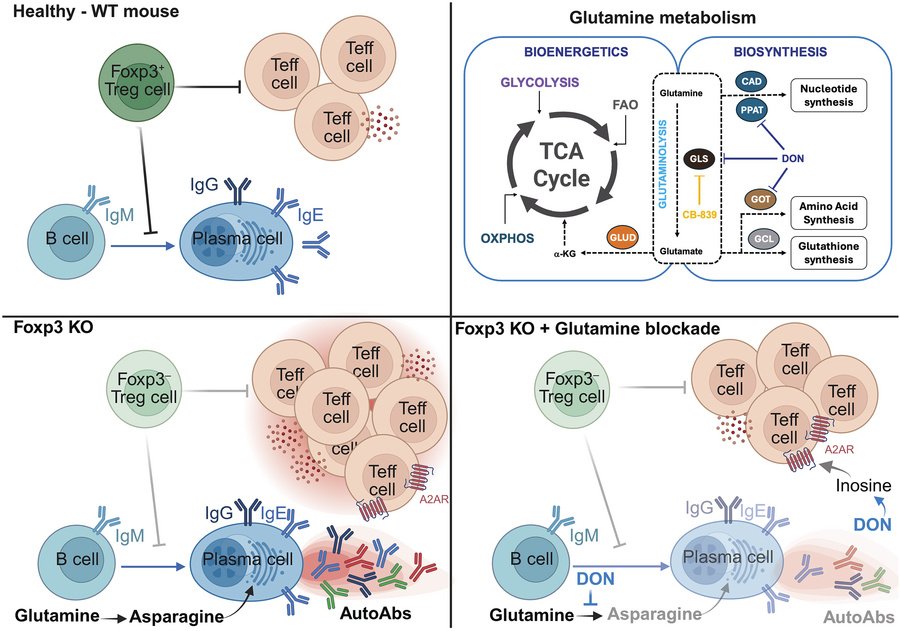
Interesting finding:
Glutamine-dependent biosynthetic pathways fuel autoreactive T and B cells in Foxp3 deficiency–mediated disease
🧬 Succinate is more than a metabolite.
New work in @ScienceAdvances shows that SUCNR1 regulates hepatic metabolic flexibility, glucose oxidation & adaptation to feeding. Its loss increases gluconeogenesis and shifts anaplerosis toward glutamine
https://t.co/loGcGzAkY6
It looks more and more like pyroptosis is more ancestral than apoptosis. Defense first. Then the defense mechanisms got co-opted for homeostasis.
One day I will write about this again...
Mechanism and plasticity of primitive pyroptosis | Science Advances https://t.co/1P8o0Hz1D7
A new study in "@Nature Cardiovascular Research" suggests atherosclerosis meets key criteria of an autoimmune disease, advancing a decades-long scientific debate.
Read more: https://t.co/GnuePQaYjj
#Atherosclerosis#Immunology#CardiovascularResearch