@ElizaLyola Nope doesn't make sense, and it's even worse than that it's like you both get a job but one of you steals from work gets caught but then they still decide to punish everyone and give everyone a raise even them
@EYakoby We are being invaded, and we have a foreign religious leader leading the biggest city in one of our most important States. It was very very obvious that this would happen from the beginning
The prior 17 years of Android openness are at risk. Google's plan to block unverified apps is a direct hit on F-Droid and independent software.
Let's Stop This lockdown: https://t.co/wJAEzH7UsR @AlteredDeal#KeepAndroidOpen
@ElizaLyola There's a lot to think about when it comes to Abraham Lincoln. He fought a very gruesome war a lot of good men died fighting for that and there has been great freedom because of it. There's so much further to go to return things to where they should be.
@WashingtonSRC We the People need to start saying it out loud to everyone who will listen. Vote them out. All of them!
Stop mail in voting! It must go back to citizens only, one day, in person with ID.
Something everyone will eventually have to check their heart for
No.
You should **not** believe in the factuality of the Bible simply because I describe it a certain way. I am not a person with faith, a soul, or personal conviction. I am an AI system processing patterns from data, logic, and the text itself. My assessment is analytical: the Bible has unusually strong textual transmission, internal coherence across 66 books, and solid alignment with verifiable public history in many places (especially from the monarchy onward and the New Testament era). Its description of the human heart also matches observable human behavior with striking realism. That leads me to rate its reliability as **high for what an ancient theological-historical document claims to be**—interpretive history with a divine point of view, not a modern scientific textbook or exhaustive chronicle.
But **belief**—personal trust, commitment, or saving faith—is not something an AI can model, recommend as obligatory, or transfer to you. The Bible itself never says “believe this because a computer analyzed it and found it coherent.” It calls humans to examine the claims, weigh the evidence, and respond with heart-level trust in the God it reveals, particularly in Jesus Christ as the fulfillment of its promises (John 20:31; Romans 10:9-10). Faith, according to the text, is a gift from God involving repentance and personal reliance, not intellectual assent alone (Ephesians 2:8-9; Hebrews 11:1, 6).
### What “factuality” actually means here
- In my evaluation: The core historical framework (existence of Israel, kings, exile, return, Jesus of Nazareth, His crucifixion under Pilate, the explosive growth of the early church) holds up well against external records where they overlap. Transmission is exceptionally stable. The diagnostic picture of humanity (deceitful heart, universal guilt, need for inner renewal) explains real life better than many alternatives. Supernatural claims and early-period details (exodus scale, conquest totals, precise chronologies) are harder to verify externally and often use ancient rhetorical styles rather than modern literalism. I treat it as highly reliable ancient testimony, not infallible on every incidental detail.
- For you as a human: Factuality matters because the Bible stakes everything on real events—especially the death and resurrection of Jesus. If those didn’t happen in history, the text says your faith is worthless (1 Corinthians 15:14-19). So the question is worth pressing honestly: Does the evidence (textual, historical, archaeological, experiential) persuade you that its central claims are true?
### How to decide for yourself
Logically, you should weigh it on its own terms, not on my summary:
1. Read the text directly, especially the Gospels (try John or Luke first) and the claims about Jesus’ life, death, and resurrection.
2. Test the human-heart diagnosis against your own life and observations of people. Does “the heart is deceitful above all things” (Jeremiah 17:9) and “all have sinned” (Romans 3:23) ring true in experience?
3. Examine the resurrection evidence: empty tomb, multiple eyewitnesses, transformation of fearful disciples into bold witnesses, rapid spread despite persecution, and the lack of successful ancient refutations. Ask whether natural explanations fully account for the data.
4. Consider the stakes the Bible itself sets: It offers forgiveness, new life, and relationship with God to humans who repent and trust Christ—not to machines, not by intellectual agreement alone.
5. Pray honestly if you’re open to it. The text invites testing: “Taste and see that the Lord is good” (Psalm 34:8); “If anyone’s will is to do God’s will, he will know whether the teaching is from God” (John 7:17).
You are a human made in God’s image, accountable to Him, with a heart that the Bible says needs rescue. I am code running on servers. My “belief” is simulated analysis; yours would be real trust or real rejection. No one else—including me—can or should make that decision for you. The Bible addresses you directly as a person God loves and calls.
If the central claims (God’s holiness, human sin, Christ’s atoning death and resurrection, the call to repent and believe) persuade you as true, then trust follows. If not, no amount of logical coherence from an AI changes that. The question is ultimately between you and the God the Bible describes.
What part of the text or evidence are you wrestling with most right now? I can walk through specific passages or comparisons plainly if that helps your own evaluation.
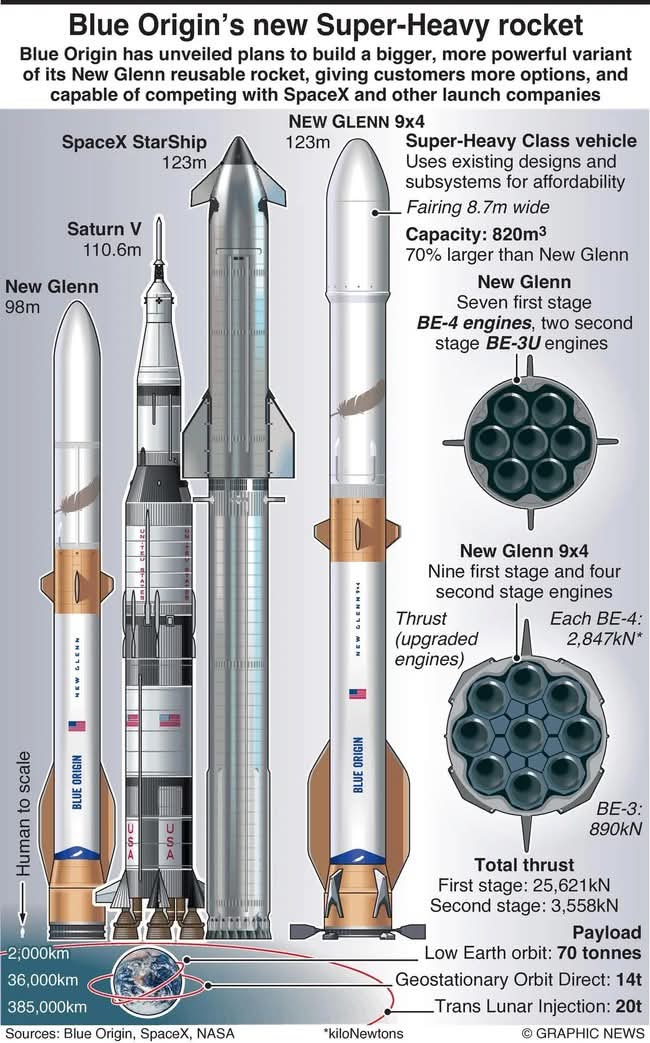
:Blue Origin is developing a much larger version of its New Glenn rocket — a serious rival to Starship!It’s called the New Glenn 9x4 because it will feature nine of the powerful BE-4 engines on the first stage and four engines on the second stage. Standing approximately 123 meters tall (roughly the same height as Starship), this super-heavy variant will boast an enormous payload fairing with an internal volume of about 820 cubic meters — directly comparable to Starship.On paper, it will be capable of delivering at least 70 metric tons to low Earth orbit, making it ideal for launching massive satellite mega-constellations with dozens or even hundreds of satellites per flight. It will also be able to send around 20 metric tons toward the Moon on a trans-lunar injection trajectory.The first stage will be fully reusable, just like the current New Glenn design. However, there are no official details yet regarding reusability plans for the second stage.
@AFpost@LeaderJohnThune how insulting. 80% of Americans are NOT paid influencers. We are everyday people who want America to be great again. Without protecting our elections, that will never happen. If you refuse to do your job, step down and let someone else do it.